




Highest Yielding Cannabis Strains: A Grower’s Guide
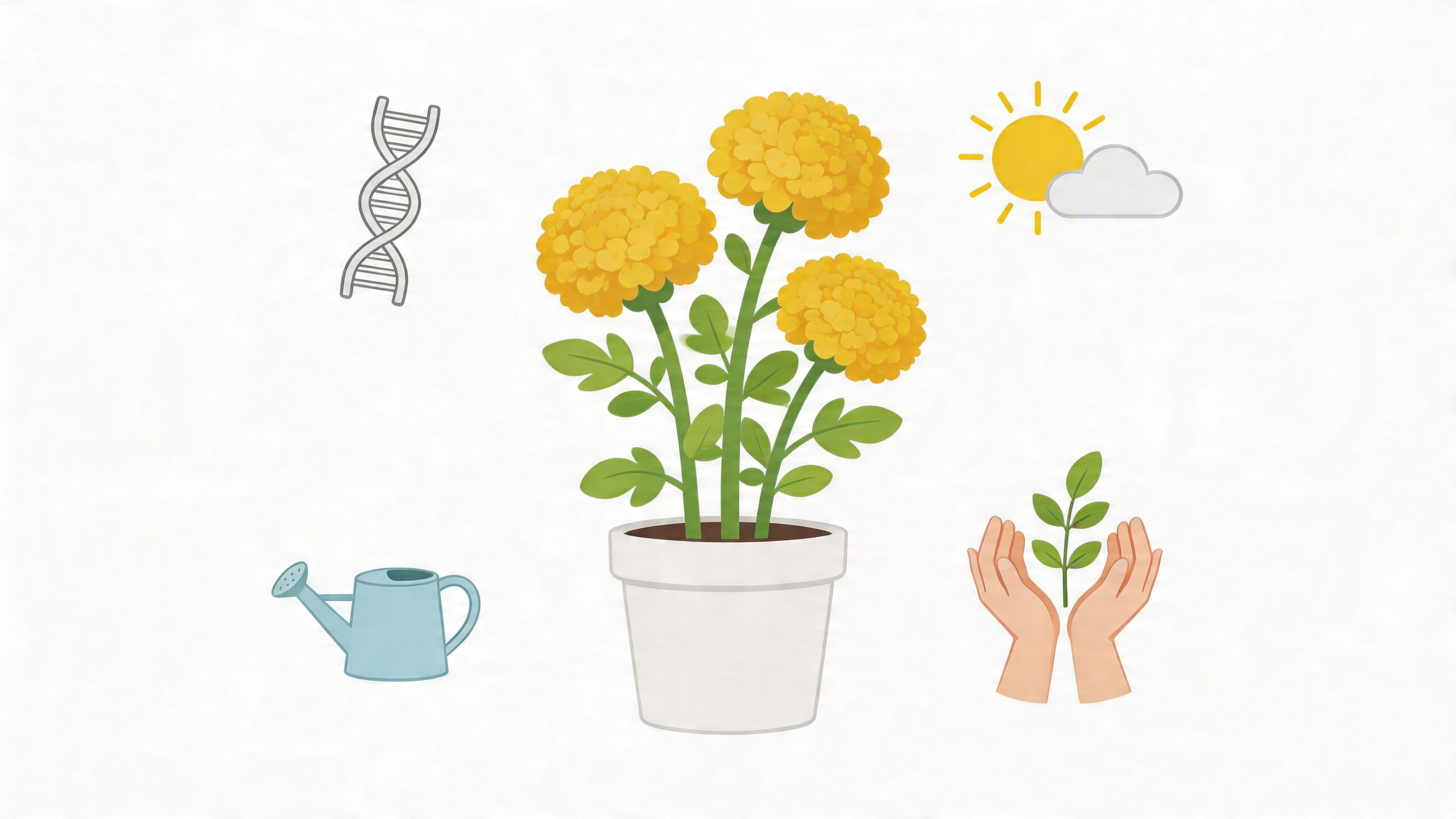
Most advice about the highest yielding cannabis strains starts in the wrong place. It starts with the biggest number on the seed page, then works backward from there. That’s how home growers end up frustrated, because breeder max numbers are usually built around dialed-in conditions, experienced hands, and a setup that leaves very little room for mistakes.
A better question is simpler: What can your space support, consistently? That shift matters more than people think. A cultivar that looks average on paper can absolutely outproduce a so-called monster if it fits your tent, your light, your climate, and your skill level.
Home growers keep running into the same gap between hype and reality. As noted in this breakdown of highest-yield cultivars and realistic home results, proficient indoor growers often land around 400 to 600 g/m², and non-ideal home setups can come in 30 to 50% lower because of limited space, weaker lighting, and basic mistakes. That doesn’t mean big harvests are out of reach. It means yield is less about chasing a fantasy number and more about stacking smart decisions.
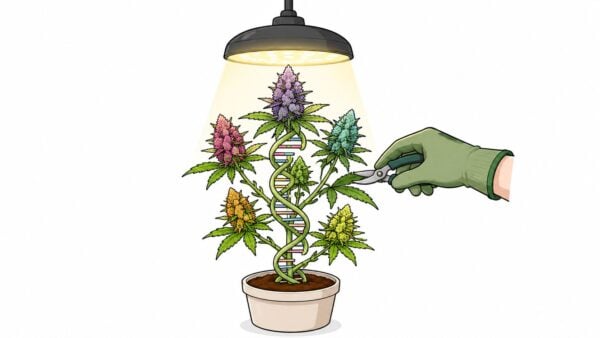
If you want more flower in the jar, the game is pretty straightforward. Pick the right genetics, shape the canopy, keep your environment steady, and stop expecting one trick to fix everything. That’s what actually works.
Forget the Hype About Monster Yields
The biggest mistake new growers make is treating advertised yield like a promise. It isn’t. It’s a ceiling, and ceilings only matter if the whole room is built to reach them.
A lot of high-yield lists blur together because they mix commercial-style results with beginner expectations. That’s why people buy a cultivar labeled as a giant producer, then pull a modest harvest and assume they picked the wrong plant. Usually the issue isn’t the cultivar. It’s the mismatch between marketing conditions and a normal home grow.
Why the numbers feel so far apart
Seed descriptions usually reflect best-case potential. Think strong light, even canopy, healthy root zone, clean airflow, proper timing, and a grower who catches problems early. Most hobby growers are dealing with at least one limiting factor, sometimes more than one.
Common examples look like this:
- Light mismatch: A big, vigorous cultivar underpowered by the fixture will stretch and leave lower flower sites underdeveloped.
- Crowded tents: Too many plants in a small footprint means blocked airflow and uneven light spread.
- Late corrections: Nutrient issues, watering mistakes, or pH swings don’t always kill a grow, but they absolutely cut into harvest size.
- Poor plant shape: One tall main cola and a bunch of shaded lower branches usually looks impressive early, then disappoints at trim time.
Practical rule: Judge a cultivar by how reliably it performs in ordinary conditions, not by the flashiest number attached to it.
What a good harvest really looks like
A good harvest is one that fits your goals. If your tent stays full, your drying space is packed, and you come away with flower you’re happy to keep, that’s a win. You don’t need a record-breaking crop for the grow to pay off in saved dispensary runs, avoided taxes, and the satisfaction of pulling your own supply from a space you built yourself.
That also changes how you compare cultivars. A short, sturdy plant that finishes cleanly and fills the canopy can be a better yield choice than a taller, fussier one with more dramatic claims. Consistency beats hype, especially when you’re growing after work, in a spare room, or in a tent that has to stay manageable.
Most home growers don’t need the highest theoretical yield. They need the highest dependable yield for their setup.
That’s the true frame for choosing among the highest yielding cannabis strains. Not “Which one has the wildest number?” but “Which one can I grow well, again and again?”
What Actually Determines Your Harvest Size
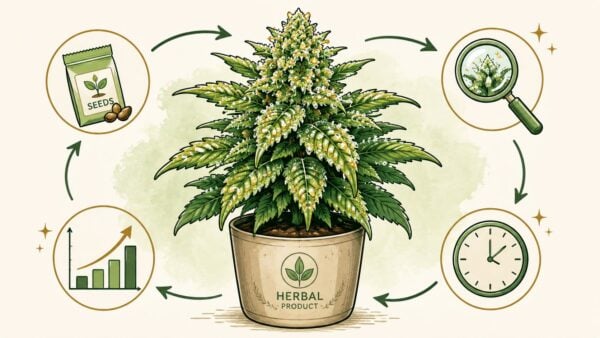
Big harvests work like a good cake. The recipe matters, but so does the oven, the ingredients, and the person handling the whole process. You can’t fix a weak bake with frosting, and you can’t rescue poor grow fundamentals with one “high-yield” label.
Here’s the quick visual version.
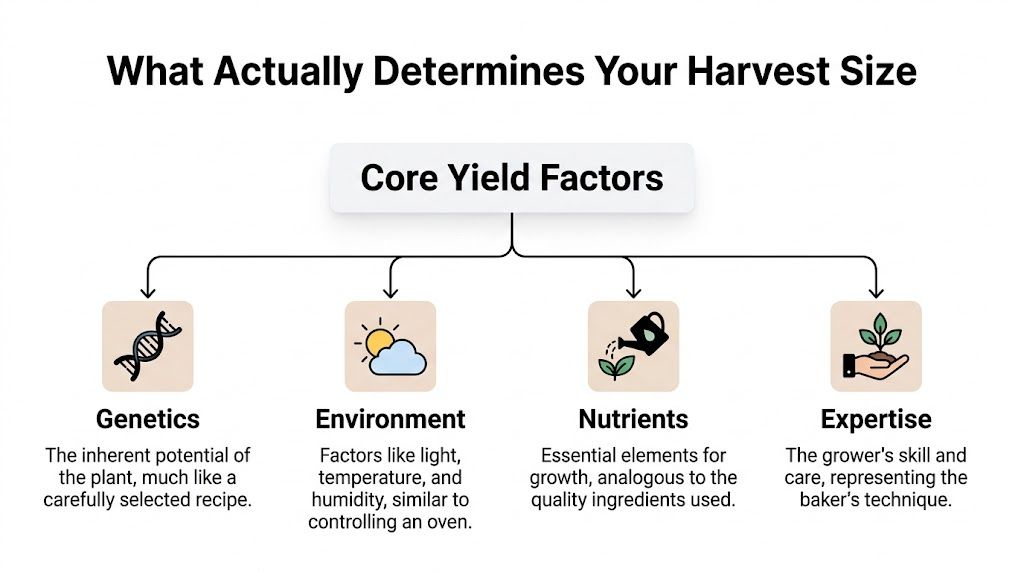
Genetics set the ceiling
Some cultivars build more biomass than others. That isn’t marketing fluff. It’s structure, branching, vigor, internode spacing, and how the plant handles flowering.
A clear example is Moby Dick. According to this guide to top high-yield cultivars, it can reach up to 650 g/m² indoors, partly because its Haze side drives rapid biomass accumulation. That same source notes yield can be enhanced by 15 to 20% with increased CO2 at 1200 to 1500ppm during bloom. Useful, yes, but only if the rest of the room is already in good shape.
Genetics give you potential. They do not give you a free pass.
Environment is your oven
Light is the big one. If your canopy doesn’t get even coverage, you’ll see it in larfy lowers, weak side branches, and airy flower. Good yield growers obsess over canopy shape because they know light distribution matters just as much as total power.
If you want to tighten up this part of your setup, a solid place to start is this indoor cannabis lighting guide. The practical takeaway is simple. Match plant count and cultivar size to the light footprint you have, not the footprint you wish you had.
Environment also includes temperature, humidity, and airflow. When any of those swing too hard, plants spend energy reacting instead of building weight.
Nutrients are the ingredients
Plants need enough food to support vigorous growth, but overfeeding is one of the fastest ways to slow them down. A hungry plant underperforms. An overfed plant often locks out, stalls, or burns. Neither one yields well.
What usually works best at home is boring consistency:
- Keep feed schedules simple
- Watch leaf response, not just the bottle chart
- Water thoroughly, then let the medium cycle properly
- Avoid major changes late in flower unless the plant clearly asks for it
A high-yield cultivar can process more input than a delicate one, but that doesn’t mean more is better. It means balance matters more.
Expertise shapes the result
Two growers can run the same cultivar in the same tent and finish with very different harvests. The difference is usually timing, restraint, and observation. One notices the canopy leaning unevenly and fixes it early. The other waits. One spaces plants for airflow. The other packs the tent and hopes for the best.
You don’t need fancy gear to grow more. You need fewer avoidable mistakes.
Harvest timing belongs here too. Cutting early leaves weight on the table. Waiting too long can dull the overall quality of the flower and push the plant past its best window. Yield isn’t one decision. It’s the accumulated result of dozens of small ones made at the right time.
High-yield Cultivar Families to Know
If you’ve been around growers for a while, you start hearing the same names over and over. Not because people are stuck in the past, but because certain genetic families keep proving they can stack weight without becoming a complete pain to manage.
Some of the highest yielding cannabis strains come from old-school lines that breeders kept working because they delivered. Heavy branching, dense flower set, dependable vigor, and a growth pattern that responds well to training. That’s usually what puts a cultivar on the repeat-grow list.
A quick visual rundown helps before getting into the family traits.
The Skunk and Critical side of the family
This group tends to be popular for a reason. Skunk-derived cultivars often grow with sturdy structure, good lateral branching, and the kind of vigor that forgives a few minor mistakes. Aromatically, they usually lean pungent, funky, earthy, or sharp, depending on the cross.
Critical Mass is one of the clearest examples of why these lines matter. In this profile of top-yielding cultivars, Critical Mass is described as a cross of Afghani and Skunk #1, with reported indoor yields of 550 to 700 g/m² in Sea of Green setups and outdoor production around 800 to 1200 g per plant. That tells you what the lineage was built to do. Pack on flower.
The trade-off is that dense, weighty buds ask for attention. You can’t crowd a canopy and ignore airflow just because the cultivar is vigorous. Heavy producers need room to breathe.
The Big Bud lane
Big Bud has been a yield reference point for decades because it was selected for volume first. It’s the kind of cultivar family growers bring up when they care less about novelty and more about filling drying racks.
Its general growth habit is exactly what home growers want from a production plant:
- Compact enough to manage indoors
- Strong enough to support fat flower clusters
- Responsive to training
- Straightforward enough for a newer grower to learn on
That makes it useful in tents, spare closets, greenhouses, and any setup where predictability matters.
If you want more flower, choose cultivars that naturally build lots of usable bud sites. Fighting a plant’s structure for an entire run gets old fast.
The White Widow and Haze crossover camp
This family is interesting because it challenges a lazy assumption that big-yielding cultivars have to be short, squat, and heavily indica leaning. Some Haze-influenced plants can absolutely produce at a high level if you manage their stretch and train them early.
Moby Dick sits in this lane. White Widow brings resin and tighter structure, while Haze contributes the vigorous upward push and biomass. The result, in the right hands, is a plant that can fill a canopy hard. The risk is obvious too. If you let a stretchy cultivar run wild indoors, it can outgrow your plan in a hurry.
That’s where understanding indica, sativa, and hybrid growth traits helps. Not because labels tell you everything, but because growth habit matters a lot when yield is the goal.
A quick comparison
| Family Name | Typical Growth | Common Vibe |
|---|---|---|
| Skunk and Critical family | Vigorous, branchy, reliable, often easy to fill a canopy with | Pungent, classic, heavy, straightforward |
| Big Bud family | Compact to medium structure, dense flower set, responds well to training | Broad-shouldered, old-school, stash-jar filler |
| White Widow and Haze family | More stretch, strong vigor, bigger vertical push, needs shape control | Frosty, loud, expansive, energetic |
How to use family knowledge in a home grow
A lot of growers waste time comparing single cultivar names when they’d be better off looking at family traits first. If you know you’ve got limited headroom, a giant Haze-heavy option may not be your smartest path. If your room tends to run warm and crowded, a dense heavy-bud cultivar may need more discipline than you want to give it.
Family patterns won’t replace hands-on experience, but they do shorten the learning curve. You start noticing what a cultivar is likely to do before it does it. That’s a huge advantage when you’re trying to maximize the harvest from a fixed space.
Practical Techniques to Boost Your Yield
Once genetics are handled, training is where most home growers find extra harvest weight. Not because training is magic, but because it fixes one of the most common yield killers, uneven light use.
If a plant grows like a Christmas tree indoors, the top wins and the bottom sulks. Training turns that into a flatter canopy where more bud sites sit in useful light. That’s how you make a normal tent produce like a smarter tent.
Low-stress training works because it opens the plant
LST is exactly what it sounds like. You gently bend and tie down branches so the plant spreads outward instead of racing upward. It’s one of the most practical yield tools for home growers because it doesn’t require much gear and it teaches you how the plant wants to grow.
A simple LST routine looks like this:
- Start early: Begin when stems are still flexible and easy to guide.
- Pull the main top sideways: This breaks the plant’s natural dominance and encourages side branches to catch up.
- Keep adjusting: Every few days, retie or reposition branches to maintain an even top line.
- Leave room between shoots: Packed growth looks exciting, but airflow and light penetration matter more.
Big Bud is a classic example of a cultivar that responds well here. In a seed bank’s overview of high-yielding strains, Big Bud is listed at 550 to 700 g/m² indoors, and training methods like LST and SCROG are noted as useful for exposing lower bud sites, with many growers routinely reporting over 600 g/m².
SCROG rewards patience
SCROG, or Screen of Green, adds a physical screen above the plant canopy. As branches grow up into it, you guide them sideways to fill open squares. The screen becomes a map for even canopy development.
What makes SCROG so effective is that it forces discipline. You stop letting one branch dominate. You spread energy across the whole footprint.
A basic SCROG approach:
- Set the screen at a workable height
- Tuck branches under and outward instead of letting them shoot straight up
- Fill empty spaces before flower gets too far along
- Remove weak growth below the useful canopy so the plant focuses upward
The best SCROG growers aren’t trying to make the plant taller. They’re trying to make every square of the tent earn its keep.
The downside is time. SCROG isn’t ideal if you need fast turnarounds or move plants often. But for a fixed indoor setup, it’s one of the cleanest ways to turn light into flower.
Pheno-hunting matters when you want repeatable heavy runs
Even inside one cultivar, plants can show different growth habits. Some branch harder. Some stretch more. Some stack denser flower. That’s why experienced growers pay attention during the whole run, not just at harvest.
The practical version of pheno-hunting for a home grower is simple:
- Label everything clearly
- Take notes on vigor, shape, and flower development
- Notice which plant used space best
- Prioritize the one that gave weight without creating headaches
You don’t need to overcomplicate it. Just observe what worked in your room. That’s how yield gets more predictable over time.
Choosing Seeds for Your Specific Grow Setup
The best yielding cultivar isn’t universal. It depends on whether you’re working with a tiny tent, a backyard season, or a room where you want to compare a few standout phenotypes. Chasing the same answer as everyone else usually leads to a bad match.
A lot of growers buy for hype and only later think about plant size, finish time, and how much hands-on work they can realistically give. That order should be reversed. Choose for fit first, then for upside.
Small indoor hobbyist
If you’re growing in a limited footprint, your best move is usually a cultivar that stays manageable and finishes without drama. That can mean a compact autoflower or a feminized photoperiod that responds well to light training and doesn’t demand a huge veg window.
The point isn’t to grow the tallest plant. It’s to fill your available canopy evenly and finish with flower you can dry and store without chaos.
A good filter for this type of grower:
- Controlled height
- Reliable branching
- A finish time that matches your patience
- A growth pattern that won’t overwhelm your light footprint
If you’re weighing seed types for a smaller setup, this autoflower vs feminized seeds comparison helps sort out what makes sense for your space and schedule.
Stability-focused home grower
Some people don’t want the wildest cultivar on the market. They want one that behaves. That’s smart. A stable grow is easier to repeat, easier to troubleshoot, and usually better for keeping jars full without turning the hobby into a second job.
For this grower, proven high-yield families often make more sense than chasing the newest release. The win condition is consistent output, not bragging rights.
Look for cultivars that are known for:
| Priority | Why it matters |
|---|---|
| Predictable structure | Easier canopy management and less mid-grow surprise |
| Good response to training | More ways to maximize a modest space |
| Reliable finishing behavior | Fewer headaches late in flower |
Craft grower or collector
If you enjoy hunting standout plants, newer genetics can be worth a look. Projection-focused breeder updates for 2026 have put attention on cultivars like Hyper Za and Puff Pastry, which are described by Humboldt Seed Company as balancing high yields with 33 to 35% average THC and climate adaptability in their high-THC cultivar roundup. That kind of pairing is interesting for growers who want production without giving up modern flavor and potency.
Selection becomes more personal. You might accept more variation if the upside includes a phenotype with serious structure, loud aroma, and enough output to justify keeping it in rotation.
Don’t buy seeds for someone else’s room. Buy for your ceiling height, your climate, your schedule, and how much daily attention you’ll honestly give the plants.
That’s the difference between a fun run and an annoying one.
Timing Your Harvest for Maximum Weight
A lot of growers get impatient right at the finish line. That costs weight.
If you cut too early, the flowers often haven't fully swollen. They can look close, smell great, and still have more size left to build. Waiting through that final stretch is one of the easiest ways to avoid leaving hard-earned flower on the plant.
What to watch on the plant
You don't need fancy language for this. You need to look carefully and consistently.
The main visual cues:
- Pistils: When lots of fresh white pistils are still shooting out, the plant often isn't done building.
- Bud shape: Late-stage flowers usually look fuller, denser, and more settled.
- Trichomes: Check them with a loupe or pocket microscope. Clear usually means early. Cloudier heads often signal a more complete finish.
For a more detailed walkthrough, this guide on when to harvest cannabis is a handy reference.
Early, on time, or late
Each harvest window changes the result a bit.
Too early:
You usually give up weight, density, and that finished look. The aroma can seem less developed too.
Right on time:
This is the sweet spot if your goal is maximum usable flower with the cultivar's intended character still intact.
Too late:
You may shift the aroma profile and the overall vibe away from what you wanted. Some growers like that. Others feel the plant lost its best expression.
Let the plant finish the job. The last part of bloom often feels slow, but that's where a lot of the final heft shows up.
Simple habits that help
A few endgame habits make a difference:
- Check daily near the end: Don't guess based on the calendar alone.
- Stop chasing perfection in every leaf: Late flower plants often look rough around the edges.
- Support heavy branches: Big yield strains can lean hard as flowers finish swelling.
- Keep your environment steady: Late stress is a rotten time to create problems.
The biggest mistake is harvesting by excitement. The better move is harvesting by observation. When you've done the work to choose the right cultivar, train it properly, and keep the canopy healthy, patience at the end is what lets the whole run cash in.
Your Realistic Harvest Checklist
A strong yield usually comes from doing ordinary things well, over and over. Not from chasing every advanced trick you see online. If you keep the basics tight, the harvest tends to follow.
Use this as a quick pre-grow and mid-grow check.
Before you germinate
- Match the cultivar to the space: Pick feminized or autoflower seeds based on your tent size, headroom, and schedule.
- Be honest about your light: Choose a plant count and cultivar size your fixture can cover well.
- Plan airflow early: Heavy producers need room around them, not just above them.
During vegetative growth
- Train for width, not height: Use simple LST to spread branches and create more usable tops.
- Watch structure closely: Remove weak interior growth that won’t reach meaningful light.
- Keep inputs steady: Sudden feed changes and messy watering habits usually show up later in reduced flower mass.
A tidy, even canopy beats a jungle every time in a home tent.
During flowering
- Maintain even light distribution: Adjust the canopy as needed so one branch doesn’t hog the whole zone.
- Protect airflow: Dense flower and stagnant air are a bad combo.
- Stay patient at the end: Don’t rush harvest just because the plant looks close.
After harvest planning
- Review what worked: Which cultivar handled your room best, which one trained easily, which one stacked the most usable flower.
- Repeat winners: Familiarity is one of the best yield tools you can have.
- Use comparison tools wisely: Looking at cultivars side by side is much more useful than fixating on a single number.
Growing your own is rewarding for obvious reasons. You skip dispensary lines, avoid retail taxes, and get the kind of satisfaction that only comes from smoking flower you raised yourself. The growers who keep improving aren’t usually the ones chasing the loudest claims. They’re the ones refining their setup until it produces on command.
Frequently Asked Questions About Yield
What’s a realistic first-time harvest with an autoflower
There isn’t one universal number, and anyone who gives you one without knowing your setup is guessing. A first autoflower run depends on light quality, pot size, root health, watering habits, and how much stress the plant takes early on.
What matters more is this: autoflowers reward smooth, uninterrupted growth. If you stunt them young, they usually don’t have much time to recover. For beginners, the practical move is to focus on keeping the root zone healthy, avoiding overwatering, and not overhandling the plant.
Do bigger pots automatically mean bigger yields
No. Bigger pots only help if the rest of the grow can support a larger plant. More root space can be useful, but it doesn’t replace enough light, a balanced feed program, or proper canopy control.
A huge container in a cramped tent can make management harder. You lose floor space, airflow gets tighter, and the plant may outgrow the light footprint. Pot size should match the cultivar and the room, not your optimism.
Bigger roots can support a bigger plant. They do not guarantee one.
Are sativa-dominant cultivars always lower yielding than indica-dominant ones
Not at all. That idea hangs around because many indica-leaning cultivars stay compact and are easier to manage indoors, which makes them feel more productive for the average grower. But a well-run sativa-dominant cultivar can absolutely produce hard.
The catch is management. Stretchier plants usually need earlier training and better canopy discipline. If you don’t control shape, they can waste space vertically and underuse light horizontally. When you do control shape, some of them become serious producers.
Is pheno variation really a big deal for yield
Yes, especially if you’re trying to build consistency across future runs. Even when plants come from the same cultivar line, they won’t always grow the same way. One may branch better. Another may stack denser flowers. Another may fit your tent better.
That’s why note-taking matters. Yield isn’t just about what looks biggest in week three. It’s about which plant used your space most efficiently from start to finish.
Should beginners chase the highest yielding cannabis strains right away
Only if the cultivar also fits the room and your skill level. Some big producers are very forgiving. Others get unruly fast or need more careful environmental control than a new grower expects.
For most beginners, the better move is to pick a cultivar with a strong reputation for reliable structure and easy training. Once you’ve got one smooth run under your belt, then it makes sense to test bigger, fussier plants with more upside.
If you’re ready to stop guessing and choose a cultivar that truly fits your space, take a look at Botanist Seeds. Their comparison tools make it easier to sort through feminized and autoflower options by the traits that matter in a real home grow, so you can spend less time chasing hype and more time planning a harvest you can successfully pull off.