Autoflower vs Feminized Seeds: Which Is Right for You?
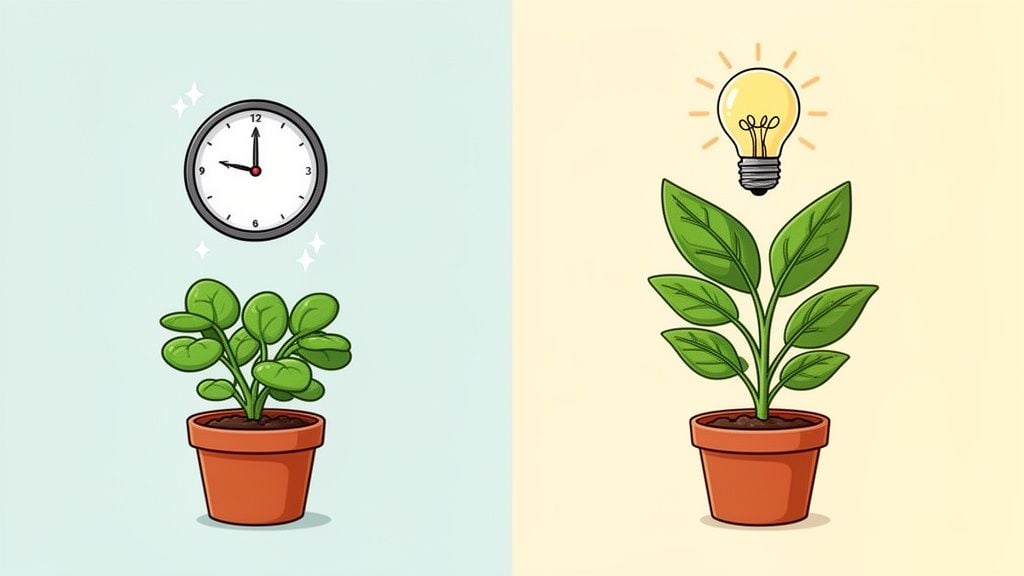
So, you’re ready to grow your own. The first fork in the road is deciding between autoflower and feminized seeds. It’s a choice that really defines your entire growing journey, and it’s not about which is “better”: it’s about which is better for you, your space, and your timeline.
At their core, the two are distinguished by one key trait: how they begin to flower. Autoflowers flip to flowering based on age, while feminized (photoperiod) seeds need a change in their light cycle to start budding. This single difference creates a cascade of effects on everything from their total lifespan to the control you have over your final harvest.
What Triggers Flowering?
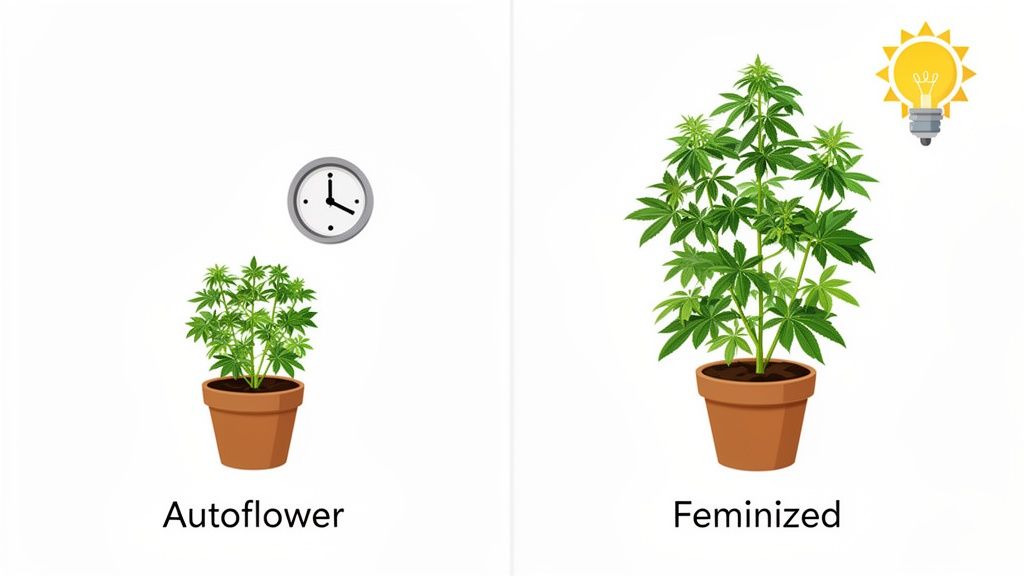
Think of autoflowers as being on a fixed, internal clock. They are genetically programmed to start flowering after just a few weeks of vegetative growth, regardless of how much light they get. This makes them incredibly straightforward. You plant the seed, and the plant takes care of the timing for you.
Feminized seeds, on the other hand, are photoperiod plants, meaning they respond to light cues. You are the one in the driver's seat. As long as you give them 18+ hours of light per day, they will stay in a vegetative state, growing bigger and bigger. To start flowering, you have to manually switch your light schedule to 12 hours on and 12 hours off.
Why This Matters: Your decision boils down to your primary goal. For a fast, simple grow, autoflowers are your best bet. If you want to experiment, train your plants for maximum size, and have total control over the harvest, feminized seeds are the way to go.
Here's a quick look at how these two paths diverge in practice.
| Comparison Point | Autoflower Seeds | Feminized (Photoperiod) Seeds |
|---|---|---|
| Flowering Trigger | Automatic (based on age) | Manual (based on light schedule) |
| Seed-to-Harvest | Fast (8–10 weeks) | Longer (3–6+ months) |
| Typical Size | Small & discreet | Can grow massive with training |
| Grower Control | Limited: plant is on autopilot | Full control over size & veg time |
| Best For | Speed, simplicity, small spaces | Huge yields, cloning, advanced training |
Ultimately, understanding this fundamental choice is the first step toward a successful harvest. By knowing what to expect, you can confidently browse the Botanist Seeds catalog and pick the perfect genetics for your setup, goals, and experience level.
Understanding the Complete Grow Timeline
When it comes to planning a grow, your timeline is everything. It dictates your entire process, from setup to harvest. The biggest difference between autoflower and feminized seeds is time: one is a sprint, while the other is a marathon where you control the pace.
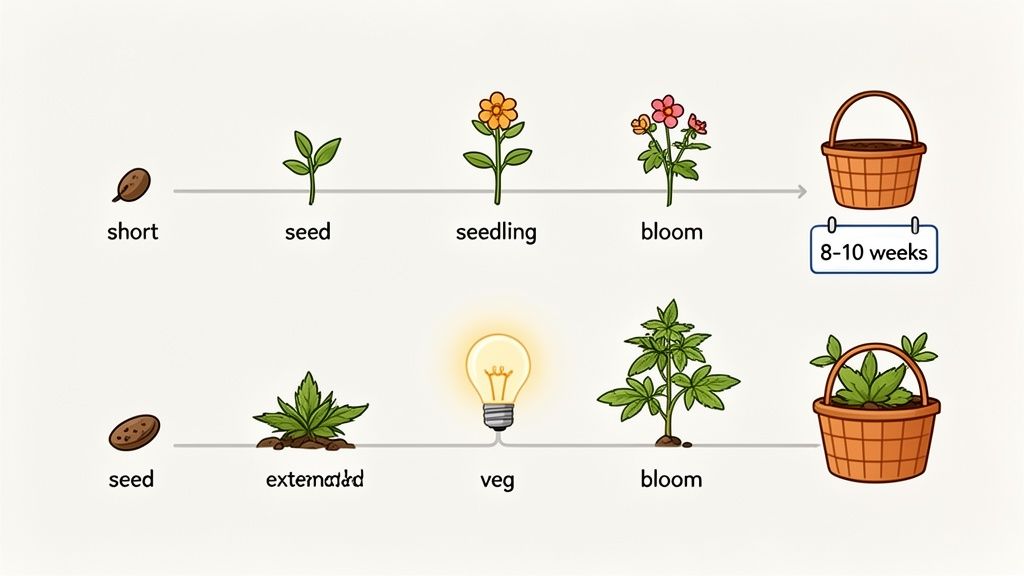
This difference comes down to one thing: what triggers flowering. Autoflowers have an internal clock and flower based on age. Feminized seeds, on the other hand, are photoperiods: they need a specific light schedule to start producing buds.
The Autoflower Timeline: An Express Route to Harvest
Autoflowers live life in the fast lane. They are genetically programmed to finish their entire lifecycle in a remarkably short window. Once that seed pops, the clock is officially ticking.
- Seedling Stage: For the first 1-2 weeks, the plant focuses on establishing a healthy root system and sprouting its first set of leaves.
- Vegetative Stage: This is a quick burst of growth lasting only about 2-4 weeks. The plant develops its leaves and branching but generally stays compact.
- Flowering Stage: Around week 3 or 4, the plant automatically switches to flowering, no matter what you do. This final push lasts for 5-7 weeks as the buds form and ripen.
All in all, you’re looking at a seed-to-harvest time of just 8 to 11 weeks. This speed is fantastic for growers who want a quick turnaround, need to fit multiple harvests into a single outdoor season, or just don't have the patience for a long grow. You can find more of these speedy genetics in our complete collection of autoflower seeds.
The key takeaway with autoflowers is their preset timeline. You can’t extend their growth phase to fix a mistake or grow a bigger plant. What you see is what you get, and it all happens fast.
This rapid, automatic flowering is why autoflowers are becoming so popular. While feminized seeds held a dominant 48.9% revenue share in 2026, industry analysis shows autoflowers are expected to see the fastest growth rate through 2032. They simply remove the technical challenge of managing light cycles. You can read more about these trends in this global cannabis seeds market report.
The Feminized Timeline: You Control the Calendar
With feminized (photoperiod) seeds, you are in the driver's seat. These plants won't flower until you tell them to. As long as you give them 18 or more hours of light per day, they will stay in their vegetative stage, getting bigger and stronger.
This control is a huge advantage. You get to decide exactly how big your plant gets before initiating the flowering stage. When you're ready, you "flip" the plant into flower by switching your light timer to a strict schedule of 12 hours on and 12 hours off. This change mimics the shortening days of fall and signals to the plant that it's time to start producing buds.
A typical timeline for a feminized grow looks like this:
- Seedling Stage: Just like an auto, this initial stage takes about 1-2 weeks.
- Vegetative Stage: Here’s where you have all the power. You can veg for a short 3-4 weeks for a smaller plant or let it go for 2+ months to grow a massive bush. A longer veg time almost always means a larger potential harvest.
- Flowering Stage: After you flip the lights, flowering generally takes 8-12 weeks, though this can vary by cultivar.
Because of that flexible veg period, a full feminized grow can take anywhere from 3 to 6+ months from seed to harvest. It definitely demands more patience, but the payoff is total control and the potential for truly massive yields.
Yield Potential and Plant Size Expectations
When it comes to harvest, every grower wants to know the same thing: how much can I expect? The answer really starts with your seed choice. This decision frames everything that follows, from the size of your plants to the final weight of your harvest.
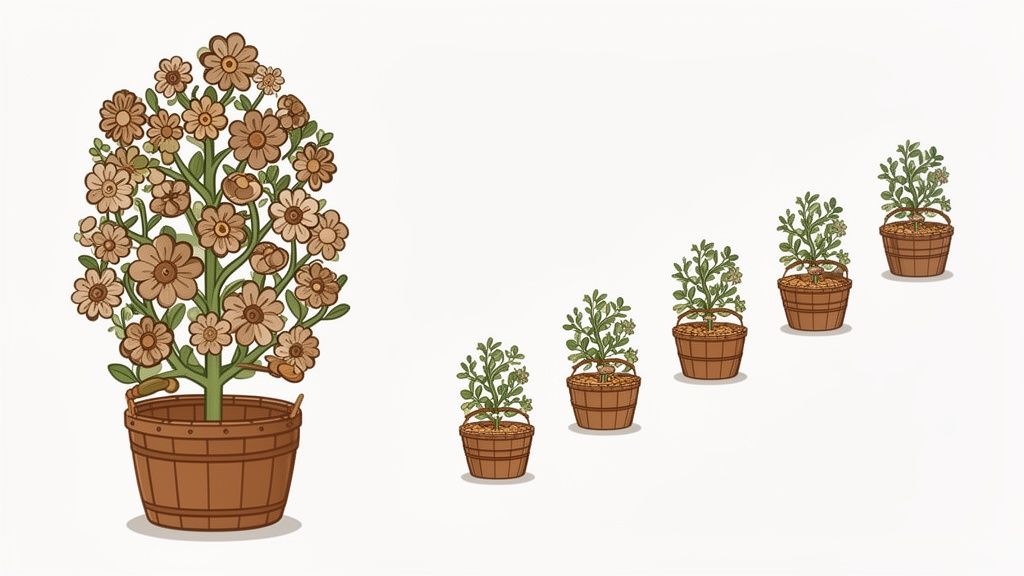
Ultimately, this isn't about one seed type being objectively "better." It's a classic grower's dilemma: do you aim for one massive haul, or would you rather have a steady, rotating supply?
Feminized Seeds: Going for a Massive Harvest
If your goal is to get the absolute biggest yield possible from each individual plant, feminized photoperiods are the undisputed heavyweights. Their secret lies in the vegetative stage: you, the grower, are in complete control. As long as you keep them under an 18+ hour light cycle, they will just keep growing, packing on size and developing more future bud sites.
This extended growth phase is your opportunity to cultivate some truly massive plants. Got a big grow tent or a secure backyard? You can let a feminized plant veg for weeks, or even months. The math is simple: a longer veg time almost always leads to a bigger, more robust plant structure that can support a staggering amount of flower.
- Bigger Plants, Bigger Yields: Feminized plants can stretch several feet tall, especially outdoors, and produce significantly more flower per plant than any autoflower.
- Perfect for Maximizers: If you want to pour your energy into just a few large plants to stock up for months at a time, this is your path.
- Huge Training Potential: That long veg stage is a dream for growers who use training techniques to push their final harvest weights even higher.
For a closer look at the cultivars that give you this level of control, check out our selection of photoperiod seeds. They are the first choice for anyone who puts size and single-harvest volume above all else.
When you want the potential for enormous individual harvests, choose feminized seeds. You control how big they get. With enough space and patience, your reward is a massive haul from just one grow cycle.
Autoflowers: The Perpetual Harvest Strategy
Autoflowers play by a different set of rules. Their lifecycle is on a fixed timer, so they simply don't have the time to develop into monsters. Most autos stay conveniently compact, rarely topping two or three feet. Naturally, this means a single autoflower plant will yield a more modest amount compared to a fully vegged feminized plant.
But here’s the brilliant trade-off: what you lose in size, you gain in speed. This incredible efficiency unlocks a growing style that many hobbyists swear by: the perpetual harvest.
Instead of waiting months for one big harvest, you can stagger your plantings every few weeks. This creates a continuous, rotating cycle where you’re pretty much always a few weeks away from trimming some fresh buds. It turns your grow space into a personal production line, perfect for those who want a steady supply without the "feast or famine" of a single huge harvest.
A Perpetual Harvest in Action:
- Week 1: You plant your first auto seed.
- Week 4: Plant your second seed. Your first plant is already starting to flower.
- Week 8: Plant your third seed. Now, your second is flowering, and your first is getting frosty and close to finishing.
- Week 10-12: You harvest your first plant, while the other two continue their journey.
This method is a game-changer for personal use. It ensures you never run out and avoids the sometimes-overwhelming task of trimming and curing several pounds all at once.
A Practical Comparison for Home Growers
Alright, theory is great, but let's talk about what really matters in your grow space. Beyond the lifecycle charts and yield predictions, how do autoflower and feminized seeds actually perform day-to-day? We’re looking at the practical stuff: the difficulty, the space they take up, the sensory experience you can expect, and what it all costs.
For anyone looking to grow their own, these are the details that make or break the experience. Your choice here will dictate everything from the size of your tent to how much time you'll spend with your plants. Let's lay it all out so you can confidently pick the seed that fits your home and your life.
Growing Difficulty and Forgiveness
When you're just starting, you want a plant that can handle a few mistakes. Both seed types have their strong points for new growers, but they offer very different kinds of safety nets.
Autoflowers: Their main appeal is simplicity. Because they switch to flowering on their own, you don't have to worry about managing light cycles, a huge hurdle for many beginners. The catch? Their short life means there's very little time to recover from stress. If you overwater or mess up nutrients early on, that plant may be permanently stunted, resulting in a disappointing harvest.
Feminized Seeds: These photoperiod plants are far more resilient. If you run into trouble during the vegetative stage, you can just let the plant recover for an extra week or two before you flip the lights to a 12/12 schedule. This flexibility is a massive advantage for learning the ropes. The trade-off, of course, is that you are in full control and must trigger the flowering stage yourself.
Many new growers find the hands-off nature of autoflowers to be the perfect way to get their feet wet. You can explore some of the most forgiving varieties in our guide to the easiest strains to grow indoors.
Space Requirements and Discretion
The amount of space you have is often the deciding factor. Whether you’re working with a corner of a closet or an entire basement will point you toward one seed type over the other.
Autoflowers are the champions of compact grows. Their Ruderalis genetics keep them naturally short and bushy, and most varieties stay under three feet tall. This makes them ideal for:
- Small grow tents (2×2 ft or 3×3 ft)
- Stealthy balcony or patio gardens
- DIY "space bucket" or cabinet grows
Feminized plants, on the other hand, can get huge. With a potentially long vegetative period, they will grow to fill whatever space you provide. While this is fantastic for maximizing yields in a big tent or outdoor plot, they need a lot of vertical headroom. If you're growing a feminized cultivar indoors, be prepared for a plant that could easily stretch to four to six feet tall without training.
Potency and Aromatic Profile
This is a big one. For years, a persistent myth claimed that autoflowers were weak. While there might have been some truth to that in the early days of auto breeding, modern genetics have almost entirely closed the gap.
Originally, the Ruderalis genes that give autoflowers their automatic flowering trait also diluted their active compounds. But expert breeders have spent the last decade crossing elite, high-potency photoperiods back into their auto lines. The result? Today’s top-shelf autoflowers deliver a vibe and aromatic profile that can easily rival their feminized cousins.
Sure, the absolute most potent, record-breaking cultivars are still usually photoperiods. But for the average home grower, the difference is negligible. You can find incredibly aromatic and enjoyable autoflowers that will satisfy even the most discerning hobbyist. Don't let outdated rumors steer you away.
Overall Cost Effectiveness
Let's talk money. Figuring out which seed is more cost-effective isn't just about the initial price: it’s about the total cost of running your grow from start to finish.
Autoflower Cost Considerations:
- Electricity: Most growers run lights for 18-20 hours a day for the plant's entire life. This can mean higher electricity bills compared to a photoperiod's 12/12 flowering cycle.
- Seed Cost: You can't really clone autoflowers, so you have to buy new seeds for every single run. This becomes a recurring expense.
Feminized Seed Cost Considerations:
- Cloning: This is a game-changer. Once you find a "mother" plant you love, you can take cuttings to create an endless supply of genetically identical clones for free.
- Yield Per Plant: Because they can grow so much larger, a single feminized plant often yields significantly more, making it more cost-effective when you look at cost-per-gram.
Before you make up your mind, take a look at this quick side-by-side comparison. It breaks down the key differences to help you see at a glance which seed type is the better match for you.
Autoflower vs Feminized Seeds At a Glance
A direct comparison of key characteristics to help you quickly decide which seed type fits your growing style and goals.
| Characteristic | Autoflower Seeds | Feminized (Photoperiod) Seeds |
|---|---|---|
| Lifecycle Speed | Very Fast: 8-10 weeks from seed to harvest. | Slower: 3.5-6+ months depending on veg time. |
| Growing Difficulty | Easy for beginners (no light cycle management). | Moderate (requires flipping to 12/12 light cycle). |
| Forgiveness | Low. Mistakes can permanently stunt the plant. | High. Can recover from stress during vegetative stage. |
| Typical Size | Small and compact (usually under 3 ft). | Medium to very large (can exceed 6 ft). |
| Yield per Plant | Lower. | Higher to much higher. |
| Cloning | Not possible. Requires new seeds each grow. | Easy. Can create endless free plants from a mother. |
| Best For | Speed, discretion, small spaces, multiple harvests per year. | Maximum yield, training techniques, cloning, breeding. |
Ultimately, choosing between autoflower and feminized seeds is about matching the plant's characteristics to your specific goals, resources, and experience level. There's no single "best" choice: only the best choice for your grow.
Choosing the Right Seed for Your Situation
Alright, we've gone through all the technical details, but specs on paper only tell part of the story. The real question is, which seed actually makes sense for your grow? This is where the choice becomes personal. It all comes down to your space, your timeline, and what you’re hoping to achieve.
This is the point where the autoflower vs. feminized seeds debate shifts from theory to a practical, real-world decision. Let's look at a few common grower scenarios to help you figure out which camp you fall into and choose your seeds with confidence.
The First-Time Grower
If this is your first time, you’re probably feeling a mix of excitement and a little bit of "what if I mess this up?" The idea of managing light cycles, timers, and potential problems might sound like a headache you'd rather avoid. You just want a straightforward path to successfully harvesting your own flower.
- Your Goal: To get from seed to a successful harvest with as few complications as possible, learning the ropes along the way.
- Your Best Choice: Autoflower seeds. Their "set it and forget it" flowering cycle is a game-changer. You can focus on the fundamentals: watering, feeding, and just watching your plant thrive: without stressing over precise light schedules. They handle the timing for you.
An autoflower is perfect for building confidence. Getting that first successful harvest under your belt is incredibly rewarding, and these seeds make the whole process feel much more accessible right from the start.
The Closet Cultivator
For so many of us, limited space is just a fact of life. Whether you're working with a small tent tucked into a spare room, the corner of a closet, or even a discreet pot on an apartment balcony, you need a plant that stays compact. The last thing you want is a plant that stretches right up to the light and outgrows its home.
This is where autoflowers are absolute champions. Their genetics naturally keep them short and bushy, making them ideal for small-scale grows where you can’t have a plant taking over the room.
When you’re tight on space, an autoflower is almost always the answer. A compact, low-odor autoflower cultivar will give you a great harvest without drawing unwanted attention or dominating your living area.
This simple chart is a great visual guide for making a choice based on whether your main priority is speed or sheer size.
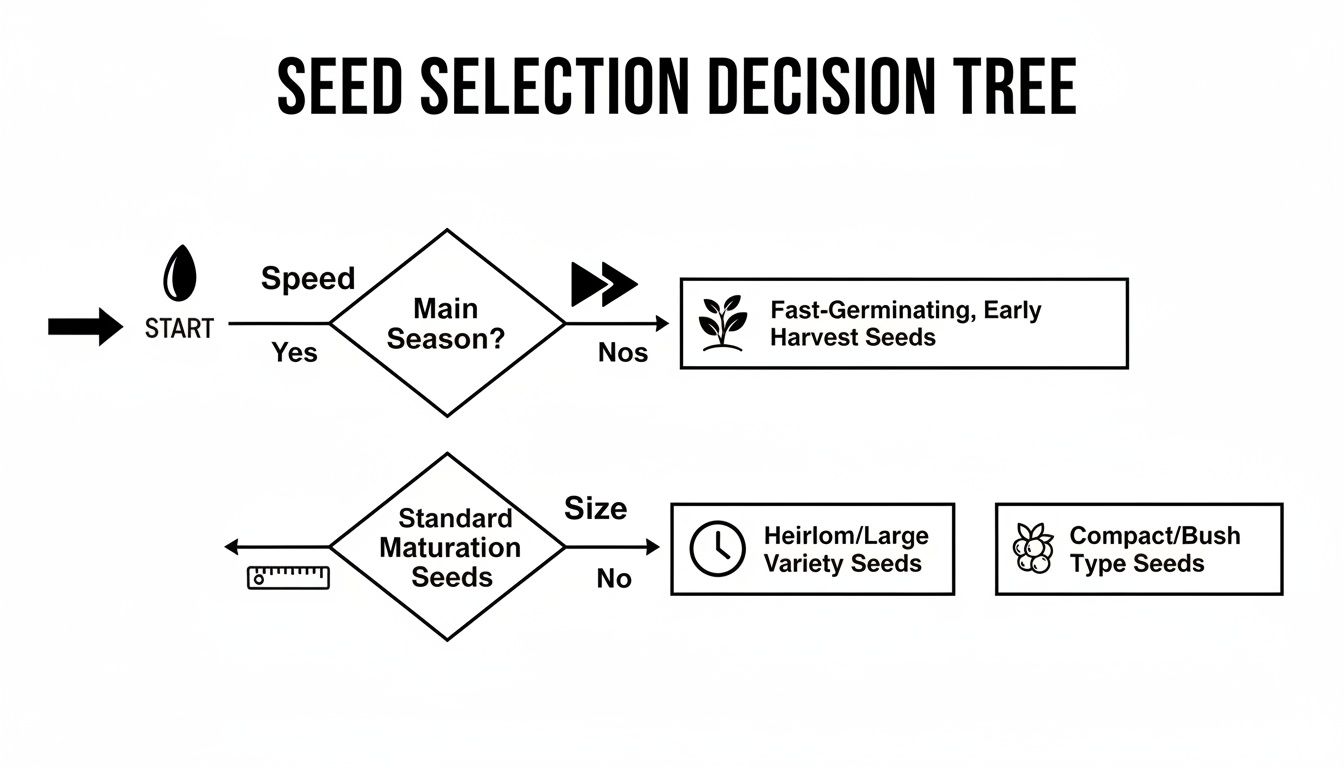
As you can see, if getting a harvest done quickly is your primary goal, the path leads straight to autoflowers. If you're more focused on growing the biggest plant you can, feminized seeds are the way to go.
The Yield Maximizer
Is your dream to fill every single jar you own from one massive harvest? If you’ve got the room: a large grow tent or a secure outdoor patch: and your main goal is to squeeze every possible gram of flower from each plant, then feminized seeds are your ticket. They put you in the driver's seat.
You control their size by extending the vegetative stage, allowing you to grow a feminized plant into a massive bush with dozens of future bud sites. It definitely requires more patience and hands-on management, but the payoff can be a harvest that lasts you for months.
- Your Goal: To produce the biggest possible harvest from a single grow cycle.
- Your Best Choice: Feminized seeds. The power to control their veg time means you can cultivate enormous, high-yielding plants that an autoflower just can't compete with on a per-plant basis.
The home-grow movement is booming. North America currently dominates the global market with 38.7% of all cannabis seed sales, and the United States alone accounts for 24.5% of that share. This growth is driven by people just like you who are discovering the satisfaction of growing their own. You can find out more about how American growers are shaping the market in this detailed industry report.
So, What's the Verdict?
After walking through these common setups, you should have a much clearer idea of which seed type is the right fit for your personal growing style.
You should choose an autoflower if:
- You're a new grower looking for a forgiving and simple first experience.
- You're growing in a small space like a closet, small tent, or balcony.
- You value speed and want to get from seed to harvest as fast as possible.
You should choose a feminized seed if:
- Your number one goal is the largest possible yield from each plant.
- You have plenty of space for plants to get big and stretch out.
- You enjoy having total control over the growing process and timeline.
Ultimately, there is no single "best" seed: only the best seed for you and your situation. Now that you know where you stand, you can explore the Botanist Seeds catalog with confidence and find the perfect cultivar for your next grow.
Frequently Asked Questions About Seed Types
Growers ask us about the differences between autoflower and feminized seeds all the time. To help you get your grow started on the right foot, we’ve put together some straightforward answers to the most common questions we hear.
Can You Clone Autoflowers Like Feminized Plants?
This is a fantastic question, and the short answer is no: at least, not in any practical way. While you could technically snip a cutting from an autoflowering plant, the new clone is stuck on the exact same internal clock as its mother.
Think of it this way: if you take a cutting from a mother plant that is three weeks old, that clone is also considered "three weeks old." It’s going to try flowering at the same time as the mother, which means you'll end up with a tiny, disappointing plant that yields next to nothing.
Feminized photoperiod plants are a different story entirely. You can keep a "mother plant" in its vegetative stage pretty much forever by giving it 18+ hours of light each day. This lets you take countless clones, and each one can grow into a full-sized, productive plant on its own timeline.
For anyone wanting to preserve the genetics of a special plant or run a perpetual harvest from one proven winner, feminized seeds are the only practical choice for cloning.
Are Autoflowers Less Potent Than Feminized Seeds?
This is an old myth that’s becoming less true with every single harvest. For a long time, autoflowers did have a reputation for lower potency, and honestly, it was deserved. Their Ruderalis genetics: the part of their DNA that gives them the auto-flowering trait: is naturally low in active compounds.
But that was then. Modern breeders have spent years carefully crossing today's most powerful photoperiod cultivars back into their autoflower lines, and the results speak for themselves.
- Modern Genetics: Today’s best autoflowers can easily go toe-to-toe with feminized seeds in terms of their aromatic profiles and the overall experience they provide.
- The Potency Gap: While the world-record-setting cultivars are still usually photoperiods, the gap has shrunk dramatically. You're no longer sacrificing quality for speed.
- A Great Experience: You can now find dozens of incredible autoflower cultivars that deliver a fantastic sensory experience, perfect for any home grower's needs.
Don't let outdated forum posts from ten years ago fool you. You can absolutely grow top-shelf flower with modern autoflower seeds.
Which Seed Type Is More Forgiving for New Growers?
This is where the debate gets fun, because a strong case can be made for both. The right answer really depends on what you, as a new grower, are most worried about messing up.
Autoflowers are often recommended because they take one of the biggest variables off your plate: managing light cycles. You don't have to worry about switching your lights to a 12/12 schedule to trigger flowering: the plant just handles it. That simplicity is a huge relief for beginners.
The trade-off is that their rapid lifecycle leaves almost no room for error. If you stress an autoflower early on, it will likely stay stunted for its entire short life.
Feminized photoperiod plants, on the other hand, offer way more room to recover. If you make a common mistake during the vegetative stage: like overwatering or nutrient burn: you can just give the plant extra time to bounce back. Simply keep the lights on for 18+ hours a day for another week or two until it looks healthy again, then flip to flower.
- If your main concern is forgetting to manage light cycles, go with an autoflower.
- If you're more worried about making general growing mistakes, a feminized seed provides a much better safety net.
Either way, you can end up with a fantastic first harvest. The best choice is the one that gives you the most confidence to get started on your home growing journey.
Ready to make your choice? The best way to start is by exploring a curated selection of reliable genetics. At Botanist Seeds, we make it easy to find the perfect cultivar for your setup, whether you need the speed of an autoflower or the massive yield potential of a feminized seed.
Check out our full catalog and start your growing adventure today.