F1 Hybrid Seeds Explained for Cannabis Growers

Why do so many growers hear F1 hybrid seeds are “better” and still end up unsure what they're actually buying? The confusing part isn't the genetics, it's the sales talk around them. If you want the plain version, an F1 hybrid is the first offspring from two stable parent lines, and that first cross is exactly why breeders use it for consistency, uniform shape, and predictable performance (Springer chapter on F1 hybrid breeding).
For home growers, that matters because the label isn't just a fancy way of saying “hybrid.” It tells you the seed came from a specific first-generation cross, not from some vague mixed pool. Blending two well-made coffee beans on purpose is different from emptying random leftovers into the grinder and hoping the cup tastes the same every time.
What F1 Hybrid Seeds Actually Mean
The simplest way to read F1 hybrid seeds is this, they're the first filial generation from crossing two genetically distinct but stable inbred parent lines (Springer chapter on F1 hybrid breeding). That's the whole core of the label. The “F1” part isn't marketing language, it marks the exact first cross.
Why breeders make that first cross
Breeders spend time making inbred parent lines because those parents are near-uniform on their own. When they cross them, the offspring tend to come out much more uniform too, which is why growers often see more predictable structure, timing, and finish from an F1 run. That uniformity is the practical reason F1s keep showing up in commercial breeding.
A good coffee analogy helps here. If two baristas use the same two beans and the same recipe, you expect a similar cup. F1 breeding tries to do something similar with plants, except the “recipe” is genetic, not culinary. The point is not mystery, it's repeatability.
Practical rule: if the breeder is calling something an F1, they're signaling that the seed was made from a deliberate first cross, not a loose mix of traits.
For cannabis growers, that usually means a tighter set of plants across a run. You still need good light, nutrition, and environment, but you're starting with genetics that are built to behave more alike than open-ended seed lines. That's the main reason F1s are attractive to home growers who want fewer surprises and less phenotype chasing.
The Genetics Behind Hybrid Vigor
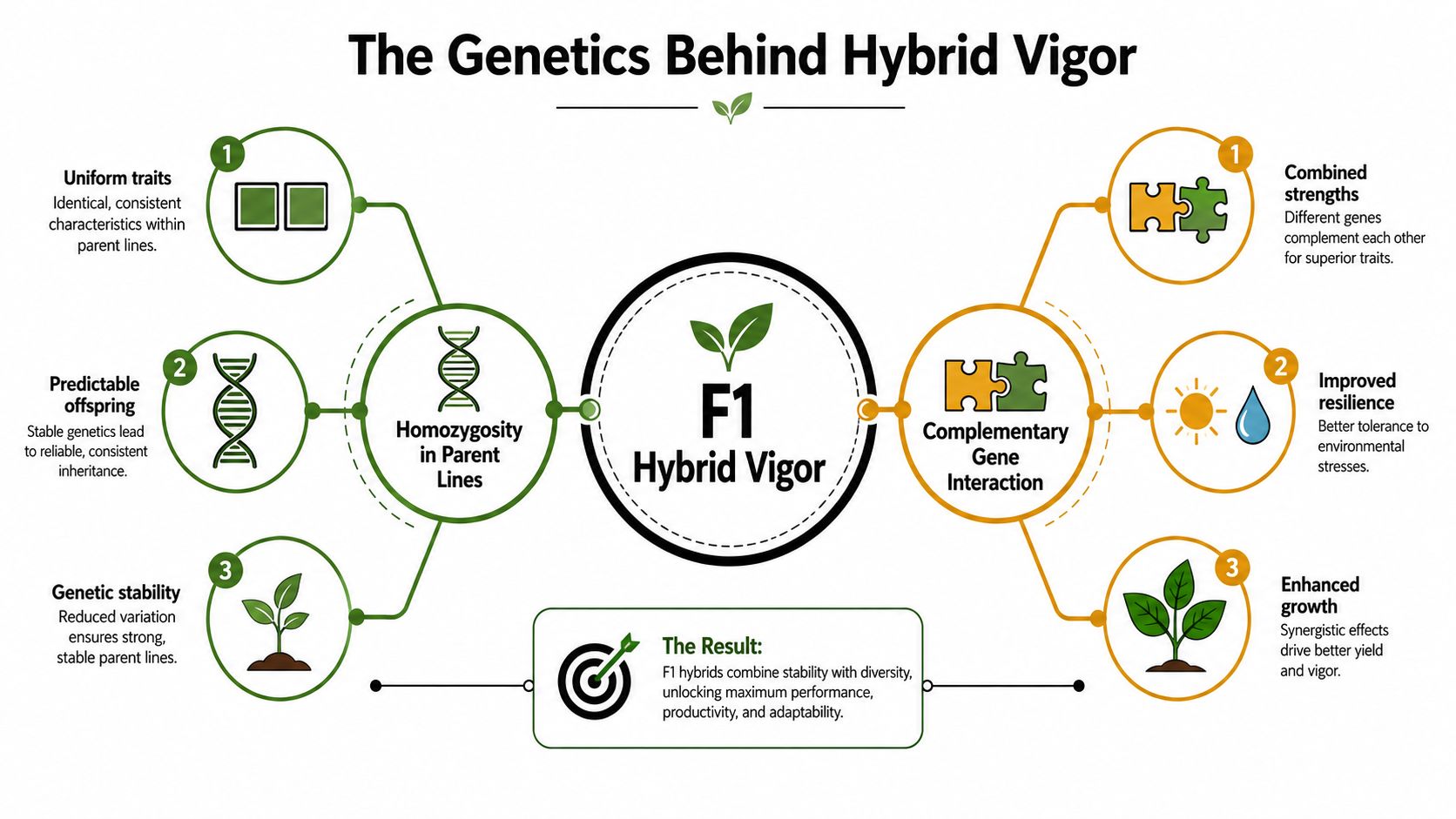
Hybrid vigor sounds technical, but the idea is straightforward. Two stable parent lines carry different strengths, and the first-generation offspring can combine those strengths in a way that looks more even and often more vigorous than either parent alone. In genetics terms, the parent lines are homozygous enough to stay predictable, while the offspring become heterozygous, which is where heterosis, or hybrid vigor, appears (Springer chapter on F1 hybrid breeding).
The easy version of the mechanism
Two paint trays can give a clear mental model. Each tray holds a limited set of colors, and each one has something the other lacks. When a breeder combines two carefully prepared parent lines, the offspring can express a cleaner, stronger mix than either line alone.
That is why breeders do not treat every cross the same way. If the parents are still variable, the seedlings will be variable too. F1 breeding depends on starting with lines that are already controlled and then making one deliberate first cross, so the result is a dependable mix rather than a roll of the dice.
Core idea: stable parent lines in, uniform offspring out. If the parents are not tightly controlled, the F1 label loses most of its value.
For home growers, the practical effect shows up in the tent or room. You may see a more even canopy, plants with similar structure, and a harvest window that feels easier to plan. Germination can also feel more even when the genetics are well worked, though the environment still carries a lot of weight. Uniform genetics do not replace good growing habits; they make the results easier to manage.
How F1 Hybrids Became a Global Standard
F1 hybrids did not become important because marketers liked the label. They became important because breeders proved the method could work at scale. Hybrid corn moved from experimental breeding into commercial use in the 1930s, and by the end of that decade it had reached nearly 100% of cultivation in the Corn Belt, with broader nationwide adoption following by 1960 (historical source).
That timeline matters for cannabis growers because it shows how quickly a breeding approach can move from trial stage to standard practice once it solves real production problems. The same historical source explains that commercialization also helped build a transnational seed industry and changed the role of public scientists in crop development. In plain language, hybrid breeding moved out of the margins. It changed who produced seed and how crop development was organized.
The broader crop picture
By 1960, F1 hybrid crops had become dominant in several major U.S. segments, including 99% of corn planted, 95% of sugar beet, 80% of spinach, 80% of sunflowers, 62% of broccoli, and 60% of onions (historical crop history overview). Those figures show that hybridization was not limited to one crop family. It became a broad commercial standard across grains and vegetables.
The history goes back farther than many growers expect. Improved vigor in hybrid plants was first noticed in 1716 by Thomas Fairchild, then observed again in 1763 by Koelreuter and 1793 by Sprengel (agricultural history reference). The idea itself is old, but the large commercial system is what turned it into an everyday tool for breeding.
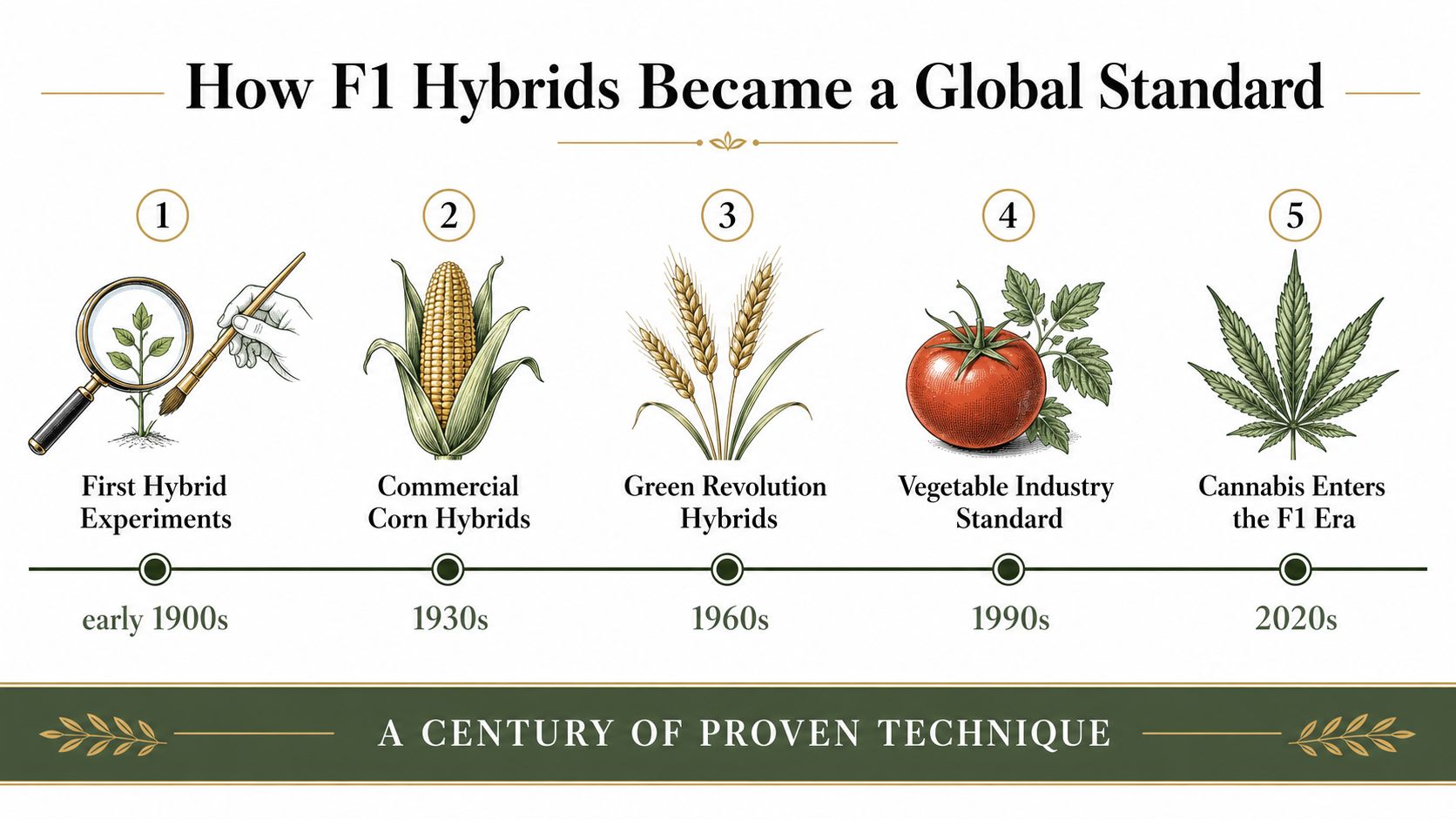
For home growers, the takeaway is simple. F1 hybrid seeds are not a passing trend, they sit inside a long breeding model that already reshaped staple crops. That does not mean every F1 is worth buying, but it does mean the underlying method is familiar and proven, not experimental. If you want to see how those stable first-generation traits compare with more variable seed generations, the practical side becomes clearer in a phenotype variation guide.
F1 vs F2 and Other Cannabis Seed Types
The easiest way to understand seed choice is to compare what happens after the first cross. F1 is the uniform first generation. F2 is where segregation starts to show up, so you get more variation from plant to plant. If your goal is a tight run with a known result, that difference is the whole game.
| Seed Type | Uniformity | Predictability | Best For |
|---|---|---|---|
| F1 | High | High | Consistent home grows and uniform harvests |
| F2 | Lower | Lower | Phenotype hunting and selection work |
| Other stabilized cultivars | Often good, depending on line | Depends on breeder | Growers who want known traits without first-generation limitations |
If you want a deeper look at how phenotype variation shows up in practice, the simplest reference point is this phenotype guide. That's where the abstract genetics starts looking like actual plant differences in a grow space.
What each choice really does
F1s help when you want the breeder's advertised traits to show up in a more even way across the whole room. F2s are more useful when you're trying to find something new inside a line, because the variation gives you more room to select. Other stabilized cultivars sit somewhere else on the map, depending on how far the line has been worked.
If you want one uniform run, choose the generation that was built for uniformity. If you want to search for variation, don't expect the first cross to give you the widest spread.
A lot of confusion comes from treating all “hybrid” labels as interchangeable. They aren't. The generation number changes the experience, and so does the breeder's goal. That's why the label matters more than the hype around it.
What Hybrid Vigor Looks Like in the Grow Room
Hybrid vigor sounds abstract until you see it in a catalog or in the tent. One specialist cannabis source reports F1 hybrid lines reaching up to 1.8 kg/m² under optimized conditions, with some cataloged selections showing 75 to 85 day cycles, 70 to 90 cm plant height, and THC ranges around 20 to 25% plus terpene totals up to 2.81% (F1 Seed Tech). Those are upper-end figures under optimized conditions, not promises for every setup.
What those numbers can help you plan
A compact plant is easier to fit into a small indoor footprint. A shorter cycle can matter if you want a faster turnover and a cleaner schedule. A higher-yielding, more consistent line also reduces the odds that one plant runs way ahead of the rest and throws off your canopy management.
That said, catalog numbers don't tell the whole story. They don't show how a cultivar smells in the room, how it stacks under your light, or how it handles a rough environment. They also don't guarantee the same result in every home setup, because environment still drives a lot of the outcome.
Read the catalog like a grower, not a shopper
- Yield figures: treat them as a ceiling under ideal conditions, not a floor.
- Plant height: use them to judge tent fit, training needs, and spacing.
- Cycle length: compare it with your own schedule, not just the breeder's label.
- Terpene data: useful as a signal, but not a substitute for real aroma preference.
The point of F1 vigor isn't just “more.” It's more predictable more often. That's useful when you're growing at home and want fewer surprises, fewer awkward height differences, and less time sorting through plants that all behave differently.
The Honest Drawbacks Home Growers Should Know
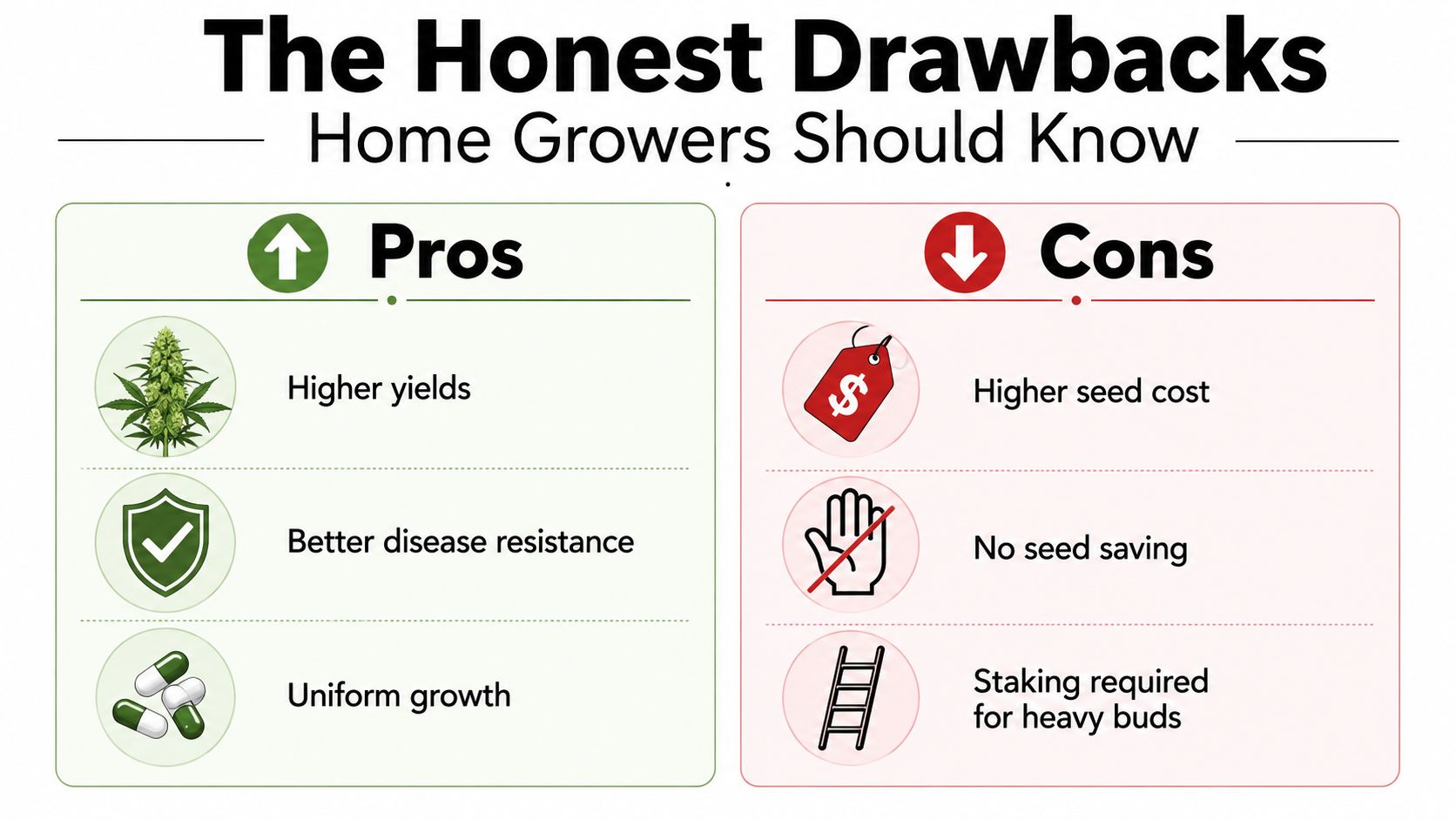
The most practical drawback of F1 hybrid seeds is simple, they usually cost more, and they are not a one-time buy if you want the same result again. The Royal Horticultural Society notes that F1 hybrids are more expensive to produce and do not breed true from saved seed, so home growers who want the same traits often need to purchase fresh seed for the next run (RHS overview of F1 hybrids). That changes the economics fast for a small garden.
Why the premium can feel worth it, or not
If you care about uniformity, a tighter finish window, and less phenotype hunting, the higher price can still make sense. If your main goal is to keep seed costs low and reuse what you harvest, the calculation looks very different. The hidden expense is not just the seed packet, it is that the breeder has to rebuild the same line again if you want it back in the same form.
A simple way to judge it is to ask what you are paying for. Some growers are buying convenience, predictability, and a more even canopy. Others are paying for a plant they will not be able to reproduce from saved seed in a way that stays true to the original. That is why F1s can feel like a smart purchase in one room and an expensive habit in another.
The climate-resilience debate is messier still. Breeders and gardening guides often describe F1s as vigorous and able to handle stress, but that does not always line up with what growers see once the plant meets a real environment. The broader lesson is that resilience is partly genetic and partly practical, because the same cultivar can perform very differently depending on heat, moisture, light, pests, and local conditions.
A plant can have strong genetics on paper and still struggle if the environment is wrong. Input access, local adaptation, and day-to-day care shape the outcome just as much as the cross itself.
For home growers, the question is not whether F1 hybrids are good or bad. It is whether the extra cost buys you something you use, such as more even growth, fewer surprises, or a crop that fits a crowded space better. If you are trying to preserve seed over time, this preservation guide is the practical companion piece for handling seed storage the right way.
The honest answer is that F1 hybrids can be excellent tools, but they are still tools. A grower who wants uniformity and a cleaner setup may find the premium reasonable, while a grower who wants to save seed and keep costs down may prefer a different path.
Buying, Growing, and Preserving F1 Genetics
Buying F1s makes the most sense when you shop with a plan instead of chasing the flashiest label. Start by looking for breeder descriptions that clearly state the generation, the intended structure, and the expected finish window. If the line sounds vague, treat it like any other unproven product and keep your money in your pocket.
A practical buying checklist
- Check the breeder's language: look for a clear explanation of what the F1 cross was built to do.
- Match the cultivar to the space: compact plants suit small tents, taller ones need room to stretch.
- Think in runs, not packets: buy with one full grow cycle in mind, not just curiosity.
- Expect to repurchase if you love the line: saved F1 seed won't reliably return the same plant.
Preservation is where a lot of growers get tripped up. If you want the same cultivar again, the honest answer is usually to buy fresh seed for the next run or work directly with a breeder who is maintaining the line. For a broader seed-storage approach, this preservation guide is the practical companion piece.
Growing them well without overcomplicating it
Uniform genetics still need a uniform environment. Keep light, watering, and nutrition consistent so the plants can express the traits the breeder selected for. If one plant is getting stressed while the others are cruising, your results stop looking like the catalog and start looking like your weakest input.
That's also why F1s are nice for home growers who value simplicity. Fewer surprises mean less time adjusting every plant as if it were a different project. You still have to pay attention, but the room tends to behave more like a planned run and less like a phenotype lottery.
Choosing a Breeder and Final Recommendations
The breeder matters as much as the label. A strong F1 is only as useful as the parent lines behind it, and a breeder who doesn't explain those lines is asking you to trust marketing instead of genetics. If you want a broader look at how premium seed lines are presented and priced, this premium seed market overview is a useful companion reference.
What to look for before you buy
- Clear generation labeling: you want an actual F1 designation, not loose language.
- Transparent trait goals: structure, timing, aroma direction, and finish should be easy to understand.
- Consistency across descriptions: if every cultivar sounds like a miracle, the breeder's copy is doing too much work.
- A plan for repeatability: if you want the same result again, ask how the line is maintained.
For most home growers, the answer is simple. F1 hybrids are worth it when you care about uniformity, manageable plant size, and a more predictable harvest window. They're less compelling when your main goal is seed saving or exploring variability on the cheap. If you're growing for convenience, consistency, and a smoother decision-making process, F1s fit that job well.
FAQ
Are F1 seeds worth the premium? Sometimes, yes, if the uniformity and consistency save you time or reduce guesswork. If you're on a tight budget and want to reuse seed, the value drops.
Can you save seed from F1 plants? You can save seed, but you shouldn't expect the same traits to show up the same way again.
What should you expect from the first run? A more even grow than you'd usually get from a less controlled seed line, assuming the breeder did the work well.
How do you judge breeder transparency? Look for plain language, stable trait descriptions, and enough detail to tell whether the line was built for repeatable results or just hype.
If you're comparing cultivars for a home setup, Botanist Seeds can help you match the genetics to the kind of run you want. Use the comparison tool, compare a few F1 options side by side, and pick the line that fits your tent, your timeline, and your budget.
If you want to narrow your next run without wasting money, start comparing cultivars at Botanist Seeds. It's a straightforward way to line up the genetics, the space, and the kind of harvest you want at home.