



What Is Open Pollination and Why It Matters for Growers
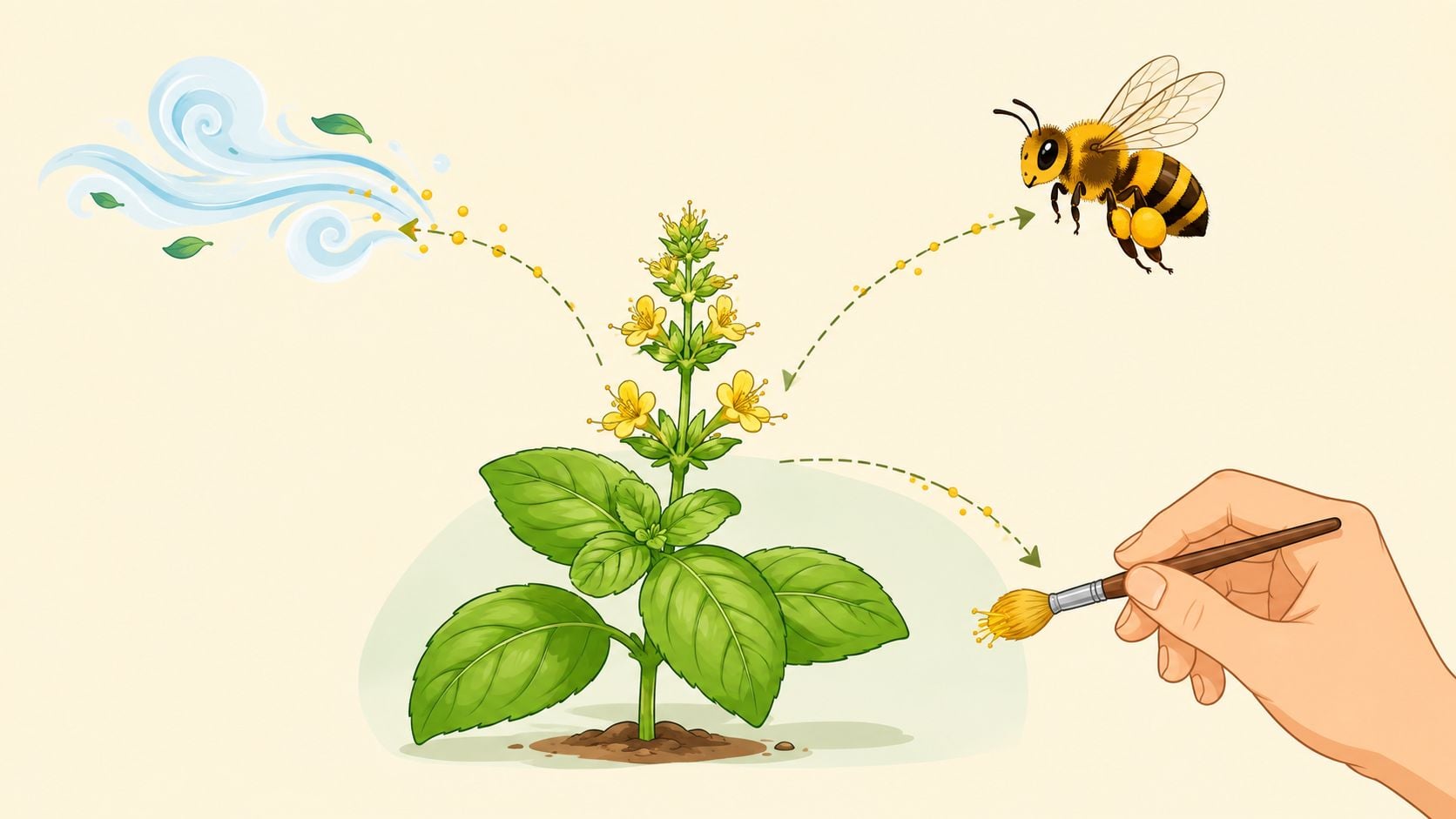
Open pollination is a natural breeding system where plants are fertilized by wind, insects, birds, water, or self-pollination without a breeder controlling the pollen source, and the resulting seed is expected to reproduce true-to-type when the parent stock is kept isolated from other compatible varieties. In tree-breeding research, open-pollinated families were not as simple as the old half-sib label suggests, with relatedness values in one study landing above 0.25 and below 0.50.
If that sounds more technical than the seed packet usually makes it, you're not wrong. The phrase shows up on garden tags, breeding notes, and cannabis cultivar pages because it tells you something practical about what the next generation is likely to do, especially when you care about seed saving, line stability, and whether a cultivar behaves the same way from run to run.
What Is Open Pollination in Simple Terms
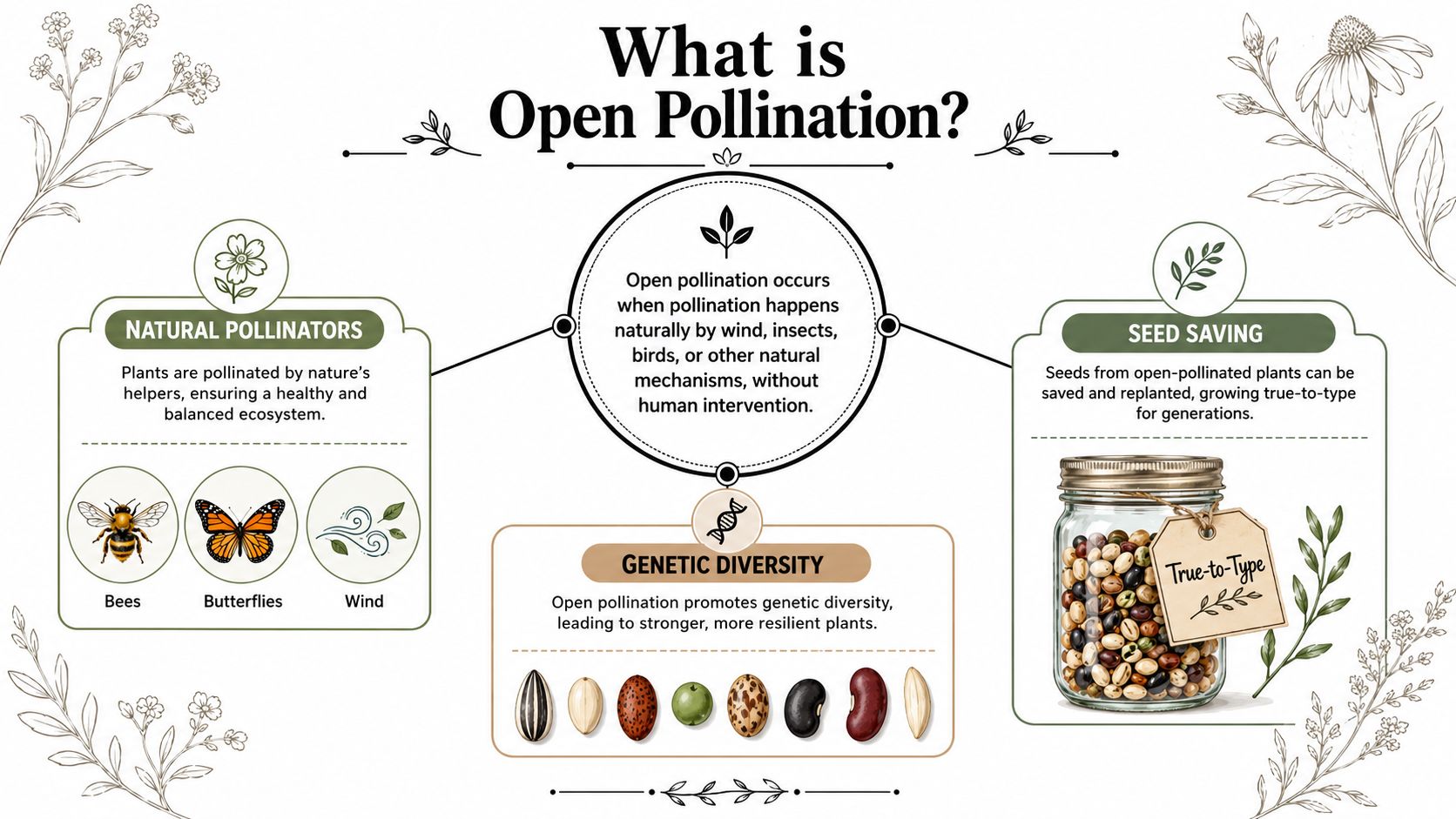
Open pollination means the plant sets seed without a breeder choosing the pollen parent by hand. The pollen source can be wind, insects, birds, water, or the plant's own biology, depending on the species. In plain English, it's nature doing the mating while the grower stays out of the way.
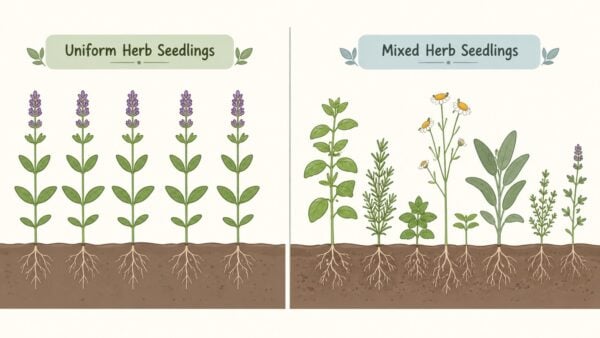
That matters because open-pollinated seed is usually discussed as a way to keep a cultivar line recognizable over time. If the parent stock stays isolated from other compatible varieties, the offspring are expected to look and grow like the parent generation rather than shuffling into a messy mix. For home growers, that's the appeal, you can keep a line going, save seed, and work with something that behaves predictably.
Why growers keep seeing the term
Seed banks use open pollination because it helps explain stability without promising uniformity that the seed line can't really guarantee on its own. A lot of confusion comes from people treating the phrase like it means “identical forever.” It doesn't. It means the pollen came through a natural process, and the line can stay close to type when the grower controls isolation well.
Practical rule: Open pollination describes the pollination process, not a guarantee that every offspring will be identical in every setup.
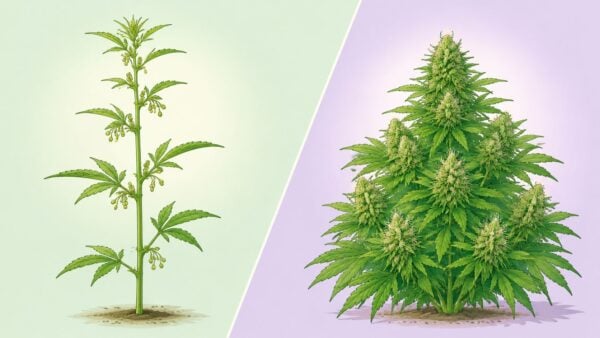
For cannabis growers, that distinction is useful. If you're comparing cultivars for a tent, greenhouse, or backyard run, open-pollinated lines can be a solid base for seed saving and local selection, while hybrids are usually chosen when the goal is a more locked-in first-generation result. That's the primary fork in the road, natural reproduction versus breeder-controlled crossing.
How Open Pollination Happens in Nature
How does pollen move from one flower to the next without a breeder standing there with a brush? In nature, the answer depends on the plant's flower structure and on what the pollen can ride on.
The main routes pollen takes
Wind-pollinated plants release light pollen that can drift from flower to flower. That is why crops like corn or spinach are often discussed alongside careful spacing, because airborne pollen does not care about your intentions. If you grow a plant that sheds a lot of pollen on a breezy day, the next seed generation can shift quickly when nearby plants are compatible.
Insect-pollinated plants work differently. Bees, butterflies, and beetles carry pollen as they visit flowers for nectar, and that movement is a big part of how open pollination works in agriculture. A 2023 global crop-pollination dataset found honey bees made up 34.22% of recorded pollinator counts, followed by bumblebees at 19.19% and other wild bees at 13.13% (crop pollination dataset). The same source notes that around 75% of crop species grown for food depend on pollinators to some extent, and about 35% of total food production by tonnage depends on them.
Human-mediated activity is the third pathway, even though it is not what people think of first. Growers can move pollen by hand or with tools in controlled seed production, which is still pollination, just not open pollination in the strict sense. For a closer look at that breeding side, see how F1 hybrid seeds are made.
A few species also rely on self-pollination or water movement. The exact mechanism depends on flower biology, which is why one crop can be easy to save seed from and another can turn into a cross-pollination headache.
What that means in a grow tent
In a tent, you are not dealing with acres of pollen drift, but the basic biology still applies. If compatible plants are flowering nearby, pollen can still move where you do not want it. That is why open pollination is really about movement, not just about whether humans touched the flower.
For growers, the useful question is simple, who moved the pollen, and how much control did you have over the result? That movement, whether by wind, insect, or human hand, is what determines whether your seed stays true to type.
Open Pollination Compared to Controlled Crosses and F1 Hybrids
What separates open pollination from a controlled cross or an F1 hybrid is who is doing the deciding. With open pollination, the pollen flow follows the natural setup, or a loose one inside the same line. With a controlled cross, the breeder chooses the parents. With an F1 hybrid, two selected parent lines are paired on purpose to get a specific first-generation result.
If you want a line you can keep, save, and keep selecting from, open pollination fits that job well. If you want a very specific outcome from the first generation, controlled breeding usually gives you more precision.
Here's the cleanest way to separate them.
| System | Pollen Source | Offspring Stability | Best For |
|---|---|---|---|
| Open Pollination | Natural, or unmanaged within the line | Stable when isolated, but not perfectly uniform in every setting | Seed saving, line maintenance, local selection |
| Controlled Cross | Chosen by the breeder | High control over the intended pairing | Breeding projects, trait targeting |
| F1 Hybrid | Two selected parent lines | Strong first-generation consistency, later seed won't repeat the same way | Uniform production, breeder-defined performance |
Open-pollinated lines are often chosen because they can be replanted and selected over time. That makes them useful for growers who want to keep a cultivar going without resetting the process every season. Hybrids serve a different purpose. Breeders use them when they want a predictable performance package in the first filial generation, not when they expect saved seed to keep behaving the same way forever.
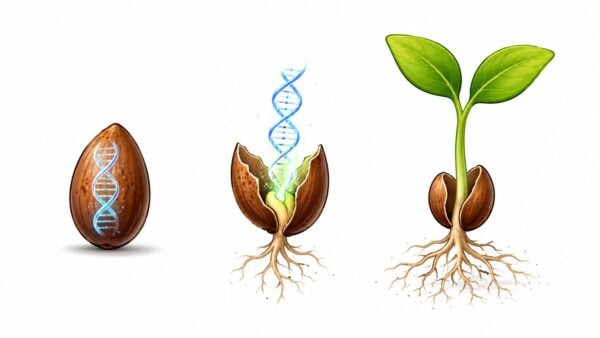
The genetic detail matters, especially if you are trying to keep cannabis seed lines true to type. A 2014 PubMed study on open-pollinated tree families found relatedness in Robinia pseudoacacia ranged from 0.20 to 0.43 with a mean of 0.34, while Gleditsia triacanthos ranged from 0.29 to 0.55 with a mean of 0.36. Those values sit above the classic half-sib benchmark of 0.25 and below full-sib relatedness of 0.50, which is a useful reminder that open-pollinated seed lots can still carry a fair amount of structure.
Open-pollinated seed can be stable, but it is not magic. The result depends on how clean the pollen environment is.
For cannabis growers comparing seed types, the practical takeaway is straightforward. If you want repeatable cultivar traits over multiple runs, open pollination helps when you are planning to save seed and keep a line going. If you want a very specific first-run expression, a hybrid system is often the better fit. For a closer look at breeder-led hybrid strategy, see how F1 hybrid seeds are made.
OP Cultivars, Landraces, and Modern Cannabis Genetics
In cannabis, OP cultivars are usually valued for how they preserve a recognizable line while still leaving room for selection. That's why people talk about them differently from breeder-built hybrids. They give you a more open genetic lane, which can be a plus if you like working with a cultivar that keeps its identity without being overly locked down.
Where landraces fit
A landrace is a population that developed in a region over time, shaped by local conditions and natural selection more than by modern commercial breeding. That makes landraces important as genetic starting points, because breeders can use them to build new cultivars while keeping some of the original character. If you want the broader background on that category, this landrace reference is a useful companion.
Open-pollinated cannabis lines and landraces overlap in conversation, but they're not identical labels. A landrace points to origin and long-term regional adaptation. Open pollination points to the reproduction method and the way seed was produced. A cultivar can be open-pollinated without being a landrace, and a landrace can be worked into modern breeding without losing its historical role as a source population.
Why variability isn't always a problem
A little variation can be useful. Home growers and phenotype hunters often want enough diversity to spot something with a better structure, a cleaner finish, or a more interesting aromatic profile. That's different from a commercial room that needs every plant to stack the same way.
Useful mindset: Stability and diversity aren't enemies. They're just tools for different goals.
Feminized and autoflower workflows still matter. Those seed types are about how the seed is sold and how the plant expresses sex or flowering timing, but the parent genetics still need to be solid if you want consistent results. Open-pollinated stock can feed that pipeline by giving breeders a dependable base population to work from.
The biggest mistake is treating “OP” like a synonym for “old” or “unrefined.” Modern breeders use open-pollinated material all the time because it keeps useful traits available for selection. In practice, it's one of the foundations that lets cannabis genetics stay flexible instead of getting trapped inside a tiny pool of repeat crosses.
How to Save and Select Open-Pollinated Seeds
Saving open-pollinated seed works best when you treat it like a careful habit, not a chore you rush at the end of harvest. The goal is to keep the traits you want and avoid pollen you did not plan for. That begins long before the seeds come off the plant.
Start with the plant you want again
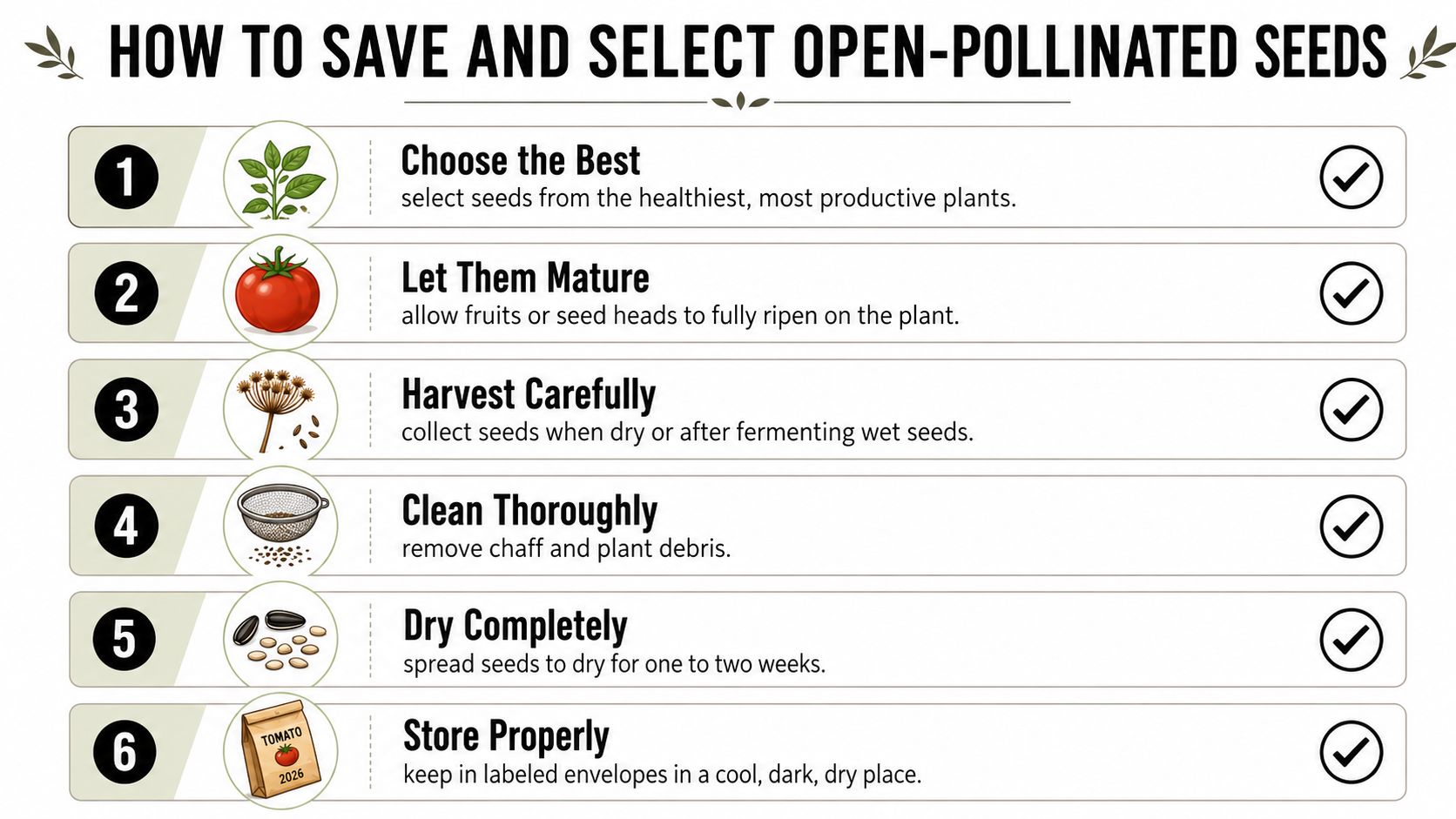
Pick the healthiest, most productive cultivar plants in the run. Look at structure, aroma, vigor, and how the plant handled your space. If a plant needed constant babysitting, it is usually not the one you want to keep in your seed line.
Let the seed mature fully on the plant. Harvesting too early leaves you with seed that may look finished but stores poorly. After that, harvest carefully, clean off chaff and plant debris, and dry the seed thoroughly before storage. If you want a plain-language reference for the preservation part, this seed storage guide is a useful companion.
The University of Illinois Extension notes that growers saving seed from some crops need serious separation distances, including 1,300 feet for spinach, 5,200 feet for sweet corn, 2,600 feet for broccoli and onions, and 4,000 to 26,000 feet for kale and collards from certain cole crops (Illinois Extension). Cannabis does not map neatly onto those exact crop distances, but the lesson still applies, isolation matters if you want a line to stay true.
A simple home workflow
- Choose the best plants: Keep seed only from the cultivar that showed the traits you like most.
- Let seed ripen fully: Do not harvest early just because the plant looks done.
- Handle gently: Crushed or damaged seed will not store as well.
- Dry completely: Spread seed out until it is fully dry before packing it away.
- Store cool, dark, and dry: Labeled envelopes or jars work if the space stays stable.
Drying and storage are where a lot of home growers cut corners. A dry, dark place is boring, but boring is good when you want seed to last.
Isolation Distances and Barriers That Keep Your Line Clean
Even a good seed line gets messy if stray pollen gets in. That is the part a lot of new growers underestimate. Open pollination only stays useful when you control who can reach the flowers, or at least reduce the odds enough that the next generation still makes sense.
What isolation really means
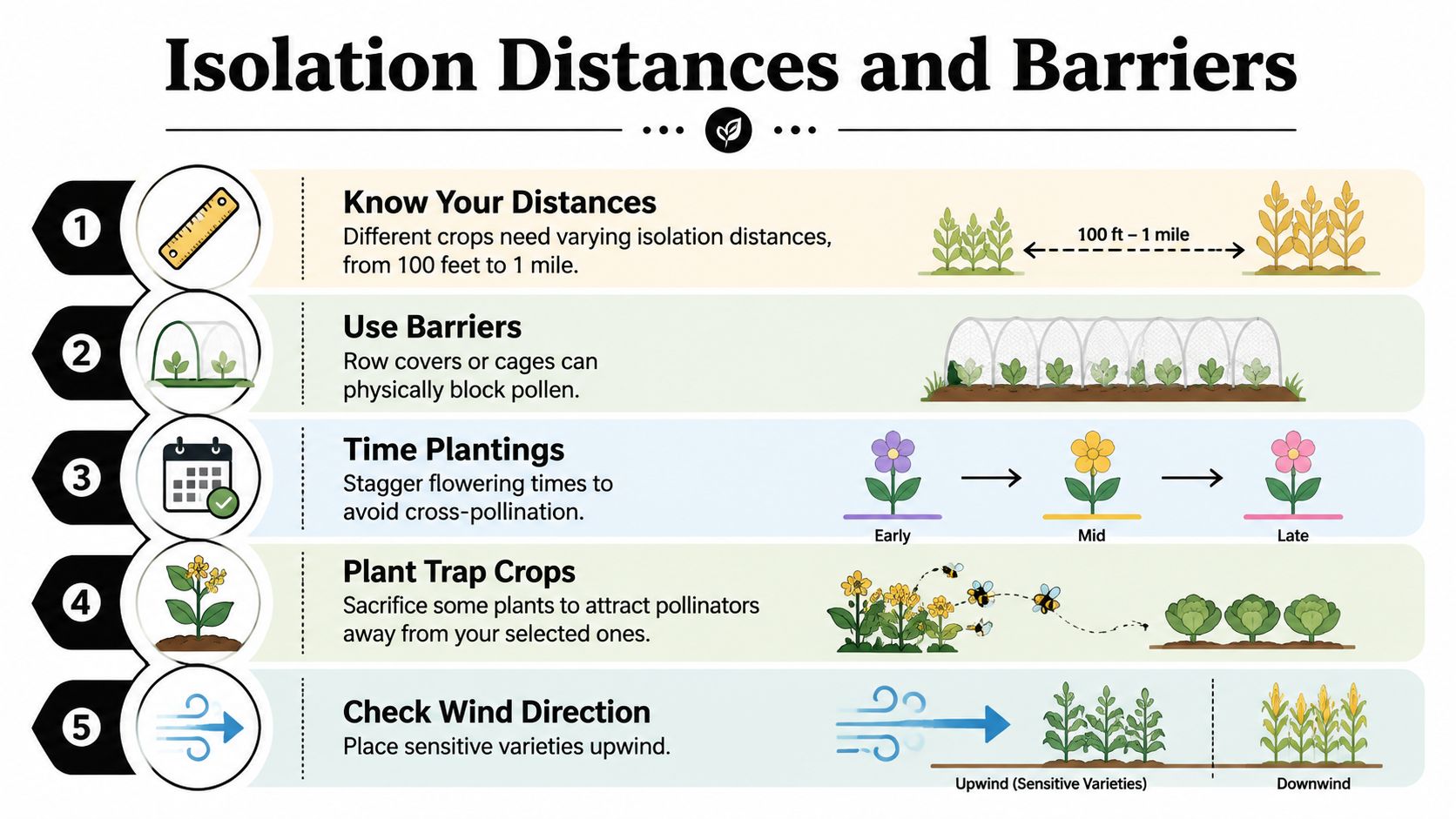
Isolation is part distance, part timing, and part common sense. Some crops need a lot of space to stay true, which is why extension guidelines list separation distances ranging from 1,300 feet for spinach to 26,000 feet for some cole crops. Cannabis does not map neatly onto those exact crop distances, but the lesson carries over clearly, pollen moves farther than many backyard growers expect.
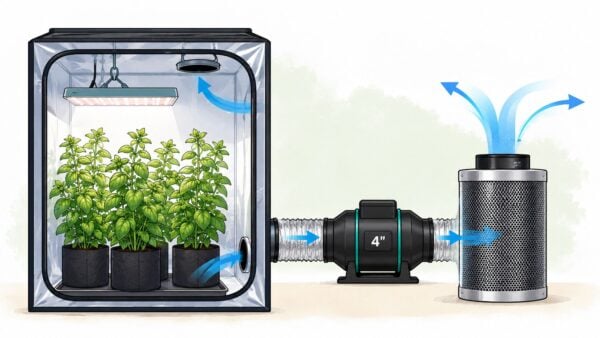
For a hobby setup, physical barriers can help a lot. Mesh screens, isolation bags, and greenhouse structure all reduce the chance that pollen reaches the wrong cultivar. Staggering flowering windows helps too, because plants that are not flowering at the same time cannot cross as easily.
Practical ways growers keep pollen out
- Know your spacing: Bigger separation usually means cleaner seed.
- Use barriers: Row covers, cages, or enclosed spaces can block pollen.
- Time flowering: Staggering bloom periods lowers the chance of overlap.
- Pick the right location: Upwind placement helps when pollen moves with air.
- Reduce plant traffic: Fewer moving parts mean fewer chances for accidental transfer.
Simple rule: If you cannot control the pollen source, control the calendar or the enclosure.
For cannabis growers, the backyard reality hits here. You do not need farm acreage to care about pollen drift, but you do need a plan. A cultivar grown next to other flowering sources can drift out of type fast enough to ruin the run you wanted to preserve. Open-pollinated seed only earns its reputation when the isolation is tight enough to support it.
Common Misconceptions About Open Pollination
One of the biggest myths is that open-pollinated seed is automatically uniform. It can be very stable, but only when the parent line stays isolated from other compatible varieties and the grower keeps selection disciplined from one generation to the next.
Another mix-up is treating open pollination and self-pollination as if they are the same thing. Self-pollination is one possible route, but open pollination is broader than that. It refers to natural fertilization without a breeder hand-picking the pollen source, and that can happen through several paths, not just selfing.
There is also a common assumption that OP cultivars must be weak or old-fashioned. That does not hold up. Breeders still use open-pollinated stock because it preserves useful genetics for later work, and growers still choose it when they want a cultivar they can keep and shape over time.
The relatedness data from tree breeding is a helpful reminder. As noted earlier, the 2014 PubMed study found open-pollinated families in two species landing between half-sib and full-sib benchmarks, rather than sitting at a single fixed point. That is a clean example of why “open” does not mean random in the sloppy sense. It means nature handled the mating, and the resulting seed lot still has structure.
Bottom line: Open-pollinated seed can be highly useful, but it only behaves as well as the pollen environment around it.
The last misconception is that OP automatically means regular seed. That is not the right way to think about it. Feminized and autoflower workflows can still rely on strong underlying genetics, and the open-pollinated part is about how the parent line was reproduced, not a blanket promise about sex expression or flowering behavior.
FAQ on Open Pollination for Cannabis Growers
Can an open-pollinated cultivar be feminized or autoflower? Yes. Those labels describe how the seed behaves in cultivation, while open pollination describes how the parent line was reproduced. They can overlap, but they aren't the same thing.
How do I know if a seed line is stable? Look for clear notes about isolation, parent selection, and repeatable traits. If a seller only uses vague language, that's a warning sign.
Do I need huge isolation distances at home? Not always, but you do need a plan. The tighter the pollen control, the more likely the line stays true.
Is saving OP seed worth it? If you like keeping a cultivar going and selecting your own expression over time, yes. If you want a fresh, tightly managed result every cycle, buying new feminized or autoflower seed may be easier.
Botanist Seeds makes it easier to compare genetics without the usual guesswork, so you can choose a cultivar that fits your space, your pace, and the kind of harvest you want. If you're ready to sort through options with less noise and more clarity, visit Botanist Seeds and use the catalog to find a fit for your next run.