




Maui Wowie Strain: The Complete Grower’s Guide
I first ran into Maui Wowie in a small backyard grow where the plants looked like they wanted to outclimb the fence. The jar cracked open later with a sharp tropical smell, and it was obvious why this old Hawaiian cultivar never really left the conversation.
Ready to grow it yourself? Shop Maui Wowie seeds at Botanist Seeds.
Why Maui Wowie Still Matters After All These Years
Maui Wowie has staying power because it feels like cannabis history you can still grow at home. It's widely described as a Hawaiian sativa that emerged in the 1960s or early 1970s on Maui, and independent strain references say it's been cultivated for more than four decades. That matters to collectors and home growers because not every classic cultivar keeps its identity long enough to survive the market churn. Hytiva's history note on Maui Wowie gives a good snapshot of why it's still talked about as an old-school tropical sativa.
What keeps people coming back isn't hype, it's the mix of tropical aroma, tall structure, and a lively sativa feel. You don't grow Maui Wowie because it's trendy. You grow it because it has a very specific personality, one that still stands out even next to newer dessert-heavy cultivars and loud hybrids.
A cultivar with real nostalgia, not just marketing
The best part about a classic like this is that it rewards growers who like a plant with character. Maui Wowie has long been associated with Hawaii's early cultivation scene, which gives it a kind of cultural gravity that newer names can't fake. That history also makes it a fun home project if you're the type who likes to compare what's in the tent against what's in the jar and think about the line between old genetics and modern re-selection.
Practical rule: if a cultivar still gets discussed decades later, it usually earned that attention in the tent, not in a billboard.
For home growers, that translates into a very simple upside. You're not chasing the latest shiny label, you're working with a cultivar that has a known identity, a recognizable aroma, and a growth pattern that can teach you something about canopy control. That's satisfying in a way that goes beyond just stacking jars.
Why it still works in a home setup
Maui Wowie also makes sense for people who like a challenge without chaos. It's vigorous, it stretches, and it asks you to stay ahead of the canopy, but it doesn't feel random if you manage it well. That makes it a good choice for growers who want a classic tropical sativa experience and don't mind doing a little plant training to get there.
The bigger appeal is personal. Growing a cultivar with this kind of legacy means you're not just pulling a harvest, you're preserving a piece of cannabis culture in your own space. If you care about the story behind what you grow, Maui Wowie still earns its spot.

The Genetic Mystery Behind the Maui Wowie Strain
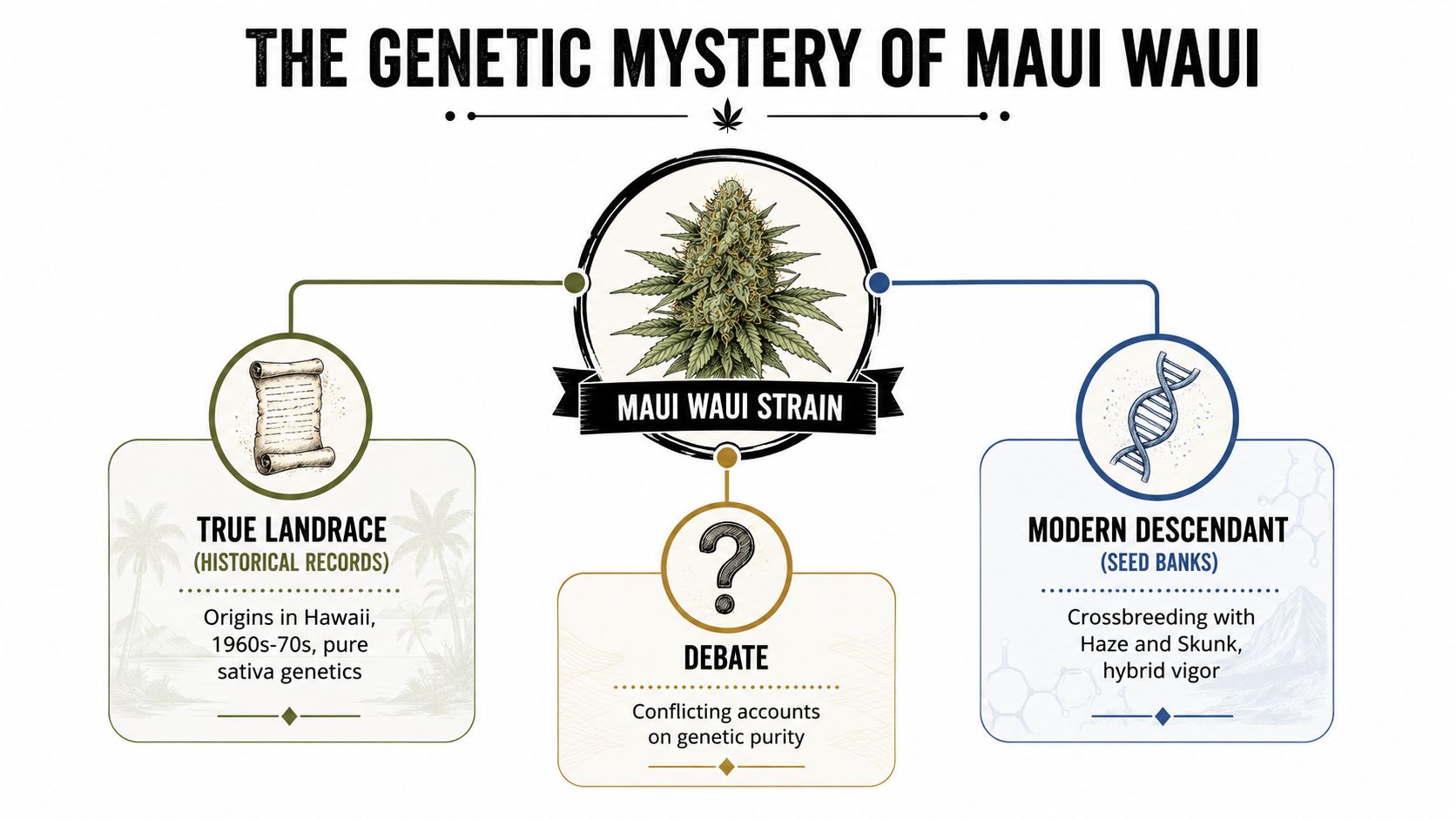
The first thing to understand about Maui Wowie is that the lineage story is messy, and that mess is part of the reality of older cultivars. Historical references describe it as a Hawaiian sativa or landrace-derived selection, but they also say the exact parentage is uncertain because the strain predates modern breeding records. Some strain references, including Hytiva's Maui Wowie profile, point out that the historical trail does not fully identify the second parent.
That matters because the word landrace gets used loosely in cannabis. A true landrace is a population shaped mostly by regional conditions over time, while a landrace-derived selection means someone chose a strong expression from that background and carried it forward. Maui Wowie sits in that gray area, and that is why so many articles talk past the issue instead of addressing it directly.
Landrace, selection, or modern descendant
The practical difference shows up in the grow room. If a cultivar is stable in the landrace sense, you would expect fairly consistent structure and aroma across repeated grows. Maui Wowie, at least in the way it is described today, looks more like a legacy Hawaiian line that has been preserved, reselected, and commercialized over time. That is why you will see sources call it a landrace in one place and a landrace-derived hybrid in another.
A useful way to judge the label is to look at the plant, not the buzzwords. Maui Wowie is generally described as sativa-dominant, with tall, vigorous growth and long internodes. Those traits fit the old tropical story, but they also leave room for phenotype drift, especially when different seed lines are being sold under the same name.
If the breeder record is thin, the plant itself becomes the best evidence.
That is why growers should pay attention to morphology, aroma, and lab data instead of assuming the name tells the whole truth. Long, open branching, a tropical terpene profile, and moderate THC all support the classic description. A plant that is squat, heavy, and cookie-like is probably not what the typical user means when they say Maui Wowie.
How to judge authenticity without getting fooled by the label
The cleanest approach is to compare three things. First, check the breeder's notes and any stated preservation history. Second, look at the actual growth pattern, because Maui Wowie is known for height and stretch. Third, check whether the finished flower lines up with the expected tropical, bright profile instead of a generic sweet hybrid aroma.
That is the takeaway. Authenticity is a pattern, not a slogan. For a clearer look at heirloom and preserved genetics, the landrace primer from Botanist Seeds is a useful companion read because it frames the difference between true regional lines and modern commercial selections in a way growers can use.
Aroma, Flavor, and Cannabinoid Profile
Maui Wowie's smell is the reason a lot of people remember it. The finished flower is usually described as tropical, citrusy, and pineapple-forward, with a clean sweetness that stays bright instead of turning heavy. If you want a broader terpene context, Botanist Seeds' terpene guide is a good reference point for understanding how citrus, pine, and fruit notes tend to show up in finished cultivars.
What the jar should smell like
A good jar of Maui Wowie usually opens with pineapple and sweet citrus first. From there, you can get mango, guava, green herbs, and a little pine on the back end. That mix is why people keep calling it “tropical” instead of just “fruity,” because there's a fresh, airy quality to the aroma that keeps it from becoming candy-like.
The flavor follows the nose closely. On the inhale, you'll usually get bright pineapple and citrus. On the exhale, there's often a clean pine finish that keeps the profile from getting too sugary.
What to expect from the numbers
Published strain guides consistently place Maui Wowie in a THC band of roughly 15% to 24%, with many descriptions clustering around the high teens to low 20s, and CBD typically below 1%. Independent guides also note that some batches can test lower or higher depending on grow conditions and phenotype selection. That's why the same cultivar can feel fairly different from one grow to the next.
| Trait | Typical Range |
|---|---|
| THC | Roughly 15% to 24% |
| Common reported THC cluster | Roughly 18% to 22% |
| CBD | Typically below 1% |
| Aroma | Pineapple, citrus, tropical fruit, pine |
| Flavor | Bright fruit, citrus-lime, clean pine finish |
The easy mistake is to chase the highest number and ignore the rest of the profile. Maui Wowie isn't about brute-force potency. It's about a bright sensory profile and a character that feels more classic than crowded-room loud.
Why batch variation matters
A lot of the spread in potency comes down to how the plant was grown, dried, and selected. If the canopy was uneven or the finish was rushed, the flower can lose some of the sparkle that makes this cultivar stand out. A dialed-in grow usually does more for Maui Wowie than just pushing feed harder.
How to Grow the Maui Wowie Strain at Home
I've seen Maui Wowie do its best work when growers respect its height from day one. It's usually described as around 80% sativa / 20% indica, and in the right outdoor setup it can stretch well above 10 feet. That kind of structure changes the whole grow, because you are not managing a compact bush, you are managing a plant that wants to climb. Strainpedia's Maui Wowie profile reflects that tall, vigorous habit, and Canapuff's strain guide also points to the 9 to 11 week flowering time and indoor yield expectations.
Set the plant up for height before it surprises you
Give it room early. Maui Wowie likes strong light, steady airflow, and a frame that keeps the top from running away with the rest of the plant. If you wait until flower stretch is already in full swing, you end up reacting to the plant instead of steering it.
Practical rule: top early, train early, and keep the canopy level before the stretch gets ahead of you.
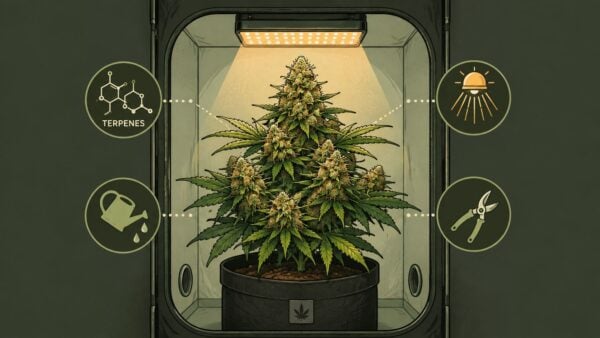
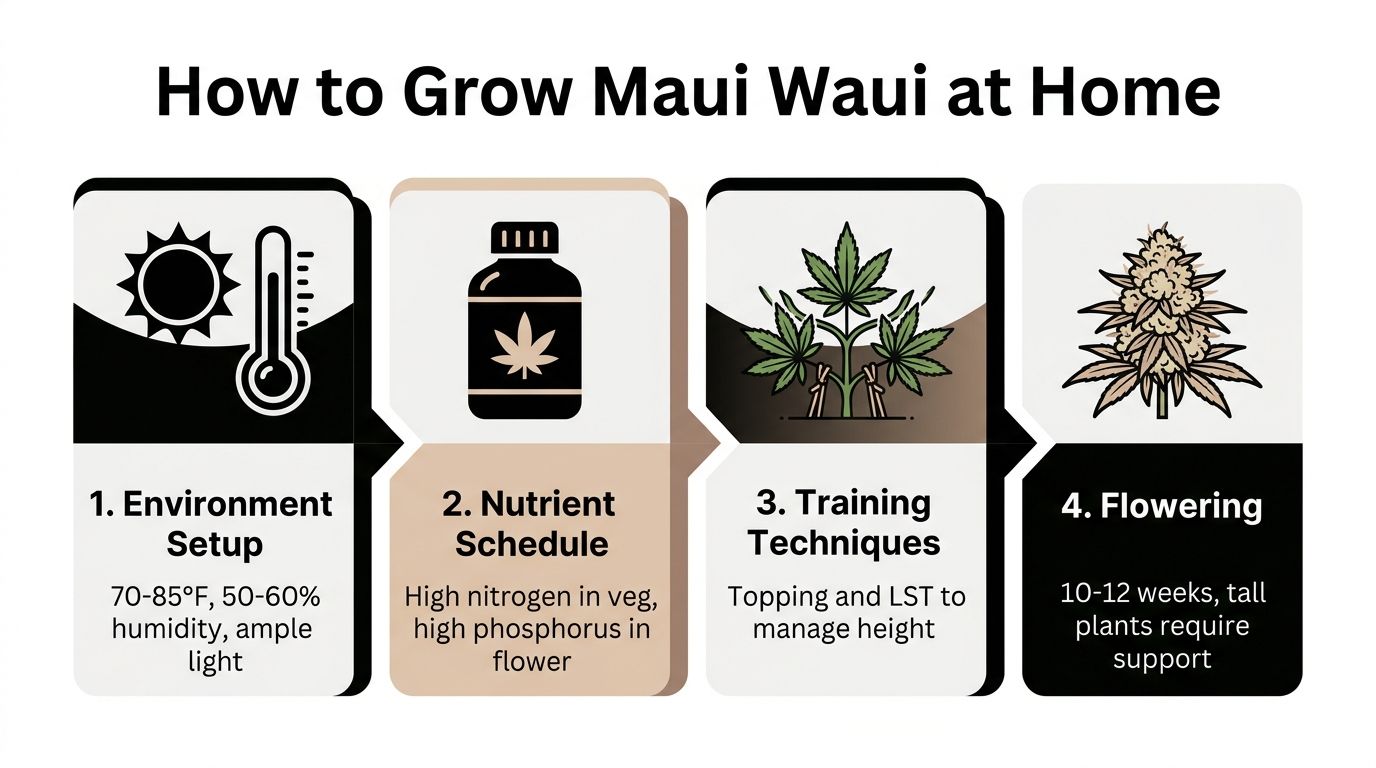
For indoor growers, topping and low-stress training are the tools I reach for first. They spread out the main growth sites and stop the plant from becoming one tall spear. A sea-of-green setup can also fit this cultivar, and one independent guide reports indoor yields of about 350 to 450 g/m² with a flowering window of 9 to 11 weeks. Botanist Seeds' feminized versus autoflower guide is a useful comparison point if you are deciding how much structure you want to manage before training even starts.
Climate control matters more now than it used to
Older grow notes often treat Maui Wowie like it only belongs outdoors in a tropical setting, but real home grows deal with heat swings, humidity changes, and tighter ceilings. The plant's open, lanky shape can help airflow, and it can also get messy fast if you let it stack itself into a thick top half. That trade-off matters in modern indoor rooms and in unpredictable outdoor weather.
Keep conditions steady instead of chasing them around. If the room runs hot, push airflow across the canopy and around the root zone. If humidity climbs in flower, open the structure with training and avoid letting branches crowd into each other.
Here's the practical version:
- Top before the plant gets away from you. Maui Wowie stretches hard, so early structure pays off later.
- Use LST to flatten the canopy. That helps light reach lower sites and keeps the plant manageable.
- Treillage or support is worth planning for. The plant can run tall outdoors and may need help standing cleanly through flower.
- Don't overfeed just because it's vigorous. Vigorous growth does not mean it wants heavy hands.
The line I trust most with this cultivar is simple, structure beats brute force. A well-shaped plant stays easier to finish, easier to dry, and less likely to become a headache when the weather turns or the tent runs tight.
Finishing the flower without losing the profile
The final stretch is about keeping the aroma intact and avoiding stress. A slow, clean finish usually holds the tropical terpene profile better than pushing the plant too hard late in flower. That matters if you want the pineapple and citrus notes to stay clear instead of getting flattened out by a rough finish.
The YouTube grow diary below is a useful visual reference for the kind of training and canopy management this cultivar responds to:
Choosing Between Feminized and Autoflower Seeds
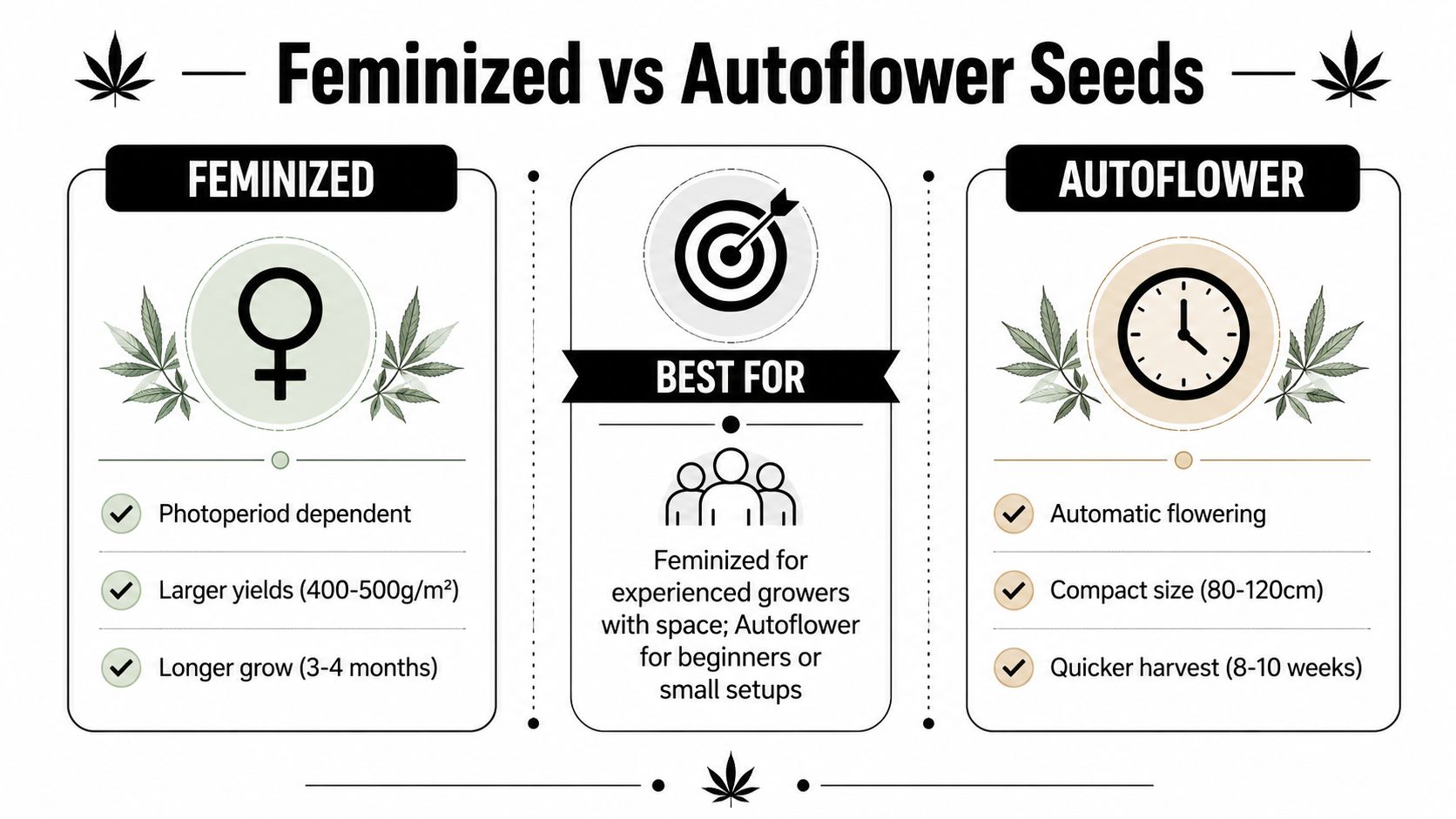
The seed format changes the whole experience with Maui Wowie. If you want more control over size and training, feminized seeds are usually the better fit. If you want a faster, simpler grow with less schedule management, autoflower seeds make more sense. For a clean comparison, Botanist Seeds' feminized versus autoflower guide is a solid place to start.
Feminized fits growers who want to steer the plant
Maui Wowie's tall structure benefits from a grower who can hold the plant in veg a little longer, shape the canopy, and decide when to flip. That's why feminized seed is a strong match for people with enough ceiling height and enough patience to train properly. It gives you more control over the final size and usually rewards that control with a better-managed canopy.
This is the better pick if you like to scrog, top, or run a room where every square foot matters. It also fits growers who want to make the most of the cultivar's natural stretch instead of fighting it late.
Autoflowers work when space and time are tight
Autoflowers make sense when you want simplicity. They don't ask you to manage light cycles the same way, and that can be a relief for apartment growers or anyone with a small, fixed setup. If your main priority is getting a tropical cultivar into the jar without a long commitment, autoflower is the easier path.
The trade-off is control. You usually get less room to correct mistakes once the plant starts moving, so your early environment has to be cleaner and more consistent. That's fine if you're disciplined, but it's not the best option if you like to tinker with shape and structure.
Quick rule of thumb: if your setup can handle training, feminized is the better canvas. If your setup needs simplicity, autoflower is the safer bet.
Which one fits Maui Wowie better
For this cultivar specifically, feminized often makes more sense because Maui Wowie likes room to stretch and respond to training. Autoflower can still work, especially for a faster turnaround, but you give up some of the steering room that helps this cultivar look and finish its best. If you're comparing options, think less about what sounds easier and more about what your space can support.
Where to Buy Maui Wowie Seeds and What to Look For
Buying Maui Wowie is mostly about reducing guesswork. Since the cultivar has a messy historical record and a lot of re-selection behind it, the seller's transparency matters as much as the name on the package. You want clear breeder notes, a believable lineage story, and enough detail to tell whether the line is being presented as a preserved Hawaiian selection or just a nostalgic label.
What to check before you buy
Start with the description. A good listing should tell you something about growth habit, flowering time, and aroma, not just throw out a classic name and a couple of flashy adjectives. If the listing never mentions structure, terpene character, or how the plant behaves, that's usually a red flag.
Then look at the reputation of the source. Established sellers tend to be clearer about what they're offering, especially when the cultivar has historical ambiguity. That doesn't guarantee perfection, but it does reduce the odds of getting a random interpretation of a well-known name.
A few things are worth checking every time:
- Breeder transparency: clear notes beat vague nostalgia.
- Morphology details: tall sativa structure should show up in the listing or grow reports.
- Flowering expectations: the seller should give you a realistic timeline.
- Aroma description: pineapple, citrus, and tropical fruit notes should be part of the picture.
How to think about authenticity
The best filter is consistency. If one source claims Maui Wowie is a landrace and another says it's a landrace-derived hybrid, that's not automatically a dealbreaker. It just means you need to look at the whole profile instead of the name alone. The more the plant, the aroma, and the breeder notes line up, the more confidence you can have that you're getting something close to the classic expression.
If you're comparing multiple cultivars for your setup, a comparison tool is useful because it keeps your decision anchored to traits that matter in the tent, not just labels that sound good in a listing. That's the best way to avoid paying for mythology instead of genetics.
Common Maui Wowie Growing Questions Answered
Does Maui Wowie do better outdoors or indoors? Outdoors can be a great fit if your climate is warm and you've got room for a tall plant. Indoors gives you more control over height and finish, which matters because this cultivar stretches hard and doesn't politely stay small.
What structure traits matter most? Look for an upright sativa frame, long internodes, and a plant that responds well to training. Those traits help you keep the canopy open and the lower sites useful instead of shaded out.
How do you handle stretch in early flower? Start training before the flip and keep the top growth spread out. If the plant is already racing upward when stretch hits, you're playing defense instead of managing the shape.
What about nutrient burn? Don't assume vigorous growth means it wants a heavy hand. Maui Wowie can look hungry because it grows fast, but overfeeding can still stress the plant and flatten the aroma you're trying to preserve.
Does hotter, more variable weather ruin it? Not if you plan for it. Stable airflow, sensible canopy density, and a training style that prevents the plant from stacking too tightly go a long way toward keeping the finish clean.
If you're ready to compare Maui Wowie against other cultivars for your next run, check out Botanist Seeds and use the catalog to match the plant's height, timing, and structure to your actual space. A good seed choice saves you from fighting the wrong plant all season, and a classic like Maui Wowie is a lot more fun when it fits the room instead of taking it over.