Yuck Mouth Strain: Grower’s Guide to Genetics
You're probably at that point where the tent's empty, the seed tabs are open, and you're trying to decide whether your next cultivar should be easygoing or worth the extra attention. Yuck Mouth strain lands in that sweet spot where a home grower can get excited without signing up for a diva plant. It's known as a high-potency indica-dominant hybrid, it finishes in a practical window, and it has the kind of yield reputation that makes the whole run feel less like a science project and more like a worthwhile stash-builder.
What makes it interesting is the balance. You're not just chasing a loud name, you're looking at a cultivar with a real track record for strong cannabinoid levels, manageable flowering time, and the kind of structure that can reward a careful setup. If you've ever wanted to skip the dispensary line, keep more of your own money in your pocket, and still end up with jars you're proud of, this one belongs on the shortlist.
Why Yuck Mouth Deserves a Spot in Your Garden
A lot of growers pick their next cultivar the same way they choose a drill bit or a grill tool, they want something that does the work without making the whole run harder than it needs to be. Yuck Mouth strain fits that kind of garden because it has a reputation as an indica-dominant hybrid with high THC and heavy yield potential. It also gets talked about as a plant that can finish in a practical window, which matters once you're trying to keep a real grow space moving on schedule. A current phenotype guide can help you sort out why one seed run may look a little different from the next, especially before you commit a whole tent to it.
That variability is part of the deal at home. One Yuck Mouth plant may stack tighter and finish a touch sooner, while another may stretch a little more or throw denser flowers if the environment is dialed in. That is normal with this kind of cultivar, and it is exactly why careful growers pay attention to training, canopy spacing, and what each plant is telling them instead of assuming every cut will behave the same way.
What That Means for a Home Grow
For a self-sufficient hobbyist, the practical upside is easy to see. A plant that finishes in a workable window and still has a reputation for strong output is simpler to fit into a normal life, especially if you are balancing work, family, or a garage full of other projects. You can plan the space better, line up your dry room with more confidence, and avoid the common mistake of overcommitting to a cultivar that looks great on paper but drags on too long in practice.
Yuck Mouth also leaves room to learn without feeling like you wasted months. You get a chance to practice canopy management, see how a high-potency hybrid responds under your setup, and still have a real shot at a satisfying harvest. If you are choosing with the long game in mind, that is a solid trade-off for a home garden.
The Genetic Blueprint Behind Yuck Mouth
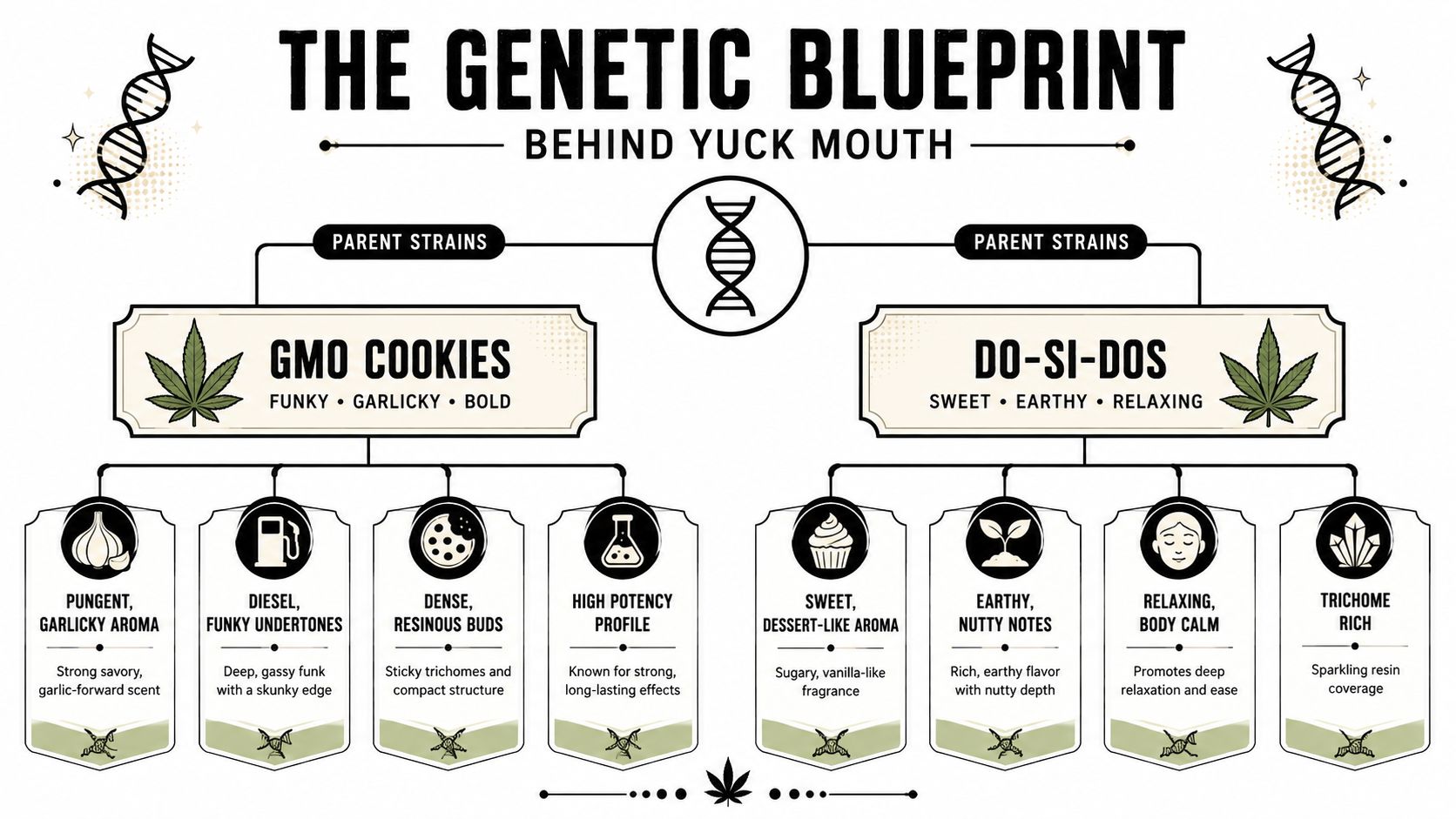
A home grow starts making more sense once you know where Yuck Mouth strain comes from. The cultivar is widely documented as a cross of GMO Cookies × Do-Si-Dos, and that parentage shows up in the way the plant behaves in a tent or in a yard. The lineage also points to a cultivar that tends to build weight instead of chasing height, which is the kind of thing growers notice fast once the veg space starts filling up. For a closer look at how that family tree is usually presented, the genetic lineage chart lays out the parent strains and their shared traits.
Why the Parentage Matters
GMO Cookies brings the loud, pungent side of the equation. Do-Si-Dos contributes tighter structure and a heavier plant profile, which helps explain why Yuck Mouth is usually talked about as an indica-dominant hybrid rather than a lanky stretcher. If you've run enough hybrids, you know that kind of background usually shows up in the canopy before it ever shows up in the jar.
That matters because a grow room is not a lab, it is a set of trade-offs. A plant with this kind of lineage may reward a grower who can manage height, keep airflow moving, and support heavier flowers later in bloom. It is the sort of genetic setup that makes training choices, topping, and spacing count more than wishful thinking.
Breeder History and What It Suggests
Archive Seed Bank is the breeder name commonly attached to the line, which gives growers a clearer trail to follow. SeedFinder lists the strain as suitable for indoor or outdoor cultivation, notes a flowering time of about 65 days, and points to feminized-seed availability (SeedFinder strain info). That kind of starting point does not guarantee identical plants from seed, but it does tell you the line has a defined commercial history.
The practical value is simple. A familiar breeder tag makes it easier to compare notes, sort through phenotype reports, and decide how much room to give the plant before you commit a run. If phenotype variation is the part you want to understand better, the Botanist Seeds phenotype resource is a useful reference for seeing how different expressions can show up from the same seed line.
Grower's takeaway: Lineage will not do the work for you, but it gives you a better read on how the plant is likely to handle training, support, and the rest of the garden.
Aroma, Taste, and What to Expect from the Terpene Profile
The jar smell is where Yuck Mouth strain starts making sense for a lot of growers. This cultivar is commonly associated with a profile that leans pungent, funky, and earthy, with enough sweetness underneath to keep it from feeling one-note. That kind of mix lines up well with its GMO Cookies and Do-Si-Dos background, because both parents are known for expressive scent and a full-bodied finish.

How to Read the Aroma
Open a well-cured jar and the first impression is usually loud. Think garlic funk, damp earth, sweet dough, and a savory edge that hangs around in the room. That doesn't mean every phenotype will land exactly the same way, because expression shifts with environment and cure, but it does tell you what kind of sensory lane you're in.
If your setup runs too hot or your dry is sloppy, the profile can flatten fast. A careful dry and cure helps the sharper notes settle into something more balanced, and that's where the strain really earns its keep. The jar reward matters here, because this is one of those cultivars where the final smell can feel like a direct payoff for doing the unglamorous work correctly.
What Helps the Flavor Show Up
A few simple habits usually make a bigger difference than people expect:
- Dry with patience: Rushing the dry can mute the funk and leave the flower feeling rough.
- Keep cure conditions steady: Stable storage helps the aroma settle instead of fading.
- Don't overcook the plant late: Heavy-handed feeding near the finish can get in the way of a clean flavor.
- Trim with care: Rough handling knocks off the sticky edge that carries a lot of the scent.
The terpene story is useful even if you're not trying to sound like a lab sheet. It tells you whether this is a cultivar for bright citrus or for deeper, funkier room-filling aroma. Yuck Mouth sits firmly in the second camp, and that's a big reason people keep coming back to it.
For a broader look at why scent works the way it does, the Botanist Seeds terpene guide is a good reference point.
Cultivation Techniques for Maximum Yield and Quality
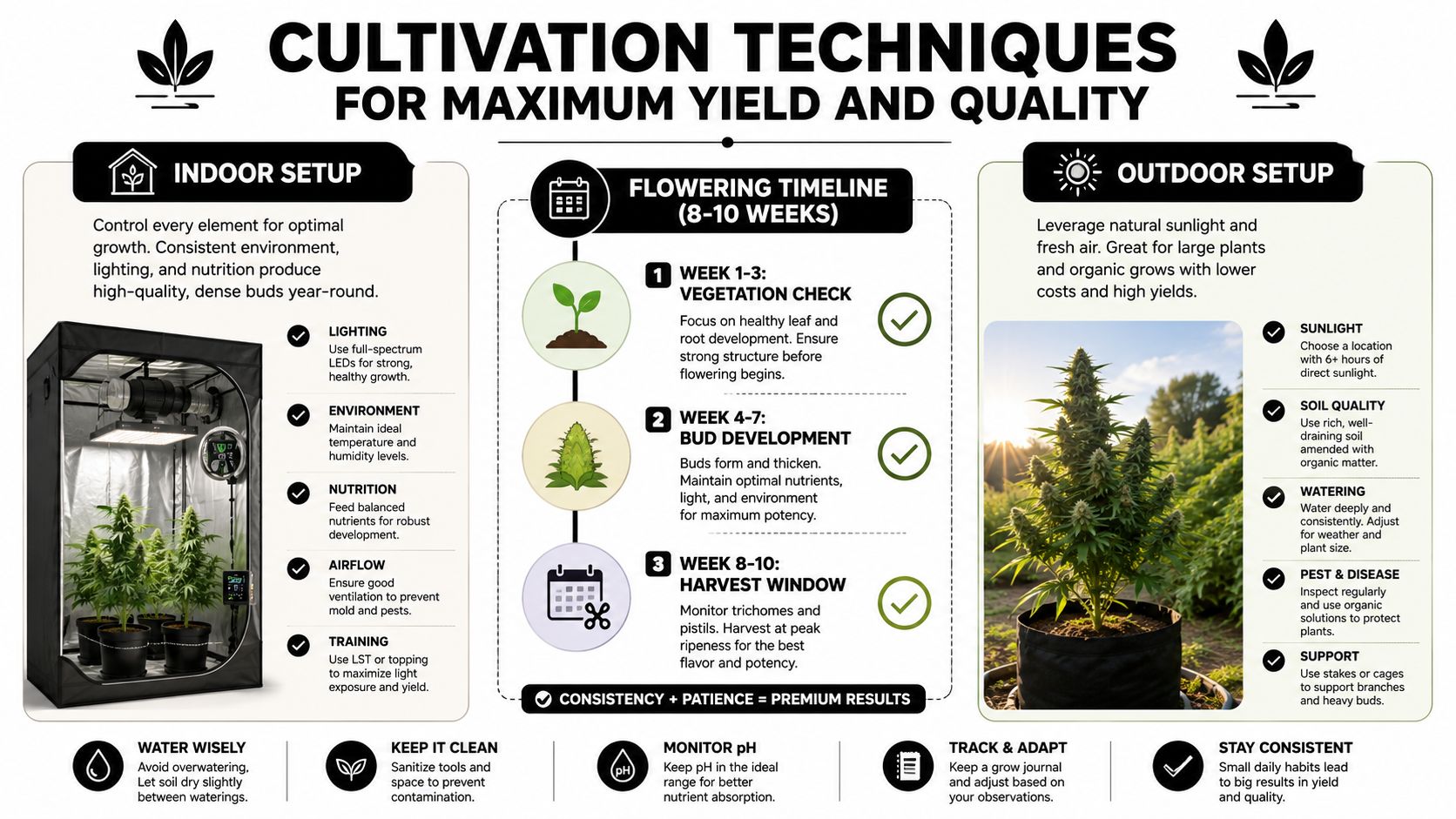
Yuck Mouth can pay off in a clean, organized grow, but it won't forgive a sloppy one. In practice, the strain rewards growers who keep the canopy balanced, the environment steady, and the finish clean. Reports across grow references point to a productive indoor plant with a manageable flower window, and that makes it a solid fit for home setups where you can stay on top of training and timing without overcomplicating the run.
Indoor Setup That Fits the Plant
Indoors, the main job is keeping the canopy even. Yuck Mouth usually responds well to low-stress training, a sensible topping plan, and enough veg time to build several productive tops before the flip. You do not need a complicated system, you just need to stop the plant from turning into one crowded spear with shaded lower growth.
A few habits usually make the difference:
- Even canopy management: Spread the tops so light reaches more of the plant, not just the crown.
- Moderate defoliation: Take only the leaves that block airflow and light, because overdoing it can slow the plant down.
- Stable lighting distance: Keep light intensity consistent, since this cultivar is better finished clean than stressed for a little extra weight.
- Feed with restraint: High-potency cultivars can take a solid feed plan, but pushing too hard can make the finish sloppy.
A good rule is simple. If light can reach into the canopy and air can move under it, the plant is in a better place than most growers realize.
Phenotype variation matters here too. Some plants stay more compact and manageable, while others stretch a bit more and ask for tighter training. If you spot a faster vertical push early, correct it early, because waiting usually means more shading and more cleanup later.
Outdoor Setup and Timing
Outside, the big advantage is room. Letting the plant express itself in full sun usually gives you a better shot at size, provided the season is long enough and the weather stays cooperative. The harvest window is commonly described as landing in late September to early October, which works well in many temperate gardens, but only if you stay ahead of moisture and airflow issues near the end.
Dense flowers are the trade-off outdoors. They can bulk up nicely, but they also trap moisture if the weather turns damp at the wrong time. Give the plant enough root room, keep lower growth from turning into a wet tangle, and use whatever shelter or spacing you have available to keep the buds breathing.
A simple outdoor approach usually holds up best. Strong support, clean airflow, and early attention to branching will do more than fancy tricks.
Flowering Timeline and Troubleshooting
Flowering is commonly described as falling in the roughly 8 to 10 week range indoors, with some growers seeing a little variation depending on phenotype and conditions. That is short enough to plan around without feeling rushed, but long enough that the last stretch still matters.
The practical problems are usually plain and predictable:
- Crowding, which traps humidity and buries lower sites.
- Overfeeding, which can make the plant finish heavy but not clean.
- Bad timing, especially chopping before the plant has fully settled.
If the canopy stays open, the feed stays sensible, and the final dry is handled with care, Yuck Mouth can finish into dense flowers that reflect the work you put in. The plant is not hard to grow, but it does reward growers who pay attention to the boring parts, the parts that keep a garden steady instead of flashy.
How Yuck Mouth Compares to Similar High-Potency Cultivars
A home grower comparing strong cultivars usually runs into the same trade-off. One plant finishes faster, another stacks more weight, and a third asks for tighter canopy control. Yuck Mouth strain sits in a practical middle ground, with enough potency to satisfy a serious run and a flowering window that still fits normal home-garden planning.
That balance matters more than raw hype. A cultivar that looks impressive on paper can become a headache if it stretches too much, ripens unevenly, or demands constant correction. Yuck Mouth is easier to place in a grow because it keeps the conversation on manageable timing, solid output, and how much work you want to put into the canopy.
Yuck Mouth vs Similar Cultivars
| Cultivar | Flowering Time | Indoor Yield | THC Range |
|---|---|---|---|
| Yuck Mouth | About 8 to 10 weeks | Around 500 to 600 g/m² indoors in seed listings, with other grow references near 500 to 550 g/m² | Commonly 24% to 25%, with reports of 27.38% THC and phenotypes over 30% THC |
| High-potency hybrid with faster finish | Often shorter than Yuck Mouth, depending on the cultivar | Usually depends more on structure than raw weight | Often strong, but exact range varies by cultivar |
| Heavy-yielding hybrid with longer finish | Often longer than Yuck Mouth, depending on the cultivar | Can out-yield in ideal conditions | Potency can be high, but finish takes more patience |
Where Yuck Mouth Fits Best
Yuck Mouth makes the most sense for growers who want a serious result without dragging the cycle out. It works well in a garden where you care about dense flowers, a respectable harvest, and enough structure to justify a little training. If your space is tiny and you want the quickest possible turnover, another cultivar may fit better. If you have room to shape the plant and you want a heavier run, Yuck Mouth starts to look like a smart pick.
Phenotype variation is the part to respect here. Some plants will finish tighter and more compact, others will want more support and a steadier hand through the stretch. That is normal with strong hybrids, and it is why I'd rather judge Yuck Mouth by how it performs in a real room than by a single sales pitch. For a clean overview of how to set up each stage, a practical growing cannabis stages guide is a better use of time than chasing buzzwords.
The other practical point is consistency of expectation. The potency range is strong enough that you do not need to oversell it, and the growth habit is workable enough that you do not need to baby it either. That combination makes Yuck Mouth a sensible choice for growers who want a high-potency cultivar that still leaves room for ordinary garden decisions, like how hard to train, how much airflow to keep, and how far to push the finish before harvest.
Planning Your Yuck Mouth Grow from Seed to Harvest
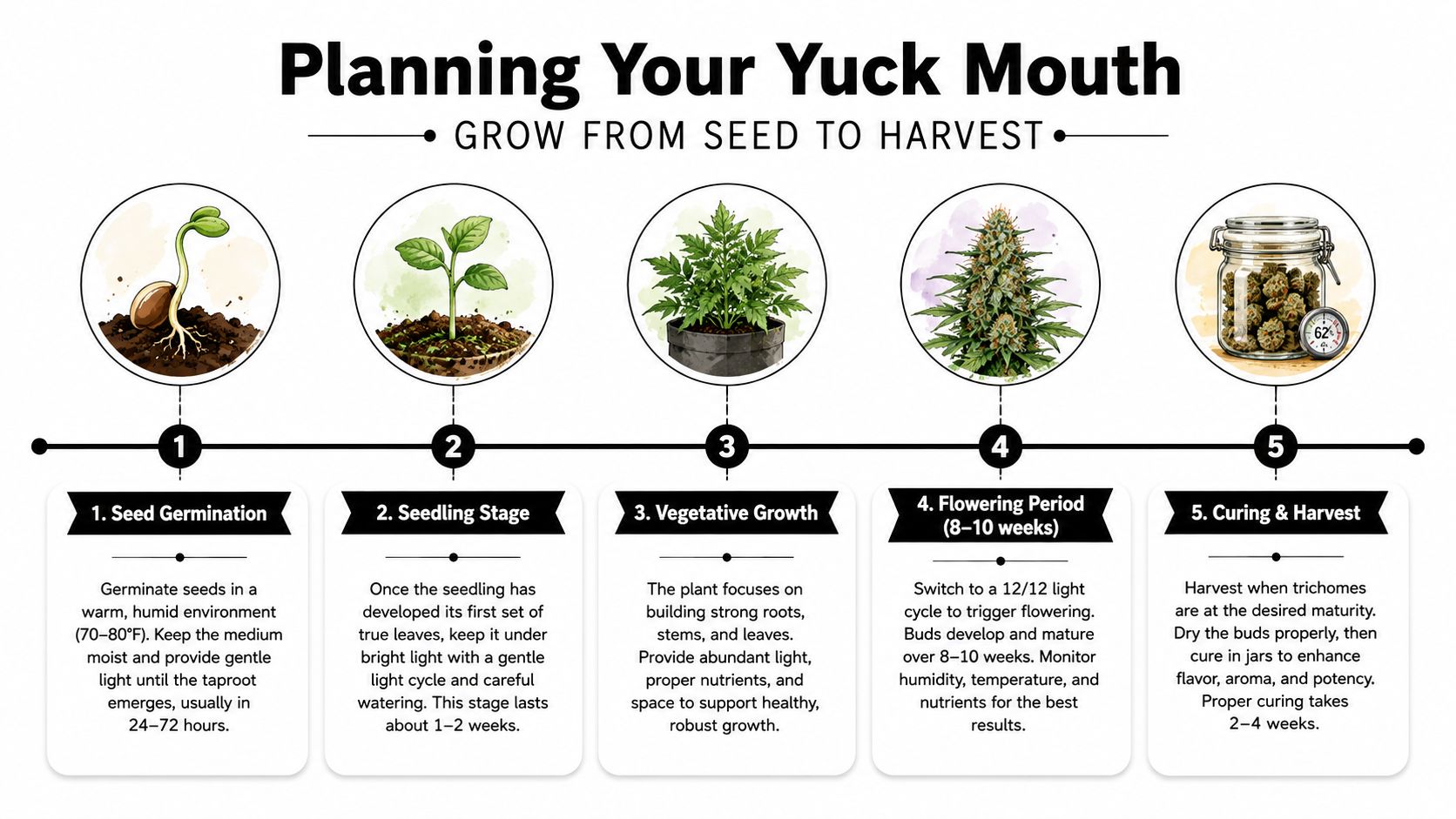
The cleanest way to run Yuck Mouth strain is to treat it like a staged project, not a guess-and-check grow. Start with a stable seedling phase, build a strong vegetative frame, then carry that structure into flower and give the plant room to finish cleanly. Grow reports place the flowering window in the moderate range, so the primary job is keeping each phase tidy enough that the final jar matches the plant's potential, as noted earlier.
A Simple Roadmap
The first move is choosing feminized genetics that fit your space and your patience. That gives you a cleaner path to flower and fewer surprises in a small home setup, which matters more than people admit when every square foot counts.
After that, the whole grow becomes a sequence of small decisions:
- Seed germination: Keep conditions steady and do not rush the first taproot.
- Seedling stage: Protect the young plant from stress, because early damage lingers.
- Vegetative growth: Build structure before you think about flower.
- Flowering period: Keep the canopy open, watch humidity, and let the plant finish properly.
- Curing and harvest: Handle the dry and cure like they matter, because they absolutely do.
For a broader timeline reference, the Botanist Seeds growing stages guide is useful when you are mapping your run from start to finish.
What Usually Separates a Good Run from a Great One
The growers who do well with this cultivar usually treat the whole process like maintenance, not drama. They stay ahead of airflow, avoid overfeeding, and resist the urge to chop early just because the flowers look fat. That last part matters more than people want to admit, because patience in the final stretch often shows up in the jar.
Phenotype variation is part of the deal with Yuck Mouth. Some plants stay tighter and more compact, while others stretch more and need stronger support through the flower push. That is normal with a strong hybrid, and it is why a grower should judge it by how it behaves in the room, not by a single glossy description. If you want a clearer mental map for the run, the practical growing cannabis stages guide is still the better reference than trying to guess the plant's habits from the label.
Home growing also carries the obvious upside. You are not waiting in line, you are not paying retail markup every time you want something decent, and you get the quiet satisfaction of knowing you built the result yourself. That feeling matters, especially when the cultivar is good enough to make you proud of the work.
If you are ready to compare options and lock in a cultivar that fits your setup, start with a feminized pick and use the tools that make selection easier. Botanist Seeds has the seed options and comparison help to narrow it down, so you can spend less time second-guessing and more time growing something you will be happy to harvest.