Navigating the Premium Seed Market for Best Cultivars
You’re probably doing what most home growers do the first time they shop seriously for seeds. You’ve got five tabs open, every pack says “elite genetics,” every cultivar looks amazing in the photos, and the price spread makes no immediate sense. One option looks cheap enough to grab on impulse. Another costs enough that you stop and ask, “What am I paying for here?”
That question matters more than the cultivar name on the pack.
The premium seed market can feel noisy because a lot of sellers borrow the language of quality without explaining what quality looks like in practice. Some banks put real work into stable genetics, clear cultivar data, and reliable fulfillment. Others mostly sell a vibe. If you’re trying to grow at home without wasting time, money, and tent space, you need a better filter than hype.
A serious buyer doesn’t just ask what sounds good. They ask what’s likely to grow the way it was described, whether the supplier can be trusted, and whether the cultivar fits the setup they already have. That’s the difference between building a clean, efficient run and buying random seed packs because the artwork looked cool.
Your Guide to the Premium Seed Market
A grower I know had a very normal problem. He wanted one solid autoflower for a small indoor run, but after twenty minutes of browsing he had built a cart full of completely different cultivars. One was advertised for speed, one for loud aroma, one for bag appeal, and one because the breeder page made it sound rare. He wasn’t confused about what he liked. He was confused about what mattered.
That’s a common sticking point in the premium seed market.
Price alone doesn’t tell you much. A budget pack can still grow well, and an expensive pack can still disappoint if the breeder work is sloppy or the seller is careless. What you’re really buying is the chance of a predictable result. That means a seed that starts strong, grows in a way that matches the listing, and finishes with the kind of flower you were expecting.
Practical rule: Buy seeds the same way you buy equipment. Judge them by reliability, fit, and repeatability, not by branding alone.
A good buyer usually looks at three things first:
- The genetics behind the cultivar: Does the breeder give you enough real information to understand the plant?
- The seller behind the listing: Can they ship securely, answer questions, and stand behind what they sell?
- Your own grow style: Are you working with a small tent, a patio, a spare room, or a bigger hunt?
Those questions cut through most of the noise fast.
If you can read a cultivar page with a skeptical eye, you stop shopping emotionally and start shopping like a grower. That doesn’t make the process less fun. It makes it more rewarding, because the seeds in your cart match your plan instead of your mood.
What "Premium" Really Means for Cannabis Seeds
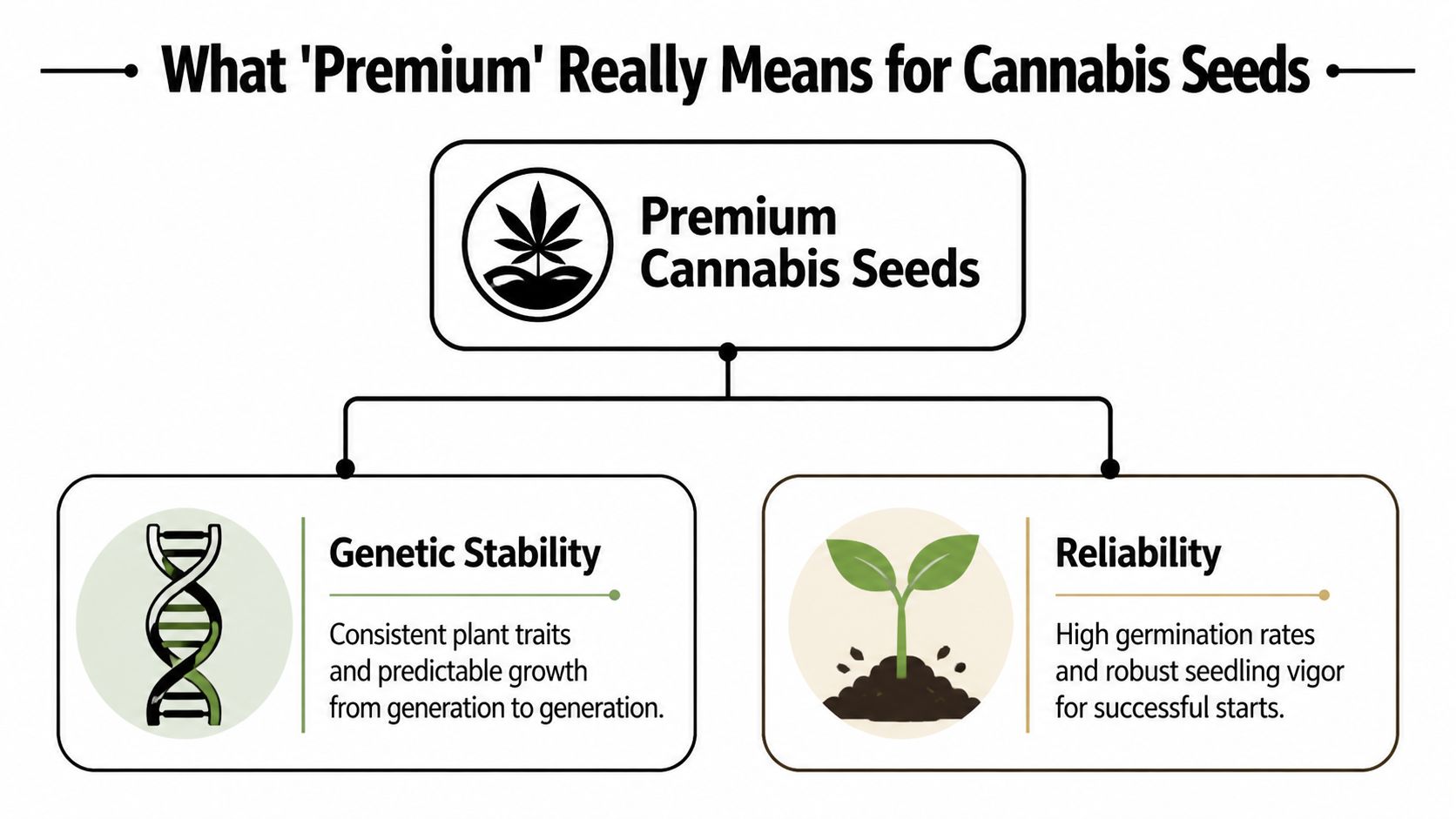
“Premium” gets thrown around too loosely. In practice, it means genetic stability and reliability. Not glamour. Not loud packaging. Not a clever cultivar name.
A premium seed should give you a plant that behaves close to the description. That includes structure, aroma, finishing window, and general consistency across the run. If a seller can’t explain those basics clearly, the word premium doesn’t mean much.
Stability is the whole game
Think about your favorite craft beer. You buy it because you know what you’re getting. Same brewery, same label, same profile in the glass. Good cannabis breeding works the same way. The breeder’s job is to narrow the range of surprises so the plant you grow lands near the target they advertised.
That matters a lot for home growers. You don’t have endless room for experiments, and they aren’t trying to turn every run into a science project. They want a cultivar with a known shape, a likely finish window, and an aroma profile that fits their taste.
Here’s the practical version of that idea:
- Stable growth habit: Helpful if your canopy is small and your headroom is limited.
- Predictable flowering behavior: Easier to plan around life, travel, and drying space.
- Consistent sensory traits: Better odds of getting the nose, flavor, and vibe that drew you to the cultivar in the first place.
Why feminized and autoflower seeds dominate serious home grows
For a home grower, premium almost always starts with feminized and autoflower seeds because they simplify the path to harvest. Controlled breeding is a big reason premium banks can deliver more than 99 percent female plant reliability, along with germination rates averaging 90 to 95 percent and yields of 400 to 600g/m² in optimized environments, according to best practices published by Premium Seed Market.
That kind of predictability is what people are paying for.
Autoflowers are especially useful when speed, simplicity, and tight spaces matter more than running a long, heavily managed cycle. Feminized photoperiod cultivars make more sense when you want greater control over training and a wider hunt across a few carefully chosen options. Neither format is “better” in every case. They’re tools for different growers.
Premium seeds save frustration first. Better flower is the result, not the starting point.
The mistake people make is treating premium as a luxury label. It’s closer to buying insurance against wasted effort. If your time matters, if your tent space matters, and if you care about getting the cultivar you thought you bought, premium starts to look less like a splurge and more like basic planning.
Understanding the Modern Seed Landscape
The premium seed market has layers, and knowing those layers helps you avoid buying blind.
At the top, you’ve got breeders. They create and refine the genetics. Some have a clear identity and a track record you can follow through multiple cultivar releases. Then you’ve got seed banks, which act more like curators and retailers. A strong seed bank can make good genetics easier to find and compare. A weak one can turn even good genetics into a risky purchase if storage, labeling, or fulfillment are sloppy.
Then there are resellers who mainly repackage, relist, or white-label products. That doesn’t automatically mean bad seeds, but it does mean you should ask harder questions about origin and handling.
Who deserves your trust
If I’m trying to trace a seed back to something real, I want to know:
- Who bred it: A named breeder with a visible body of work is easier to evaluate.
- Who packed and stored it: Seed quality can slide if handling is careless.
- Who’s selling it now: Retail standards matter more than people think.
This is why two listings for what appears to be the same cultivar can feel very different. One seller gives lineage, plant behavior, and clear expectations. Another gives a dramatic description and not much else. That gap tells you something.
Why the wider seed industry matters here
Cannabis didn’t invent premium genetics. The broader seed world has worked this way for a long time. In the USA premium seed market, valued at USD 20 billion over a five-year historical analysis, GM seeds dominate because of superior yield and resilience, according to Ken Research’s market report on the USA premium seed market. The same report notes that this push for optimized outcomes parallels premium cannabis breeding, where 99%+ feminized seeds are designed to improve predictability and reduce wasted effort.
That comparison is useful because it strips out the hype.
Farmers don’t pay more for advanced seed genetics because the packaging is nice. They pay more because performance and consistency matter. Home growers should think the same way. You don’t need to borrow big agriculture’s language, but you should absolutely borrow its mindset. Buy genetics for the result they’re built to deliver.
If you can’t figure out who bred the cultivar and who handled the seed, you’re not buying with much control.
Once you see the market this way, seed shopping gets less emotional. You stop asking which listing feels premium and start asking which listing is connected to a real chain of accountability.
How to Evaluate Seed Genetics and Breeders
A cultivar page can tell you a lot if you read it like a grower instead of a fan. Good listings give you enough detail to picture the plant in your room. Weak listings mostly try to create excitement.
The strongest signal is usually not the name. It’s the quality of the supporting information.
Read the spec sheet like it matters
When I scan a cultivar listing, I care about lineage first. Not because lineage is a magic guarantee, but because it gives context. If the parentage includes familiar building blocks, you can often make a decent first guess about structure, stretch, and aromatic direction.
Then I look at a short list of practical fit questions:
- Flowering time: Does the finish window match your patience and schedule?
- Expected height and shape: Will it fit your tent without turning into a hassle?
- Aromatic profile: Does the seller describe the smell in a way that sounds specific instead of recycled?
- Cultivar type: Is this sold as feminized or autoflower, and does that match how you like to run a grow?
Aroma deserves more attention than many buyers give it. If a description only says “gas” or “fruity” and leaves it there, I don’t learn much. Better listings give you layers. Citrus rind, floral spice, berry sweetness, earthy funk. If you want to get better at reading those descriptions, it helps to understand the compounds behind them. A solid primer on cannabis terpenes makes cultivar pages easier to decode.
Green lights and red flags
| Green Lights (Signals of Quality) | Red Flags (Reasons for Caution) |
|---|---|
| Clear lineage information that helps you understand the cultivar’s background | Vague parentage or no lineage at all |
| Specific notes on growth pattern, structure, and finish | Heavy hype language with almost no cultivation detail |
| Aroma descriptions with nuance and consistency | Generic copy that could fit any cultivar on the site |
| Breeder identity is visible and easy to research | The breeder is hidden, unclear, or seems interchangeable with every listing |
| The cultivar description matches the likely use case, such as compact indoor growth or bigger outdoor expression | The listing promises everything at once, fast, huge, easy, rare, loud, beginner-friendly |
Judge the breeder, not just the pack art
Breeder quality shows up in consistency and transparency. I trust breeders more when they present their work like they expect growers to use it, not just admire it. That means coherent lineage, realistic descriptions, and a catalog that makes sense as a body of work.
Buyer check: If the listing tells you how the cultivar looks in a photo but not how it behaves in a room, keep scrolling.
Community chatter can help, but use it carefully. Look for patterns, not one loud opinion. If several experienced growers describe the same cultivar in similar terms, that’s useful. If every review sounds copied from a promo card, it probably is.
A good breeder doesn’t need to oversell. The details do the talking.
Choosing a Trustworthy Seed Supplier
The best genetics in the world don’t help if the supplier ships old stock, packs seeds carelessly, or disappears when there’s a problem. In the premium seed market, the store matters almost as much as the cultivar.
That’s not glamorous advice, but it’s the kind that saves headaches.

What a solid supplier looks like
A reliable supplier tends to make boring things easy. Ordering is straightforward. Payment options feel normal and secure. Shipping policies are clear. Contact information is visible. You don’t need detective work to figure out who you’re dealing with.
Here’s the checklist I’d use before placing an order:
- Clear shipping standards: Look for discreet shipping, realistic timelines, and a process that doesn’t feel improvised.
- Visible support: You should be able to contact a real team through a clear support channel.
- Guarantee language you can understand: If there’s a reship or germination policy, it should be written plainly.
- Accurate product pages: Strong suppliers usually carry that same clarity into listings, packaging, and order updates.
One useful signal is how a supplier handles problems before they happen. If they explain replacements, damaged shipments, or order issues clearly, they probably deal with customers like adults. If every policy feels slippery, assume support will be slippery too.
Red flags that aren’t worth gambling on
I get suspicious fast when a supplier hides the basics. No real company details, no plain support process, no clear shipping terms, and no evidence they stand behind deliveries. That usually means you’re on your own if anything goes sideways.
Common warning signs include:
- Thin contact info: A store that makes itself hard to reach is telling you something.
- Messy listings: Inconsistent descriptions, broken pages, and copy-paste product text suggest weak handling overall.
- Policy fog: If guarantees are vague, they may not exist in practice.
This quick video covers some of the same trust signals growers should watch for before ordering:
A trustworthy seed supplier doesn’t just process your order. They protect your start.
That’s the standard. You’re not buying a T-shirt. You’re buying the first step of a whole grow cycle. If the supplier treats fulfillment like an afterthought, the rest of your project starts on shaky ground.
Practical Buying Strategies for Your Grow Style
Good buying decisions get easier when you stop asking, “What’s the best cultivar?” and start asking, “What fits the way I grow?” Your room, schedule, tolerance for complexity, and flavor preferences all matter more than trendiness.
That’s where the premium seed market starts making sense. Premium options are only worth the price if they match the job.

Small-space growers should keep it tight
If you’re running a compact tent, don’t build a shopping cart like you’ve got a warehouse. Pick one reliable autoflower cultivar and focus on execution. That usually gives you a cleaner first result than juggling multiple plant behaviors in a cramped space.
Autoflowers make a lot of sense for growers who want simplicity, a faster turnaround, and less schedule management. If you’re still weighing that against photoperiod options, this guide on autoflowering vs photoperiod is worth a read before you buy.
A practical small-tent plan usually looks like this:
- Choose one cultivar, not three: Uniformity makes watering, canopy management, and harvest timing easier.
- Favor manageable structure: Compact, well-described cultivars are easier to live with than mystery stretchers.
- Buy for your actual routine: If you miss check-ins sometimes, don’t buy as if you have a full-time grow schedule.
Bigger hobby runs can be more selective
If you’ve got more room and some experience, buying a few different feminized cultivars can make sense. Not because variety is automatically better, but because side-by-side comparison teaches you a lot. You’ll quickly learn which aromas, plant shapes, and finishing styles you enjoy growing.
That kind of run works best when you stay disciplined:
- Keep the shortlist focused: Choose cultivars with a reason to be there, not just because they sounded cool.
- Mix with intention: Pair plants that suit your environment instead of fighting it.
- Take notes like it matters: The keeper often reveals itself in the boring details, not just the jar appeal.
Buy seeds for the grow you can manage well, not the grow you like imagining on a Friday night.
The biggest win in home growing is control. You skip dispensary lines, avoid retail markup and taxes, and build a stash that reflects your taste instead of whatever was available that day. But that only happens if the cart is built with a plan. Premium seeds reward clarity. They don’t rescue chaos.
Grow with Confidence
The premium seed market gets much less intimidating once you know what to ignore. Hype is easy to write. Real quality is easier to verify. Look for stable genetics, useful cultivar details, and a supplier that treats shipping and support like part of the product.
That approach puts you back in control.
A smart buyer doesn’t need the loudest listing. They need a cultivar that fits their room, their schedule, and the kind of flower they want to grow. Once you start judging seeds by reliability and fit, the market stops feeling random. It starts feeling navigable.
There’s also a different kind of confidence that comes from growing your own. You save yourself the trip, skip the line, and build a harvest that reflects your choices from day one. That’s a good feeling, and it starts long before germination. It starts with buying well.
If you’re close to ordering, slow down for ten minutes and review the basics. Check the breeder. Read the cultivar page carefully. Vet the supplier. Then make sure your setup matches the seed format you’re buying. If you need a refresh on the practical first step after the order arrives, this guide on how to plant weed seeds indoors will help you start clean.
The growers who get the most from premium seeds usually aren’t the ones chasing every new release. They’re the ones who buy with intention.
Ready to put that into practice? Use the comparison tools and cultivar guides at Botanist Seeds to sort feminized and autoflower options by the traits that actually matter for your setup, your preferences, and your next run.