Autoflowering vs Photoperiod: Which Is Best For You?
You’re probably staring at seed options right now, trying to keep the choice simple and somehow making it feel more complicated. One pack promises fast harvests and an easy run. Another promises bigger plants, more control, and the kind of canopy that makes a tent look properly full. That’s the autoflowering vs photoperiod question in real life.
Most home growers don’t need a philosophical answer. They need the right fit for their space, their schedule, their power bill, and their tolerance for messing with timers, training, and plant recovery. That’s where the decision lies.
I’ve seen growers pick photoperiod cultivars because they wanted the biggest possible harvest, then get tired halfway through a long veg. I’ve also seen growers pick autos for convenience, then realize they discover they enjoy shaping plants and wish they had more room to experiment. Neither choice is wrong. The wrong move is choosing a type that doesn’t match how you grow.
The Big Question What Kind of Grower Are You
A lot of people ask whether autoflowers or photoperiods are better. That’s not really the useful question. The better question is this: what kind of grower are you when the tent is in your spare room, the weather shifts outside, and life gets busy?
Some growers want a quick turnaround and less day to day management. They want to germinate, keep the environment steady, do a bit of gentle training, and harvest without obsessing over when to flip lights. Those growers usually feel at home with autoflower cultivars.
Other growers enjoy the process as much as the harvest. They like shaping structure, topping branches, filling out a screen, and deciding exactly when flowering starts. They tend to get more out of photoperiod cultivars because those plants give them room to steer the grow.
The lifestyle test
A simple way to think about it is to match the seed type to your habits:
- Busy schedule: Autos suit growers who want fewer moving parts.
- Hands-on style: Photos suit growers who like adjusting and refining.
- Small space: Autos often fit more naturally.
- Bigger ambitions: Photos reward patience and planning.
- Need a quicker refill: Autos usually make more sense.
- Want to keep a favorite cultivar going: Photos are the clear winner.
Practical rule: Choose the plant that matches your routine, not the one that sounds most impressive online.
That matters more than people admit. A grow that fits your life usually finishes stronger than a grow that looked great on paper but asks for more attention than you can realistically give it.
What actually causes regret
The growers who regret their choice usually run into one of these problems:
- They chose autos but wanted more control: Once an auto starts moving into flower, the clock doesn’t care that you wanted one more week to fix a canopy.
- They chose photos but underestimated the commitment: Veg can stretch longer than expected, and a strict flowering schedule demands discipline.
- They copied someone else’s setup: A method that works in a dedicated room doesn’t always translate to a closet or balcony.
- They focused on one factor only: Speed, yield, or simplicity alone won’t tell the full story.
If you’re honest about your setup, the answer gets clearer fast. The best seed type isn’t the one that wins a debate. It’s the one that gives you a smooth run and a harvest you’re proud to call your own.
The Core Difference It Is All About the Light
You see the difference the first time a grow goes slightly off plan.
With an autoflower, the plant keeps heading toward bloom whether your canopy is ready or not. With a photoperiod, you can hold the line, fix the shape, and flip to flower when the plant and the space are prepared. That one trait decides far more than people expect.
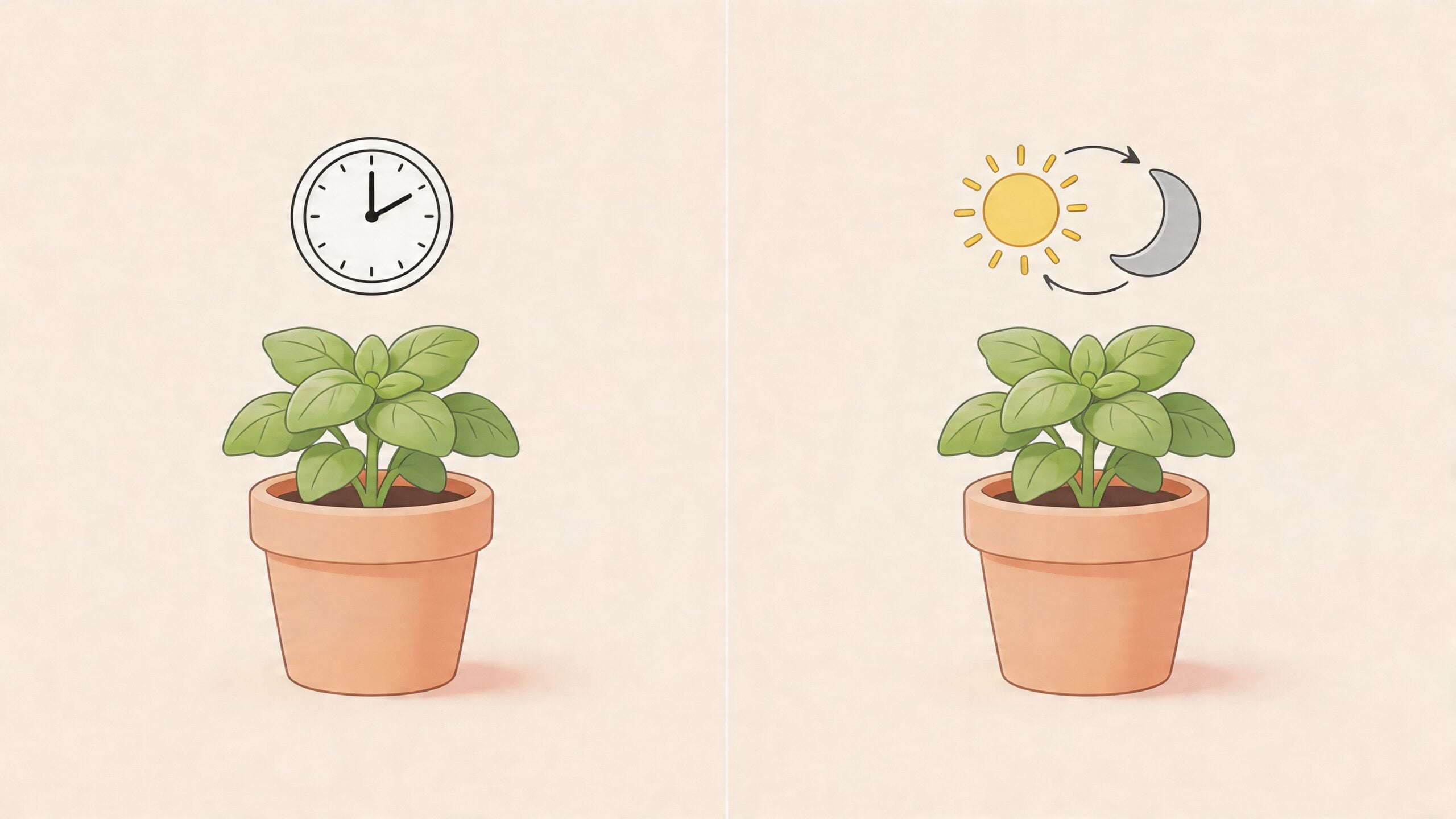
Autoflowers flower by age. Photoperiods flower by light.
Autoflowers run on a built in clock
An auto starts its transition on its own. You do not need to change the light schedule to trigger bloom, which is why autos often feel easier for a home setup. Keep the environment steady, avoid early stress, and let the plant move.
That simplicity has real day-to-day value. Your timer setup stays consistent, your routine is easier to maintain, and there is less pressure around strict dark periods. For growers running a tent in a spare room or somewhere with frequent interruptions, that can make the whole project easier to live with. If you want a clearer handle on schedules, intensity, and fixture choices, this guide on lighting for growing cannabis indoors is a useful reference.
The catch is timing. If an auto gets stunted early from overwatering, transplant shock, or a rough feeding mistake, it usually does not give that time back. The plant keeps aging, which means small problems early can turn into smaller plants at harvest.
Photoperiods wait for a light signal
Photoperiod plants stay in vegetative growth under long days and begin flowering after you switch them to a 12 and 12 light cycle. That gives you room to make decisions instead of racing a built-in clock.
This matters most when the grow is less than perfect, which is most home grows. If a plant needs another week to recover, fill the net, or build stronger branching, you can give it that week. That extra control is why photoperiod growers usually have more options with training, plant size, and canopy management.
You pay for that control with discipline. A photoperiod grow asks for tighter timer accuracy, real darkness during lights-off, and a routine you can stick to. In a busy house, that can be the difference between a smooth flower cycle and a stressful one.
Why the light trigger changes the whole grow
The flower trigger shapes how the grow fits your space, your power bill, and your schedule.
- Autos suit growers who want a simpler lighting routine and fewer chances to mess up a flower trigger.
- Photos suit growers who want more control over size, structure, and timing.
- Autos are less forgiving of early stress because the plant does not wait for you to correct mistakes.
- Photos are less forgiving of light leaks and schedule sloppiness once flowering starts.
- Autos can be easier to fit around everyday life.
- Photos usually reward growers who enjoy hands-on plant work and tighter environmental control.
The short version is simple. Autos reduce light-management pressure. Photos give you more control over the plant, but they ask more from your routine in return.
Comparing Growth Cycles Yields and Quality
Most growers compare autos and photos by asking one question first. Which one gets me to harvest faster. That matters, but it is not the whole decision once you have paid a few electric bills and lived through a few rough runs.
What changes most is how the grow behaves over time. One plant asks you to protect momentum. The other lets you build toward a bigger finish.
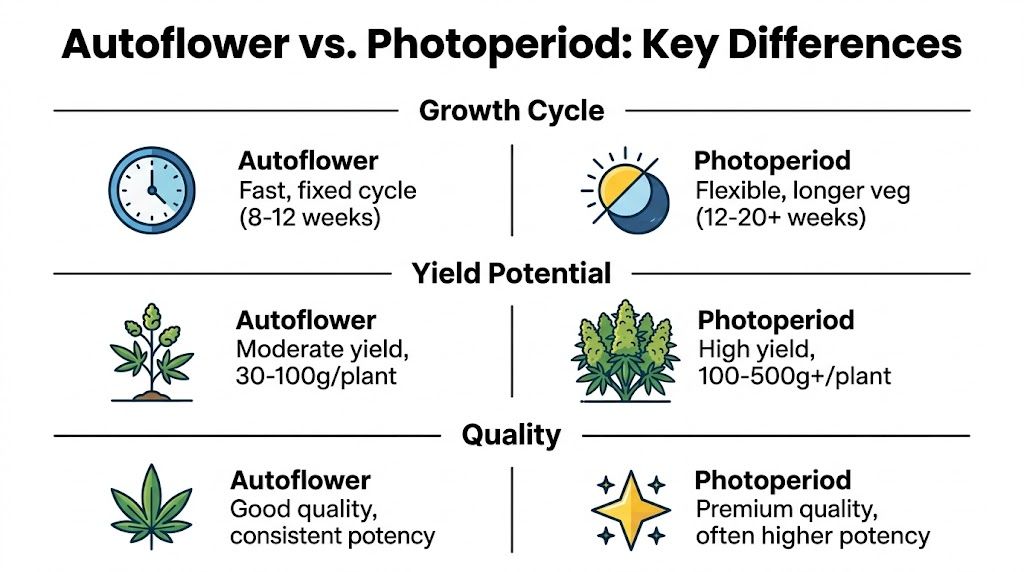
| Attribute | Autoflower | Photoperiod |
|---|---|---|
| Growth cycle | Fast and fixed | Longer and flexible |
| Flower trigger | Age | Light cycle change |
| Light management | Simpler | More precise |
| Yield potential | Moderate | Higher ceiling |
| Training freedom | Limited by time | Broad toolkit |
| Cloning | Poor fit | Strong fit |
| Best for | Speed, small spaces, simple runs | Control, larger harvests, repeatable production |
Growth cycle in real terms
Autos move with a set rhythm. If the first few weeks go smoothly, they feel efficient and satisfying. If those first weeks go sideways, you feel the loss at harvest because the plant keeps aging whether the root zone is ready or not.
Photoperiods give you more room to decide what kind of plant you want to finish with. You can hold veg longer, fix a weak start, and build a fuller canopy before flowering. For home growers still learning structure and timing, that flexibility often makes the whole run less punishing.
If you want a clearer picture of how plants build size before bloom, this guide to the growth or veg phase connects the timeline to the choices you make in the tent.
Yield potential is where photos usually separate
This is still the clearest performance gap. Photoperiod strains usually produce more per plant and give you a higher ceiling per run than autos, according to Seedbanks’ comparison of autoflowering vs photoperiod strains.
The reason is simple. Yield comes from plant size, root mass, branch count, and canopy development. A photoperiod can keep vegetating until those pieces are in place. An auto has to work with the time it has.
That difference matters even more in average home setups, where a plant might lose a few days to transplant stress, feeding mistakes, or a temperature swing. A photoperiod can recover and still finish strong. An auto often finishes smaller.
Why the gap is not just genetics
A lot of side by side comparisons leave out the human factor. Two growers can run the same auto and get very different results depending on how clean the early weeks were.
Autos reward stable conditions from day one. Good watering habits, steady environment, and gentle handling make a bigger difference than many newer growers expect. If your setup is dialed in and your routine is consistent, autos can be impressively productive for their size and speed.
Photoperiods are more forgiving in a different way. You can correct course without feeling like the clock is beating you every morning. That changes the stress level of the grower too, not just the plant.
Quality is much closer than it used to be
The old idea that autoflowers are automatically second tier does not hold up well anymore. Modern autos can produce strong aroma, solid resin, and enjoyable effects when the genetics are good and the plant stays healthy.
Photoperiod cultivars still tend to offer the wider menu if you are chasing a very specific terpene profile, unusual plant structure, or a heavier selection process from clone to clone. They also give you more time to bring a plant to full size before flower, which can help overall presentation and consistency in a tuned room.
For many home growers, quality ends up being less about auto versus photo and more about whether the plant had an easy life. Light intensity, root health, dry-back, temperature, and harvest timing usually decide more than the label on the seed pack.
A strong auto feels like a smart, efficient run. A strong photo feels like a project you had time to shape.
What works best for each goal
- You want the biggest single harvest: Photoperiod
- You want a shorter, more self-contained project: Autoflower
- You want flexibility if life interrupts the grow: Photoperiod
- You want a plant that fits a simpler routine: Autoflower
- You care about watt-for-watt output over a bigger canopy: Photoperiod
- You want solid quality without stretching the grow for months: Autoflower
The short version is practical. Photos usually win on yield ceiling and recovery room. Autos win on speed, turnover, and simplicity. The better choice depends on whether you value control, lower effort, faster finish, or a grow that fits your weekly routine with less friction.
Cultivation and Training Techniques
The difference shows up fast once your plants are established and you start deciding how much you want to intervene. It is at this stage that autoflowering vs photoperiod stops being theory and becomes hands in the tent.
Autoflowers reward restraint. Photoperiods reward planning.
How to handle autoflowers without slowing them down
Autos don’t give you much time to recover from mistakes. Since the lifecycle is fixed, every stress event matters more. That’s why the safest play is a simple, early approach with gentle shaping instead of heavy cutting.
Low stress training is the move most growers should lean on. Bend, guide, and open the plant up while it’s still flexible. Don’t treat an auto like a photoperiod that can just veg longer and bounce back.
If you want a practical walkthrough, this guide to low stress training autoflower plants lays out the basics cleanly.
- Start early: Gentle tie downs work best when stems are still soft.
- Avoid stacking stress: Don’t combine rough transplanting, hard pruning, and feed corrections in the same window.
- Keep the root zone stable: Autos hate losing momentum.
- Read the plant daily: If it looks stalled, stop “improving” it.
A short visual always helps here:
What photoperiods let you do
Photoperiod cultivars are a different game. Since you control when flowering begins, you can push structure much harder. Topping, wider lateral growth, branch management, screen work, and recovery time all become real tools instead of risky gambles.
That’s where a lot of growers fall in love with photos. You’re not just growing the plant. You’re building it.
Common methods that fit photoperiods well include:
- Topping: Useful when you want more than one dominant top.
- SCROG: Great for filling a canopy evenly.
- SOG: Works when the goal is a different style of canopy management.
- Super-cropping: Helpful in experienced hands when stems get vigorous and height needs control.
The big point isn’t the list of techniques. It’s the recovery window. A photoperiod can take stress, settle back in, and keep building because you decide when the plant flips.
If you like shaping a cultivar into the exact footprint you want, photoperiods give you breathing room that autos just don’t.
Cloning changes the whole workflow
This is one of the biggest practical differences, and it matters a lot once you move beyond casual one-off grows. Photoperiods can be kept as mother plants and cloned for repeat runs. Autos can’t fill that role in the same way because their age-driven clock keeps moving.
That means photoperiods are stronger for growers who want:
- Consistency: Same structure and growth habits from run to run
- Phenotype keeping: Hold onto a favorite cultivar
- Perpetual systems: Keep production moving in a more repeatable rhythm
Autos are great for convenience. Photos are better if you want a system.
That’s why many hobby growers start with autos, then shift toward photos once they realize they enjoy the craft side and want to preserve a standout cultivar instead of starting fresh every time.
Choosing Your Cultivar The Best Fit for Your Grow
The easiest way to make this decision is to stop thinking in categories and think in real setups. Most growers can see themselves pretty clearly once the choice is framed around routine, space, and expectations.
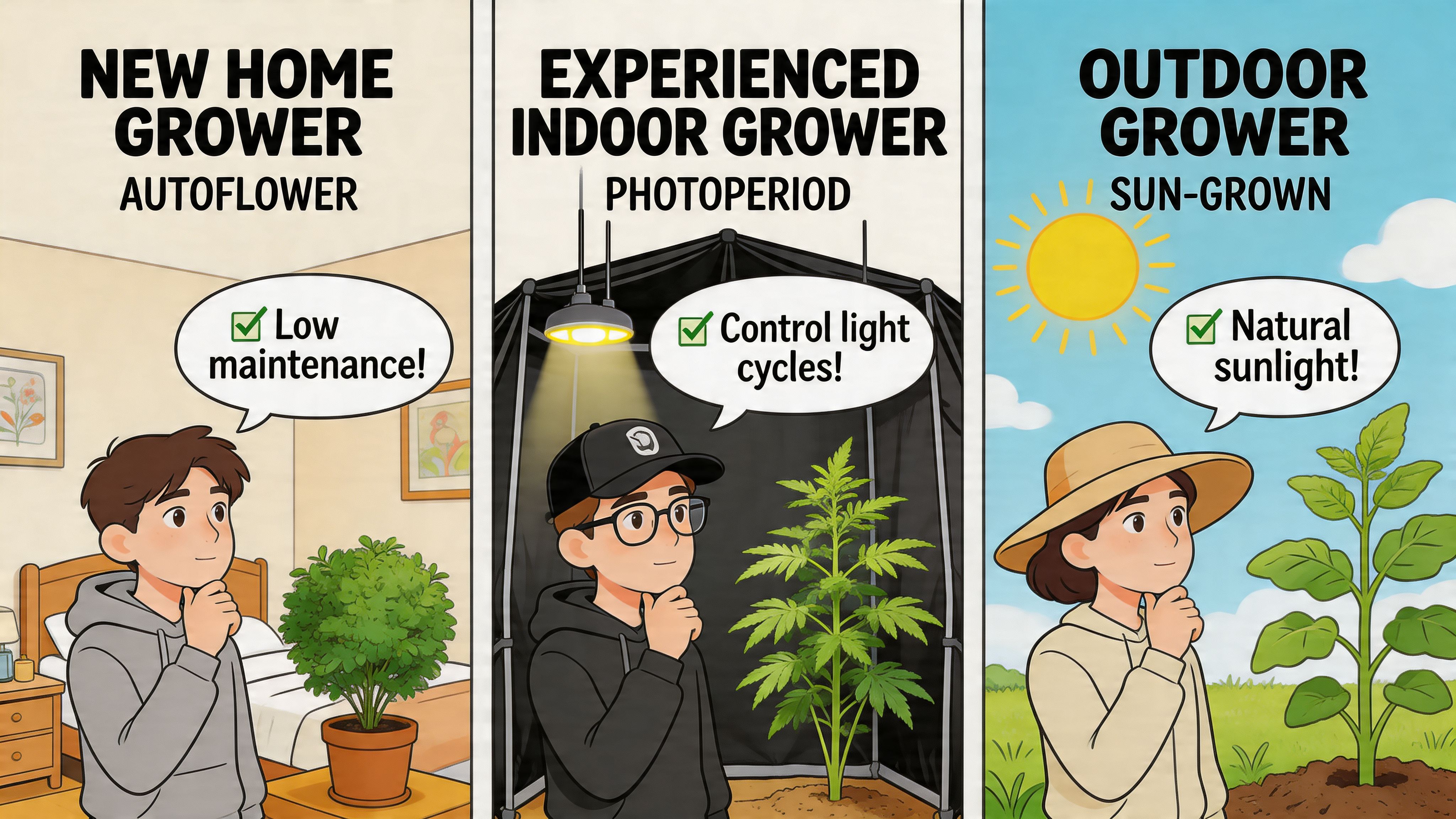
The first time home grower
If this is your first run, autoflowers often make the process less intimidating. You don’t need to manage the transition into flowering, and you don’t need to wonder whether the plant is “ready” to flip. You keep the environment stable, avoid rough handling, and let the cultivar move through its cycle.
That simplicity matters. Early grows already come with enough variables, watering, airflow, light distance, feeding discipline, and basic patience. Removing the pressure of light cycle timing can make the whole experience feel more approachable.
Autos also suit growers who want the emotional payoff sooner. There’s a lot to be said for getting from seed to jar on a shorter timeline. It keeps enthusiasm high.
The stealth grower with limited room
If your tent is small, your balcony is exposed, or you just don’t want a plant taking over the whole space, autos are often the cleaner fit. Their more compact growth habit makes them easier to manage without constant pruning or structural correction.
This isn’t just about size. It’s about lifestyle friction. A smaller, faster plant is easier to hide in plain sight, easier to keep tidy, and easier to run without feeling like your whole home now revolves around one crop.
Good stealth setups usually benefit from:
- Compact structure: Easier to manage in tight vertical space
- Simpler timing: Fewer chances to mess up a dark cycle
- Shorter commitment: Useful when privacy or weather creates pressure
- Less overgrowth risk: Helpful in closets, cabinets, and modest tents
The craft grower who likes control
Some growers don’t want simple. They want room to work. They want to top, shape, recover, and build a canopy that looks intentional from edge to edge. That grower should go photoperiod.
Photoperiod cultivars suit people who enjoy the process as a hobby in its own right. If you like checking branch spacing, adjusting tie points, and deciding exactly when the plant is ready for bloom, photos will feel much more satisfying.
They also fit the grower who has enough patience to let a plant become what it wants to become under guidance instead of rushing to a finish line.
The best photoperiod runs usually come from growers who enjoy spending time with the plant, not from growers trying to hurry it along.
The perpetual harvest hobbyist
If consistency matters, photoperiods pull ahead again. Being able to keep a mother and clone from a known performer changes how you plan future runs. It reduces guesswork and makes the whole setup feel more repeatable.
This is especially useful for growers who want:
- a favorite flavor profile again
- the same plant shape across cycles
- more predictable canopy management
- a smoother long term workflow
Autos can still be part of a regular rotation, but they don’t offer that same keeper-plant advantage.
The outdoor grower dealing with timing pressure
Outdoors, the answer depends a lot on your season and your tolerance for uncertainty. If your weather turns early, or you want the option to run more than one cycle without waiting on the natural season shift, autos are often the safer play.
If you have enough time, enough sun, and enough room for larger plants, photos can reward that with much more scale. Outdoor photos can become real projects. Outdoor autos tend to feel more tactical.
So the practical fit usually looks like this:
- Want speed and easier scheduling: Autoflower
- Want stealth and compact growth: Autoflower
- Want hands-on shaping and bigger upside: Photoperiod
- Want clones and long term consistency: Photoperiod
- Want less timer stress indoors: Autoflower
- Want full control over veg length: Photoperiod
Individuals often already know which camp they’re in. They just need permission to choose based on their actual life instead of what sounds most impressive in a forum thread.
The Practical Tradeoffs Cost Energy and Effort
Set up two tents in the same spare room and the difference shows up fast. One grow asks for stricter timing, more attention to light control, and usually a longer stretch of fans, lights, and climate gear running. The other tends to be simpler to keep moving, even if the daily light hours are higher.
That is why this decision goes beyond speed versus yield. It affects what you pay each month, how often you need to intervene, and whether the grow fits around work, family, travel, or a house full of people who do not care about your dark cycle.
Analysts at GrowSensor’s 2024 autoflower vs photoperiod guide note that autos can reduce electricity bills by 20 to 30% for hobby growers in some setups. The reason is straightforward. A shorter 8 to 12 week run on a steady 18 to 24 hour light schedule can use less total energy per harvest than a photoperiod run that stretches to 16 to 20+ weeks with longer veg, a flip, and more time for every supporting piece of equipment to stay on.
Why the cheaper option is not always the one with fewer light hours
A lot of newer growers look at an 18/6 or 20/4 auto schedule and assume the bill has to be higher. Sometimes it is. More often, the total calendar time matters more than people expect.
I have seen plenty of photoperiod grows get expensive for one simple reason. Veg keeps creeping. The plants are not quite full enough, the canopy is not quite even enough, or life gets busy and the flip happens a week later than planned. Meanwhile, lights, exhaust, circulation, dehumidification, and air conditioning keep running.
That extra month adds up.
Autos are less flexible, but they also remove some of the temptation to keep extending the project.
Effort has a cost too
Photoperiods reward precision. They also punish sloppiness more clearly.
You need to stay on top of a few things:
- Flowering depends on a clean light schedule
- Dark periods need to stay dark
- Timer mistakes can create stress
- Light leaks matter
- Longer runs create more chances for overfeeding, overcrowding, or environmental drift
Autos simplify that side of the job. You still need to water well, feed sensibly, and keep the environment in range, but the whole grow usually feels easier to live with. For a busy home grower, that matters.
The lifestyle fit is real
If your tent is in a garage, basement, office, or shared room, photoperiods can turn small household habits into grow problems. Opening the space at the wrong time, checking plants during lights-off, or dealing with inconsistent routines becomes more of a factor. Autos are often more forgiving in mixed-use spaces because the schedule stays straightforward.
Photoperiods make more sense if you enjoy the process itself and have a space you can control properly. They give you more room to steer the crop, but they ask for more discipline in return.
That trade-off is easy to underestimate until you have run both. The better plant for your setup is often the one you can manage cleanly for the full cycle without turning a hobby into another daily obligation.
Your Decision Checklist Finding Your Perfect Botanist Seeds Cultivar
If you want the short version, use this checklist and be honest with yourself.
Choose an autoflower if
- You want a faster harvest: A shorter cycle makes the whole process feel more manageable.
- You’d rather keep lighting simple: Fewer schedule changes means less timer stress.
- Your space is limited: Compact plants are easier to manage in small tents, closets, or balconies.
- You prefer a lighter touch: Gentle training and a straightforward workflow suit your style.
- You want less day to day fuss: Autos are a strong fit for busy growers.
- You care about practical efficiency: A shorter run can make energy use feel easier to justify.
Choose a photoperiod if
- You want the biggest yield potential: Photos have the stronger ceiling when conditions are dialed in.
- You enjoy training plants: Topping, screen work, and structural shaping all fit better here.
- You want full control over veg time: You decide when the plant is ready to flower.
- You want to clone a favorite cultivar: This is a major advantage if consistency matters.
- You like refining a setup over time: Photos reward patience and involvement.
- You have a dedicated grow space: Precision matters more, but the payoff can be worth it.
The best move is the one you can run well, repeatedly, without turning your hobby into a chore.
If you're ready to choose a cultivar that fits your setup, browse Botanist Seeds and use their comparison tools to sort by grow style, space, and goals. Whether you want a fast autoflower run or a photoperiod cultivar you can really shape and refine, starting with the right genetics makes the whole grow feel smoother from day one.