A Home Grower’s Guide to the Sea of Green Method
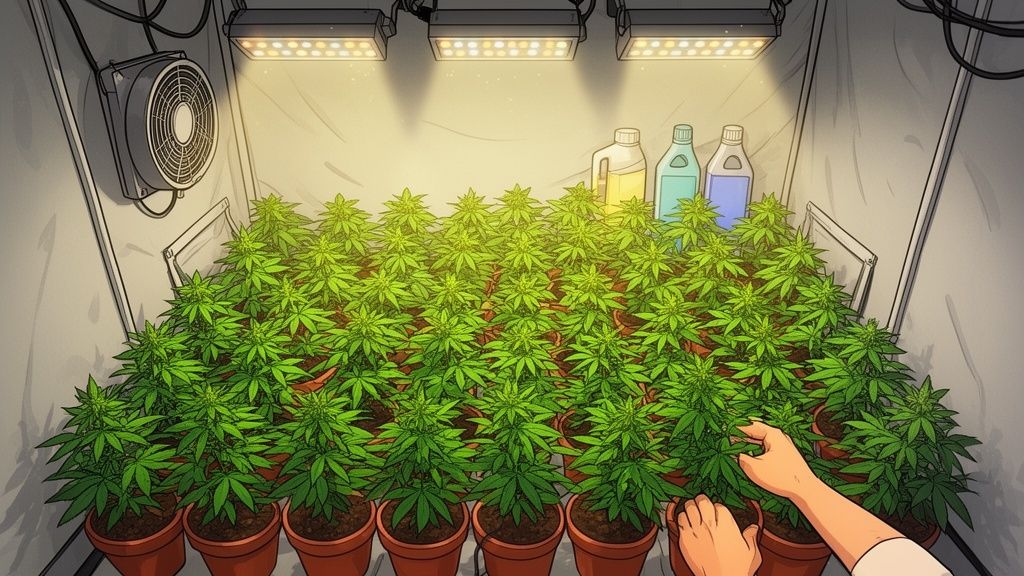
Let's talk about one of the smartest ways to maximize your grow space: the Sea of Green (SOG) method. At its core, SOG is all about speed and efficiency. Instead of spending months coaxing a few large plants to maturity, you grow a larger number of smaller plants and flip them into flower much, much faster.
The result is a dense, even canopy of main colas that completely fills your tent, a literal "sea of green."
What Is the Sea of Green Method
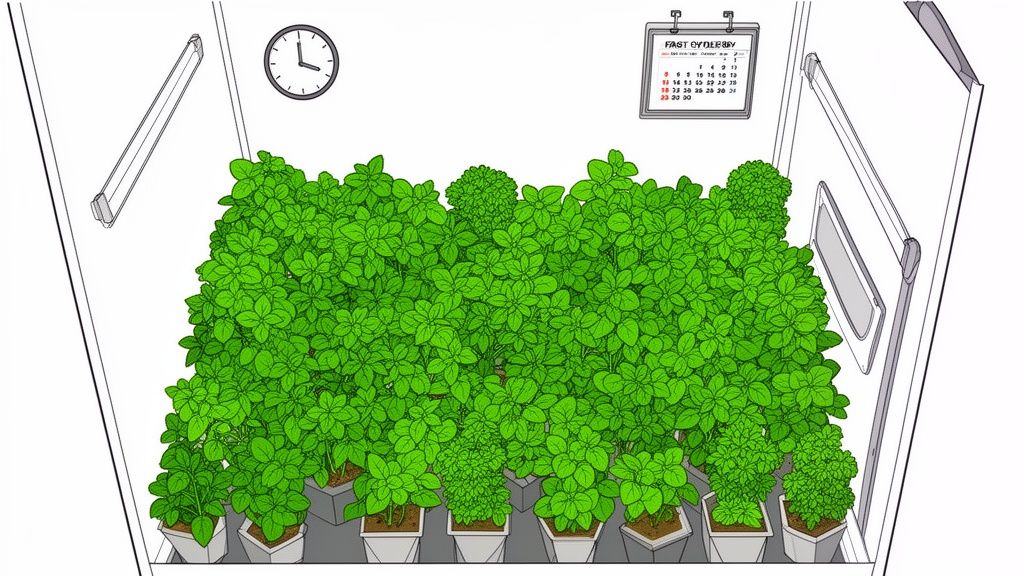
For a home grower, this technique is a total game changer. It means you're not waiting forever for your next harvest. You get to use every last square inch of your space, which leads to a more consistent, perpetual supply of your own flower. It's about getting fantastic results without needing a massive, complicated operation.
The entire philosophy behind SOG is to dramatically shorten the vegetative stage. With a traditional grow, you might veg your plants for weeks, even months, to get them big and bushy. With SOG, you’re cutting that time down to almost nothing.
This isn’t some new idea. The Sea of Green method actually came out of the Netherlands back in the 1980s. Canny Dutch growers realized they could pack their rooms with a high density of plants, sometimes 4 to 16 per square foot, to create a perfectly uniform canopy. By slashing the vegetative phase to just a week or two, they were pulling down consistent harvests every 8 to 10 weeks.
SOG Method vs Traditional Growing
To see how these two styles differ in the real world, let's look at a quick comparison. The table below breaks down the key differences between a SOG setup and a more standard approach to growing.
| Factor | Sea of Green (SOG) | Traditional Method |
|---|---|---|
| Plant Count | High (e.g., 9-16 in a 4×4 tent) | Low (e.g., 1-4 in a 4×4 tent) |
| Veg Time | Very short (1-2 weeks) | Long (4-8+ weeks) |
| Harvest Frequency | High (every 8-10 weeks) | Low (every 4-6 months) |
| Plant Size | Small, single main cola | Large, bushy with many branches |
| Training Required | Minimal, mainly lower pruning | Extensive (topping, LST, etc.) |
As you can see, the timelines and plant management are worlds apart. SOG is built for speed and simplicity, while a traditional grow focuses on maximizing yield from just a few large plants.
Let’s put that into perspective. Imagine two growers, both using a standard 4×4 tent. The first grower decides to cultivate four huge plants, which will require a good eight weeks of vegetative growth. The SOG grower, however, fills the tent with sixteen smaller plants and only vegs them for two weeks.
The SOG grower will literally be harvesting their crop around the same time the traditional grower is just starting to see their first flowers form. That’s the real power here.
While the total yield per harvest might end up being similar, the SOG grower can pull off two or even three harvests in the time it takes to complete a single traditional cycle. For anyone who values a steady personal supply, that's a massive advantage. It also means you’re saving on electricity and other running costs in the long run.
Why It Works for Home Growers
The Sea of Green strategy is almost tailor-made for the self-sufficient hobbyist. You get the satisfaction of a full tent and a quick turnaround, all without the headache of training and wrangling a few massive, unruly plants. It feels much more like managing a tidy, efficient garden.
This approach is incredibly versatile, too, working just as well with feminized seeds as it does with autoflowers.
Now, while SOG is all about getting to harvest day quickly, a related technique called Screen of Green (SCROG) focuses on pushing yields to the absolute max from just a few plants. If you're curious about the other side of the coin, you can explore our guide on the SCROG method to see which style is the right fit for you.
Planning Your SOG Grow and Choosing Cultivars
Alright, so you see the potential of the Sea of Green method and you're ready to get started. That's the right attitude. The first move is a little bit of planning, and no, I'm not talking about complex spreadsheets. It’s more about taking a good look at your grow space and deciding what you want to achieve.
Getting this early groundwork right is what sets you up for a smooth, low-stress run. A couple of smart choices right now will prevent a world of headaches later on and help you nail that heavy, fast harvest you’re after. The two biggest pieces of the puzzle are your plant count and the cultivars you choose to grow.
How Many Plants Can You Realistically Fit?
The whole point of SOG is to fill your canopy wall-to-wall, and fast. Naturally, this means using more individual plants than you would for a conventional grow. The ideal number really boils down to your tent size and the pots you plan on using.
Think of it as a balancing act. Smaller pots let you pack more plants in, but going a little larger gives each one some crucial elbow room. Finding that sweet spot is key.
Here are a few solid starting points for common tent sizes I've worked with:
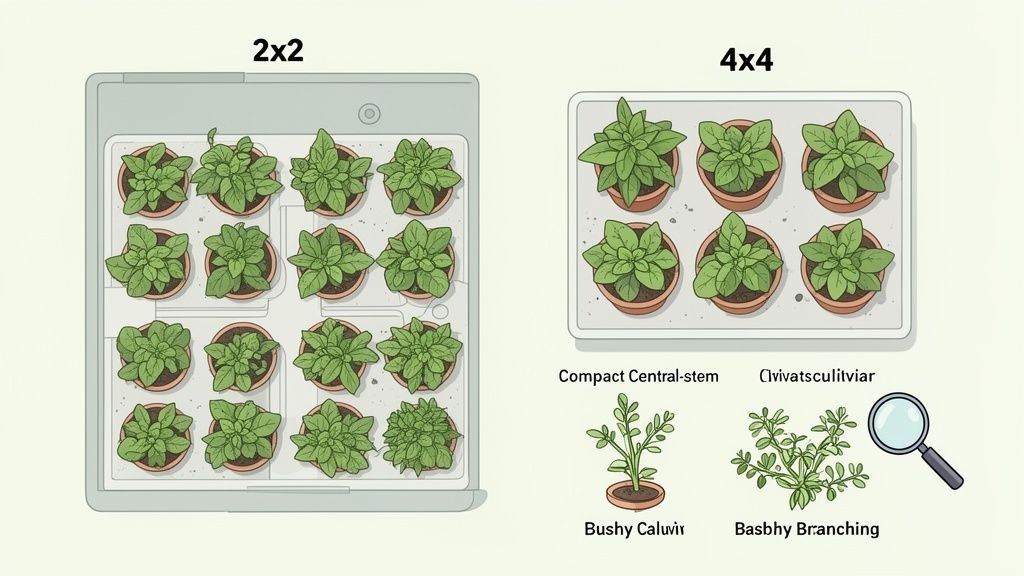
- 2×2 Tent: This little space is perfect for a highly efficient SOG. You can easily fit 4 plants in 2-gallon pots, giving each plant a 1×1 foot square. That's plenty of real estate for the SOG style.
- 3×3 Tent: With a 3×3, you have a bit more room to play. A classic setup is 9 plants in either 2 or 3-gallon pots. This creates that perfect grid that fills the entire footprint.
- 4×4 Tent: In a 4×4, you could stick with 9 plants but give them larger 3-gallon pots for more root mass. Or, if you want to push the numbers, you can squeeze in 16 plants by using smaller 1 or 2-gallon pots.
The main thing to remember is to avoid getting greedy and overcrowding them. You need light to penetrate all the way to every cola, and you need air to move freely between the plants. Jamming them in too tightly is a recipe for underwhelming lower buds and potential humidity issues.
Choosing the Right Cultivars for SOG
This might just be the most critical decision you make for your SOG grow. Not every cultivar is built for this method. Because you’re planting so densely, you need plants with a very specific growth habit: they need to shoot straight up, focusing their energy on a single, dominant main cola with very little side branching.
The perfect SOG plant is a vertical specialist, pouring all its resources into one giant, dense bud. A bushy, sprawling cultivar will just end up fighting its neighbors for light, creating a tangled mess and defeating the purpose of an organized, even canopy.
As a rule of thumb, Indica and Indica-dominant cultivars are a great place to start. They often have that naturally short, stocky structure, the classic "Christmas tree" shape, that behaves perfectly in a SOG. Their predictable structure helps keep the canopy tidy and ensures every plant pulls its weight.
When you're browsing the Botanist Seeds catalog, here's what to keep an eye out for:
- Growth Pattern: Look for descriptions that mention a “strong central cola,” “minimal side-branching,” or a “compact” frame. These are tell-tale signs that a cultivar will play nice in a crowded SOG environment.
- Autoflower or Feminized: Both are excellent choices. Autoflowers are particularly great for SOG because their fast, pre-programmed life cycle perfectly complements the method's quick turnaround. With feminized seeds, you get the same result; you just have to manually flip your lights to a 12/12 schedule after a very brief 1-2 week vegetative period.
- Genetic Consistency: Using seeds from a trusted breeder like Botanist Seeds is non-negotiable. Stable feminized and autoflower genetics help you get more uniform growth across all your plants. This consistency is absolutely essential for creating that flat, even sea of green.
By taking a few minutes to map out your space and pick a cultivar that’s a natural fit for the SOG style, you're paving the way for an incredibly efficient and satisfying grow. You get to sidestep the dispensary lines and taxes while feeling the pride that comes from a successful, rapid harvest you grew with your own two hands.
Alright, let's get into the good stuff: gearing up your grow space for a proper sea of green run. The success of a SOG grow really comes down to getting your environment dialed in from the get-go. This isn't about having the fanciest, most expensive setup, but about using your gear smartly to create the perfect conditions for a crowded canopy.
Your entire grow will pivot on three main things: your lighting, the pots you choose, and how you handle your nutrients. If you nail these three, you’re on the fast track to the kind of heavy, quick harvest that makes SOG so appealing. Let's break down what really matters for each.
Dialing in Your Lighting
For a SOG grow, even canopy coverage is non-negotiable. You’re aiming for a flat, uniform carpet of top colas, and you simply can't have hot spots torching some plants while others are left stretching in the shadows. A perfectly even light spread is what ensures every single plant is pulling its weight and contributing to your final yield.
This is where you'll hear growers talk about Photosynthetic Photon Flux Density (PPFD). It's a technical term, but all it really means is how much usable light is actually hitting your plants. With SOG, you want that PPFD number to be as consistent as possible across the entire canopy.
You can grab a dedicated light meter to get precise readings, but even some smartphone apps can give you a rough idea. Just move the sensor around your grow space at the height where your plant tops will be. If you see the numbers drop off a cliff in the corners, you know you need to adjust your light’s height or maybe add a smaller light to fill in the dark spots.
The goal isn't just to blast your plants with raw power. It's about delivering the right amount of light evenly across every square inch. This steady, consistent energy is the fuel for uniform growth, and it stops taller plants from hogging all the light and shading out their neighbors.
Choosing the Right Pot Size
When you're running a Sea of Green, you have to completely rethink your pots. Those big 5 or 7-gallon fabric pots you might use for a single monster plant? Forget 'em. For SOG, smaller pots are your best friend.
There are two big reasons why we go small:
- You can pack way more plants into the space. This is the core principle of SOG: high density is key to creating that solid canopy.
- They naturally restrict the root ball. A smaller root zone helps keep the plants compact and encourages them to put all their energy into that one main cola instead of growing out a bunch of bushy side branches.
For most SOG gardens, pots in the 1 to 3-gallon range are the sweet spot. I'm a big fan of square pots because they fit together perfectly, leaving no wasted space. You can really maximize every bit of your tent's footprint that way.
Your SOG Nutrient Strategy
Because the Sea of Green method moves so fast, we're talking a vegetative stage of just 1-2 weeks, your feeding schedule has to be on point. You don’t have a month to figure out a deficiency and correct it. The whole game is to give them a quick shot of growth-focused nutrients right out of the gate, then immediately switch to a bloom-heavy formula the second you flip the lights to 12/12.
Your main job is to provide a solid nitrogen foundation for that very brief veg period to get healthy leaves and stems established. As soon as you make the flip to flower, you'll dial back the nitrogen and ramp up the phosphorus and potassium to get those buds forming.
Growers can have great success with this method, especially with the right genetics. Indica-dominant classics like Northern Lights or White Widow are popular SOG choices, and well-dialed indoor setups commonly report around 400-600 grams per square meter, though results vary widely with light, environment, and experience. It works so well because the even light penetration helps every single bud develop to its full potential, which you can read more about in this in-depth cannabis cultivation report.
How to Manage Your SOG Canopy
Alright, this is where the hands-on work really separates a good SOG from a great one. Managing a Sea of Green canopy isn't like tending to a few large, bushy plants, it's about minimal, but highly targeted, action. Nail this part, and you'll see firsthand why the method is famous for its fast, heavy harvests.
The whole game is to funnel all the plant's energy upward. You want every resource going straight to the main colas that are soaking up all that precious light. This means you have to be a little ruthless with the lower parts of your plants, the stuff that's inevitably stuck in the shadows. This focused pruning is the secret to a uniform, top-heavy canopy.
The Art of Lollipopping
Spend any time around experienced SOG growers, and you’ll hear the term lollipopping. It might sound a bit silly, but it’s a perfect description of what you’re doing. You’re stripping away all the lower branches and fluffy growth, leaving each plant looking like a lollipop: a long, bare stem with a big, round flower site right at the top.
By removing those lower branches, which would only ever produce wispy, larfy buds anyway, you're making a strategic trade. You force the plant to stop wasting its resources on growth that will never amount to much. Instead, all that power gets redirected to the main colas, making them bigger and denser. It’s a classic case of working smarter, not harder.
The best time for this is right around the flip to flower or within the first couple of weeks. You want to get it done early so the plant doesn't waste a single day feeding branches you’re just going to chop off later.
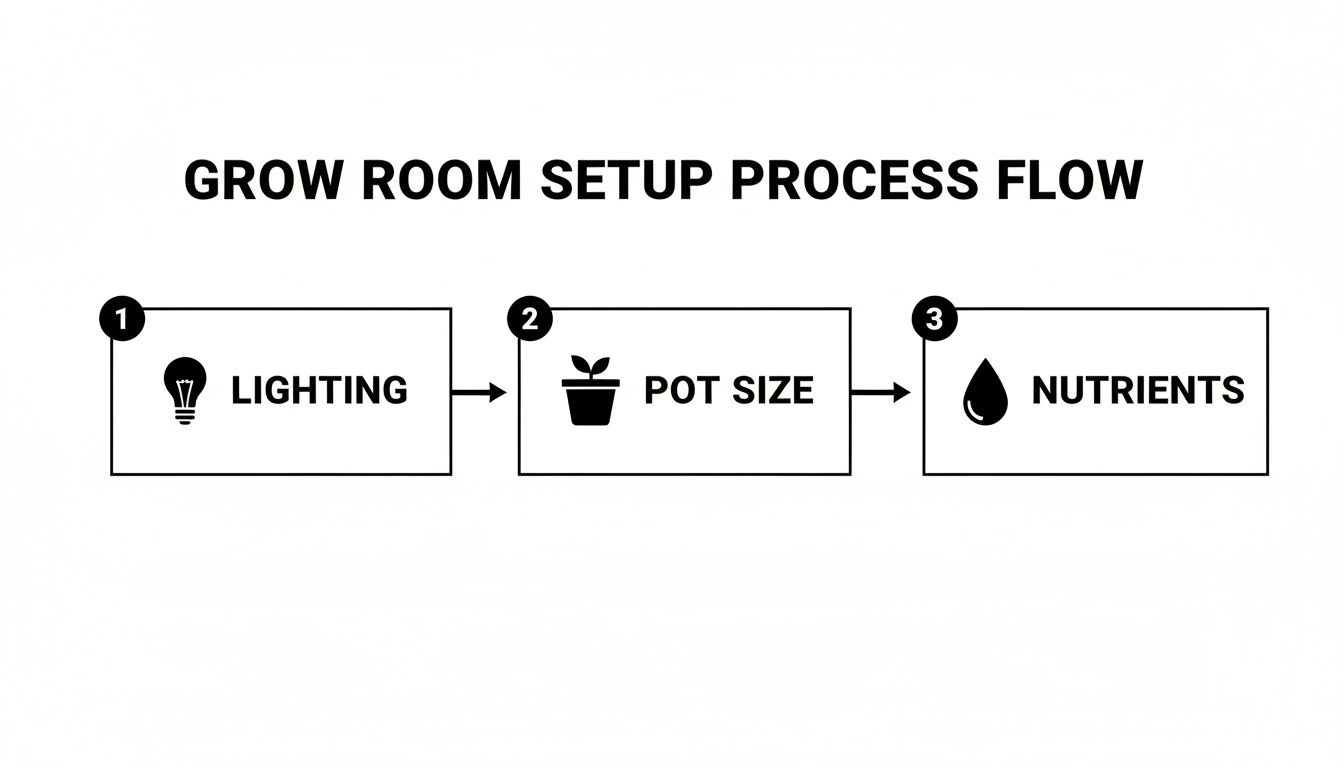
These three elements, lighting, pot size, and nutrients, are the foundation of a successful SOG. They work in tandem to create the perfect environment for your tightly packed canopy to thrive.
When to Flip and Final Pruning
The "flip" is simply when you switch your light schedule to 12 hours on and 12 hours off. For photoperiod-sensitive plants, this change in light is the biological trigger to stop vegetative growth and start making flowers. With a SOG, this happens incredibly fast, usually after just 1-2 weeks from sprout. You’re just looking for them to get tall enough to form a solid main cola, and that’s it. You can learn more about what this entails in our guide on the growth or veg phase.
Here’s a practical timeline to keep it simple:
- Final Prune: Do your major lollipopping session either the day before you flip the lights or within the first week of the 12/12 cycle. This is your one big chance to clean up the plant bottoms without causing too much stress.
- The Flip (Feminized Seeds): After that short 1-2 week veg period, switch your timer to 12/12. This is the moment that kicks off flowering.
- Autoflower Approach: If you’re running autoflowers, things are even simpler. Just keep your lights on an 18/6 or 20/4 schedule for their whole life. They’ll start flowering on their own, but you should still perform that same lollipopping cleanup around week three or four from sprout.
The key is one aggressive pruning early on, and then hands off. Constantly picking at your plants throughout the flowering stage can stress them out and ultimately reduce your yield. Trust the process and let them do their thing.
This intentional management is what transforms a collection of small, individual plants into a single, cohesive, and highly productive sea of green. By being deliberate with your pruning and timing, you ensure every plant pulls its weight, contributing to a canopy that’s as impressive as it is bountiful.
Harvesting Your SOG and Common Mistakes to Avoid
This is the moment every grower looks forward to. After weeks of careful work, that dense, even carpet of green is ready, and it's time to reap the benefits. Harvesting a sea of green can look like a huge job because of the sheer plant count, but it's actually much more straightforward than tackling a few monster plants with dozens of tangled side branches.
The whole process becomes a simple, repeatable rhythm: snip the main cola, do a quick trim, and move on to the next one. The trick is knowing the perfect time to start. You’ll need a jeweler's loupe or a digital microscope to get a close look at the trichomes. When they've shifted from glassy and clear to mostly milky-white with just a touch of amber popping up, you've hit the peak harvest window. Our full guide on when to harvest your plants dives deep into getting this timing just right.
Setting Realistic Yield Expectations
So, what can you actually expect to pull from a SOG setup? This is where the method’s efficiency really pays off. While every grow is different, influenced by your light, genetics, and environment, SOG is famous for being an incredibly productive use of space.
With a well-dialed-in system, experienced growers can push their yields up to an impressive 1.5 grams per watt of light. Compare that to the 0.5 grams per watt that's more typical for traditional growing styles, and you're looking at a potential 300% increase in output from the exact same footprint. Even if you're new to this, aiming for 0.75 grams per watt is a completely reasonable and achievable goal.
For the home grower, this means more flower, more often. You're getting the absolute most out of your tent and your electricity bill, which is what building a sustainable personal supply is all about.
Common SOG Mistakes to Sidestep
Getting that first SOG harvest under your belt is an amazing feeling, but a few common hurdles can trip up even seasoned growers. Knowing what they are ahead of time makes them easy to avoid.
Choosing the Wrong Cultivar: This is, without a doubt, the number one mistake. Cultivars that are genetically programmed to grow wide and bushy will just fight you the whole way, creating a chaotic, shaded-out mess. You have to start with genetics that naturally focus their energy on a dominant central cola.
Overcrowding Your Space: It’s so tempting to cram in just one more plant, but you have to resist. Without proper airflow between plants, you’re just asking for mold and mildew. If you can’t see the floor of your tent between the pots, you’ve likely packed them in too tight.
Uneven Light Coverage: A SOG canopy lives and dies by its light source. If your light has a powerful "hot spot" in the middle and weak output at the edges, the corner plants will stretch for light and the whole canopy will become uneven. A quality LED that provides a uniform PAR map from corner to corner is a must-have.
The most successful SOG grows feel less like managing individual plants and more like tending to a single, unified organism. Every decision, from cultivar choice to light placement, should support that uniform canopy.
Another classic error is vegetating for too long. The veg stage in a SOG is brutally short, often just 1-2 weeks for feminized seeds. If you let them get too big before you flip the lights to a 12/12 cycle, they will stretch too much in early flower. This leaves you with lanky, sparse plants instead of the short, dense colas you were aiming for.
By keeping these potential pitfalls in mind, you’re setting yourself up for a harvest that’s not just big, but also a breeze to process.
Answering Your SOG Questions
Once you get the theory behind the Sea of Green, you start running into the practical questions. It's a simple method on paper, but a little know-how goes a long way in the grow room. Let's clear up some of the most common things growers ask when they're getting started.
Can I Run a Sea of Green with Autoflowers?
You absolutely can, and honestly, they're a fantastic choice for it. Autoflowers are practically built for the sea of green method. Their tendency to grow a single, fat main cola, stay on the smaller side, and finish up fast aligns perfectly with the entire SOG philosophy.
The best part? You just plant them and let them go. There's no flipping light schedules to worry about, which takes a major variable out of the equation. For the best results, look for autoflower cultivars specifically described as having that classic, strong central growth.
What's the Right Plant Count for a 4×4 Tent?
This is probably the number one question we hear. For a standard 4×4 foot tent, you're usually looking at a SOG setup with anywhere from 9 to 16 plants. The final number really comes down to the pot size you choose.
A solid, reliable starting point is using 3-gallon square pots. You can fit 9 plants in a clean three-by-three grid, giving each one plenty of room. If you're feeling ambitious and want to maximize your numbers, you can switch to smaller 1 or 2-gallon pots and comfortably fit 16 plants.
The key is to avoid packing them in so tightly that they're fighting for light and air. You want every main cola to get blasted with direct light and have enough airflow to prevent issues down the line. A little breathing room makes a huge difference.
Should I Use Seeds or Clones for SOG?
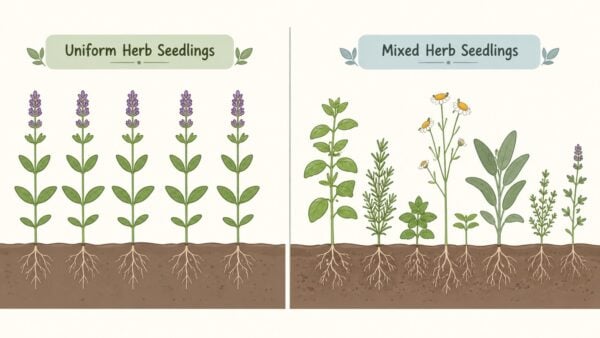
While the old-school way was to use clones for their perfect uniformity, modern genetics have really changed the game. You can get incredible results using seeds, as long as you know what to look for.
The trick is to start with high-quality feminized or autoflower seeds from the same batch. Genetics from a trusted source like Botanist Seeds are so stable these days that the plants grow with more than enough consistency for a beautiful SOG canopy. Plus, starting from seed means you don't have to deal with maintaining a mother plant or sourcing clones, which makes the whole process much more straightforward.
Is SOG Better Than SCROG?
One isn't "better," they're just different strategies for different goals. It all boils down to what you're trying to achieve with your harvest.
- SOG (Sea of Green): This method is all about speed and turnaround time. You grow many small plants with a very short veg period to get a harvest as quickly as possible.
- SCROG (Screen of Green): This method is about maximizing yield from just a few plants. It involves a much longer vegetative stage where you train branches through a screen to create a massive, even canopy.
If your main priority is keeping your jars full with quick, consistent harvests, SOG is definitely the technique for you.
Ready to start your own Sea of Green? Finding the right genetics is the first, most important step. Take a look at the Botanist Seeds catalog to find the perfect Indica-dominant and autoflower cultivars for your next run. https://botanistseeds.com