




Mold Resistant Strains: Your 2026 Guide to Rot-Free Harvests
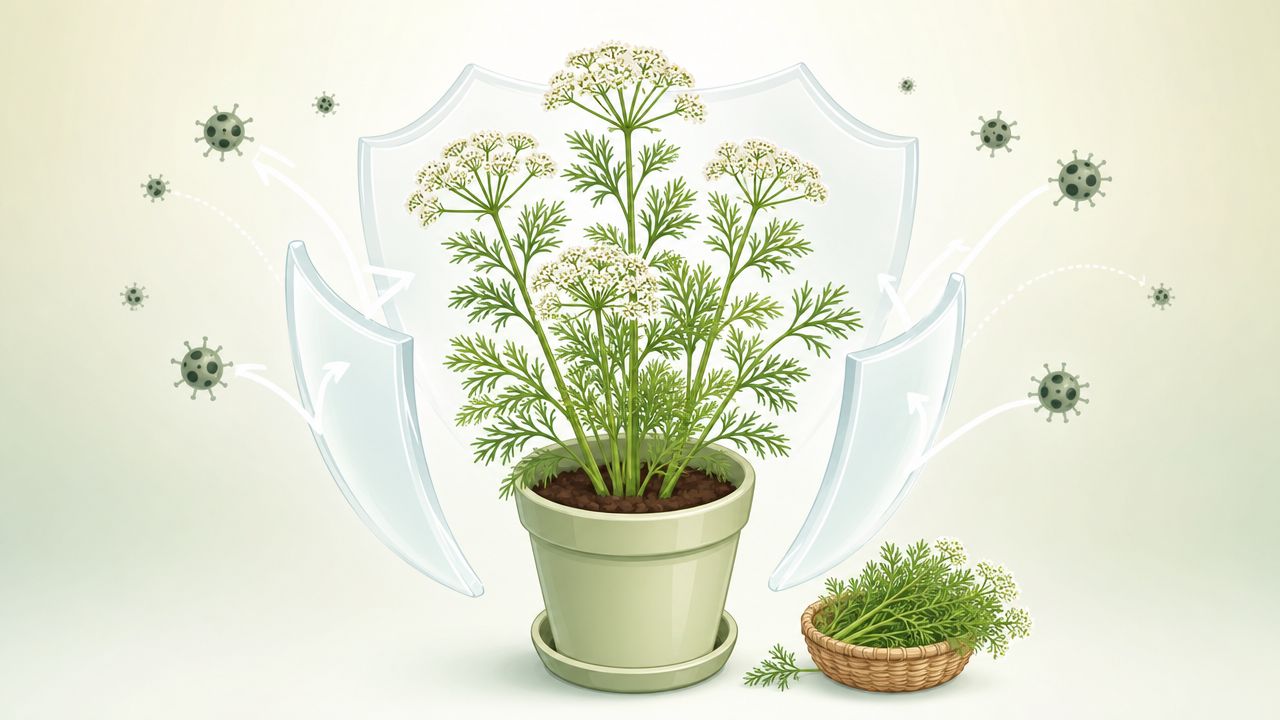
You're a couple of weeks from harvest, the flowers look great, and then the weather turns sticky or your tent starts feeling a little too still. That's the moment a lot of growers get nervous, because mold doesn't usually show up when the plant is struggling early. It shows up when everything looked fine yesterday.
The good news is that you can stack the odds in your favor. The bad news is that there's no such thing as a mold-proof plant. Mold resistant strains reduce risk, they don't erase it. If you want a clean finish, you need two things working together: the right cultivar and a grow space that doesn't hand mold an easy win.
Most articles stop at a list of names. That's useful up to a point, but it doesn't teach you how to think. If you understand why certain cultivars handle wet conditions better, you can make smarter choices for your own room, greenhouse, or backyard instead of gambling on marketing copy.
Protecting Your Harvest Before It Starts
Late flower is where growers get punished for cutting corners. A cultivar can look vigorous, smell great, stack nicely, and still end up with rot if moisture hangs around inside dense buds or in a crowded canopy. That's why the best time to think about mold isn't after you spot it. It's when you're choosing seeds and setting up your environment.
A lot of beginners shop for mold resistant strains like they're buying a guaranteed feature. They see terms like “highly resistant” and assume the problem is solved. It doesn't work that way. Resistance is more like a head start. It gives you a plant that's less likely to trap moisture and more likely to handle rough weather, but you still have to grow it well.
Practical rule: Pick genetics for your climate first, then build your room around protecting airflow and keeping moisture from settling into the flowers.
If you grow outdoors in a place with wet mornings, late season rain, or heavy dew, you need cultivars with structure that sheds moisture better. If you grow indoors, you need to stop thinking that four walls and a light automatically mean control. Mold loves stale corners, overgrown plants, and sloppy humidity habits.
Keep these three ideas in your head from day one:
- Choose for structure: Open, airy cultivars usually give mold fewer places to get established.
- Control your room: Fans, humidity management, cleanup, and pruning matter just as much as seed choice.
- Act early: Mold is much easier to prevent than to fix once flowers are deep into ripening.
That's the actual approach. Not hype, not miracle cultivars, not wishful thinking.
What Actually Makes a Cultivar Mold Resistant
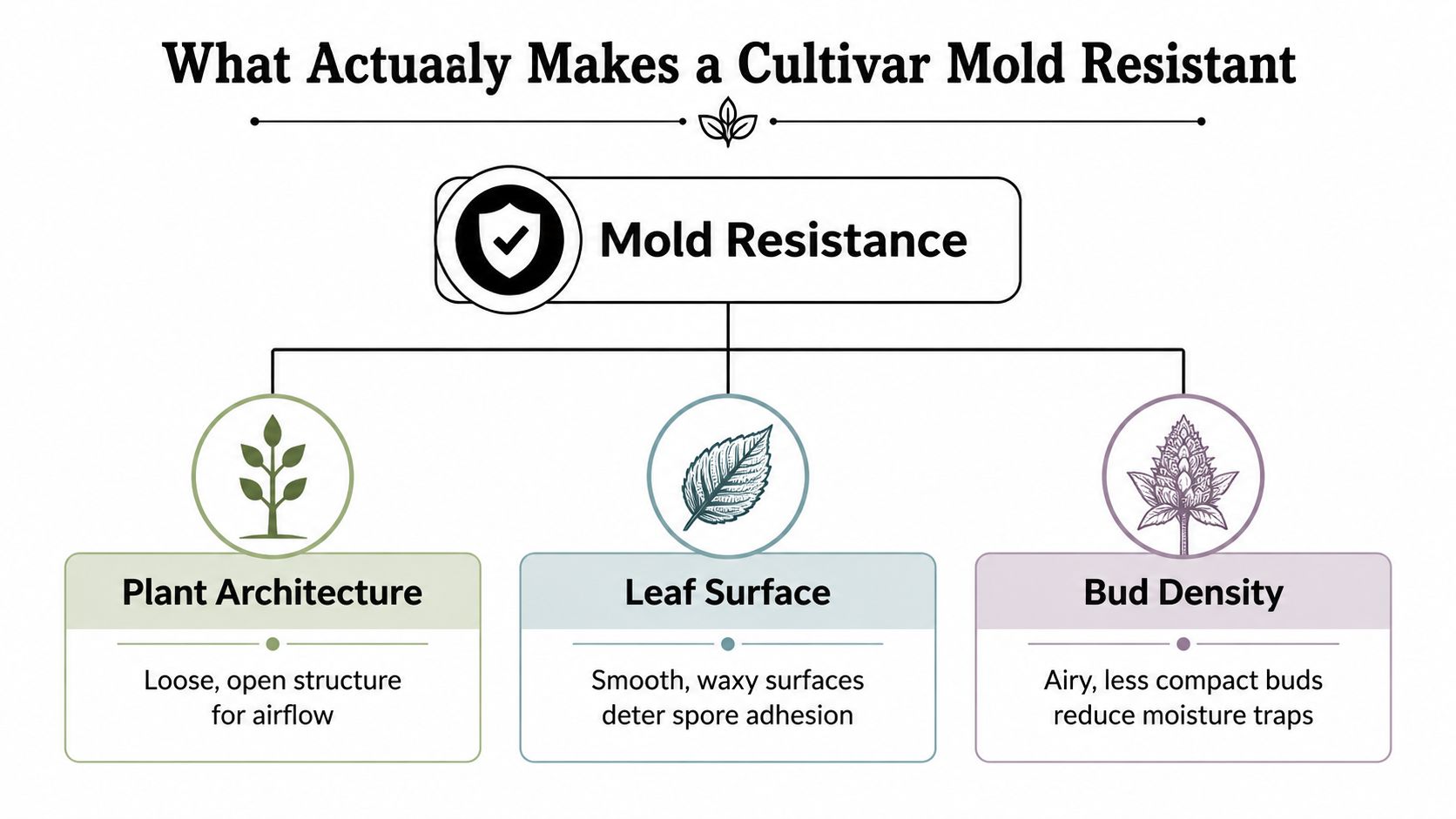
“Mold resistant” usually comes down to genetics expressed through plant structure. The useful question isn't “Which name on a list is best?” It's “What does this plant physically look like, and does that shape help moisture leave the canopy fast?”
According to a seed bank’s overview of mold resistant cultivars, many resistant lines trace back to humid regions of Asia and Central America, where landraces adapted over generations to wet conditions. The traits tied to that history are wider internodal spacing, airier buds, and higher resin production, and those traits lower risk by reducing the moisture trapped in flowers.
Architecture matters more than hype
Consider two houses after a rainstorm. One has good ventilation, open spacing, and air moving through it. The other is packed tight with damp corners and nowhere for moisture to escape. Cannabis flowers behave the same way.
Dense, chunky buds can be beautiful, but in a humid setup they can also act like little moisture traps. Airier flowers don't hold that same dampness for as long, especially when the plant also has more room between branches.
That's why sativa leaning and landrace derived cultivars often get recommended for humid climates. It's not because they're magical. It's because their shape often works better in wet conditions. A seed bank’s explanation of mold resistant traits makes this point clearly, linking lower bud rot and mildew risk to more internodal spacing, looser floral structure, and less tightly packed buds.
What to actually look for
When you read a cultivar description, ignore the dramatic promises and look for clues about form.
Good signs include:
- Open branch spacing: More room between nodes usually means better airflow through the plant.
- Airier flower structure: Not every grower wants fluffy buds, but they often dry off faster in risky weather.
- Resin heavy flowers: Resin gets talked about for aroma and bag appeal, but it's also commonly associated with harder, more weather-tolerant lines in resistant genetics.
Less helpful signs include:
- Pure marketing language: “Super resistant” without any mention of structure doesn't tell you much.
- Very compact growth with very dense buds: That setup can work fine in a dialed room, but it gives you less margin for error.
- Descriptions that only focus on potency or yield: Nice to know, not useful for mold prevention.
A cultivar can be resistant because of how it grows, not because somebody gave it a catchy label.
Resistance is always relative
This is the part growers need to hear. There isn't one mold-proof gene that overrides a bad environment. The whole point of resistant cultivars is that they buy you tolerance, not immunity.
If your room stays muggy, your canopy is too thick, dead leaves pile up, and buds never get moving air, even a smart genetic pick can still fail. On the flip side, a well-managed space can carry a moderately resistant cultivar a lot farther than anticipated.
Once you understand that, seed shopping gets easier. You stop chasing claims and start reading plants.
Your Grow Space Is Your First Line of Defense
A solid cultivar helps, but your grow space decides whether that advantage means anything. I've seen growers blame genetics for mold when the problem was a packed tent, weak air movement, and humidity drifting around unchecked late in flower.
Good growers separate themselves through their actions. They don't just buy “mold resistant strains” and hope for the best. They build a room that makes life hard for mold every single day.
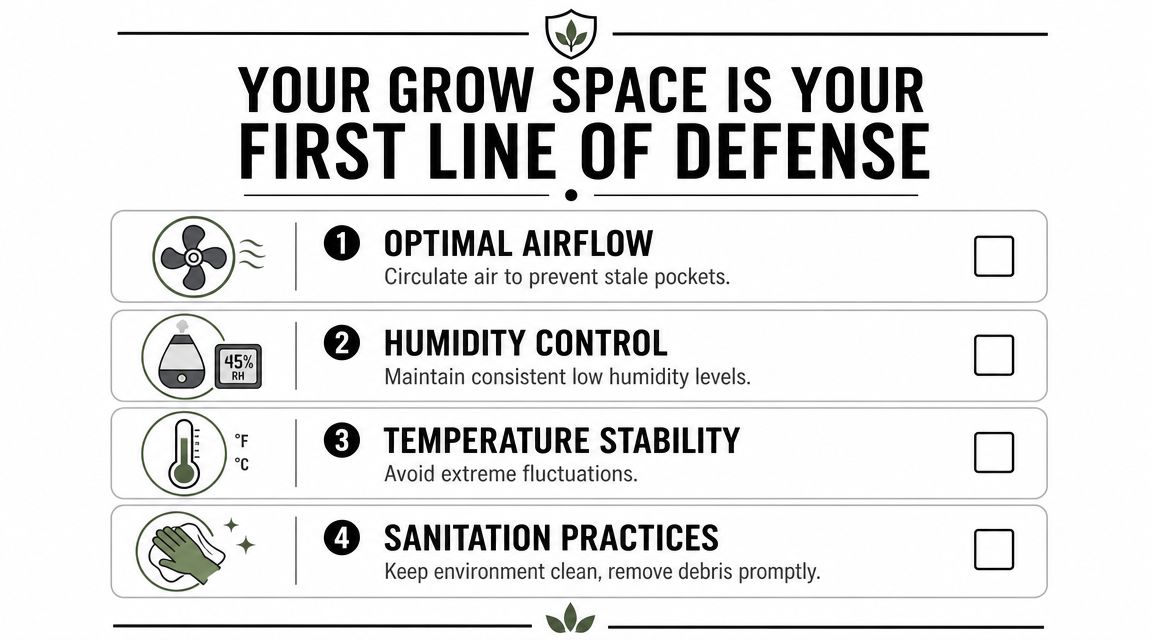
A simple checklist helps keep the basics tight.
Humidity needs active management
Professional cultivation guidance highlighted by a seed bank’s article on mold resistant cannabis recommends keeping relative humidity at 40–60% during vegetative growth and 40–50% during flowering. That matters even if you're running a resistant cultivar, because breeders and growers are both addressing the same problem from different angles.
If your room swings around outside those ranges, don't shrug it off. Check your dehumidifier, ventilation, and watering habits. If you're still dialing in the balance between temperature and moisture, a good VPD chart for weed makes it easier to understand how the room is behaving.
Air movement beats stale pockets
Fans aren't there just to make leaves wiggle. Their job is to stop damp, still air from sitting inside the canopy. That's where mold gets comfortable.
What works:
- Oscillating airflow: You want moving air around and through the plants, not one fan blasting the same branch all day.
- Clear space under the canopy: Clean up the lower growth that never sees useful light and just blocks circulation.
- Reasonable plant spacing: If every plant is touching the next one, moisture sticks around longer.
What doesn't:
- A crowded jungle look: It might seem productive, but packed foliage creates shaded, humid zones.
- One weak clip fan in a full tent: Better than nothing, not enough for heavy flowering plants.
- Letting runoff, wet trays, or dead leaf matter sit around: Mold doesn't need an engraved invitation.
Here's a useful walkthrough if you want a visual reset on room control:
Prune with airflow in mind
A lot of growers defoliate for light penetration alone. That's only half the job. You're also trying to create channels where air can move and moisture can leave.
Use a restrained approach:
- Remove leaves that are stacked on top of each other and creating damp shade in the middle of the plant.
- Thin crowded interior growth that won't develop well anyway.
- Keep checking after stretch because a tidy plant in early flower can become a crowded one fast.
Grower mindset: Environmental control isn't a backup plan for weak genetics. It's what allows good genetics to finish clean.
How to Spot a Genuinely Resistant Cultivar
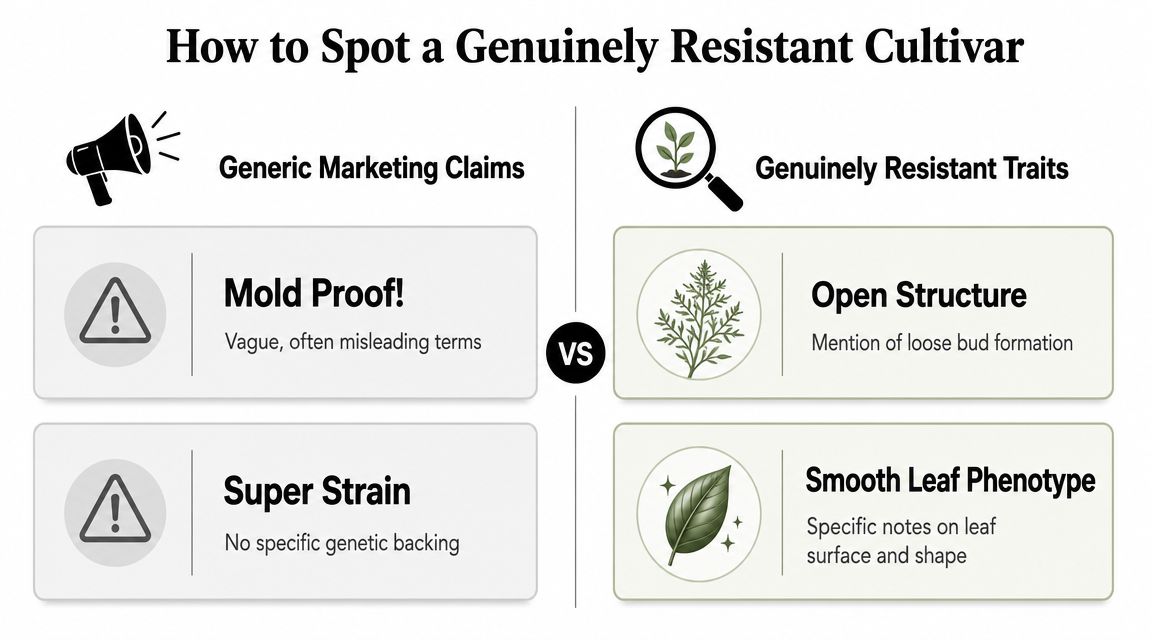
The seed market is full of big claims and thin details. That's especially true with mold resistance. A lot of listings promise protection, but they never explain what resistance means, what traits support it, or where the cultivar tends to perform best.
That's why you need to read descriptions like a grower, not like a shopper.
Read past the label
If a listing says “mold resistant,” ask what in the plant supports that claim.
A better description might mention:
- Open structure
- Looser bud formation
- Sativa leaning growth habit
- Outdoor suitability in damp climates
- Autoflower speed for finishing before ugly weather settles in
A weaker description usually leans on slogans. If all you get is “excellent resistance” with no detail, you still don't know whether the cultivar resists moisture because of shape, speed, or just breeder confidence.
There's also value in understanding phenotype variation in cannabis, because even within a cultivar family, the way a plant expresses itself can change how much airflow and density you're dealing with.
Classics versus modern F1s
There's a real split in the market right now between trusted legacy cultivars and newer F1 hybrids. Both can make sense. They just answer slightly different grower needs.
According to Green Avengers' discussion of mold resistant strains for humid summers, Northern Lights Auto has a long reputation for usefulness and decades of proven value in resistant breeding, while newer F1 hybrids like Hyperion F1 and Apollo F1 are marketed as being “better equipped” to handle pests and diseases like Botrytis. The catch is that real-world comparative data is still emerging.
Here's the practical breakdown:
| Type | What it offers | Trade-off |
|---|---|---|
| Legacy cultivars | Familiar performance, lots of grower history, easier to research | Older reputation can turn into folklore if details are vague |
| Modern F1 hybrids | More uniformity and strong breeder focus on resilience | Claims may get ahead of independent real-world comparisons |
Good questions to ask before you buy
Not every grower needs the newest release. Not every classic is still the right fit either.
Ask these before choosing:
- What climate am I fighting? Wet outdoor fall, coastal humidity, basement tent moisture, greenhouse condensation.
- Do I want speed or size? Autoflowers can help dodge bad weather windows. Larger photoperiod cultivars may need more canopy work.
- Does the listing describe structure clearly? If it doesn't, assume you'll need more hands-on management.
- Is this cultivar known for density? If yes, be honest about whether your environment is controlled enough to support it.
The smart move is to match cultivar behavior to your setup, not to buy based on the loudest promise.
Troubleshooting Mold When It Still Appears
Even careful growers can run into trouble. A humid spell outdoors, a dehumidifier issue, a packed cola you should've opened up sooner. When you spot mold, the job is damage control. Stay calm and move fast.
What early trouble looks like
The first signs are usually subtle. A sugar leaf looks dead for no obvious reason. A section of a bud turns dull, grayish, or oddly soft. Powdery mildew can show up as a dusty coating on leaf surfaces, while bud rot often hides inside the flower before you fully see it from the outside.
Trust your instincts if something looks off. Healthy flowers don't suddenly collapse in one small patch for no reason.
If one bud looks suspicious, inspect the ones touching it next. Mold rarely respects your wishful thinking.
What to do right away
Don't squeeze the affected bud and don't start waving it around while you inspect it. The goal is to limit spread.
Take these steps:
- Isolate the area: Stop brushing against nearby flowers and keep your hands and tools clean.
- Remove affected material carefully: Cut well beyond the visibly damaged part so you're not leaving questionable tissue behind.
- Bag and discard it immediately: Don't toss infected plant matter on the floor or leave it in the room.
- Increase airflow at once: Open the canopy, improve circulation, and get rid of stagnant pockets.
- Lower humidity fast: If your room has drifted too high, correct it the same day.
Know when to cut losses
Small, caught-early spots can sometimes be contained. A plant with multiple infected tops or obvious spread deep into the canopy is a different story. At that point, saving one plant can put the rest of the harvest at risk.
Use common sense over attachment:
- Cull heavily affected plants if they threaten the room.
- Inspect nearby cultivars closely because spores don't stay politely in one place.
- Review what caused it after the emergency is handled. Usually it's density, stale air, excess moisture, or delayed harvest.
Mold punishes hesitation. Decisive action gives the rest of your crop a chance.
Find Your Perfect Cultivar at Botanist Seeds
Most growers don't need more strain lists. They need better filters for making decisions. If you've made it this far, you already know the game. You're not looking for a fantasy plant that never molds. You're looking for a cultivar whose structure, finish time, and growth style fit your space and climate.
That matters because a humid outdoor grow in the Northeast is a different challenge than a small tent in a warm spare room. One grower needs an airy plant that handles wet mornings. Another needs an autoflower that finishes before a bad weather stretch. Another needs a dependable feminized cultivar that won't turn into a thick wall of foliage by week five.

What smart selection looks like
The market still has a transparency problem. As noted in a seed bank’s discussion of mold resistant cannabis strains, a lot of coverage leans on anecdotal breeder claims like “highly resistant” without defining what that means or showing how much risk is reduced. That's why growers keep ending up with generic promises instead of useful detail.
A better way to choose is to weigh a few practical points at the same time:
- Your local moisture pressure: Rain, dew, coastal air, basement humidity, greenhouse condensation.
- Your grow style: Indoor, outdoor, balcony, tent, or greenhouse.
- Your tolerance for maintenance: Some cultivars are forgiving. Others need more pruning and spacing discipline.
- Your preference for feminized or autoflower seeds: Both can simplify the path to a successful harvest, especially when you want a cleaner, more predictable home grow.
Use the details that actually matter
If you're comparing cultivars, don't get distracted by flashy naming or one-line claims. Look for descriptions that tell you how the plant grows, how compact it gets, whether the buds run dense or open, and whether the cultivar is a good fit for damp conditions.
That's also why using a seed source with better catalog structure matters. A site that helps you compare growth patterns, flowering behavior, and cultivation traits saves time and helps you avoid buying a cultivar that fights your environment from day one. If you care about how the seed market is evolving toward more transparency and better shopping tools, this look at the premium seed market is worth a read.
The best mold resistant strain is the one that fits your setup
This is the part people skip. A cultivar that performs well in one garden can still be the wrong move in another. If your room runs humid and crowded, a super dense plant is going to ask more from you. If your outdoor season gets rough late, a faster autoflower or a more open plant may be the smarter play.
The upside is simple. Once you know what to look for, you stop guessing.
You start picking cultivars based on:
- Structure over slogans
- Climate fit over hype
- Manageability over bragging rights
- Reliable feminized and autoflower genetics over unnecessary complications
That's how you get to a harvest you're proud of. Fewer surprises, fewer losses, less money burned on the wrong pick, and a lot less chance of watching great flowers go bad right at the finish line.
If you want help choosing a cultivar that matches your grow style, browse Botanist Seeds. Their comparison tools, detailed listings, and focus on dependable feminized and autoflower genetics make it easier to sort through the noise and find a smart fit for your next run.