Mastering the vpd chart weed in 2026
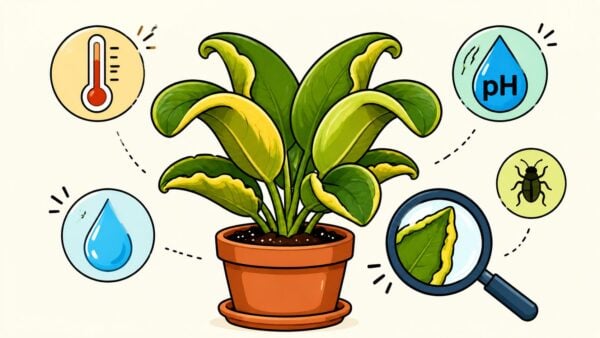
You’ve probably had this moment already. Your tent looks dialed. The temp is steady, the humidity seems reasonable, your lights are set, and your feminized or autoflower plants are doing okay. But only okay.
They aren’t falling apart, but they also aren’t giving you that locked-in, vigorous look that makes you stop and grin. Growth feels decent, not sharp. Leaves look fine, not happy. Bud development is moving, not stacking the way you hoped.
That’s where vpd chart weed searches usually start. Not because growers want more science homework, but because basic temperature and humidity targets stop being enough after a while. Once you realize your environment can look “right” and still feel off to the plant, VPD starts making sense fast.
Why Your Perfect Temperature Isnt Perfect
A lot of home growers get told some version of this: keep the room warm, keep humidity in range, and you’re good. That advice isn’t wrong. It’s just incomplete.
Take a common tent setup. Air sits at 75°F and humidity sits at 50%. On paper, that sounds solid. But plants don’t experience your room the way your wall monitor does. They experience the air through their leaves, through water movement, and through how hard they have to work to stay balanced.
When fine isnt the same as thriving
This is why two growers can run the same cultivar at the same air temperature and get different results. One gets steady growth. The other gets that upright, energetic posture that makes the whole canopy look switched on.
The missing piece is often Vapor Pressure Deficit, or VPD. It sounds technical, but the idea is simple. VPD tells you how strongly the air is pulling moisture from the plant.
If that pull is too weak, the plant gets lazy. If the pull is too strong, the plant gets stressed. The sweet spot is where transpiration moves at a pace the plant can use.
Your room can be comfortable for you and still be slightly off for the plant.
That’s why a VPD chart matters. It turns random climate tweaking into something intentional. You stop guessing whether you should raise humidity, lower it, or leave it alone.
Why small tent growers should care
This isn’t just for giant commercial rooms with expensive automation. In a small tent, little changes hit harder. A fan adjustment, a humidifier kick-on, or a warm afternoon can shift the plant’s whole experience.
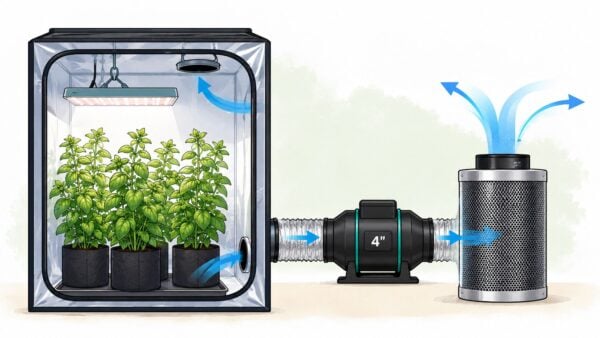
If you’re building out or refining your setup, a practical guide to grow rooms for weed helps because room design affects how easy VPD is to control in the first place.
Here’s the useful mindset:
- Temperature is one input: It matters, but it doesn’t tell the full story.
- Humidity is another input: Same deal.
- VPD combines them: It gives you a better read on what the plant is dealing with.
- Plant response is the ultimate test: The chart guides you, the leaves confirm it.
Once that clicks, you stop chasing “perfect room numbers” and start creating conditions your plants can use.
What Exactly Is VPD Anyway
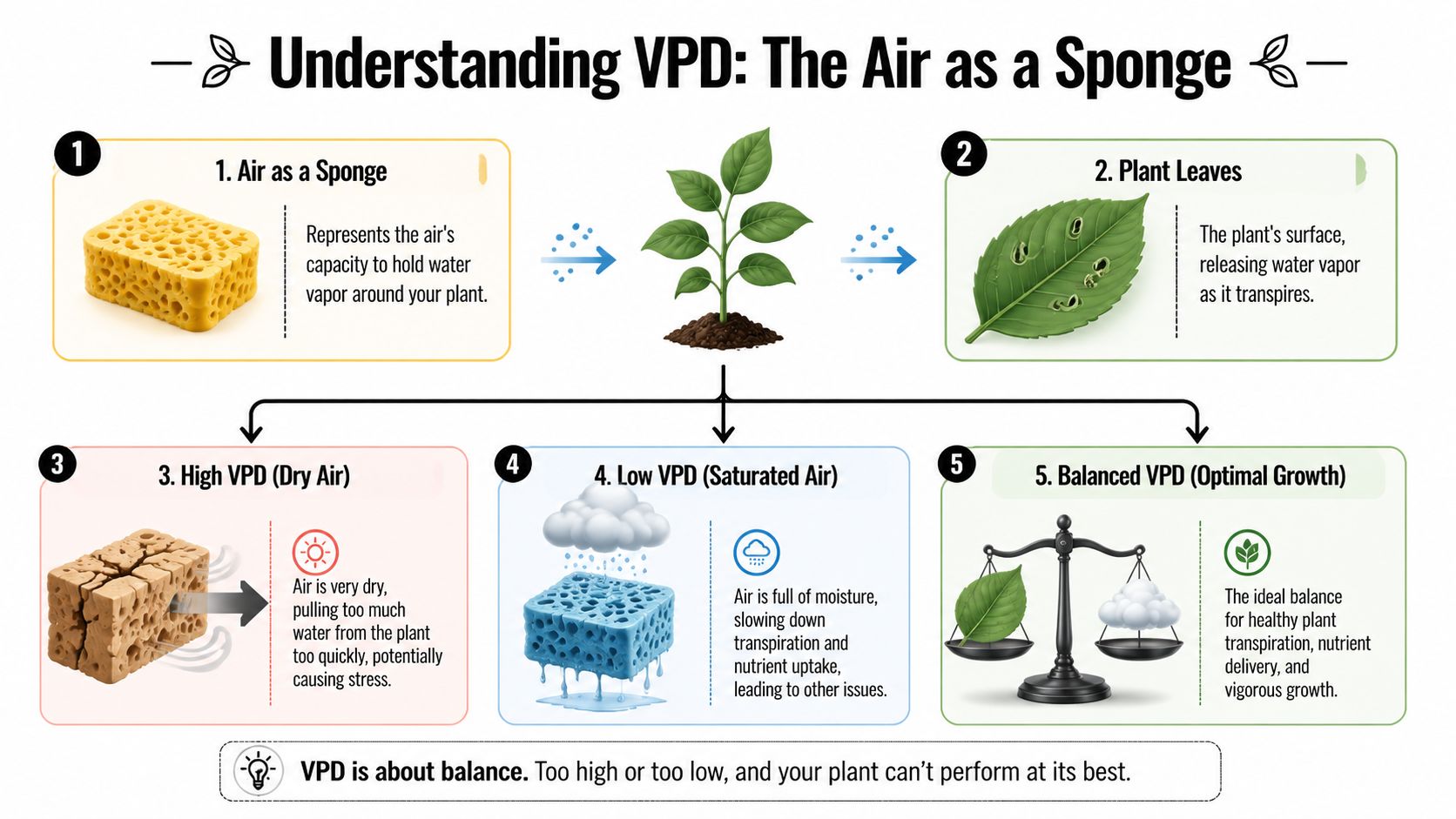
VPD sounds like one of those terms designed to make simple things seem harder than they are. It isn’t. Imagine the air in your tent is a sponge.
A dry sponge can soak up a lot of water. A damp sponge can’t take much more. Your leaves release water vapor all day through tiny openings, and the air around them either accepts that moisture easily or resists it.
The sponge analogy that makes it click
If the air is very dry, the sponge is thirsty. It pulls moisture from the leaves fast. That means high VPD.
If the air is already loaded with moisture, the sponge is basically saturated. Water doesn’t leave the leaf as easily. That means low VPD.
The best zone sits in the middle. The plant can transpire at a healthy pace, pull water and nutrients upward, and keep exchanging gases without fighting the room.
Why transpiration matters so much
Transpiration is just the plant moving water out through the leaves. But that simple process powers a lot:
- Nutrient movement: Water helps carry nutrients from the root zone upward.
- Cooling: The plant sheds heat through moisture loss.
- Gas exchange: Healthy stomata support CO2 uptake.
- Growth rhythm: A plant in balance tends to build better structure and stronger momentum.
That’s why VPD isn’t some side metric. It sits right in the middle of how the plant functions.
According to Pulse Grow’s guide to VPD, precise VPD management can boost cannabis yields by 20% or more by optimizing transpiration rates, which fuel photosynthesis, improve nutrient uptake, and reduce stress-induced losses in bud size and quality.
What high and low VPD feel like in real life
You don’t need to memorize formulas to use a vpd chart weed grower style. You just need to understand the behavior.
When VPD is too high
The air is pulling hard. Plants can lose moisture faster than they want to. They may look tense, edges can feel less relaxed, and growth can lose that easy, vigorous feel.
When VPD is too low
The air is too damp. Moisture doesn’t move off the leaf surface efficiently. The plant slows down, and your room can start feeling muggy in a way that invites trouble.
When VPD is balanced
Everything tends to look smoother. Leaves sit with purpose. Growth feels efficient. The plant isn’t struggling to conserve water, and it isn’t stuck in stale, wet air either.
Practical rule: VPD is not about making the room “dry” or “humid.” It’s about making the air thirsty enough to keep the plant working, but not so thirsty that it panics.
If you want one sentence to remember over a beer, use this one: VPD measures how hard the air is asking your plant to sweat.
Your Ultimate Cannabis VPD Charts
You’re standing in front of a small tent, the thermometer says the room is fine, and the hygrometer says humidity looks fine too. The plants still seem a little off. That is the moment a VPD chart starts earning its keep.
A good chart turns two separate readings, temperature and relative humidity, into one practical answer. It shows how hard the air is pulling moisture from the plant right now. For a hobby grower, that matters because you do not need more theory. You need a fast way to check whether your tent is helping the plant cruise or making it work harder than it should.
What the chart is actually showing
A cannabis VPD chart is a grid. Temperature runs one direction. Relative humidity runs the other. Where those two numbers meet, you get a VPD value in kPa.
That single number is easier to use than it looks.
Low values usually mean the air is holding a lot of moisture already, so the plant has a harder time releasing water through its leaves. Higher values mean the air is thirstier, so the plant loses water faster. The sweet spot sits in the middle, where the plant can move water, nutrients, and energy without getting bogged down or pushed too hard.
Your target changes as the plant grows
This is the part that trips up new growers. There is no one perfect VPD for the whole run.
Young plants want softer conditions because their roots and leaf area are still developing. A mature plant in flower can handle, and often prefers, a drier target. Cornell University’s Controlled Environment Agriculture resources note that growers commonly use a VPD range around 0.2 to 0.8 kPa for propagation and 0.8 to 1.2 kPa for production, which gives a solid practical frame for stage-based growing in a tent: Cornell CEA guidance on vapor pressure deficit.
Here’s the simple grower version:
| Growth Stage | Ideal VPD (kPa) | Quick Note |
|---|---|---|
| Clones and seedlings | 0.3-0.8 | Keep the air gentle while roots catch up |
| Vegetative growth | 0.8-1.1 | Supports steady transpiration and vigorous leaf growth |
| Early flowering | 1.0-1.2 | A solid middle ground during the transition |
| Late flowering | 1.2-1.5 | Drier air can help dense buds finish cleaner |
These ranges are practical targets, not prison bars. If your chart says you are a little outside the zone for a few hours, that does not mean the grow is ruined. It means you know what to adjust.
Use the chart like a tent-side cheat sheet
The best way to use a VPD chart is almost boring. Print it. Save it on your phone. Tape it to the wall beside the zipper.
Then when your tent is at, say, 82°F and 70% RH, you can stop guessing. You look at the chart, find the intersection, and compare that number to the stage your plant is in. That keeps you from making random changes because the room feels muggy or dry.
That is the win here. A VPD chart takes a dense plant science topic and turns it into a quick, practical check. For a small home grow, that kind of clarity is how you stack more healthy days in a row, and healthy days are what turn into the kind of harvest you are proud to say you grew yourself.
How to Read and Use Your VPD Chart
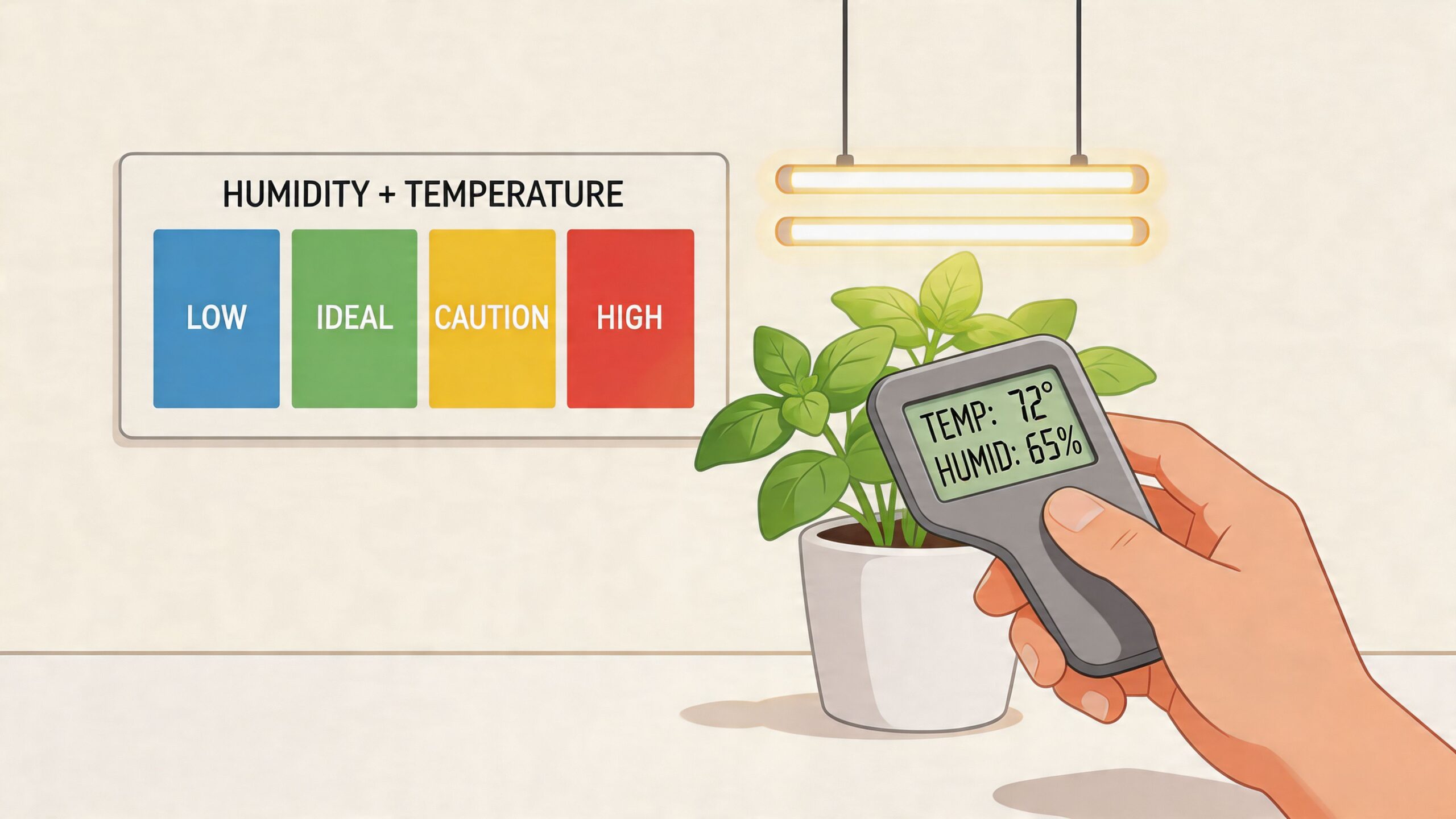
You unzip the tent, check the meter, and see numbers that look fine on their own. Maybe the temperature seems warm but reasonable. Maybe the humidity seems a little high but nothing scary. The chart is what turns those separate readings into one useful answer. Is the air pulling water from the plant too slowly, too fast, or about right for this stage?
That is the whole job.
Start with three inputs: air temperature, relative humidity, and the plant’s growth stage. On the chart, find your temperature on one axis and your humidity on the other. Where those two meet, you get a VPD number. Then compare that number to the target range you already saw earlier for clones, veg, early flower, or late flower.
A simple way to read it is this: the chart tells you how hard the air is tugging on the plant’s moisture.
Low VPD means the air is already holding plenty of water, so the plant does not transpire much. High VPD means the air is thirsty, so the plant loses water faster. Cannabis usually performs best when that tug matches the job the plant is trying to do at that moment.
Read the number, then read the plant
The chart gives you a target. Your plant tells you whether that target is working in your tent.
If your reading falls in range and the plant looks happy, resist the urge to keep fiddling. A lot of home growers lose ground by chasing perfect numbers hour by hour. Good growing usually looks less dramatic than that. You check the chart, make a small correction if needed, and let the plant respond.
That patience matters most in a small tent, where one tweak can swing the whole environment.
How stage changes the target
Clones and seedlings need gentler air because their root system is weak or still forming. In plain English, they cannot drink fast enough to keep up with a dry room. A lower VPD helps them hold onto moisture while they get established.
Veg plants are different. Once the roots are doing real work, the plant can handle more pull from the air. That supports steady transpiration, which helps drive water and nutrients through the plant.
Flower changes the goal again. Early flower still needs balance because the plant is stretching and setting structure. Late flower usually benefits from a drier environment, especially in a crowded tent where thick buds and trapped humidity can become a bad combination. If your room keeps running too wet, this guide on raising humidity in a grow tent without causing bigger problems can also help you understand which side of the moisture problem you are dealing with.
One tent, two different answers
Say your tent is 82°F and 70% RH.
For a clone, that might be acceptable or close enough to useful. For a plant deep in flower, the same reading can leave the room feeling too damp. Nothing about the temperature changed. Nothing about the humidity changed. The plant’s stage changed, so the right answer changed with it.
That is why growers get tripped up when they say, “My tent always runs well at this setting.” A setting is not good by itself. It is only good for a specific stage.
A practical way to use the chart each day
Use the chart like a quick tent-side decision tool:
- Check temperature and humidity at canopy level
- Find the matching VPD on the chart
- Compare it to the target range for the current stage
- Decide whether to leave it alone or make one small adjustment
- Recheck later instead of stacking multiple changes at once
That last part saves a lot of trouble. If you raise the temperature, lower the humidity, and change fan speed all at once, you will not know which move helped and which one made things worse.
The real skill is consistency
Reading a VPD chart is easy after a day or two. Using it well is more like learning how to season food. The chart gives you the range, but good results come from making calm, small corrections and paying attention to how your plants react in your specific tent.
Once that clicks, VPD stops feeling like dense grow-room science. It becomes a simple tool you can use to stack healthy days together. And in a hobby grow, that is what leads to the kind of clean, top-shelf harvest you are proud to say came out of your own tent.
Dialing It In Measuring and Adjusting VPD
Knowing the target is one thing. Hitting it in a tent is the true game.
You do not need a fancy control room to manage VPD well. You need a few reliable tools, consistent habits, and the willingness to make small changes instead of wild swings.
The basic tools that actually matter
Start simple:
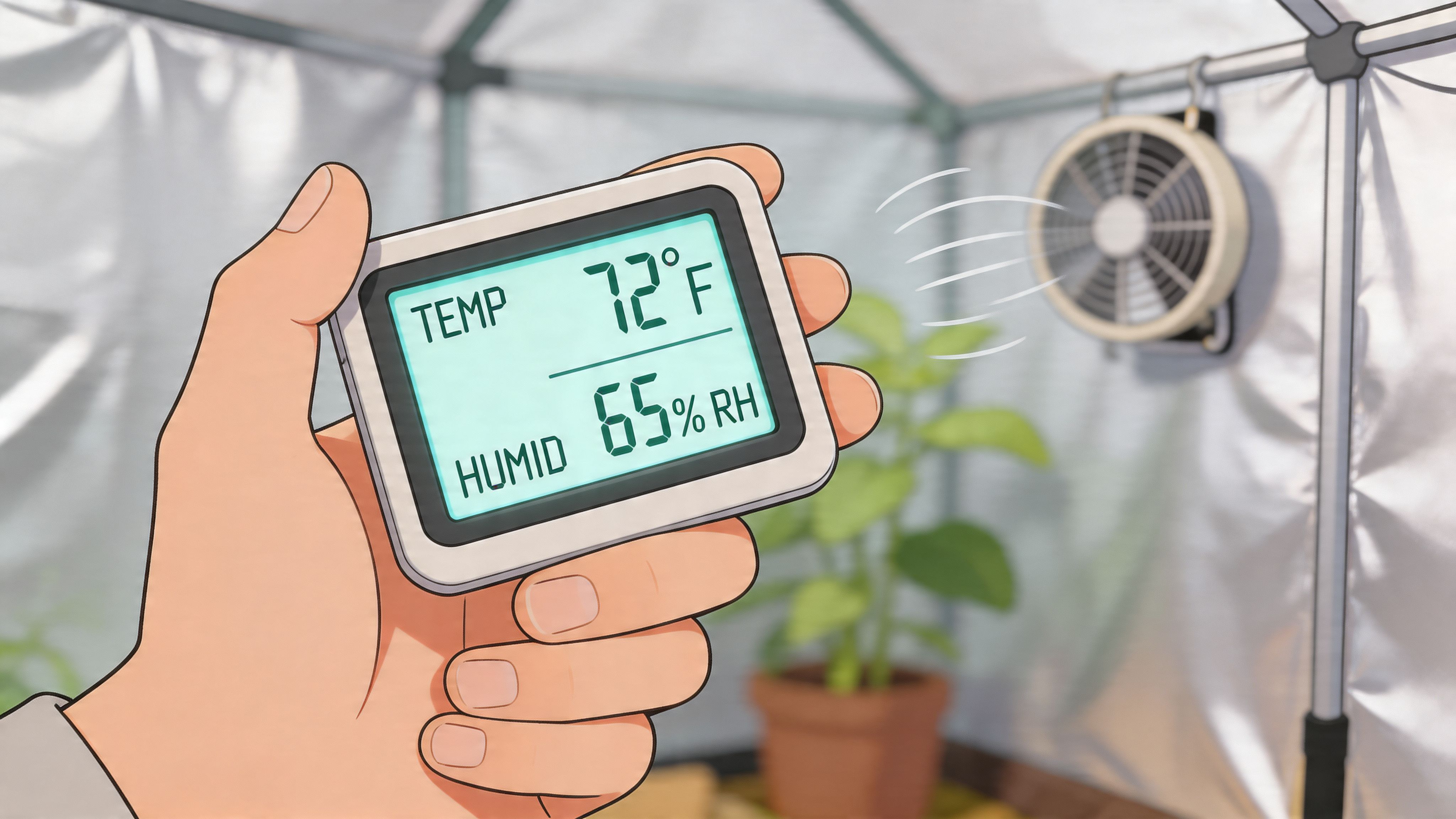
- Digital thermometer and hygrometer: This is essential. If your readings are bad, every VPD decision after that is bad too.
- Infrared temperature gun: This is the affordable upgrade that helps you stop guessing about leaf temperature.
- Humidifier or dehumidifier: Which one you need depends on whether your room runs too dry or too wet.
- Exhaust fan control: Air exchange changes both temperature and humidity, so fan speed matters more than people think.
If your tent keeps drifting dry, this guide on how to raise humidity in a grow tent is a practical place to troubleshoot the usual causes.
Why leaf temperature matters
Here’s where a lot of growers level up. The leaf is often cooler than the surrounding air because it’s transpiring. If you only use air temperature, your chart reading can be off.
According to Gorilla Grow Tent’s VPD chart guide, leaves often run 2-6°F cooler than the surrounding air, and standard air-based charts can overestimate VPD by 0.2-0.4 kPa without this adjustment.
That matters because a room you think is “perfect” may be drier to the plant than you realize.
Quick check: If you grow under strong lighting, point an infrared thermometer at the top leaves and compare that reading with room air before making climate changes.
How to measure without overcomplicating it
Use this routine:
- Check air temperature at canopy level.
- Check relative humidity in the same area.
- Read a leaf with an infrared thermometer from the upper canopy.
- Use a chart that accounts for leaf temperature if you have one.
- Make one adjustment at a time, then give the room time to settle.
That last part is where patience pays off. Tents react quickly, but they also overshoot quickly.
What to do when VPD is too high
When VPD is too high, the air is too thirsty. You want to reduce the pull.
- Add moisture: A humidifier is the obvious fix if the room is dry.
- Back off aggressive exhaust: Fast air exchange can strip humidity out too quickly.
- Lower heat pressure: If the room is running hot, bringing temperature down can help rebalance things.
- Watch leaf response: Don’t just stare at the meter. The plant should look less tense after the adjustment.
What to do when VPD is too low
When VPD is too low, the room is too damp. You want the air to accept moisture more readily.
- Remove moisture: A dehumidifier helps if the room keeps feeling wet.
- Increase air exchange: More turnover usually helps clear stale humidity.
- Raise temperature slightly if appropriate: Warm air changes the balance.
- Thin the jungle effect: A packed canopy can hold moisture around leaves longer than you think.
The best growers treat VPD like steering, not like flipping a switch. Small corrections beat dramatic ones almost every time.
Common VPD Mistakes and Easy Fixes
Most VPD mistakes come from trying too hard, too fast, or too strictly. That’s good news because those are fixable problems.
A chart is a tool. It isn’t the boss of your grow. If you treat the chart like a rigid command and ignore what the plant is showing you, you can end up making the room worse while thinking you’re improving it.
Mistake one, chasing one perfect number
A lot of growers lock onto a single VPD value and try to hold it like it’s sacred. Real tents don’t work that way. Readings drift, equipment cycles, and plants don’t care whether your display looks pretty.
The better move is to stay in the right range for the stage and watch plant behavior. A stable, slightly imperfect room beats a chaotic room that keeps bouncing around while you chase decimal points.
Mistake two, ignoring leaf temperature under LEDs
This one gets people all the time. Strong LEDs can cool leaves enough that air-based readings exaggerate how stressed the plant really is.
According to Spider Farmer’s VPD chart article, using only air VPD overestimates actual plant stress in as many as 40% of LED grows because leaves can run significantly cooler under intense light.
That means some growers are dehumidifying or heating more than they need to.
If you grow under LEDs and your room numbers say “too wet” while the plants look comfortable, check leaf temp before changing the whole setup.
Mistake three, making giant corrections
A tent looks humid, so the grower cranks the exhaust. Then it gets too dry. Then the humidifier gets turned up hard. Then the room swings back the other way.
You can probably see the pattern. The problem isn’t effort. It’s overcorrection.
Easy fixes that work better
- Change one variable at a time: Adjust humidity or temperature first, not both at once if you can avoid it.
- Wait for the room to settle: Give the environment time before judging the result.
- Check at canopy level: Readings from the wrong spot can fool you.
- Track trends, not snapshots: One weird reading doesn’t always mean the room is broken.
Mistake four, forgetting the stage changed
A healthy veg environment can become a sloppy flower environment if you never update your target. This happens a lot with autoflowers because they move quickly and the room can fall behind the plant.
The fix is simple. Tie your VPD target to the plant’s development, not to whatever settings happened to work two weeks ago.
The learning curve here is normal. Every grower has had at least one run where the room looked stable on paper and still didn’t feel right in practice.
Beyond the Basics Strain Specifics and Advanced Tips
Once you’re comfortable reading a vpd chart weed growers use for stage-based targets, another layer opens up. Different cultivars can prefer slightly different handling inside those broad ranges.
That’s where growing gets more fun. You stop treating every plant like a generic template and start noticing personality.
Why cultivar structure matters
Broad-leafed, bushier plants often move moisture differently than taller, airier plants. Canopy density changes airflow, and airflow changes how moisture hangs around the leaves.
According to Scynce LED’s VPD chart discussion, indica-dominant strains often perform better with a 10-20% lower VPD, with an example veg range of 0.7-1.0 kPa, because their denser canopies transpire more slowly.
That doesn’t mean every indica-type cultivar wants the same treatment. It means generic charts are starting points, not final truth.
What that looks like in a home tent
Say you’ve got one squat, broad-leafed cultivar and one taller, more open one. If you force both into the exact same climate target, one may love it while the other just tolerates it.
That’s where observation matters:
- Dense canopies: Often like a little more care around moisture buildup
- Airier plants: Can sometimes handle the upper side of a target range more comfortably
- Fast autos: Need quicker environmental adjustments because they don’t wait around
- Sensitive phenos: Tell you fast when your room is pushing too hard
A cultivar with tight internodes and a chunky frame may appreciate a slightly softer VPD in veg. A stretchier one may respond well to a firmer pull from the air.
Advanced growers use the chart, then personalize it
This is the difference between “following a chart” and learning your garden. You start with the standard range, then you refine based on how that cultivar grows in your room, under your lights, with your airflow.
A cultivar like Modified Grapes is a good example of why structure and expression matter. Plants with distinctive growth habits and aromatic profiles often reward growers who pay attention to environmental nuance instead of using one-size-fits-all settings.
The chart gets you into the neighborhood. Careful observation gets you to the right house.
That’s the rewarding part. You’re not just growing weed. You’re learning how a specific cultivar wants to live.
Your VPD Questions Answered
Do I need an expensive controller to use VPD well
No. A solid thermometer, hygrometer, and consistent check-in routine can take you a long way. Automation is nice, but good habits matter more than gadget collecting.
What if my VPD drifts out of range for a few hours
Usually, that’s not the end of the world. Plants respond more to patterns and consistency than to every short-lived fluctuation. If the room is mostly stable and the plants look good, don’t panic over every little wobble.
Do autoflower cultivars need a different VPD chart
Not really. They follow the same general stage logic as photoperiod plants. The difference is timing. Because autos move fast, you need to notice stage changes sooner and adjust the environment quicker.
Should I trust the chart or the plant
Both, but in the right order. Use the chart to guide decisions, then confirm those decisions by watching the plant. If the room looks ideal on paper and the plant disagrees, investigate instead of forcing the issue.
What’s the biggest beginner takeaway
Keep it simple. Measure accurately. Make small adjustments. Match your target to the growth stage. That’s enough to put you ahead of a lot of growers who are still guessing.
If you want reliable genetics to put these environmental skills to work, Botanist Seeds makes it easy to compare cultivars, shop premium feminized and autoflower seeds, and choose plants that fit your setup instead of fighting it.