Green Crack Strain: A Complete Grow Guide

You’re probably here because you want a cultivar that doesn’t pull you into the couch. A lot of home growers already have a solid evening jar. What’s harder to find is something you want around when you’ve got errands, a project, a long walk, or a house full of people.
That’s where Green Crack Feminized Seeds still earn attention. This cultivar has been around long enough to avoid the “hot new thing” cycle, and that’s part of the appeal. Growers keep coming back to it because it has a clear lane: bright aroma, fast turnaround for a sativa-leaning plant, and a vibe that many people associate with daytime use.
It’s also a cultivar that deserves an honest conversation. “Energetic” sounds great until a grower ends up with a jar they only reach for in very specific situations. Green Crack can be a great fit, but it isn’t for everyone, and that’s exactly why it’s worth understanding before you pop the seeds.
Whats the Deal with Green Crack Anyway
You open a few jars after harvest and realize they all solve the same problem. They slow the night down. That is great at 9 p.m., but not much help when you want something for a Saturday project, a social afternoon, or a long stretch of errands without feeling dulled out.
Green Crack built its reputation because it fills that gap better than a lot of popular home-grow choices. Growers keep it around for a clear reason. It tends to produce the kind of flower people reach for when they want alertness, momentum, and a brighter headspace instead of a heavy reset.
That sounds appealing, and often it is. It also comes with a real trade-off. A high-energy cultivar is only useful if the person using it wants that pace. For some people, Green Crack is a perfect daytime jar. For others, it can feel too sharp, too busy, or too easy to overdo, especially if they already run anxious or prefer a softer mental effect.
Why growers keep talking about it
Green Crack Feminized Seeds usually appeal to a few specific groups.
- Home growers who want a true daytime option: They already have enough evening flower and want something more functional.
- People who stick with proven cultivars: They prefer a name with a long track record over chasing every new release.
- Growers who care about turnaround: They want a sativa-leaning profile without the long wait some other plants demand.
That combination matters in a small home setup. A cultivar has to earn its square footage. Green Crack stays relevant because it offers a distinct use case instead of blending into the same relaxing, end-of-day pile that fills so many jars.
Green Crack makes the most sense when you want a cultivar with a job to do. I do not treat it as an all-purpose smoke. I keep it around for specific parts of the day, and that is exactly why it works.
The honest appeal
The draw here is practical, not hype. You get a cultivar that is known for a bright, recognizable profile and a quicker finish than many growers expect from something with this kind of reputation. That makes it attractive to growers who want variety in the stash without dragging out the flower cycle.
The bigger question is whether that profile fits your real habits. If you want a cultivar for cleaning the house, hiking, talking, making music, or staying engaged with a task, Green Crack has a strong case. If you want something forgiving, mellow, or easy to pass around to every kind of smoker, this may not be the best fit.
That honesty is part of the appeal. A cultivar does not need to suit every mood to deserve a place in the garden. It just needs to do one job well.
The Green Crack Profile Explained
Green Crack is easier to place in a garden when you stop treating it like a hype name and start reading it as a set of practical traits. The appeal is not mystery. It is a familiar genetic base, a growth pattern that usually makes sense indoors, and a finished flower that tends to push the day forward instead of slowing it down.
The identity in plain English
Breeder listings commonly trace Green Crack back to Skunk #1, paired with Afghani or, in some catalogs, Sweet Leaf Indica. That background matters. Skunk lines usually bring vigor and a recognizable old-school backbone, while the indica side helps explain why this cultivar often finishes faster than people expect from something with a sativa-leaning reputation.
The broad consensus from breeder descriptions is that Green Crack sits on the sativa-dominant side, with enough indica influence to keep it from growing like a wild, long-flowering spear plant. For a home grower, that usually translates to a plant you can shape and manage without turning the whole room over to one cultivar.
Green Crack at a glance
| Attribute | Specification |
|---|---|
| Cultivar type | Feminized photoperiod |
| Genetic background | Skunk #1 with Afghani or Sweet Leaf Indica, depending on breeder listing |
| Typical structure | Sativa-dominant with enough indica influence to stay more manageable than many long-flowering haze types |
| Flowering reputation | Fast-finishing for a sativa-leaning cultivar |
| THC positioning | Commonly presented as solid modern potency rather than an extreme-number cultivar |
| Known for | Daytime-oriented character, fruit-forward terpene profile, and dependable production potential |
| Pedigree | Long-running name recognition supported by breeder history and competition visibility |
What that means in real use
Green Crack separates itself from cultivars that sound great on paper but end up filling the same role as everything else in the jar. It usually offers a clear lane. People grow it because they want an upbeat, functional option, not because they need another heavy evening smoke.
That also means it has limits.
Green Crack is often a better fit for growers who want a morning or daytime cultivar with a defined purpose. It is less forgiving for users who are sensitive to intensity, prone to racing thoughts, or looking for something mellow and low-maintenance on the consumption side. A lot of strain writeups skip that trade-off. I would not. A cultivar built for alertness can cross into overstimulation if the user, dose, or timing is off.
The terpene side helps explain part of that profile. If you want a clearer read on how compounds shape aroma and feel, it helps to understand the basics of cannabis terpenes.
Why growers still keep it around
Awards and breeder history can be useful shorthand, but they are not the main reason Green Crack stays in rotation. Growers keep coming back to it because the type is recognizable. You know the job it is supposed to do, and when the plant is grown well, it usually delivers on that promise.
That kind of consistency matters more than trendy branding. In a home setup, Green Crack earns space by filling a specific slot in the stash. It suits growers who want a sharp daytime option and are willing to accept the trade-off that it will not suit every mood, every guest, or every hour of the day.
Practical rule: Keep Green Crack if you want a cultivar with a clear daytime role. Skip it if you want one jar that works for everyone.
Understanding the Sensory Experience and Vibe
You open the jar before breakfast because you have a list to get through, not because you want to disappear into the couch. That is the lane Green Crack tends to fill.
What it tends to smell and taste like
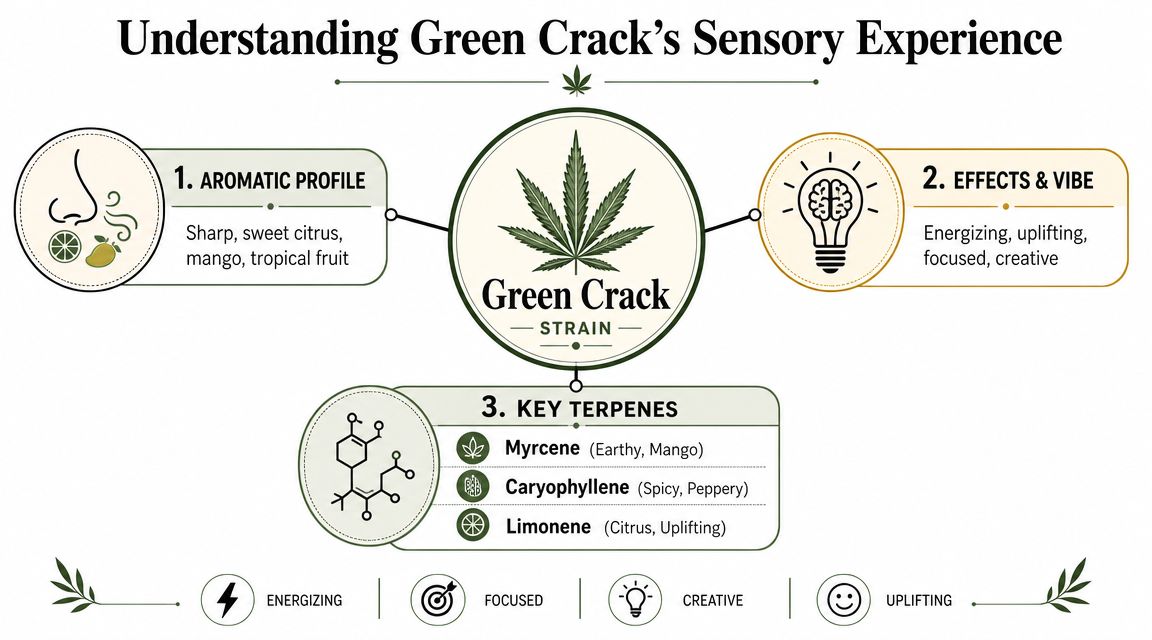
A well-grown batch usually opens with a bright, sweet smell that leans tropical or citrusy, backed by a green, slightly sharp edge. It does not usually read as heavy, doughy, gassy, or deep-earthy. If those are the profiles you chase, Green Crack can feel a little narrow. If you like a jar that smells clean, loud, and fresh, this one makes more sense.
The flavor often follows the same path. Sweet fruit up front. Citrus in the middle. A greener note on the finish.
A lot of that character comes from the terpene mix. If you want a clearer read on why one cultivar smells bright and another smells dense or spicy, this guide to cannabis terpenes and aroma compounds is a useful refresher.
The vibe in real use
Green Crack gets described as upbeat and mentally active, and that is broadly fair. What matters more is how that plays out in practice.
This is usually a cultivar for tasks, conversation, movement, and daytime momentum. It often suits growers who want a jar for house projects, outdoor work, creative sessions, errands, or social time that does not turn foggy halfway through. Used in the right window, it can feel sharp and useful.
That same sharpness is the trade-off.
For some people, especially with a heavier dose or the wrong setting, the experience can tip from focused into too busy. The mind speeds up. The body does not always soften. If you already know that stimulating cultivars can make you feel restless, overly alert, or mentally crowded, Green Crack may not be your safest default.
Who it actually fits
I keep Green Crack in the category of purpose-built daytime flower. It fits growers and users who want a clear function from a cultivar, not a one-jar solution for every hour and every mood.
It tends to fit best for:
- Daytime users with plans: People who want to stay engaged, active, and present.
- Growers tired of sleepy stash jars: Anyone trying to balance out a collection full of heavy evening flower.
- Social or task-oriented sessions: Times when being switched on is a benefit.
It tends to fit less well for:
- Late-night use: The active headspace can work against winding down.
- Low-tolerance or stimulation-sensitive users: Even a good batch can feel pushy if your comfort zone runs calmer.
- Anyone looking for neutral effects: Green Crack usually has a point of view.
That is why I do not call it universally easy, even if I like the cultivar. Its appeal is specific. When the timing is right, it is excellent. When the timing is wrong, it can feel like too much of a good thing.
Green Crack is at its best when you want direction and energy from the jar. It is a weaker fit when you want softness, flexibility, or a gentle landing.
Why Choose Feminized Green Crack Seeds
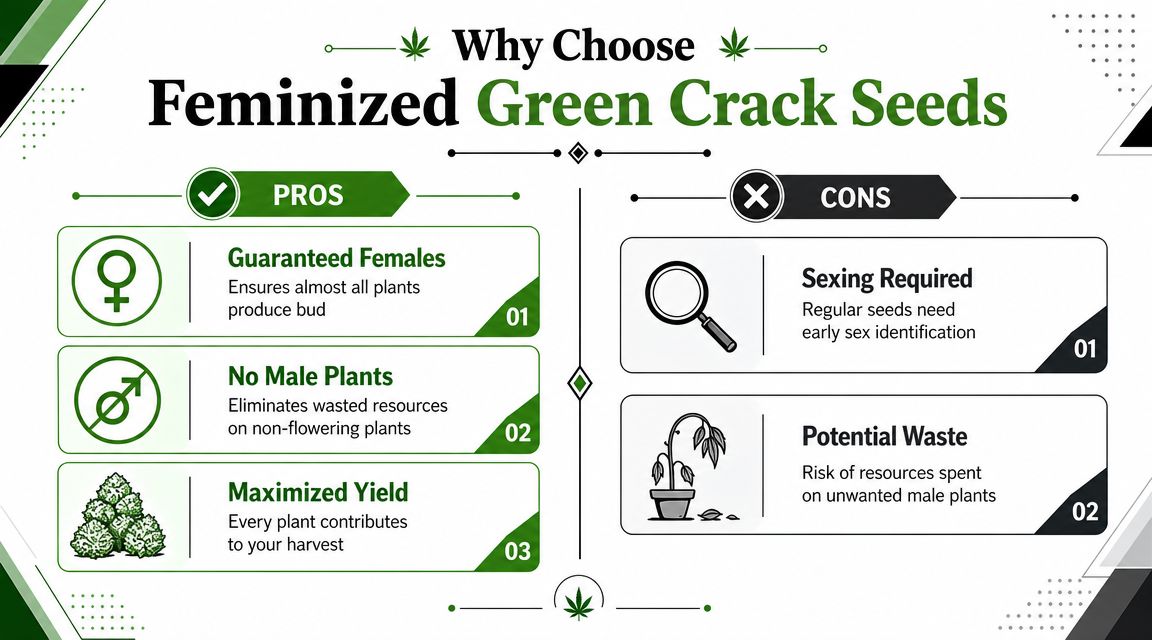
For a home grower, feminized Green Crack seeds are the practical choice. That's not about hype. It's about using your space, time, medium, nutrients, and electricity on plants that are there to produce the harvest you want.
Why feminized makes more sense at home
When you're growing in a tent, closet, spare room, or compact outdoor spot, every container matters. Feminized seeds keep the process simpler because you can plan the whole run around bud production instead of uncertainty.
That changes the feel of the grow in a good way. You can focus on:
- Canopy management
- Root zone health
- Training
- Feeding
- Flower quality
You're not burning energy on unnecessary complications. If you want a quick refresher on the basics, this guide on what a feminized seed is lays it out clearly.
The real-world advantage
Green Crack is already a cultivar people often choose for efficiency. It has a reputation for finishing relatively fast for a sativa-leaning plant and for producing strong returns when the environment is dialed in. Starting from feminized seed lines up with that same logic.
Instead of treating the grow like a lottery, you're treating it like a project with a cleaner path from seed to jar.
Key takeaway: Feminized Green Crack Seeds let you spend your effort improving the grow, not sorting through avoidable problems.
Who benefits the most
Feminized Green Crack makes the most sense for:
- First-time growers who want fewer moving parts.
- Busy hobbyists who don't want to babysit a complicated run.
- Small-space growers trying to maximize every plant in the room.
- Repeat growers who already know they prefer efficient, predictable garden planning.
That simplicity matters more than people admit. Most home growers aren't trying to turn every cycle into a science experiment. They want healthy plants, a smooth process, and jars they're proud of. Feminized seeds help keep the grow pointed in that direction.
Your Complete Green Crack Grow Guide
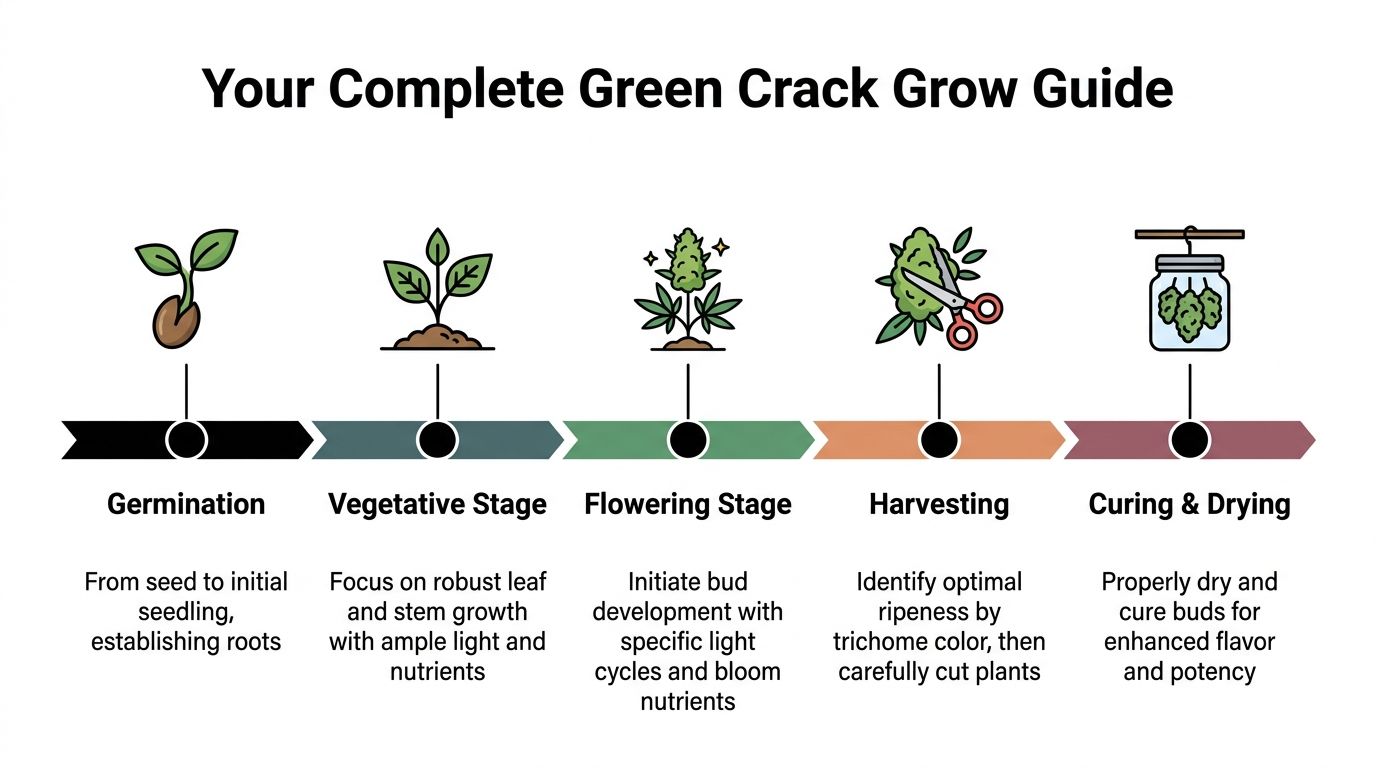
You notice Green Crack's personality early. Give it a stable room and a little structure, and it moves with purpose. Let the environment drift or feed too aggressively, and it usually tells on you fast through stretch, clawing, or a canopy that gets harder to manage than it needs to be.
Start with the right expectation
Green Crack is often treated like an easy win because it can finish relatively quickly and produce well in a dialed-in setup. That part is true. The trade-off is that fast, vigorous cultivars also punish sloppy growing faster than slower, more forgiving plants.
Treat it like a responsive plant, not a magic one.
For a broader overview of the full plant cycle, this breakdown of the stages of growing cannabis is useful alongside a cultivar-specific playbook.
Seedling and early veg
Early growth sets the tone. My rule here is simple: protect momentum. Green Crack usually responds well to steady conditions, but seedlings can stall if the medium stays too wet or the feed starts too hot.
A practical early approach looks like this:
- Water lightly and with intent: Let the container dry back enough to pull roots outward instead of keeping the whole zone soggy.
- Keep airflow soft: You want stem movement, not wind stress.
- Start nutrients conservatively: Healthy seedlings need consistency more than intensity.
- Watch the new growth: Upright leaves and even color usually tell you the room is in range.
If you get this stage right, training gets easier later because the plant keeps a steady pace instead of recovering from avoidable setbacks.
Veg strategy that actually works
Green Crack can fill a tent in a hurry. That is great for yield. It can also become a crowded mess if you wait too long to shape it.
I usually keep the canopy low and wide. This cultivar responds well to training that spreads tops out and brings light deeper into the plant. For most home growers, these are the three methods that make the most sense:
-
Low stress training
The simplest option. Bend branches early, tie them down, and keep the top layer even.
-
A strong choice in a small tent if you want to control stretch and make better use of your footprint.
-
Better suited to growers with a setup built around smaller plants and a faster turnover style.
The common mistake is letting the center thicken up because the plant looks healthy and productive. Healthy growth still needs pruning decisions. If air cannot move through the middle and light cannot reach useful sites, you end up with more leaf than flower.
Keep the canopy open enough that each main branch has light, space, and moving air. Green Crack usually pays that back.
Feeding and bloom management
This cultivar does best on a balanced program. It wants enough nitrogen in veg to stay vigorous, then a cleaner transition into bloom support without being pushed to the edge. Heavy-handed feeding is one of the fastest ways to lose quality here.
A simple bloom playbook works well:
- Keep nutrition steady instead of chasing every bottle on the shelf
- Reduce humidity as flowers bulk up
- Watch for tip burn before assuming the plant wants more
- Support branches before weight becomes a problem
- Ease off late if the plant looks overfed
That last point matters with Green Crack because its appeal is not just bag weight. People choose it for a bright, alert profile, and growers who push too hard late often end up with flower that feels heavier, rougher, and less defined than it should.
Indoor versus outdoor
Indoors, Green Crack is easier to keep in its lane. You control stretch, airflow, and flower conditions, which makes it simpler to preserve the cleaner expression many growers want from it.
Outdoors, it can produce very well if the season stays warm and dry enough through the finish. The catch is exposure. A humid finish, tight plant structure, or poor airflow can turn a promising outdoor run into a lot of cleanup and disappointment. If your local weather gets sticky late in the season, this is not the cultivar I would choose for a hands-off outdoor grow.
That honesty matters because Green Crack is not for every grower or every user. The plant and the finished flower both lean toward a more switched-on experience. If you already prefer cultivars with a calmer finish, or if overstimulation is a concern, it makes sense to keep harvest timing and feeding disciplined so the end result stays cleaner and more usable.
Common mistakes to avoid
Green Crack usually suffers from overmanagement or late neglect. Both cost quality.
Avoid these habits:
- Overfeeding early: Fast growth does not mean the plant wants maximum input.
- Waiting too long to train: A crowded canopy gets harder to fix every week you delay.
- Letting humidity drift in flower: Dense tops and stale air create predictable problems.
- Ignoring support: Branches that carry well can still flop once the flowers put on weight.
- Harvesting by impatience: A quick cultivar still needs to finish properly.
Good Green Crack is usually the result of boring consistency. Stable environment, measured feeding, early training, and enough restraint to stop tinkering once the plant is on track.
Harvesting for Maximum Quality and Yield
Green Crack can fool growers at the finish. The buds look ready, the room smells loud, and the temptation is to chop before the plant has fully settled into its best expression. That shortcut usually costs you in two places: aroma clarity and the kind of effect this cultivar is known for.

Read the plant, not your calendar
The breeder window gets you close. Trichomes tell you when to act.
For Green Crack, that timing matters more than growers sometimes expect. If you cut while most heads are cloudy and before amber starts stacking up, the finished flower usually keeps more of its sharp, daytime character. Let it run too long and the profile often shifts into something heavier and less defined. Some growers want that edge taken off. If you chose this cultivar for a brighter, switched-on result, late harvest can work against you.
I also watch the whole plant, not trichomes alone. Swollen calyxes, receded pistils, and a general sense that the plant has stopped pushing fresh growth all help confirm the call.
Drying protects what you just spent months growing
A fast dry strips a lot of what makes Green Crack worth the effort. The citrus, mango, and sharper green notes fade first, and the smoke gets flatter than it should.
My post-harvest routine stays simple:
- Trim with airflow in mind: Take off what traps moisture, then save the fine cleanup for later if needed.
- Dry in a controlled room: Keep conditions steady and avoid fans blowing directly at the flowers.
- Let the moisture leave evenly: If the outside gets crisp while the center still feels damp, slow the process down.
- Jar only at the right point: Buds should feel dry on the surface but not brittle, with a little spring left in them.
The cure improves a good dry. It does not fix a bad one.
Curing for the final payoff
Curing decides whether Green Crack finishes clean and focused or rough and muddy. Burp the jars on schedule, watch for moisture buildup, and give the flower time to settle before judging the result. Freshly jarred bud can smell strong and still be undercured.
This part matters even more with a cultivar like Green Crack because the final effect can swing with handling. A careful cure tends to preserve the clearer, more usable side of the flower. A sloppy finish can make it feel harsher, less expressive, and for some people, more jittery than enjoyable.
That is the payoff many home growers end up caring about most. You get a stash that reflects your own decisions from chop to jar, and you get a more honest read on whether Green Crack fits your taste, your tolerance, and the kind of high you want. If you are ready to start that process and still want to compare Green Crack with other cultivars that may suit your setup better, the tools at Botanist Seeds can help you sort through those trade-offs.