




White Widow Autoflowering: A Grower’s Complete Guide
You want a cultivar with a real reputation, but you don't want to babysit a grow for months or deal with a finicky light cycle. That's the sweet spot where White Widow autoflowering makes sense. It carries a familiar name, it fits small home setups well, and it gives you a shorter path from seed to jar than the old-school photoperiod version.
For a lot of home growers, that matters more than hype ever will. You want something that can fit in a tent, a spare room, or a tucked-away corner, and you want a harvest that feels worth the time, power bill, and effort. You also want the simple satisfaction of growing your own supply, skipping dispensary lines, and keeping more control over what ends up in your grinder.
Your Next Home Grow A Legendary Classic
A common home grow situation goes like this: you've got a modest tent, a decent LED, and just enough time to stay on top of watering, airflow, and basic plant care. What you don't have is patience for a long, drawn-out run that drifts off schedule or turns into a constant correction project.
That's where White Widow autoflowering earns its place. It gives you a classic cultivar name without asking you to build your whole life around the grow. You get the appeal of a well-known line, but in a format that's much easier to run at home.

Why it fits the hobby grower
White Widow autoflowering works for growers who value speed, simplicity, and a recognizable finished product. You're not choosing it because it's mysterious or rare. You're choosing it because it has a clear identity and because autoflower genetics remove some of the usual friction.
A few practical reasons growers keep coming back to it:
- Shorter commitment: It moves faster than the photoperiod version, which makes it easier to fit into normal life.
- Manageable size: It usually suits a small indoor setup better than bigger, more sprawling cultivars.
- Less scheduling stress: You don't need to obsess over flipping light cycles at the right moment.
- Rewarding finish: When it goes well, you get frosty flower from a cultivar people already know and respect.
Practical rule: If you only have room for a small grow and you want a classic that doesn't drag out the calendar, White Widow autoflowering is a sensible pick.
The appeal isn't complicated. It's a familiar cultivar in a format that respects your time.
The Story Behind This Famous Cultivar
White Widow has been a famous cannabis name for a long time, mostly because growers and buyers both remember the same thing about it: frost. The original line built its reputation on resin-heavy flower and a balanced overall character that never felt one-note.
What changed with the autoflowering version is convenience. Breeders took that classic White Widow identity and paired it with autoflower traits, creating a cultivar that flowers by age instead of waiting for a light schedule change. For the home grower, that's the significant shift.
Why autoflower genetics matter
With White Widow autoflowering, the plant starts moving into flower on its own timeline. That means less messing around with strict darkness, fewer worries about light leaks, and a simpler routine for the average tent grower.
That doesn't make it foolproof. It just changes the kind of discipline you need.
With a photoperiod cultivar, you usually have more room to correct mistakes during veg because you control when flowering begins. With an autoflower, the clock is already ticking. If you stall it early, you don't get that time back.
The real trade-off
This is why White Widow autoflowering appeals to modern hobby growers. You give up some flexibility, but you gain a lot in return.
Here's the trade in plain terms:
| Grow style | What you gain | What you give up |
|---|---|---|
| Photoperiod White Widow | More control over plant size and recovery time | More management and a longer path to harvest |
| White Widow autoflowering | Faster crop, simpler routine, less light-cycle hassle | Less time to fix early mistakes |
That trade works well in a small setup where convenience matters. If your goal is a tidy home grow with fewer moving parts, the autoflowering version is often the more practical choice.
The autoflower version doesn't replace the original White Widow. It adapts it for growers who want less complexity and a faster turnaround.
That's why this cultivar still gets attention. It keeps the name people know, but it fits the way a lot of people grow now.
What To Expect From Your Harvest
When White Widow autoflowering finishes well, it looks like the kind of flower you're proud to show off to a friend. Dense, frosty buds, a sticky feel when you trim, and that classic White Widow visual appeal that made the name stick in the first place.
The aroma usually lands in a familiar range. Expect earthy notes, some pine, a little spice, and a slightly floral edge depending on the expression you get from seed. It's not the loudest fruit-bomb style profile. It's more grounded and classic, which is exactly why some growers like it.
The jar appeal
A good homegrown batch of White Widow autoflowering tends to feel honest. It smells like cannabis, not candy. It has a resinous, old-school vibe that fits the lineage.
That matters more than people think. A lot of the reward in home growing isn't just the harvest weight. It's opening a jar later and knowing the flower inside came from your own work, your own setup, and your own decisions.
If you want to get better at reading ripeness near the finish, it helps to understand how trichomes on weed change as flowers mature.
The overall vibe
White Widow autoflowering is usually appreciated for being balanced rather than extreme. It's the sort of cultivar people reach for when they want something classic, clear-headed enough to stay social, but still substantial enough to feel like a proper session.
A simple way to think about the finished flower:
- Aroma: Earthy, piney, spicy, with a light floral lift
- Appearance: Frosty, resin-forward buds with strong bag appeal
- Vibe: Balanced, familiar, versatile, not overly one-directional
A lot of growers chase novelty. White Widow keeps getting grown because a familiar cultivar done well is still satisfying.
That's part of the appeal here. You're not growing White Widow autoflowering to surprise yourself with something strange. You're growing it because you want a dependable classic in the jar, and because producing that yourself feels better than grabbing whatever's left on a dispensary shelf.
Your White Widow Autoflowering Grow Setup
A clean, simple setup beats an overcomplicated one. White Widow autoflowering doesn't need a lab. It needs stable conditions, enough light, decent airflow, and a grower who doesn't keep changing the plan halfway through.
This checklist is a good baseline for a small indoor run:
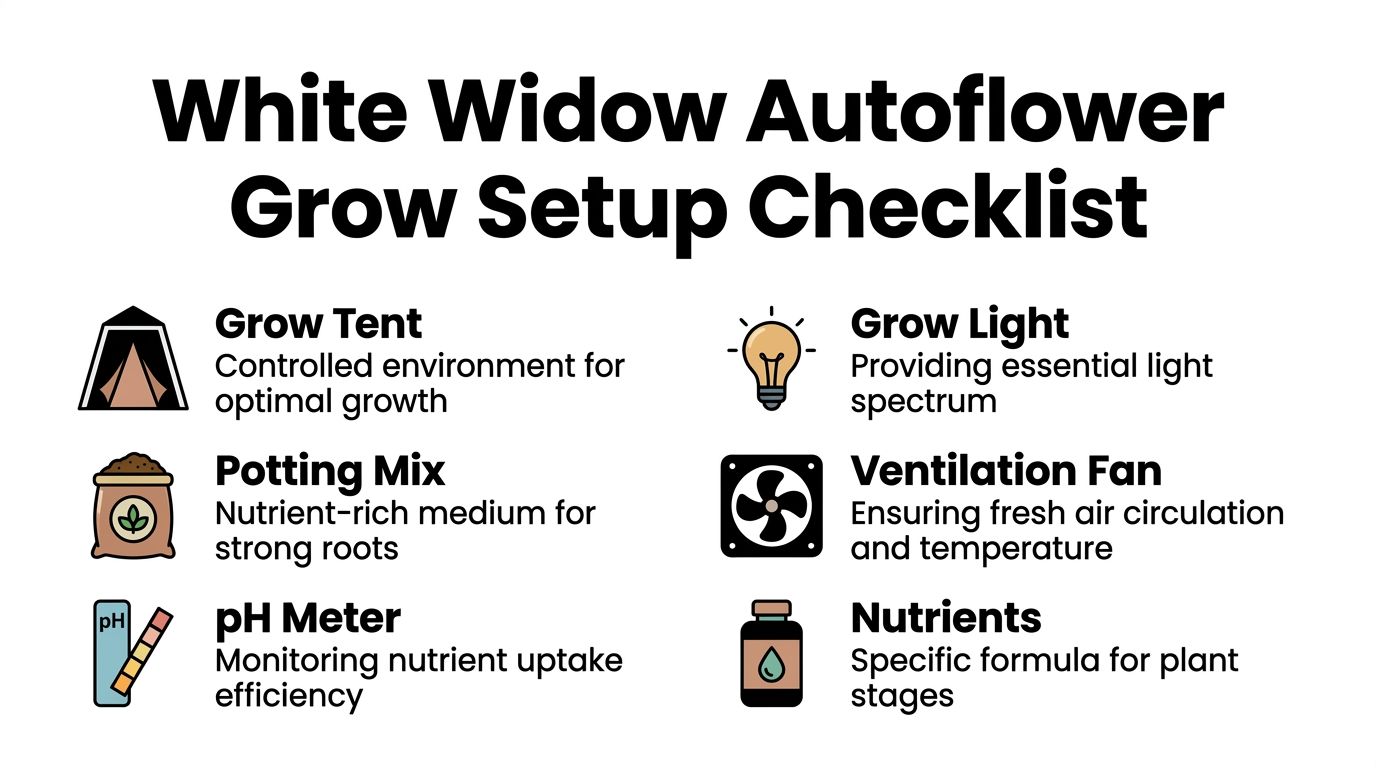
Start with the basics
- Tent first: A small grow tent gives you control over light, airflow, and smell. That control matters more than extra space.
- LED lighting: Use a quality LED that can cover your canopy evenly. Autoflowers respond well when the light is strong and consistent.
- Ventilation: You need moving air, not just for temperature but for healthier structure and a cleaner flowering environment.
- Containers: Pick the pot you plan to finish in and stick with it. Autoflowers usually do better when you avoid unnecessary root disruption.
For growers still sorting out their light routine, Botanist Seeds has a useful guide on the autoflowering light schedule.
Soil, coco, and pot choice
Your medium should match your habits.
If you want a more forgiving run, many hobby growers prefer soil or a light potting mix. It gives you a little buffer when your watering isn't perfect. If you like tighter control and don't mind paying closer attention, coco can work well too, but it asks more from you.
A simple comparison:
| Medium | Good fit for | Watch out for |
|---|---|---|
| Soil | Newer growers, lower-maintenance runs | Overwatering in early growth |
| Coco | Hands-on growers who like precision | Faster mistakes if feeding or watering slips |
Don't overthink pot size. Give the roots enough room from the start, but don't turn your tent into a jungle if your goal is a clean, manageable home grow.
Here's a helpful visual if you want to see setup basics in action:
Keep the environment boring
This is one of those cultivars that does better when the room feels steady. Big swings in heat, humidity, watering, or feed strength can slow an auto down at the exact moment you don't want that.
A few setup habits that usually work:
- Keep watering consistent: Don't drown seedlings, then let them swing bone dry.
- Feed lightly at first: Early overfeeding causes more problems than early restraint.
- Leave room around the plant: Air needs to move through and around the canopy.
- Avoid constant tinkering: Once the setup is working, resist the urge to “improve” it every other day.
White Widow autoflowering responds well to calm management. Most home growers get better results from good habits than from fancy tricks.
The Complete Seed To Harvest Timeline
You start a White Widow autoflowering seed on a Saturday, lose a week to overwatering or rough training, and the plant does not give that time back. That is the core timeline issue with autos. The short run is convenient, but it also makes early mistakes more expensive.
White Widow autoflowering is usually sold as a quick finish. A common range is about 70 to 85 days from seed to harvest, with many growers landing around the middle if the plant stays healthy and the setup stays steady, according to a seed bank’s White Widow autoflowering strain profile.
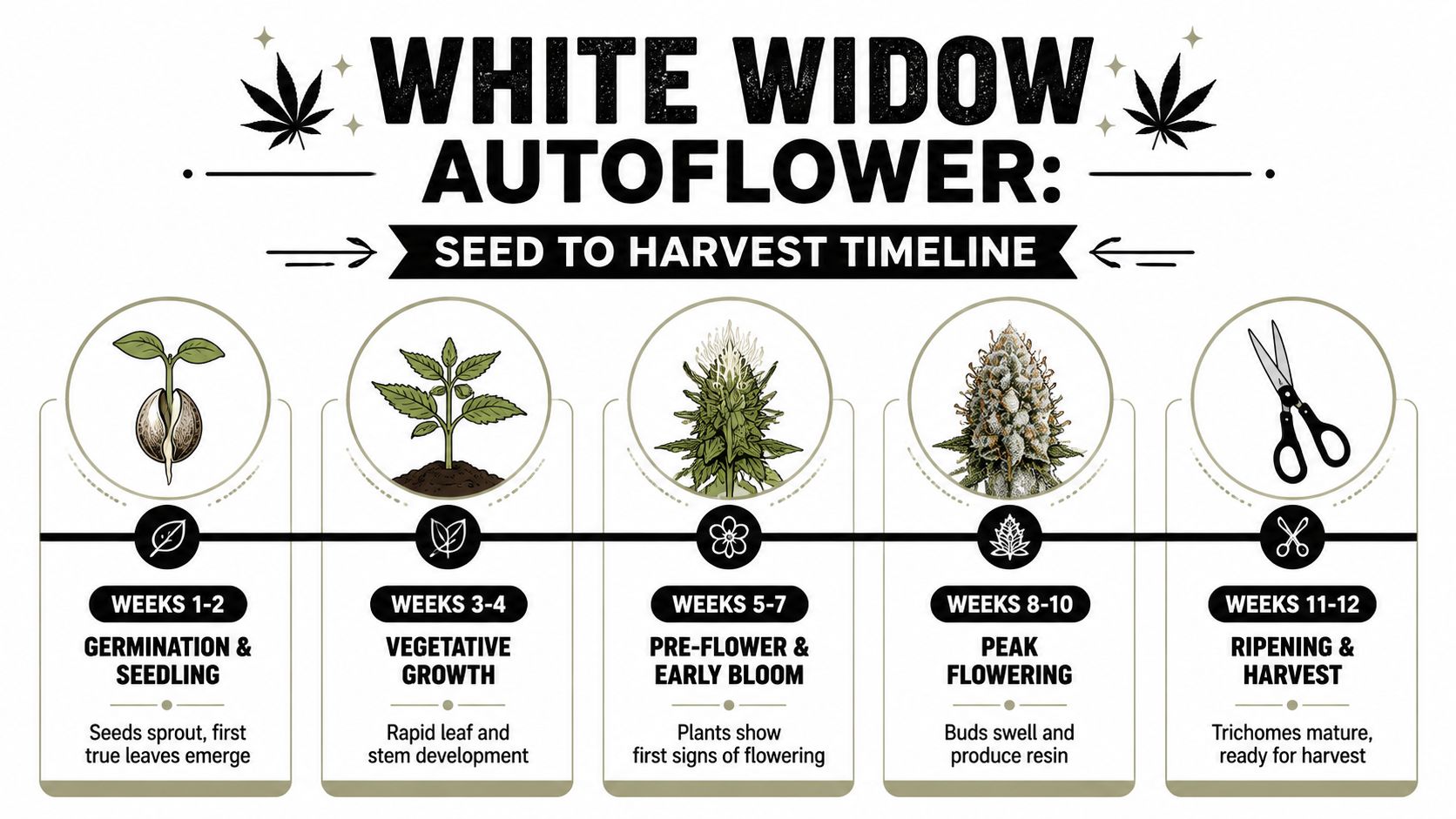
Week by week expectations
Use the timeline as a working guide. Seed-grown autos still show some variation, even from a good breeder, so consistency means giving each plant stable conditions, not expecting every seed to behave like a clone.
- Weeks 1 to 2: Germination and seedling stage. Keep the root zone lightly moist, keep the light sensible, and avoid the common mistake of treating a seedling like a hungry mature plant.
- Weeks 3 to 4: Early vegetative growth, often the only real window to shape the plant at all. This is why autoflower strategy is different. If you plan to train, do it early and lightly or skip it.
- Weeks 5 to 7: Pre-flower and early bloom. Stretch starts, bud sites set, and recovery time gets short.
- Weeks 8 to 10: Bulk-up phase. Good light and stable watering matter more than clever tweaks.
- Weeks 11 to 12: Ripening and harvest window. Some plants are ready on the early side, some need longer, so check the plant instead of harvesting by calendar alone.
If you are new to the category, this overview of what autoflower seeds are explains why the clock starts working against you much earlier than it does with photoperiod plants.
Yield expectations without fantasy
Home growers are often misled; breeder numbers usually reflect ideal conditions and a dialed-in room. A small tent, one or two plants, and a normal hobby schedule can still produce very good results, but the outcome is usually closer to "solid and repeatable" than "maxed out."
The practical trade-off is simple. Autos save time, but they give you less room to recover from stress, repotting mistakes, feed errors, or heavy training. That is why two growers using the same White Widow auto seed can finish with very different harvests.
A realistic goal for a home setup is a healthy, fully finished plant with dense buds and a clean dry, not chasing every last gram.
What usually changes the outcome
A few things make a bigger difference than strain descriptions suggest:
- Early root health: Slow starts reduce plant size fast because the veg window is short.
- Light coverage: Even light across the canopy usually beats blasting one main top.
- Training restraint: Small corrections early can help. Late plant surgery usually costs more than it gives back.
- Steady care: Consistent watering, feed strength, and climate produce better results than frequent changes.
- Harvest timing: White Widow autos can look close before they are finished, so waiting for proper ripening often improves both weight and quality.
That last point matters more than growers think. Fast does not mean rushed.
Advanced Tips and Common Questions
The biggest mistake growers make with White Widow autoflowering is treating it like a small photoperiod plant. It isn't. The short life cycle changes how you should think about training, recovery, and what “good management” looks like.
The LST question growers keep asking
A lot of guides say to use low-stress training, and that advice isn't wrong. It's just incomplete.
A key issue is timing. A seed bank notes that White Widow Auto has only a three-week vegetative phase, and that any stress-induced delay can reduce yield, which is why the better question is whether minimal intervention is the smarter move in a small home setup in their White Widow Auto grow guide.
That's the practical truth. Early, gentle LST can help. Late or aggressive training can cost you.
What tends to work
For most hobby growers, the winning move is subtle canopy management, not plant wrestling.
- Gentle bending early: If the main stem is healthy and flexible, a small bend can open up the plant without slowing it down.
- Light branch spreading: This helps more sites catch useful light.
- Minimal leaf removal: Only remove what's blocking airflow or burying key flower sites.
- Hands off after the window closes: Once flowering is clearly underway, stop trying to redesign the plant.
What usually backfires
Not every trick from photoperiod growing belongs here.
| Method | Likely result on White Widow autoflowering |
|---|---|
| Early gentle LST | Often helpful if done before the plant commits to flower |
| Aggressive shaping | Higher risk of stalling a plant that doesn't have recovery time |
| Late defoliation | Can create stress with limited upside |
| Repeated corrections | Wastes energy the plant could use for flower production |
If you're deciding between doing more and doing less, White Widow autoflowering usually rewards doing less, as long as you do it on time.
What consistency really means
Another point growers don't talk about enough is consistency from seed. White Widow autoflowering is popular, but that doesn't mean every pack from every breeder will grow the same way.
You may see variation in:
- Structure: One plant may stay squat, another may stretch a bit more
- Aroma expression: Earthy and piney can show up in slightly different balance
- Finish speed: Some plants mature right on cue, others take a little longer
- Yield behavior: Not every seed responds identically to the same setup
That doesn't mean the cultivar is unstable. It means you're growing from seed, not cloning the exact same plant repeatedly.
Common home grow problems
A few issues show up often with this cultivar:
- Overfeeding early: Dark, clawed leaves and slower growth
- Overwatering seedlings: Soft growth and sluggish root development
- Too much intervention: Training that eats into the short veg window
- Chasing online photos: Promotional shots are not a realistic benchmark for every home tent
The growers who do well with White Widow autoflowering usually aren't doing anything dramatic. They start clean, stay steady, and leave enough alone.
Finding The Right White Widow Seeds
White Widow is one of those strain names that gets used loosely. Two packs can both say White Widow Auto and still grow quite differently in a home tent. With an autoflower, that matters fast, because the plant keeps its own schedule and gives you very little time to recover from weak breeding.
A good White Widow auto line usually shows a few things with decent regularity. Flowering time lands in a predictable window. Resin production comes on early and finishes strong. Plant shape stays manageable enough for a small tent, even if one seed stays stockier and another stretches a bit more. You are still growing from seed, so some variation is normal, but the broad behavior of the line should feel familiar from plant to plant.
What to look for in a seed source
A seed bank makes a fair point in their White Widow Auto growing guide. The final flower's chemistry, structure, and yield can vary a lot between breeders. For home growers, that means the breeder matters almost as much as the strain name.
Look for a seller or breeder that gives you:
- Clear lineage details: A good source provides information beyond just the White Widow name, including how the autoflower trait was worked into the line.
- Traits that fit the classic profile: Look for notes on resin production, compact structure, and a finish that stays within the stated harvest window.
- Realistic descriptions: If every trait sounds maxed out, expect disappointment. Honest listings usually read a bit plainer.
- Repeatable home-grow behavior: You want seeds that tend to finish in the same general timeframe and hold a similar shape under the same basic conditions.
- Useful comparison tools: Side-by-side comparisons help more than flashy marketing if you are choosing for tent size, plant count, and turnaround time.
Why this matters more with White Widow autoflowering
This is less about hype and more about planning. If a breeder's White Widow auto tends to finish compact and consistent, you can pick the right pot size, avoid overcrowding, and set a realistic yield target before you even germinate. If the line is all over the place, every decision gets harder.
That is the true value of consistency for a home grower. It does not mean every seed becomes a carbon copy. It means the breeder has done enough selection work that you can expect a similar flowering pace, similar resin output, and a recognizable White Widow-style result without constant surprises.
Botanist Seeds offers that kind of comparison-focused browsing, which is useful if you want to sort cultivars by fit rather than just buying the first famous name you recognize.
If you're ready to start your next run, Botanist Seeds makes it easy to compare White Widow autoflowering with other cultivars suited to small home setups, fast turnaround times, and straightforward grows. Use the comparison tools, match the cultivar to your space and habits, and start with genetics that fit the way you grow.