Seedling Nutrients: A Simple Feeding Guide for Cannabis
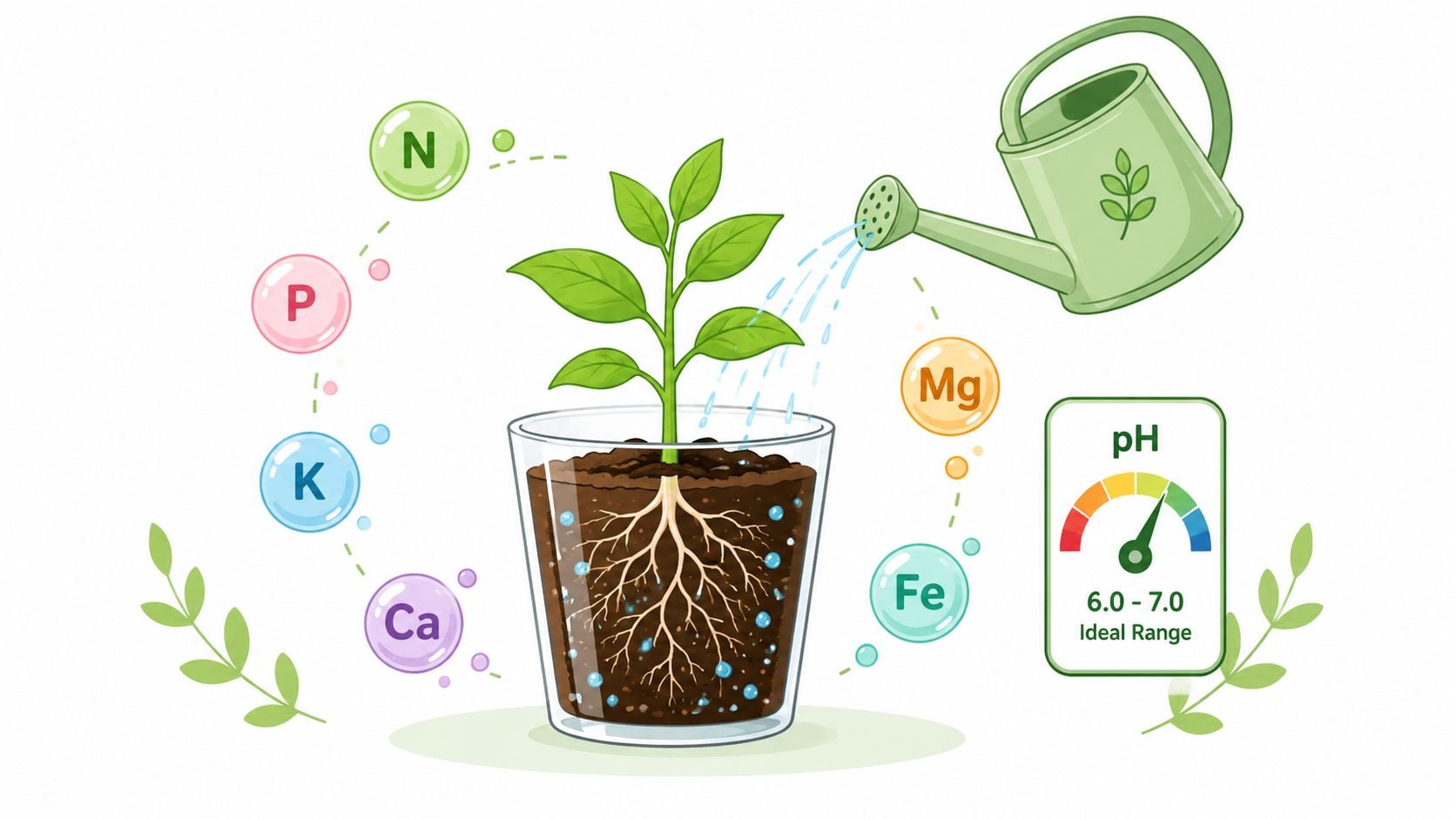
Most seedling feeding guides push you to start pouring on nutrients the second a sprout shows itself. That's the wrong instinct. In the first two weeks, under-feeding is safer than over-feeding, because the plant is living off cotyledon reserves and a tiny root system, not on a full root zone yet, and seed nutrient reserves are a real driver of early growth in the data we have on seedling nutrition seed reserves and early seedling mass.
Why Seedling Nutrients Are a Game of Less, Not More
The biggest mistake new growers make is treating seedlings like small veg plants. They are not. Early on, a seedling is still living off internal fuel, and that fuel matters a lot, since seed nitrogen and phosphorus were more important than seed carbon in explaining seedling mass in 85% of studies reviewed, while oven-dry seeds are typically more than 95% organic matter and less than 5% mineral nutrients.
That is the part people miss. The first feeding goal is to avoid forcing growth before the plant can use it. A small seedling does not need a heavy bottle mix, it needs steady moisture, good oxygen, and a root zone that stays clean, not salted up. Start too hot, and you do not speed things up, you slow root expansion and make the plant work harder than it should.
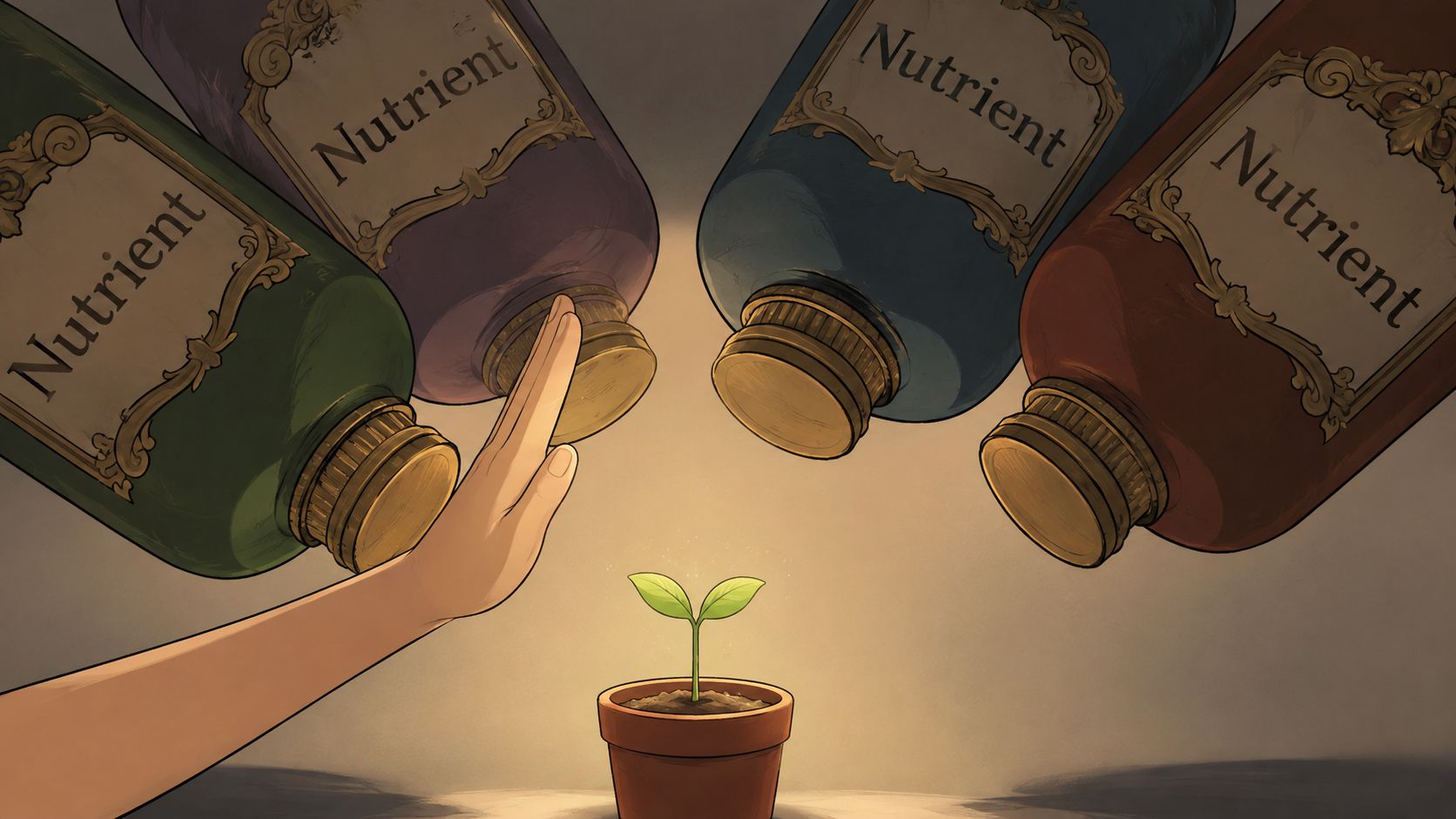
Roots first, top growth second
The first stretch is about building a root system that can support the next stage. Nursery guidance treats mineral nutrition as a quality marker, not a guessing game, because young plants have measurable tissue ranges that show whether they are sitting in a normal window or drifting out of it USDA Forest Service seedling nutrient guidance.
Practical rule: if your seedlings look hungry but the medium is already wet and salty, feed less, not more.
That is the mindset I would use every time. A lot of first runs go sideways because the grower blames weak genetics or chases a stronger formula, when the problem is that the seedling never wanted a strong feed in the first place. If you want a clean path from sprout to transplant, match the feed to the stage, not to the bottle label.
What Your Seedling Needs to Eat
A young plant does not need a long grocery list. It needs a small, balanced hit of the major nutrients, with early attention on root support and cell structure, not on forcing leafy stretch. The tissue numbers give you the shape of the target, but they do not justify heavy feeding. USDA Forest Service guidance puts average seedling tissue concentrations around 1.5% nitrogen, 1.0% potassium, 0.5% calcium, 0.2% magnesium, and 0.2% phosphorus, with wide observed ranges depending on species and culture.
The simple nutrient map
- Nitrogen, drives leaf and stem growth, but seedlings only need a light hand early. Young plants can sit in a broad nitrogen range, and that is exactly why you do not rush them with a strong mix.
- Phosphorus, supports root development, and it is one of the first minerals people get wrong. Container seedlings are often managed around 0.2% to 0.6% phosphorus in tissue targets.
- Potassium, supports water movement and general plant function, but it is not a reason to hammer seedlings with a heavy bloom-style formula.
- Calcium and magnesium, matter more than many new growers expect, especially in cleaner water programs and coco-based setups.
- Micros, are needed in tiny amounts, not as an excuse to stack boosters onto a fresh seedling.
Seeds already bring a lot to the table, so the first growth window is partly self-funded before outside fertilizer matters seed nutrient reserve review. A controlled study found that seed reserves supported phosphorus demand longer than nitrogen demand in Leucaena leucocephala seedlings, which is a good reminder that the plant is not asking for the same thing at every stage early seed reserve study.
If you want a cleaner starting point for feed choices, this guide on best nutrition for cannabis plant is worth keeping nearby.
Seedlings want a gentle starter feed, not a heavy veg booster. If you are unsure, stay light and watch the leaves, not the bottle.
What matters most in week one
Phosphorus and calcium are the usual pressure points, but the answer is not to load them blindly. Use a mild, balanced feed only after cotyledons are open and the plant is asking for it. A tiny plant cannot use what its roots cannot reach, so the medium, the water source, and the root zone matter just as much as the nutrient ratio. That is where under-feeding is safer than over-feeding, especially before the root ball starts moving.
Soil can buffer mistakes better than coco or soilless mixes, and soft or very clean water can leave seedlings short on calcium and magnesium faster than people expect. Coco behaves closer to hydro, so it punishes sloppy feeding and sloppy pH faster. If your seedling is small, pale, and sitting in a wet medium, the fix is usually less feed, cleaner water, and better root conditions, not a stronger bottle mix.
pH and EC Targets by Growing Medium
Seedling nutrient plans usually fail because the root zone pH is off, which makes the right feed strength useless. Soil buffers mistakes better than coco, and coco behaves much closer to hydro than beginners expect, so one target never fits every setup. Get the pH range right first, then keep the feed light, because the root zone decides how much a seedling can take seedling pH basics.
Seedling pH and EC Targets by Medium
| Medium | pH Range | EC (dS/m) | PPM (500 scale) | PPM (700 scale) |
|---|---|---|---|---|
| Soil | 6.0 to 7.0 | 0.5 to 1.0 | 250 to 500 | 350 to 700 |
| Coco coir | 5.8 to 6.2 | 0.5 to 1.0 | 250 to 500 | 350 to 700 |
| Peat-based mix | 6.0 to 6.5 | 0.5 to 1.0 | 250 to 500 | 350 to 700 |
| Hydro or rockwool | 5.5 to 6.0 | 0.5 to 1.0 | 250 to 500 | 350 to 700 |
The number to respect in the seedling phase is low EC, not high EC. A staged feeding approach starts with no fertilizer at germination, then moves to 25 to 50 ppm N at cotyledon opening, 50 to 100 ppm N at the first true-leaf stage, and only then goes beyond 100 ppm N before transplant, while keeping substrate EC below 1.5 dS/m because young seedlings burn easily from salt buildup staged seedling feeding guidance.
How to read the table without overthinking it
Soil growers can usually stay near the middle of the pH range because the medium gives more buffer. Coco growers need to treat pH as a daily check, because it behaves much closer to a hydro setup than a forgiving soil mix. Hydro and rockwool need the tightest control, since the root zone leaves less room for sloppy mixing.
A basic pH and EC meter is enough here. Keep the mix consistent, watch the root zone instead of the bottle, and remember that a slightly underfed seedling in the right pH range does better than a stronger mix sitting in the wrong one. For a cleaner reference on target ranges, use this pH guide for cannabis seedlings.
Most seedlings also react to water quality before they react to a nutrient label. Soft or very clean water can run short on calcium and magnesium faster than people expect, while coco can expose that gap sooner than soil. If the plant is small, pale, and sitting in a wet medium, fix the root conditions first, then adjust feed strength.
A Two to Four Week Seedling Feeding Schedule
The cleanest seedling schedule is boring on purpose. That's a good thing. You start light, step up only when the plant shows it's ready, and you don't let the calendar bully you into overfeeding a cultivar that's still building roots. For a full stage-by-stage overview, this seedling stage guide is a useful companion.
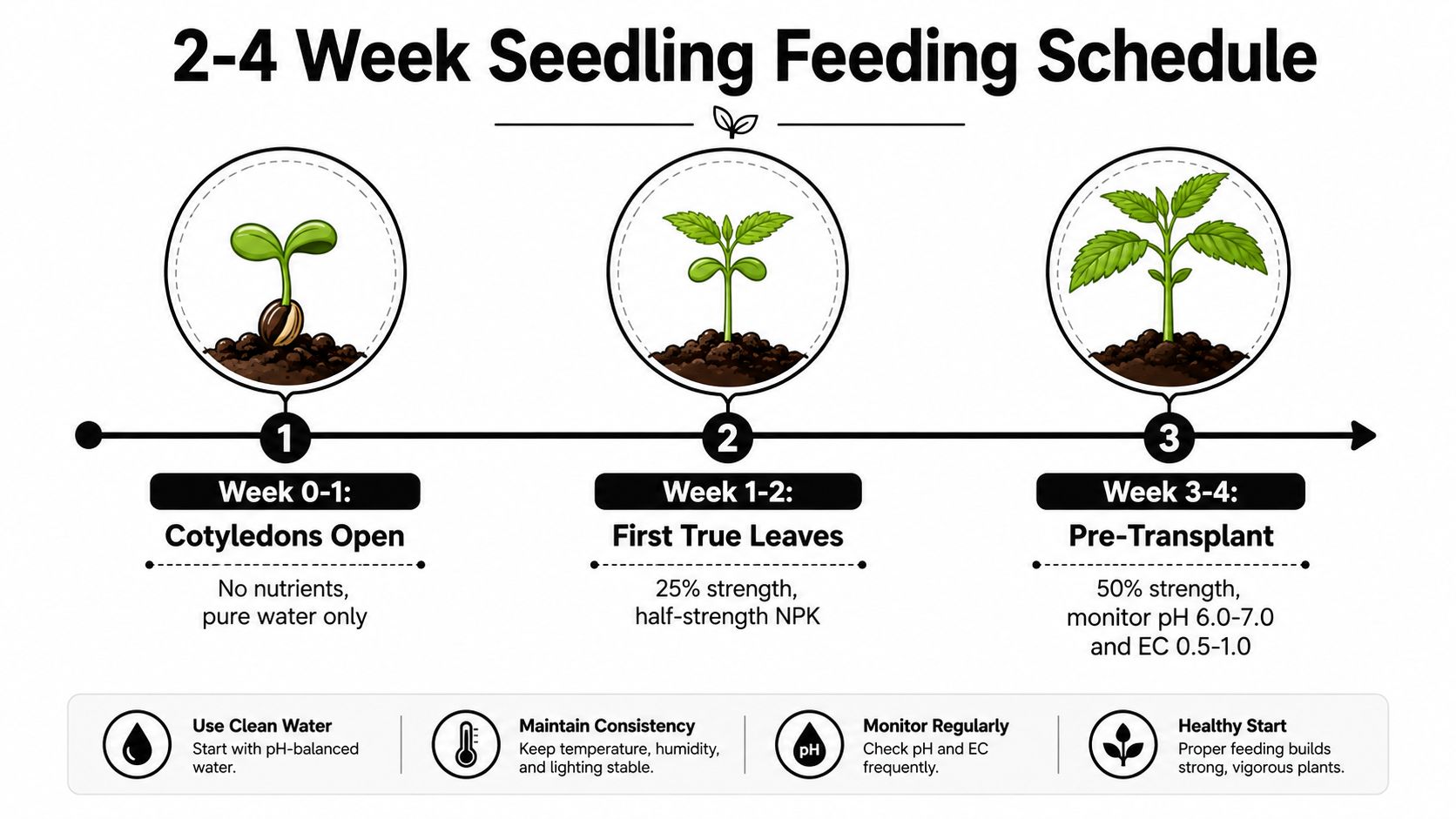
Two to four week schedule
| Stage | Feed Strength | Target EC | pH Reminder | What to Watch |
|---|---|---|---|---|
| Week 0 to 1, cotyledons open | No nutrients | 0.0 to 0.2 | Match your medium | Roots spreading, cotyledons standing up |
| Week 1 to 2, first true leaves | 25% strength, roughly half-strength NPK | 0.3 to 0.5 | Soil 6.0 to 7.0, coco 5.8 to 6.2 | New leaf pair, steady color, no tip burn |
| Week 2 to 3, early veg | 50% strength | 0.5 to 0.8 | Keep the medium range tight | Faster leaf expansion, thicker stem, no droop after watering |
| Week 3 to 4, pre-transplant | Stay at 50% or hold if growth is slow | 0.8 to 1.0 | Don't drift out of range | 3 to 4 pairs of true leaves, strong roots, no burned tips |
If you're running a basic two or three-part line, keep the mix simple. Use the base nutrient at a light rate, then add calcium and magnesium only if your water source is soft, reverse osmosis, or coco-heavy. In coco, that extra calcium and magnesium support is often the difference between a clean run and a weird, pale seedling that never seems to settle.
A straight rule for stepping up
Don't raise strength because it's “been a week.” Raise it because the seedling has added true leaves, stayed upright, and kept color without tip burn.
That rule saves more plants than any fancy additive does. A stronger feed only belongs in the mix when the seedling has enough root mass to use it. If the pot is still drying slowly and the leaves are already dark, hold the line and let the plant catch up.
Reading Your Seedling's Leaves for Deficiency and Toxicity
Leaves do not lie. Growers misread them all the time. Look at pattern, color, and texture together, then decide whether you are seeing a real shortage, excess feeding, or a pH problem that is blocking uptake.
What the symptoms usually mean
- Yellowing between veins, often points to a magnesium problem or a pH issue that is keeping magnesium unavailable. Check your pH first, then correct the medium before adding more product.
- Dark green leaves with a glossy look, usually mean too much nitrogen. Back off the feed strength and let the plant breathe.
- Leaf curl or clawing, can show excess nitrogen or a root zone that is too wet and too hot.
- Burnt tips, usually mean the mix is too strong for the seedling stage. Cut the feed and return to a lighter target.
- Purple stems, are not a diagnosis by themselves. They can show genetics, stress, or a nutrient imbalance, so do not assume you need a bigger dose just because you see color.
- Slow growth, often points to pH lockout before it points to deficiency. If the medium is outside range, nutrients can be present and still useless.
The Forest Service benchmark numbers give you a reference range instead of a guess. Container seedlings are generally kept in a 1.3% to 3.5% nitrogen range and a 0.2% to 0.6% phosphorus range in tissue guidance, while bareroot seedlings sit lower, at 1.2% to 2.0% nitrogen and 0.1% to 0.2% phosphorus Forest Service nursery nutrition benchmark.
Fix order matters
Fixing the wrong thing first is how people waste a week. If the pH is off, more nutrient will not solve it. If the tips are burned, more feeding only makes the burn worse. If the medium is soggy, the root system cannot do its job, and the plant will act hungry even when the bottle is full.
Fix pH first, feed second. Most early seedling issues wear a nutrient-shaped disguise.
That is the rule I would keep taped to the wall. It keeps you from chasing symptoms instead of causes, and it usually gets the plant back on track faster than any rescue cocktail.
Tips, Troubleshooting, and Common Seedling Questions
A few small habits make seedling care a lot easier. Water temperature should be close to room temperature, not cold enough to shock the root zone. Light should stay gentle enough that the plant doesn't stretch, but not so intense that it stalls and prays all day. And if you're running fabric pots, don't let the medium swing from soaked to bone-dry every cycle, because that kind of volatility is rough on a tiny root system.
Straight answers to the questions everybody asks
- Do seedlings need Cal-Mag? Sometimes, yes, especially in coco or when you're using reverse osmosis water. In soil with decent water, not always.
- Can you use tap water? Yes, if the water is reasonable for seedlings and not loaded with extra salts. If your tap water is already hard, keep nutrients lighter.
- How often should you water? Water by medium dryness and pot weight, not by habit. A small seedling in a big pot doesn't need constant soaking.
- Should you feed every watering? In this stage, no. Light alternating feeds are usually safer than pushing nutrients every time.
Autoflower seedlings and photoperiod feminized cultivars both want the same basic respect early on. The difference is that autos punish stunting faster because the clock is shorter, so avoid rough transplants, strong feed jumps, and sloppy watering. Keep the root zone easy to use, and let the plant set the pace.
One more thing people miss. Foliar feeding is not a seedling crutch. If the root zone is already too wet or too salty, spraying the leaves just papers over the issue for a minute. Clean up the medium first, then worry about extras.
Bottom line: young plants need rhythm, not aggression. Stable moisture, low salt, and a medium that stays in range beat product stacking every time.
Your Seedling Nutrient Checklist Before You Transplant
Keep this simple. Seedlings fail more often from too much feed than too little, so the goal here is a clean handoff, not a nutrient push.
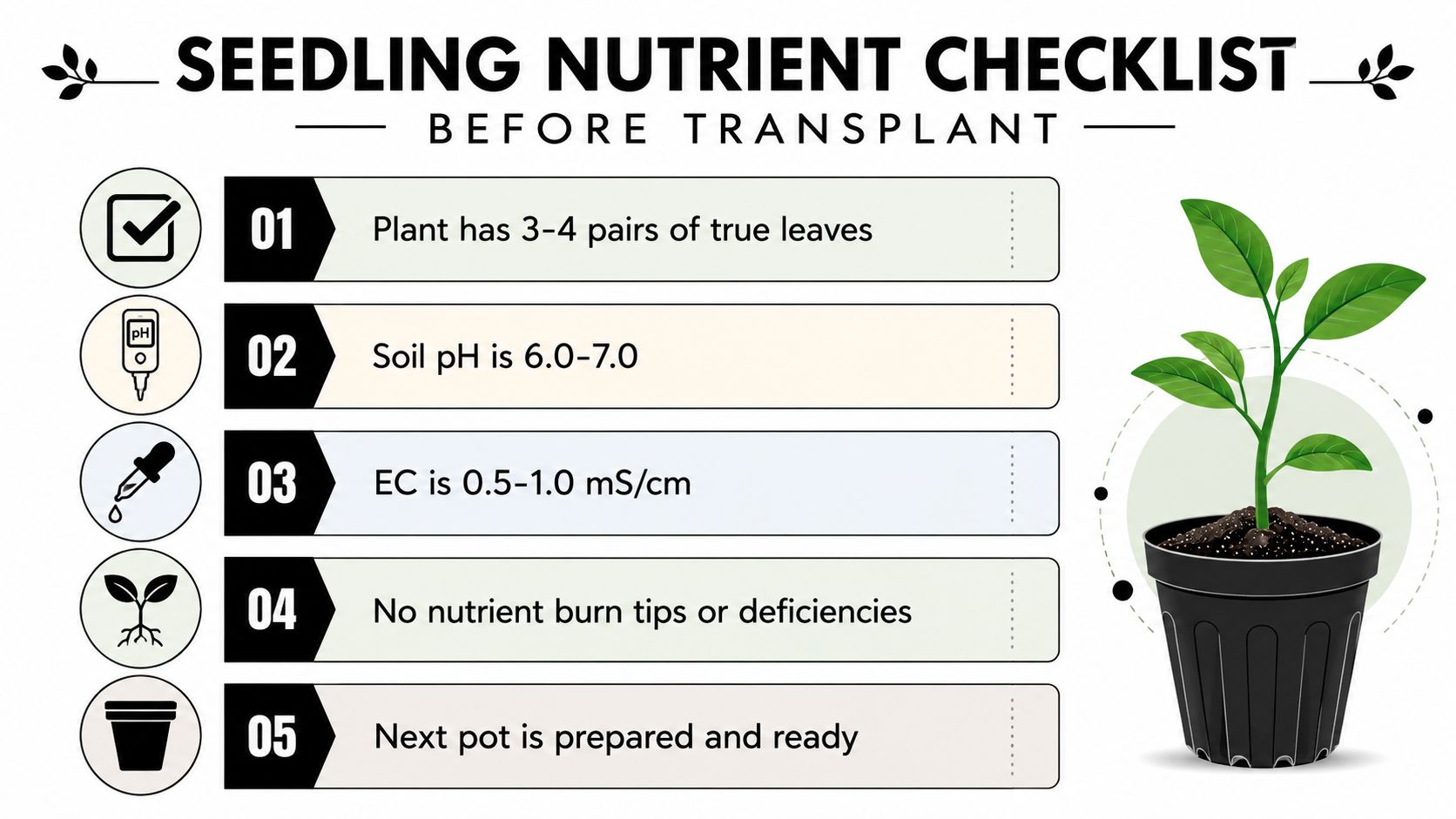
- Plant has 3 to 4 pairs of true leaves.
- Soil pH is 6.0 to 7.0, or the correct range for your medium.
- EC sits around 0.5 to 1.0 mS/cm, not higher.
- No nutrient burn tips or obvious deficiencies.
- The next pot is already prepared and ready.
The three rules worth remembering
Feed light. Seedlings do not need a heavy hand, and the first two weeks are where people usually overdo it. If the medium is already holding enough charge, adding more only raises the risk of burnt tips and stalled growth.
Fix pH first. A locked root zone makes good nutrients act useless. Check the medium and the water source together, because bad pH settings can make a clean feed look weak or messy.
Let the roots set the pace. Top growth follows root health, not the other way around. A seedling with a small, active root ball can handle a careful transplant better than a larger plant sitting in a sloppy, salty pot.
That is the whole job. Keep the feed mild, keep the medium honest, and do not rush the plant just because the bottle says it can take more. If you want to plan the rest of your run with less guesswork, use the Botanist Seeds catalog to compare cultivars that fit your space, your setup, and the kind of home grow you want to run.