Weed Fertilizer Flowering: Master Big Buds 2026
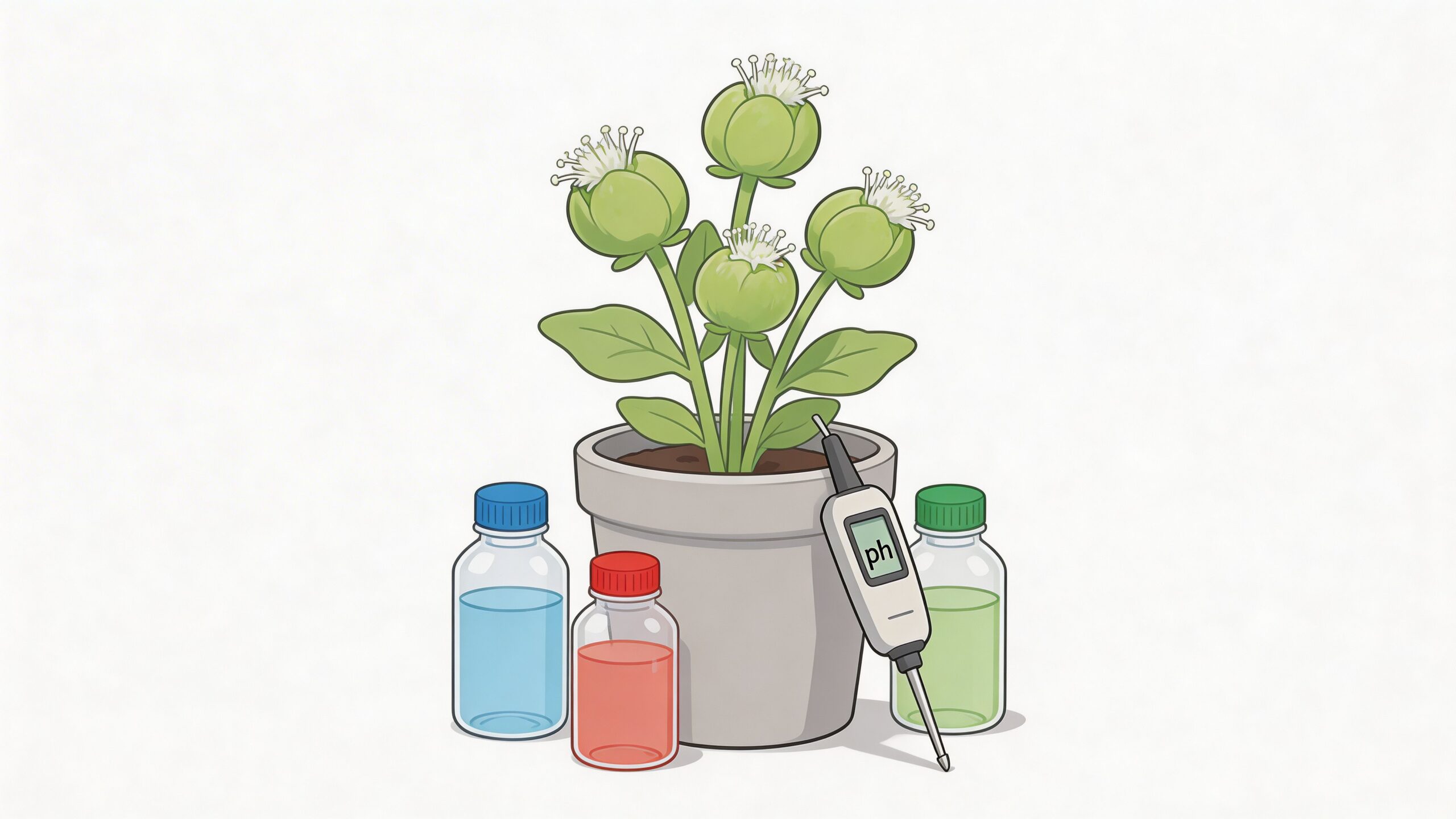
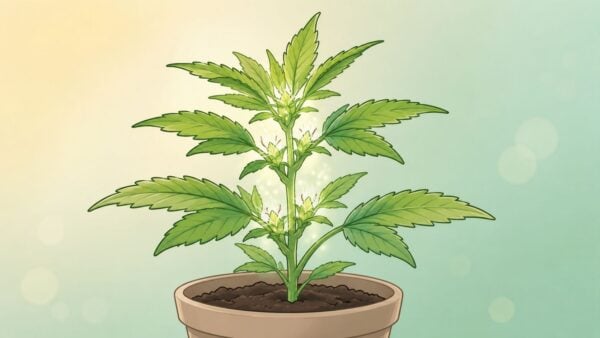
You flip the lights, check the timer, and then you see it. Tiny white pistils at the nodes. The plant that spent weeks building roots, stems, and fans has changed gears.
That moment is exciting, but it also makes a lot of home growers second-guess their feed. Do you switch nutrients right away. Do you hammer bloom booster. Do you cut nitrogen hard. Do you keep feeding like veg for another week. At this point, many decent runs drift off course.
Good weed fertilizer flowering strategy is less about buying more bottles and more about timing, restraint, and reading the plant in front of you. Buds get bigger when the feed matches what the plant is doing. Buds get better when you avoid the common mistake of overfeeding just because the label says “bloom.”
Welcome to the Flowering Stage
A lot of growers hit flowering with the same mindset they used in veg. If the plant grew fast on a stronger feed before, more should help now too. That is often the start of trouble.
In a home setup, flowering is when the plant gets less forgiving. It can still recover from mistakes, but every week matters more. Stretch, site formation, stacking, swelling, and ripening all happen in a tighter window. If you miss the handoff from veg nutrients to bloom nutrients, the plant tells on you fast.
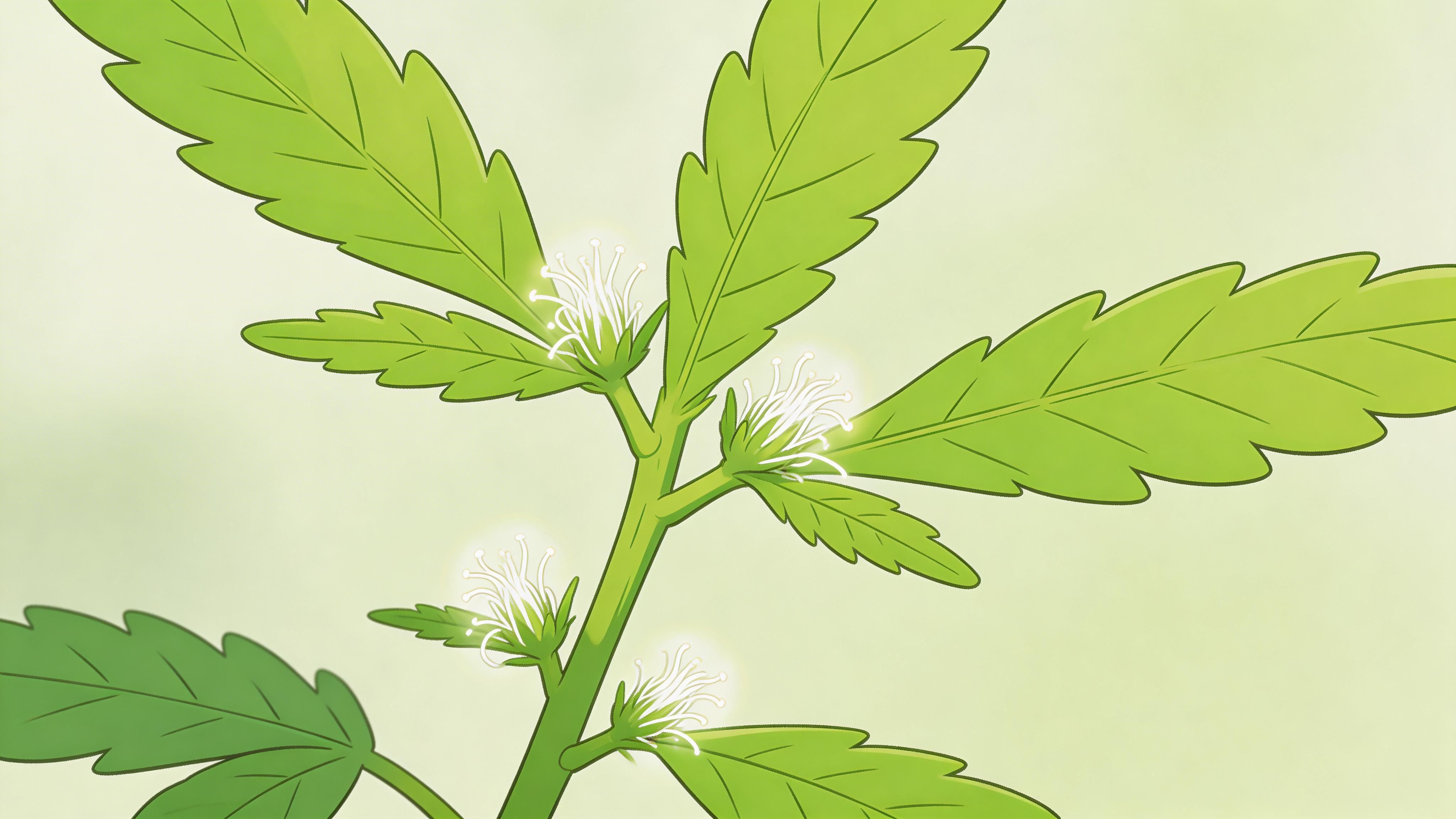
If you are still getting your timing straight, this breakdown of the stages of growing cannabis helps put the flowering shift into context.
What changes when flower starts
The plant is no longer focused on building a big frame. It still needs enough leaf mass to power growth, but the priority changes:
- Bud sites start forming: The plant begins allocating energy toward reproductive growth.
- Nitrogen demand starts easing: You still need some, just not the same veg-heavy approach.
- Phosphorus and potassium matter more: They support bud structure, bulk, and overall finishing.
That does not mean dumping a heavy bloom mix on day one.
A clean transition works better than a hard snap. Plants coming into flower still stretch, especially photoperiod cultivars. During that stretch, they need enough food to build new tissue without getting stuck in leafy, dark-green overgrowth.
Tip: If a flowering plant is deep green, clawing, and stacking leaf more than bud, excess nitrogen is one of the first things to question.
What a good flowering feed looks like
A strong flowering program is boring in the best way. It is consistent. The pH stays in range. The feed shifts gradually. The runoff or root zone stays manageable. The leaves stay healthy enough to power the buds, but not so lush that the plant acts like it is still in veg.
For most home growers, the win is not maximum bottle count. The win is getting to harvest with dense, aromatic flowers and no major lockout, no fried tips halfway through bloom, and no panic flush because one feed went too hot.
That is the essence of weed fertilizer flowering. Keep the plant productive, then get out of its way.
Understanding Nutrients for Bigger Buds
NPK on the label is not mysterious once you tie it to what the plant is doing. In flower, you are basically changing the recipe.
Veg is leaf and frame. Flower is structure, stacking, and finish.
What nitrogen does in flower
Nitrogen still matters in flowering. Anyone who tells you to eliminate it the second pistils show is asking for pale plants and weak production.
But too much nitrogen during bloom creates its own problems. The plant keeps pushing lush leaf growth, bud development slows, and the final product can come out rougher than it should. Established cultivation guidance recommends dropping nitrogen to around 200 ppm when transitioning to flower, while raising phosphorus and potassium, and it points to bloom formulas like 2-8-4 as a clear shift away from veg formulas like 5-2-3. That transition can improve yields by 20-50% for craft cultivators by preventing excess N from getting in the way of bud development, according to Cannabis Business Times on stage-specific cannabis fertilization.
The practical takeaway is simple. Reduce nitrogen, do not erase it.
Why phosphorus gets so much attention
Phosphorus is the nutrient growers usually chase hardest in flower, sometimes way too hard. It supports flower development, but more phosphorus is not automatically better.
Research connected to North Carolina State University found that a continuous program of about 15 ppm phosphorus supports flower yield and cannabinoid concentration, while many commercial supplier programs recommend 130-196 ppm P, suggesting many growers are overdoing it by 200-300% and may be hurting potency in the process, based on this cannabis phosphorus management analysis.
That lines up with what a lot of experienced growers learn the slow way. Huge phosphorus numbers on a label do not guarantee better flowers. Often they just sell the feeling that you are doing more.
Potassium is the quiet workhorse
Potassium is what helps the plant handle the heavy lifting of flowering. It supports water movement, pressure within plant tissue, and the kind of steady bulking you want once buds start putting on real mass.
In practical terms, when a bloom formula works, potassium is usually doing a lot of the dirty work behind the scenes. If nitrogen is the gas pedal in veg, potassium is part of what keeps the machine steady in flower.
Organic versus mineral feed
This is one of those debates that gets louder online than it needs to be in the grow room.
Organic feeding often gives you a wider buffer. The release is slower. Soil biology does part of the work. The tradeoff is slower correction when something drifts off.
Mineral or synthetic feeding gives you tighter control. Nutrients are available quickly. The tradeoff is that mistakes show up quickly too. Push too hard and you can burn tips or create lockout faster.
For a home grower, the better choice is usually the one that matches how you grow:
- Use organic if: You want a simpler soil-based approach and do not want to chase every small shift.
- Use mineral if: You grow in coco or hydro, or you like precise control and frequent monitoring.
- Mix carefully if: You understand what each bottle is doing and are not just stacking products because the feeding chart looks impressive.
pH and feed strength matter more than fancy additives
A lot of growers buy supplements before they master pH. That is backwards.
If pH is out of range, the roots can sit in a full buffet and still fail to eat properly. If you need a clean reference on that piece, this guide to pH for cannabis is worth keeping bookmarked.
Feed strength matters too. In a home setup, plants rarely suffer because the grower was too patient. They suffer because the grower got excited and mixed like a commercial room with perfect environmental control.
The simple version to remember
If you forget everything else, remember this:
| Nutrient | Main job in flowering | Common mistake |
|---|---|---|
| Nitrogen | Supports ongoing plant function and stretch | Keeping veg-level nitrogen too long |
| Phosphorus | Supports flower formation and development | Chasing huge P numbers because labels say bloom |
| Potassium | Helps with bulking and overall flower performance | Treating it like an afterthought |
Key takeaway: Bigger buds do not come from the strongest feed. They come from the right shift at the right time, with pH and dose under control.
Your Week-by-Week Flowering Feed Schedule
Most growers do better with phases than with rigid day-by-day micromanaging. Flowering plants do not read calendars. They respond to light cycle, root health, environment, and cultivar traits.
So use the week count as a guide, then confirm with visual cues.
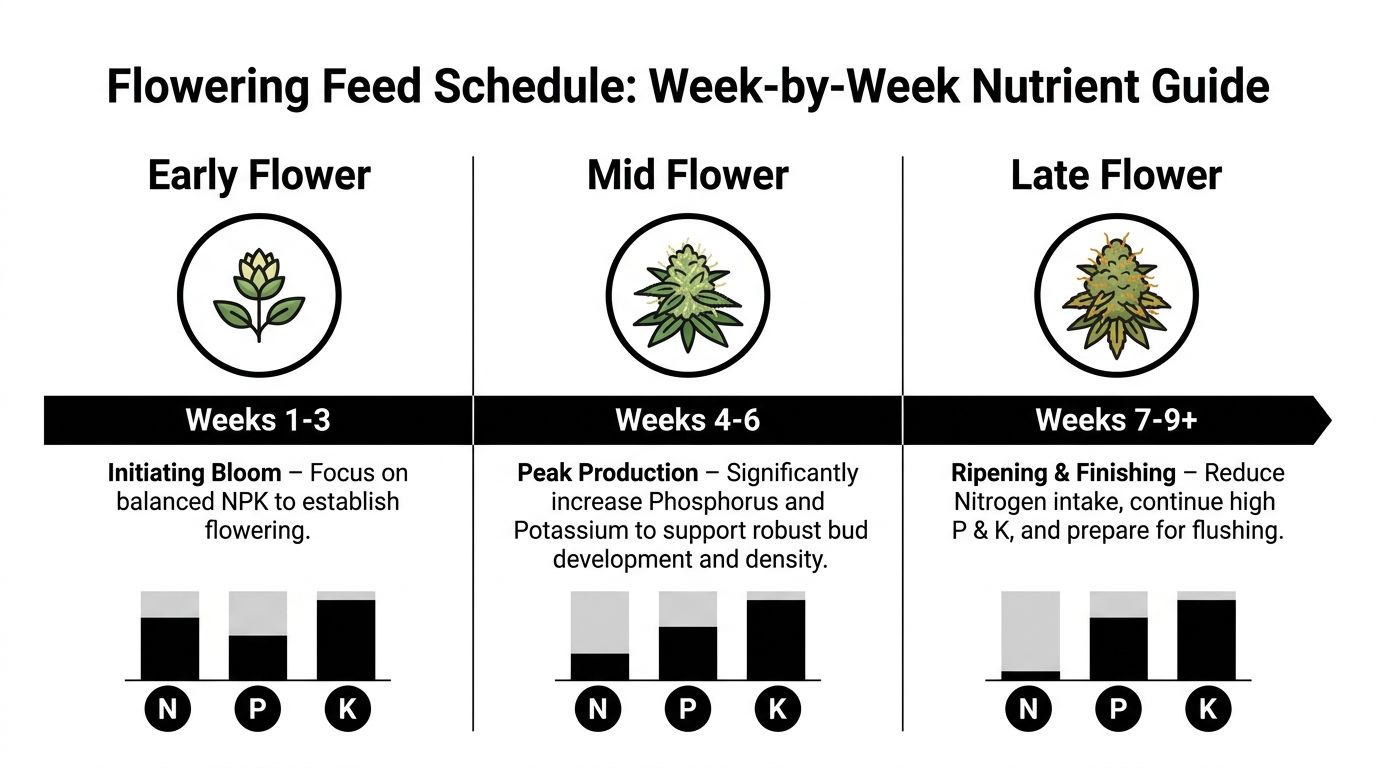
Start with a smooth transition
The first rule is not to shock the plant. If you have been feeding a veg formula, blend the handoff rather than flipping from heavy veg to aggressive bloom overnight.
A practical move for many home growers is this:
- At first pistils: Begin reducing veg nutrients and introduce bloom nutrients lightly.
- During stretch: Keep enough nitrogen in the mix to support growth.
- After stretch slows: Lean harder into the bloom profile and stop feeding like the plant still needs to build a frame.
If you are in rich soil, especially a hot bagged mix, go easy. Bottled nutrients stack on top of what is already there.
Flowering Stage Feeding Chart
| Flowering Week | Stage | N-P-K Focus | Target EC (Hydro/Coco) | Target PPM (500 scale) | Target pH (Soil) | Target pH (Hydro/Coco) |
|---|---|---|---|---|---|---|
| 1 | Early flower | Moderate N, moderate P, higher K | 1.8 to 2.0 | 200 to 250 | 6.0 to 7.0 | 5.5 to 6.5 |
| 2 | Early flower | Moderate N, moderate P, higher K | 1.8 to 2.0 | 200 to 250 | 6.0 to 7.0 | 5.5 to 6.5 |
| 3 | Early flower | Slightly lower N, elevated P and K | 1.8 to 2.0 | 200 to 250 | 6.0 to 7.0 | 5.5 to 6.5 |
| 4 | Mid flower | Lower N, higher P, higher K | 2.0 to 2.4 | 200 to 250 | 6.0 to 7.0 | 5.5 to 6.5 |
| 5 | Mid flower | Lower N, higher P, higher K | 2.0 to 2.4 | 200 to 250 | 6.0 to 7.0 | 5.5 to 6.5 |
| 6 | Mid flower | Lower N, higher P, higher K | 2.0 to 2.4 | 200 to 250 | 6.0 to 7.0 | 5.5 to 6.5 |
| 7 | Late flower | Low N, sustained P and K | 0.3 to 0.5 | 125 | 6.0 to 7.0 | 5.5 to 6.5 |
| 8 | Late flower | Low N, sustained P and K | 0.3 to 0.5 | 125 | 6.0 to 7.0 | 5.5 to 6.5 |
| 9+ | Late flower | Very low N, finishing approach | 0.3 to 0.5 | 125 | 6.0 to 7.0 | 5.5 to 6.5 |
Early flower
This phase is all about managing stretch and setting bud sites without overdriving leaf growth.
Look for:
- New white pistils
- Fast vertical growth
- More distance between nodes before stacking begins
Use a bloom feed, but keep some nitrogen available. Established guidance recommends dropping nitrogen to around 200 ppm at transition and moving toward bloom ratios like 2-8-4 rather than veg-style 5-2-3, as noted earlier in the cited cultivation guidance.
What works well here is moderate feeding and close observation. If the plant is still stretching hard and stays a healthy green, you are in the pocket. If it goes dark and glossy, back off.
Mid flower
This is when buds start looking like buds instead of promises.
Stretch slows. Sites begin stacking. Aromas get louder. The plant still needs healthy leaves, but at this point, the nutrient profile should look clearly flower-focused.
For mid flower:
- Keep nitrogen lower than transition
- Keep phosphorus and potassium elevated
- Maintain stable pH and root zone conditions
- Avoid adding every booster on the shelf at once
Research on nitrogen management during flowering found optimal nitrogen supply for conventional fertilizers at about 160-230 mg L⁻¹, with inflorescence yield dropping outside that range. It also noted that very low nitrogen can raise cannabinoid concentration, but with a yield trade-off, according to the Frontiers nitrogen management study.
That trade-off matters. A home grower chasing quality still needs enough nitrogen to keep the plant photosynthesizing well through the middle of bloom.
Tip: Mid flower is where overfeeding often shows up. If tips burn, leaves canoe, or runoff climbs hard, do not answer by adding more bloom booster. Reduce stress first.
Late flower
Late flower is where a lot of growers either ruin quality by forcing more feed, or improve quality by letting the plant finish.
The flowers are formed. Now the goals change:
- Keep the plant functioning, but stop trying to push fresh leafy growth
- Reduce nitrogen further
- Keep the root zone clean and manageable
- Watch trichomes, pistil behavior, and fade
Established guidance for late bloom says to drop nitrogen to about 125 ppm with a 1:1.5 N:K₂O ratio while maintaining adequate phosphorus as calyxes form, according to the same earlier cultivation reference already cited in this article.
That does not mean every plant should be pushed to the exact same finish. Some cultivars hold green longer. Some fade earlier. Some hungry phenos still want a little more support. The schedule is a frame, not a prison.
Soil, coco, and hydro do not behave the same
Growers often get tripped up here by copying somebody else’s chart.
Soil has buffer. Changes land slower. Corrections land slower too.
Coco behaves more like hydro than soil. It likes consistency and usually needs tighter nutrient management.
Hydro gives quick response, both good and bad. That makes stable EC and pH even more important.
A schedule only works if it respects the medium.
For autoflowers, lighten the hand
Autoflower cultivars usually appreciate a gentler version of the same flowering logic. They move fast, they have less time to recover, and they often react poorly to heavy-handed feed changes.
Keep the same priorities, just with a lighter touch. If a photoperiod can tolerate a push, an autoflower may not forgive it.
Fine-Tuning Your Feed for Top-Shelf Results
Once the basic feed is working, the next level is not about more products. It is about better timing and smaller adjustments.
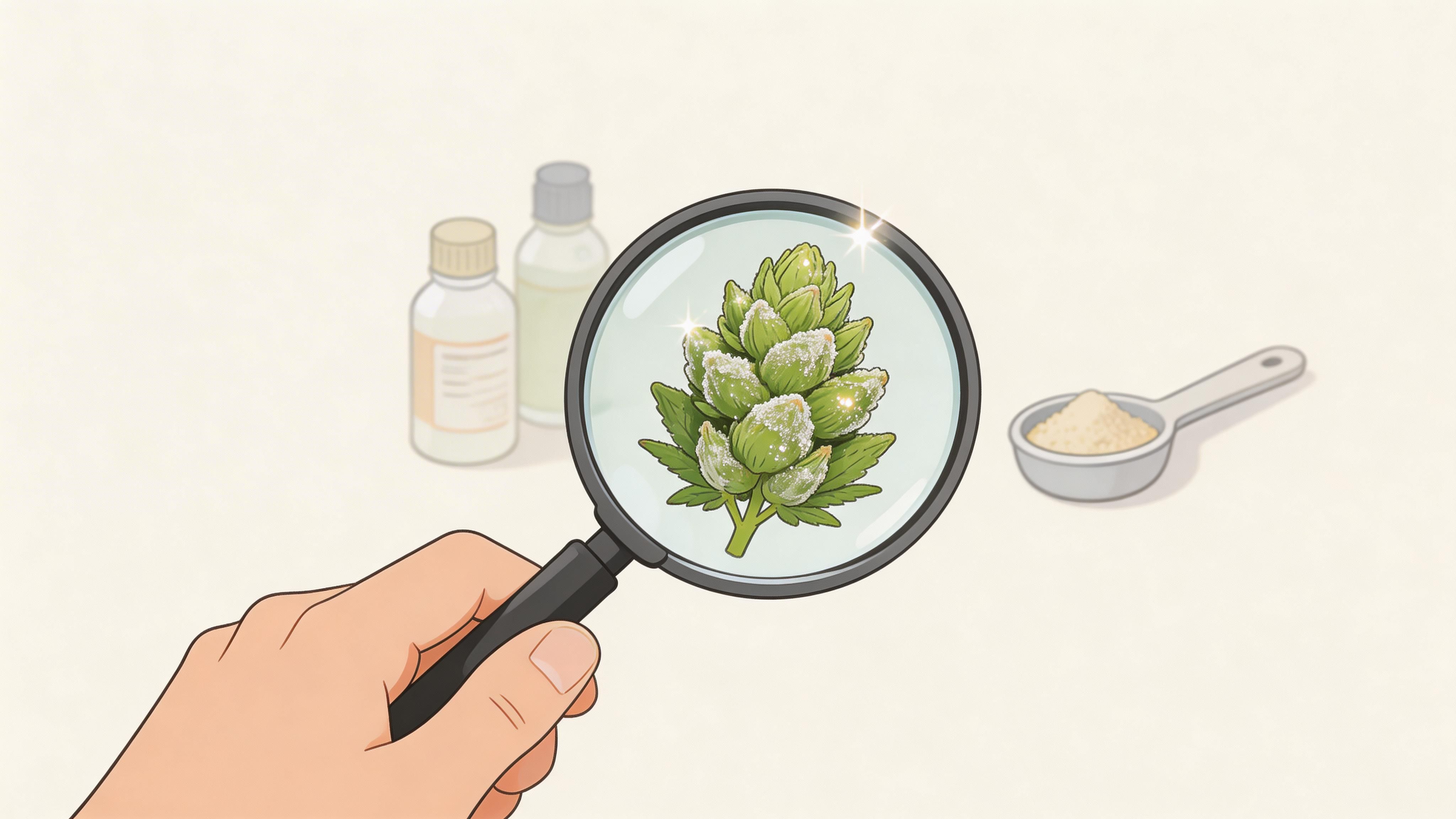
Use supplements with a reason
A lot of growers turn their nutrient shelf into a chemistry set. Most of the time, the plant would rather have fewer variables.
Supplements can help, but each one should solve a real need:
- Silica: Useful when you want stronger structure and sturdier plants.
- Calcium and magnesium: Often helpful in coco or when using filtered water.
- Molasses in soil: Some growers like it in living soil systems, but it is not a magic bloom shortcut.
- Bloom boosters: Best used carefully, not stacked on top of an already strong base feed.
If you cannot explain what a bottle is supposed to do in your room, skip it.
Cultivars do not all eat the same
In this situation, experience matters more than charts. Some cultivars are greedy. Others burn at the first sign of ambition.
Watch for patterns:
- A cultivar that stays pale and pushes hard may want a bit more food.
- A cultivar that claws and darkens early often wants less nitrogen.
- Broad-leaf plants can respond differently than lankier, narrow-leaf plants during stretch and stacking.
Good growers are not the ones who follow the bottle perfectly. They are the ones who notice which plant likes half strength and which one can handle more.
Strategic nutrient stress can improve quality
This is one of the more interesting parts of modern flowering practice. Emerging research suggests that controlled nutrient stress during flowering can increase CBD concentrations while maintaining up to 95% of total yield using one-third less fertilizer, according to this bloom fertilizer overview discussing nutrient stress strategies.
That does not mean starving every plant. It means understanding that “more feed” is not always the path to better flower quality.
In a home grow, this can look like:
- easing back late instead of force-feeding to the end
- avoiding unnecessary top-ups when the plant is already carrying enough nutrient
- letting the plant redirect internal resources as it ripens
Key takeaway: Fine-tuning is usually subtraction, not addition. Strong harvests often come from removing excess feed, not inventing a new bottle stack.
Foliar feeding during flower needs restraint
Foliar feeding can help earlier in the plant’s life, but once flowers are developing, caution matters. Wet buds invite problems. If you do use foliar sprays, keep them out of late flower and avoid soaking developing sites.
For most home growers in bloom, root feeding and stable pH are safer bets.
How to Read Your Plants and Finish Strong
Plants tell you what the feed chart never can. They show whether the root zone is happy, whether the nutrient ratio fits the stage, and whether your finish is on track.

What common symptoms usually mean
A few examples show up over and over in flowering.
Burnt tips
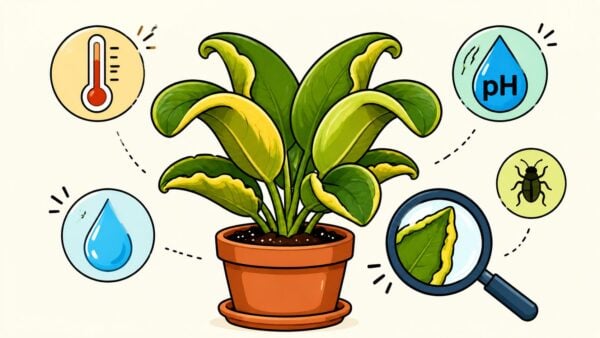
Slight tip burn is common when you are near the upper edge of feed strength. Full-on fried margins are different. That usually means the mix is too hot, salts are building up, or the plant is taking up less water than expected.
Best response:
- reduce feed strength
- check runoff or reservoir trend
- confirm pH before adding anything else
Dark green clawed leaves
This usually points to too much nitrogen, especially in early to mid flower. Buds can stall while leaves stay lush and heavy.
Best response:
- cut back veg-heavy inputs
- simplify the recipe
- avoid adding more “bloom” products until the leaf posture improves
Yellowing lower leaves
In late flower, some fade is normal. In early flower, fast yellowing can mean the plant is short on nitrogen or the pH is off.
The difference is timing. A plant fading near the finish is often just maturing. A plant fading while still building bud mass may need correction.
Rust spots or odd blotching
This can point to uptake issues rather than one simple deficiency. Root stress, pH drift, or imbalance between nutrients can all create messy-looking symptoms.
When the symptom looks random, simplify before you complicate.
Deficiency versus excess
A lot of problems look similar at first. The easiest way to split them is to ask two questions:
- Did the problem show up after I increased feed?
- Is the plant in a medium that may already hold nutrients?
If yes, suspect excess before deficiency.
If the plant has been on a light schedule for a while, looks pale overall, and the root zone numbers are not high, then a true deficiency becomes more likely.
Tip: Do not chase every leaf. Look at the trend across the whole plant and across several days.
Why the finish matters as much as the build
Late flowering is not just about keeping leaves alive. It is about helping the plant finish cleanly.
A 2023 study published in Frontiers in Plant Science found that nutrient deprivation late in flowering can significantly enhance cannabinoid concentrations. In that controlled indoor experiment, inflorescence dry matter at final harvest increased from 16.1 g plant⁻¹ at 80 mg N L⁻¹, to 22.6 g plant⁻¹ at 160 mg N L⁻¹, and 26.3 g plant⁻¹ at 240 mg N L⁻¹, but nutrient deprivation increased total CBD concentration from 2.9% to 6.5% under organic treatments and from 3.0% to 5.8% under mineral treatments. The same study reported that 80 mg N L⁻¹ could deliver comparable cannabinoid outputs while cutting resource use by up to 67%, according to the 2023 Frontiers in Plant Science study on nutrient deprivation during cannabis flowering.
That is the trade-off in plain English. More feed can build more mass. Less feed, used strategically late, can improve quality and efficiency.
A practical finish for home growers
A clean finishing approach usually looks like this:
- Stop escalating late: Once the plant is ripening, more feed rarely fixes anything.
- Let some fade happen: Healthy senescence is not the same as collapse.
- Keep watering consistent: Big wet-dry swings late in flower create their own stress.
- Watch the flowers, not just the leaves: Bud development, aroma, and resin tell the full story.
A quick visual refresher can help if you are comparing symptoms and timing in real time.

About flushing
Flushing gets argued to death. In practice, many home growers use the term to mean one of two things:
- stopping bottled nutrients near the end
- watering in a way that reduces leftover salts in the medium
For soil, growers often shift to plain pH-balanced water toward the end and allow the plant to use what is left in the pot. In coco or hydro, the finish is usually shorter and more direct because the root zone reacts faster.
The useful version of flushing is not a panic move. It is a finishing move. You are not “washing chemicals out of buds.” You are reducing excess nutrient in the medium and encouraging the plant to finish on stored reserves rather than heavy fresh feed.
Harvest the Rewards of Your Hard Work
Flowering is where the grow either cashes in or falls apart. Not because the plant suddenly got complicated, but because small mistakes start showing up in the final product.
The growers who get consistently good results keep the core rules simple. Lower the nitrogen as flower sets in. Keep phosphorus and potassium in the conversation without going overboard. Keep pH in range. Watch the plant more closely than the bottle chart.
That approach gives you better odds of finishing with flowers that look good, smell loud, and feel worth the time you put in. It also makes home growing more satisfying. No dispensary line, no guessing how fresh the jar is, no tax sting at checkout. Just your own harvest, grown the way you like it.
The last step is timing the chop correctly. If you want help dialing that in, this guide on when to harvest cannabis is the natural next read.
Once you get the hang of weed fertilizer flowering, the whole process feels less like juggling bottles and more like guiding the plant through a finish it already wants to make.
Common Questions About Flowering Nutrients
| Question | Answer |
|---|---|
| When should I switch from veg nutrients to bloom nutrients? | Start the transition when you see the plant entering flower, not weeks later. Ease into bloom feed rather than making a hard overnight switch. |
| Do flowering plants still need nitrogen? | Yes. They need less than in veg, but they still need enough to support stretch, leaf function, and flower development. |
| Is more phosphorus always better for bigger buds? | No. Overdoing phosphorus is a common mistake. A balanced program usually outperforms a heavy-handed one. |
| Should I use bloom boosters? | Only if your base feed is already dialed in and the plant needs extra support. Boosters do not fix pH issues, overwatering, or poor root health. |
| Why are my leaves clawing in flower? | Clawing often points to excess nitrogen, especially if the leaves are dark green and glossy. |
| Is yellowing normal in late flower? | Some late fade is normal. Fast yellowing too early in bloom can signal a feeding or pH problem. Context matters. |
| Do autoflowers need the same flowering feed as photoperiod cultivars? | The same principles apply, but autoflowers usually prefer a lighter hand and fewer aggressive changes. |
| Should I flush before harvest? | Many growers reduce or stop nutrient feeding near the end so the plant finishes on stored nutrients. The exact method depends on whether you grow in soil, coco, or hydro. |
Botanist Seeds makes it easier to match the right cultivar to your setup, whether you want a beginner-friendly autoflower, a heavy-yielding feminized option, or something with a specific aroma profile and growth style. If you are planning the next run, check out Botanist Seeds and use the comparison tools to find a cultivar that fits your space, your schedule, and the kind of harvest you want.