





Super Boof Strain: A Grower’s Guide
You’ve probably been there before. A grow wraps up, the jars are curing, and your brain is already on the next run. You want something that feels worth the electricity, the daily checks, and the tent space. Not just another cultivar with a loud name and average payoff.
That’s where super boof seeds tend to grab people. The appeal is simple: strong bag appeal, a loud fruit-meets-gas profile, and plant structure that rewards growers who like shaping a canopy instead of fighting one. If you grow at home because you want better flower on your own schedule, this cultivar makes a lot of sense.
Introducing Your Next Favorite Cultivar Super Boof
Super Boof didn’t hang around as a niche pick for long. It was released in 2021, and it quickly built a name with growers who wanted a modern hybrid that didn’t lean too hard in one direction. According to a seed bank’s Super Boof strain review, it’s a balanced 50/50 indica-sativa hybrid that gained traction fast after release.
That balance matters in the grow room too. Some cultivars clearly want to be run one very specific way, and they punish you if your environment slips. Super Boof tends to appeal to home growers because it offers a more even, approachable grow style while still producing buds that feel special when you finally trim them up.
Why growers keep coming back to it
A lot of the excitement around super boof seeds comes down to a few practical things:
- It feels current: This isn’t some dusty catalog cultivar that only survives on old forum nostalgia.
- It looks rewarding: Dense, resin-heavy flowers give you that “yeah, this one was worth it” feeling at harvest.
- It fits home setups well: It responds to hands-on canopy work instead of forcing you into a single approach.
Practical rule: If you enjoy tweaking your environment, training branches, and chasing flavor as much as yield, Super Boof is a strong next project.
There’s also a simple quality-of-life point here. Growing your own means fewer dispensary trips, fewer taxes built into every pickup, and no standing in line hoping the menu still has what you wanted. With a cultivar like this, the payoff isn’t only the finished flower. It’s the whole process of taking a seed and turning it into something you’re proud to jar up.
What makes it a good next run
Super Boof makes sense for growers who want a cultivar with personality, but not one that turns every week into damage control. If your last grow taught you the basics of watering, airflow, and light management, this is the kind of plant that lets you build on that.
The smart move is to approach it like a project with intent. Pick your seed type carefully, keep the climate steady, and don’t let the thick canopy get away from you. Do that, and Super Boof can be one of those cultivars you remember long after the jars are empty.
The Genetics and Vibe of Super Boof
Super Boof comes from Black Cherry Punch x Tropicana Cookies, and that family tree tells you a lot before you even pop a seed. You’re not dealing with a flat, one-note cultivar. You’re dealing with something built from fruit-forward genetics and brighter citrus-heavy stock, with enough funk underneath to keep it interesting.
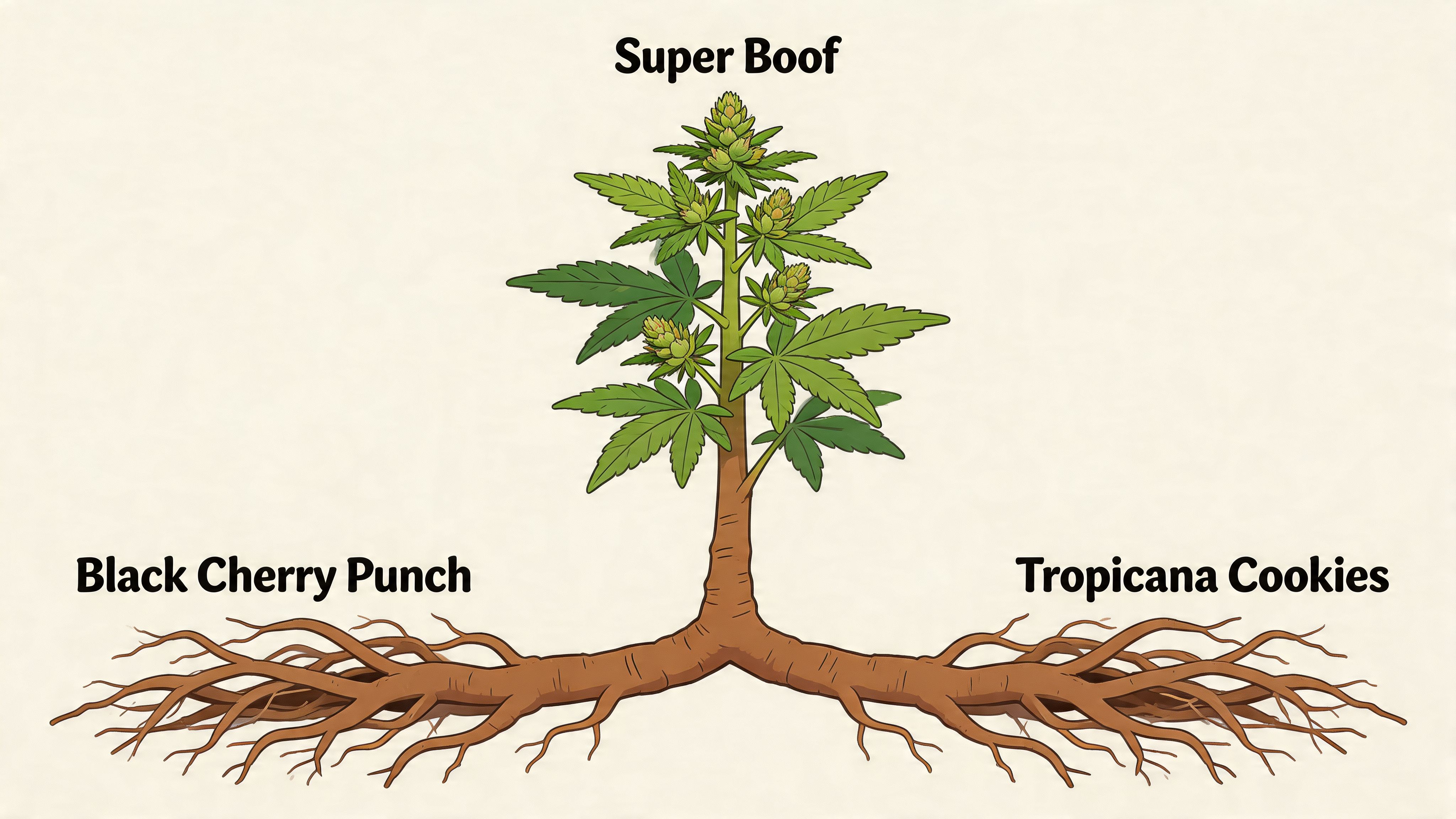
The name has its own story too. As noted in a seed bank’s Super Boof strain seeds guide, the cultivar started under the name Blockberry, and the later shift to Super Boof turned an old slang term into a badge of premium flavor and potency. That fits the cultivar pretty well. It has a playful name, but it’s not a gimmick plant.
What the parentage actually means in the jar
Black Cherry Punch brings that darker fruit direction. Tropicana Cookies pushes things toward brighter citrus. In practice, that blend is why growers often talk about Super Boof in terms of aroma first.
You’ll usually see these notes come up:
- Black cherry tones, which give it a deeper fruit edge
- Citrus character, especially the brighter orange or tropical side
- Earthy gas, which keeps the sweetness from getting too candy-like
If you want a better handle on why those aroma layers matter, it helps to read up on how cannabis terpenes shape flavor and overall character. That gives you a practical way to think about what you’re smelling, not just a list of buzzwords.
The plant’s personality
Some cultivars look nice at harvest and feel pretty plain the rest of the run. Super Boof usually has more visual interest than that. It tends to grow with enough structure to look tidy when trained well, and the finished flowers often carry the kind of color and frost that make trimming less of a chore.
The best part of this cultivar’s vibe is that the aroma usually matches the look. It doesn’t feel like a pretty plant with nothing behind it.
That said, there’s a trade-off. Big aroma and dense flower structure are great when things are going right. They also mean you need to stay honest about airflow and moisture control. Let the canopy get too thick, or let humidity sit where it shouldn’t, and this stops being a fun flavor project and turns into a cleanup job.
Why growers get attached to it
Super Boof has a broad appeal because it doesn’t lock you into one narrow experience. The overall vibe lands in a middle lane that a lot of growers appreciate. It feels upbeat without being flimsy, and relaxed without becoming dull.
That middle-lane personality also makes it a solid cultivar for sharing. If you grow for yourself and for friends, this is the sort of jar people remember by smell alone. That matters more than people admit. You can grow a lot of decent flower. Growing something with a distinct identity is different.
Choosing Your Super Boof Seeds Feminized vs Autoflower
If you’re shopping for super boof seeds, the first real decision isn’t flavor or yield. It’s feminized photoperiod or autoflower. That choice changes how much control you have, how much room you need, and how forgiving the run feels when life gets busy.
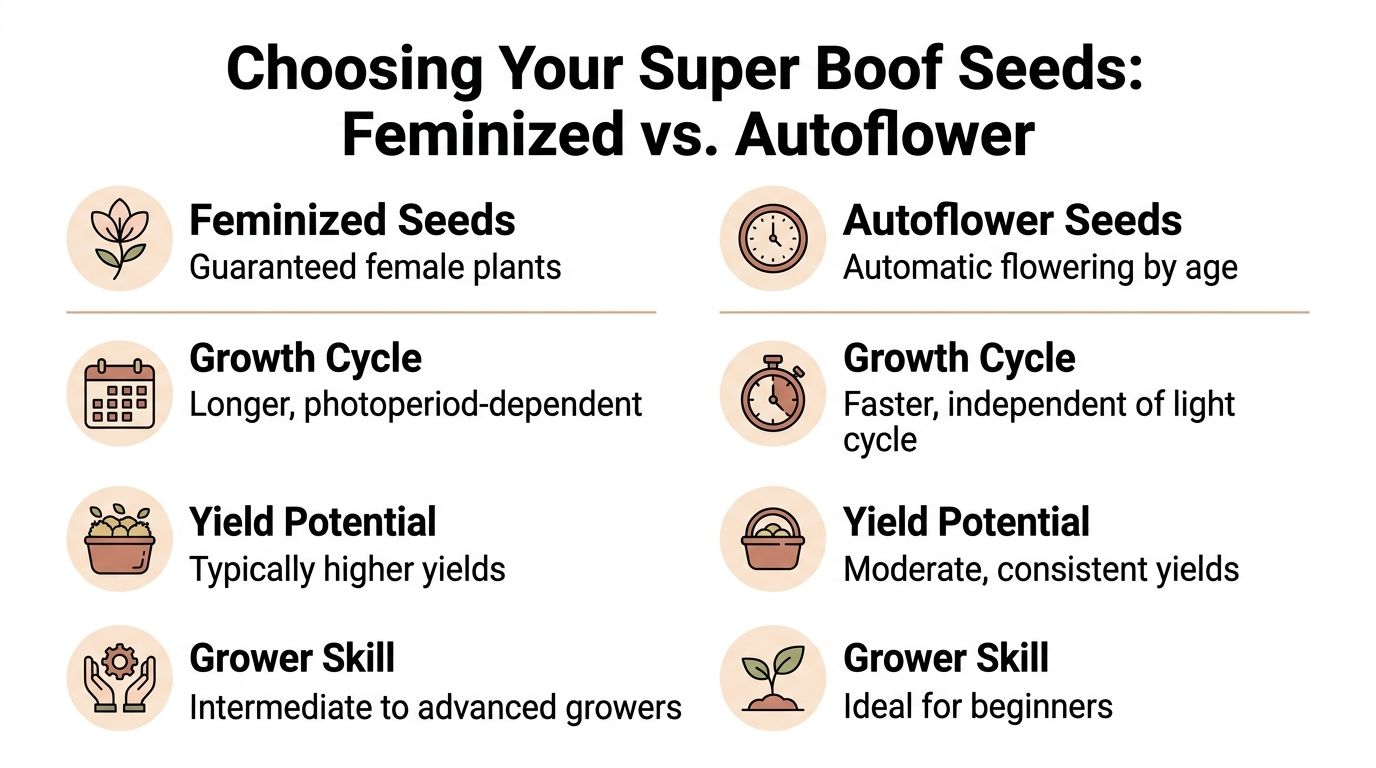
Neither option is “better” across the board. The better option is the one that fits your space and your habits. If you want a wider breakdown, this guide to autoflower vs feminized seeds is useful. The short version is below.
The practical difference
Feminized photoperiod seeds give you more control. You decide when the plant flowers by changing the light schedule. That’s ideal if you like training, filling a canopy, and correcting mistakes in veg before bloom starts.
Autoflower seeds are more about convenience. They flower based on age, not your light cycle. That makes them simpler to run, especially if you want a quicker, lower-fuss project.
| Feature | Feminized Photoperiod | Autoflower |
|---|---|---|
| Growth style | You control the flip to flower | Flowers automatically by age |
| Best for | Growers who want canopy control | Growers who want speed and simplicity |
| Training window | Longer, easier to shape and recover | Shorter, so timing matters more |
| Space use | Good if you want to fill a tent intentionally | Good for smaller, simpler setups |
| Mistake recovery | More forgiving in veg | Less recovery time if growth stalls |
When feminized makes more sense
Go with feminized if any of this sounds like you:
- You like training plants: Topping, LST, and net work are easier when you control veg length.
- You want to maximize the tent: Photoperiod plants let you fill dead space before flowering.
- You don’t mind a longer project: More time in exchange for more control is often a good trade.
This route is usually the better fit for growers who already know how they like their room set up. If you’ve got your routine down, feminized Super Boof gives you room to shape the plant instead of just keeping up with it.
When autoflower is the smarter pick
Autoflower super boof seeds are a good call if your goal is a cleaner, more straightforward run.
- You want less schedule management: No need to trigger flowering with a light change.
- Your grow space is small: A compact setup is easier to manage with autoflowers.
- You’re newer to growing: They can be a nice way to keep things moving without overcomplicating the process.
Decision shortcut: If you want control, pick feminized. If you want convenience, pick autoflower.
The trade-off is simple. Autoflowers ask for less from your calendar, but they also give you less time to fix issues. If a photoperiod plant has a rough week early on, you can usually veg longer and recover. With an autoflower, the clock keeps moving.
Your Indoor Growing Blueprint
Indoor growers have the advantage with Super Boof because you can give it the conditions it likes instead of hoping the weather cooperates. This cultivar rewards a dialed-in room. It doesn’t need fancy tricks nearly as much as it needs consistency.
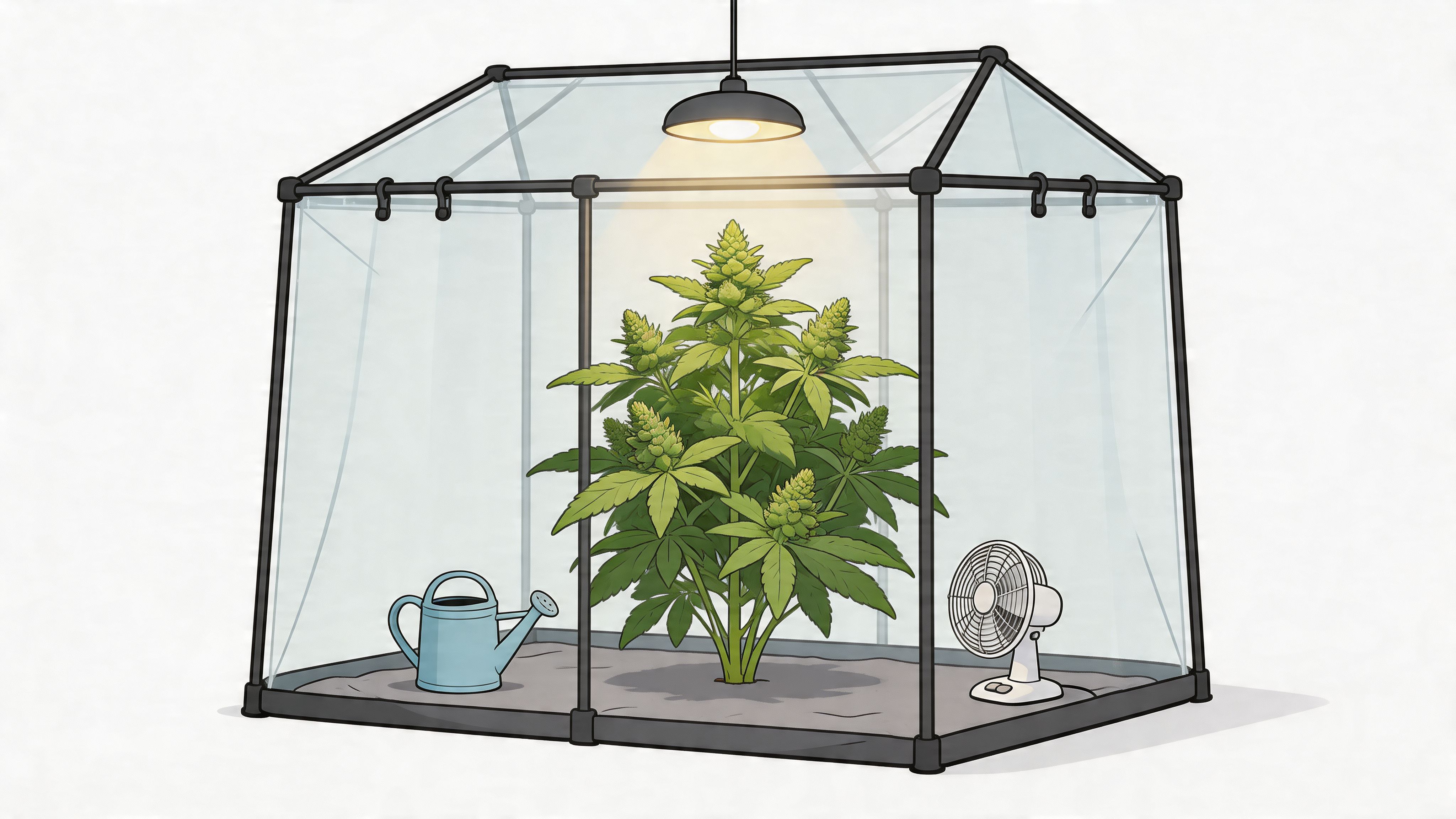
A useful benchmark comes from SeedFinder’s Super Boof grow information, which notes that Super Boof responds well to indoor HPS setups of 600W+ at 78°F and 50% RH, and that its thick lateral branching makes it a strong match for SCROG or SOG.
Get the room right first
If your environment is unstable, the rest of your plan won’t matter much. Start with the basics and lock them in before you chase anything fancy.
- Temperature: Keep the room around 78°F in active growth according to the source above.
- Humidity: Aim for 50% RH as your baseline target from that same grow guidance.
- Lighting: A strong HPS setup at 600W+ is one proven reference point from the cited breeder data.
- Air movement: Don’t let the canopy trap stale air. Dense branching needs active circulation.
A common mistake is feeding harder when the plant looks sluggish, when the underlying problem is usually climate or airflow. Super Boof tends to show you pretty clearly when the room is off. Thick growth with poor circulation is where small issues become bigger ones.
Training that actually fits this cultivar
This is not the plant to leave untouched and hope for the best. Its branching pattern gives you options, which is great, but only if you use them.
SCROG works well if you want a flatter, more even canopy. You spread the branches, keep tops at a similar height, and let the light hit more of the plant evenly.
SOG can also work if your setup and plant count support that style. The point there is efficiency and uniform tops, not letting one plant sprawl all over the tent.
Don’t confuse “vigorous” with “self-managing.” If you skip canopy work, the plant can crowd itself fast.
A simple indoor routine
For most home growers, this is the practical path:
- Start clean: Have fans, timers, and your medium ready before germination.
- Keep early growth steady: Avoid big swings in room temp or humidity.
- Train before the canopy gets crowded: Gentle LST, topping, or net work is easier early.
- Watch interior airflow: Thick branching looks great until the middle of the plant gets stagnant.
- Stay disciplined late in flower: Dense buds need dry, moving air.
If you want a quick visual walkthrough, this grow video is worth a look before you start adjusting your room:
What works and what usually doesn’t
Here’s the honest version.
What works
- A stable room
- Canopy training with a purpose
- Good airflow under and through the plant
- Not overwatering dense, actively growing plants
What doesn’t
- Letting humidity drift upward because “it looks fine”
- Ignoring lower growth until the tent turns into a wall of leaves
- Weak light over a broad canopy
- Treating every leaf issue like a nutrient problem
Indoor Super Boof can be a very satisfying run because the structure gives you something to work with. But the best results usually come from growers who keep it tidy, not growers who keep “just one more branch” until the plant takes over the whole tent.
Taking Super Boof Outdoors
Outdoor Super Boof is for growers who can give it the climate it wants, not growers trying to force it through a rough season. If your area gets good sun, decent airflow, and a reasonably dry finish, this cultivar can turn into a standout garden plant.
According to a seed bank’s Super Boof feminized listing, a single outdoor plant can reach up to 180cm, produce as much as 1000g, and finish around a mid-October harvest in the Northern Hemisphere. That same source notes the plant’s structure is strong enough to support its dense buds.

What kind of yard suits it
This cultivar generally wants warmth, sun, and a dry enough finish that the flowers can bulk up without sitting wet. If your fall is damp and still, you need to be more careful. Dense flowers plus trapped moisture are never a fun combination.
Outdoor growers get the best shot at success when they focus on site selection early:
- Pick the sunniest spot you’ve got
- Avoid dead-air corners near fences or walls
- Give each plant room around the canopy
- Use support before branches get heavy
The outdoor trade-offs
Growing outside saves you the constant power draw and gives roots and branches more freedom. It also means you lose some control. Rain shows up when it wants. Humidity doesn’t care about your plans. A photoperiod outdoor run always asks for more patience.
That’s why support and spacing matter so much here. Super Boof’s structure can carry weight, but a heavy plant still needs help if weather turns sloppy late in season. Stakes, cages, and soft ties are boring until they save a branch you would’ve otherwise lost.
Outdoors, prevention beats correction every time. Once dense flowers stay wet, you’re already behind.
How to keep it manageable
A big outdoor plant can become its own problem if you let every branch run wild. The trick is to shape it just enough that air can still move through it.
Try this approach:
- Open the center early: Remove weak inward growth before the plant gets crowded.
- Train for width, not chaos: A broad, supported plant is easier to inspect than a tangled one.
- Stay on top of cleanup: Dead leaves and low junk growth don’t help you outdoors.
- Check after storms: A quick inspection can catch damage or moisture pockets before they spread.
Who should grow it outside
Outdoor Super Boof is a strong choice for growers who already know their yard or plot well. If you’ve got a reliable sunny area and you can keep an eye on airflow, it can be a very rewarding seasonal plant.
If your climate runs cool, wet, or unpredictable late in flower, you’ll need to be more selective about placement and more disciplined about pruning. It can still be done, but this isn’t the cultivar to ignore for a week and expect everything to stay perfect.
The upside is hard to beat. Growing a plant this size through the season, then taking it down at the right moment, gives you a level of satisfaction that a quick dispensary pickup just doesn’t touch.
Harvest Tips and Seed Storage
The last stretch matters just as much as the first. You can grow a beautiful plant and still lose a lot of what made it special if you harvest too early, dry too fast, or store things carelessly.
Start with observation. Look for a plant that has finished swelling, with flowers that look mature and a canopy that has clearly shifted from active growth to finish mode. Here, patience pays off. Cutting too soon is one of the more common ways growers shortchange themselves.
Keep the finish clean
Your post-cut routine should stay simple:
- Trim with intention: Don’t manhandle the buds just to finish faster.
- Dry in a controlled space: Dark, clean, and with steady airflow matters more than speed.
- Cure without rushing: Good flower gets better when the jar time is handled right.
A loud cultivar can lose a lot of its charm if the dry is sloppy. The aroma you worked for needs a slow finish.
Seed storage matters too, especially if you bought more than you plan to run right away. As noted in the earlier a seed bank source, feminized seeds can deliver 99%+ female plants, which is a big reason growers choose them for a more reliable harvest. That reliability only helps if you store unused seeds properly.
How to store leftover seeds
Keep it basic and consistent. For long-term storage, use a place that is:
- Cool
- Dark
- Dry
That simple rule protects your investment better than any complicated hack. If you want a deeper walkthrough, this guide on how to preserve weed seeds covers the basics well.
Label what you keep. Store them where temperature swings are limited. Don’t leave packs sitting in a warm room, bright drawer, or humid garage and expect good results later.
A clean harvest, a patient cure, and proper seed storage are the habits that make the next run easier. They also make this run more satisfying, because you’re not wasting the work you already put in.
If you’re comparing super boof seeds and want a cultivar that rewards solid home-grow habits without making the process feel like homework, take a look at Botanist Seeds. Their comparison-friendly catalog makes it easier to match the right feminized or autoflower option to your setup, your schedule, and the kind of harvest you want to grow.