



Master TDS Meter Hydroponics: Calibration & PPM Guide
You're standing over the reservoir with a bottle in each hand, trying to decide whether the feed looks light or if you're about to overdo it. That moment is where a lot of home growers lose consistency. The plants might survive guesswork, but they won't always reward it.
A good TDS meter takes that guesswork off the table. In hydro, that matters fast. If you're running feminized or autoflower cultivars, especially in a compact home setup, small mistakes in feeding can show up quickly in leaf color, tip burn, growth speed, and flower development.
The nice part is this tool isn't complicated once you understand what it's telling you. You don't need to become a lab tech. You just need to know how to read the number, when to trust it, and when that number is hiding a problem.
Your Key to a Consistent Hydroponic Grow
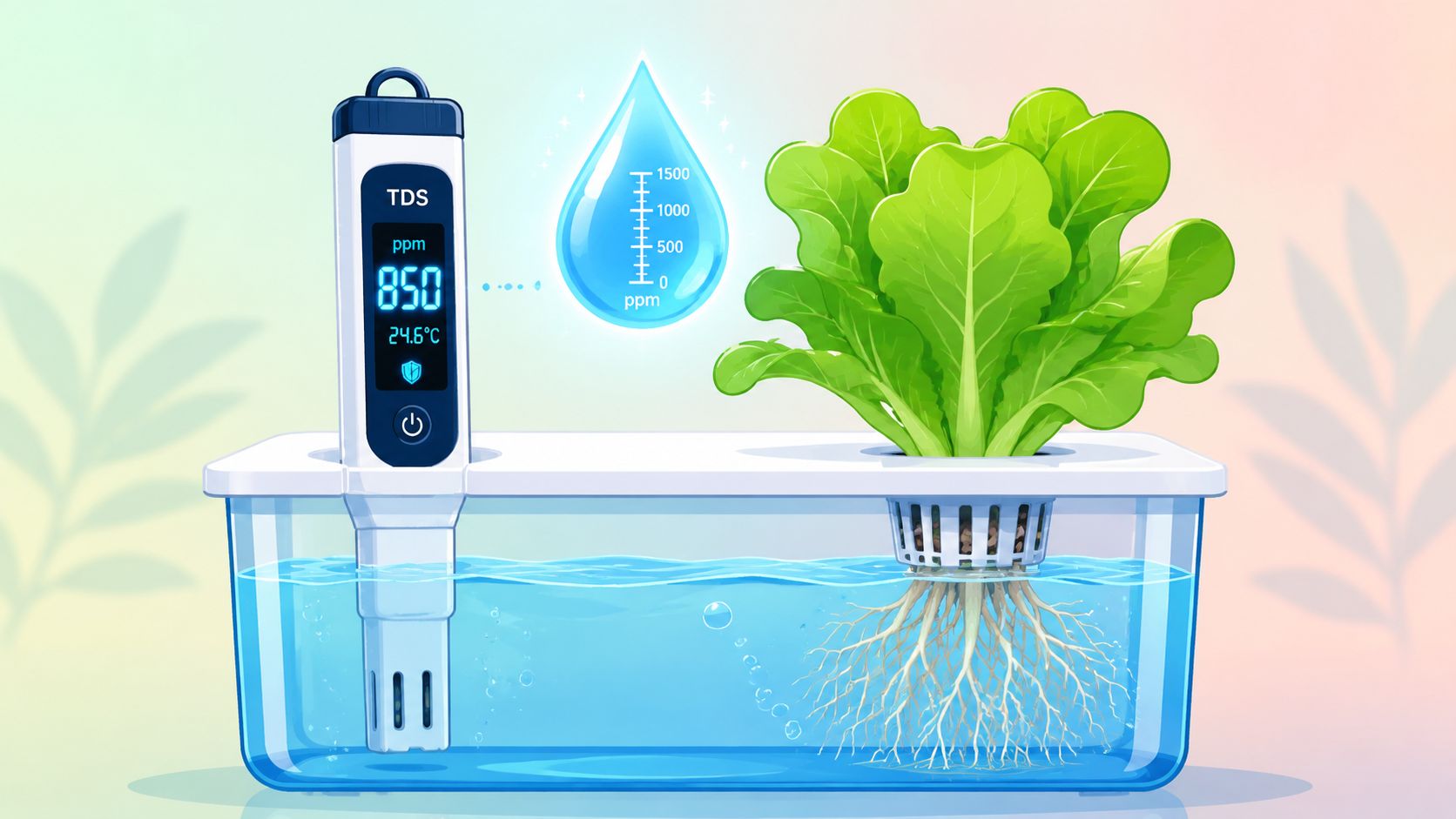
A TDS meter for hydroponics is one of those tools that seems more technical than it is. In practice, it's just a fast way to check whether your nutrient solution is weak, strong, or drifting away from where you want it.
That matters because hydro doesn't give you much buffer. In soil, the medium can soften some mistakes. In a reservoir, the roots are in direct contact with whatever you mixed. If the feed is too light, growth can stall. If it's too heavy, the plant can push back hard.
For home growers, consistency is the ultimate advantage. You want to mix the same way each time, track how the plant responds, and make small changes instead of random ones. That's how you get from “it looks okay” to a setup that repeats good results.
If you're running a bucket system or comparing nutrient strength across setups, it helps to understand how deep water culture works in practice. Reservoir management gets much easier when you stop treating the meter like a mystery box.
Practical rule: A meter won't grow the plant for you, but it will stop you from feeding blind.
The bigger shift is confidence. Once you know what the reading means, how to take it correctly, and how to judge it against the plant's stage, your whole grow gets calmer. You waste less nutrient solution, react faster when something drifts, and make decisions based on evidence instead of vibes.
What Your TDS Meter Is Actually Telling You
A TDS meter does not read nutrients one by one. It reads electrical conductivity first, then converts that reading into PPM. That is why TDS, EC, and PPM get tangled up for home growers. The meter is showing how much dissolved, charged material is helping the water carry electricity. It is not giving you a full nutrient breakdown.
Most handheld meters work this way, and the conversion standard matters. HTG Supply notes that common scales include 0.5 for NaCl, 0.55 for KCl, and 0.7 for 442, which is why the same reservoir can show different PPM numbers on different devices. Their guide lays out the relationship clearly in HTG Supply's EC and TDS guide for hydroponics.
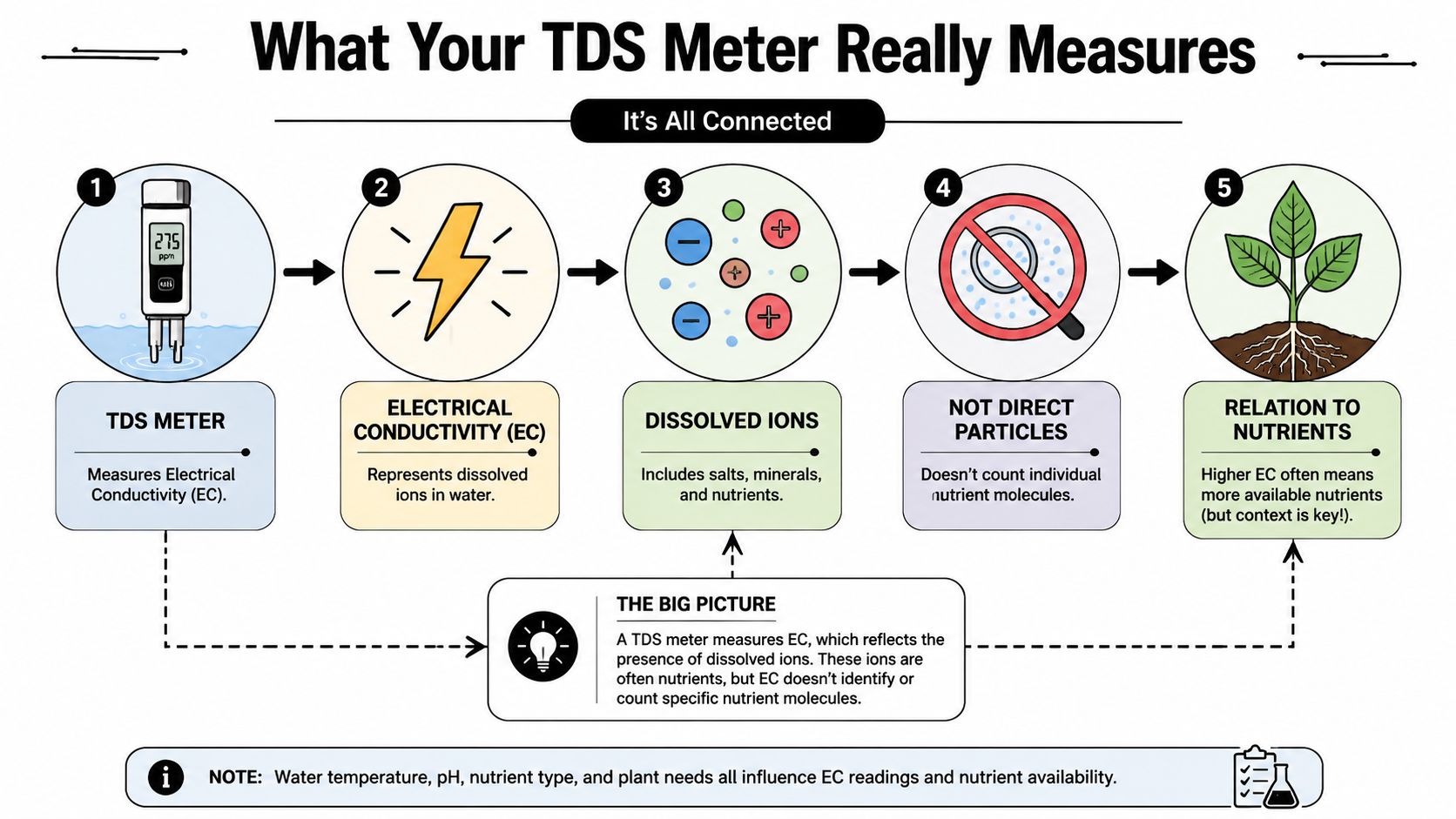
For cannabis growers, that distinction matters more than it sounds. A reading can tell you whether the solution got stronger, weaker, or stayed stable. It cannot tell you whether the plant has enough nitrogen, too much calcium, or the wrong ratio between elements. Good numbers can still hide a bad mix.
Starting water is the part many home growers miss.
If your tap water begins with a high reading, part of your TDS is already spoken for before you add a drop of nutrient. Sometimes that background load is harmless. Sometimes it is calcium, magnesium, sodium, bicarbonates, or other dissolved solids that push your total number up without feeding the plant the way you think. A reservoir mixed to 700 PPM with hard tap water is not the same as 700 PPM made with clean RO water.
Why two meters can disagree
Two growers can test the same solution and report different PPM numbers without either meter being broken. One meter may use a 0.5 conversion. Another may use 0.7. The EC underneath can be identical, but the displayed PPM will not match.
That is why I tell growers to treat EC as the cleaner reference when they compare notes, especially with cannabis feed charts from different brands. PPM is still useful for your own routine. It just gets messy when you compare one meter to another.
A simple way to keep your readings useful:
- Check your conversion factor: Look for 0.5, 0.55, or 0.7 in the manual or settings.
- Log your starting water: Test plain water before nutrients go in, so you know how much of the final number comes from the source water.
- Use one meter consistently: Trend lines matter more than chasing someone else's reading.
- Compare EC when sharing numbers: It removes a lot of avoidable confusion.
If your meter says 800 PPM, the number only means something in context. Context includes the conversion scale, the starting water, and the plant's stage.
What the number helps you decide
The meter is best used as a decision tool, not as a chemistry report.
It helps you answer practical questions in the grow room. Did the fresh mix come out where you intended? Is the reservoir concentrating because water is disappearing faster than nutrients? Is the plant eating aggressively, or is the solution staying heavy because the roots are stressed? Those are the answers that lead to better adjustments.
For home cannabis growers, that is its true value. Once you understand why the number moves, you stop treating TDS as a mystery score and start using it to make calmer feed decisions with real confidence.
How to Calibrate and Use Your Meter Correctly
A TDS meter is only helpful if the reading is trustworthy. Calibration is what makes that possible. Compare it to tuning a guitar: if the tool is off, every decision you make after that is off too.
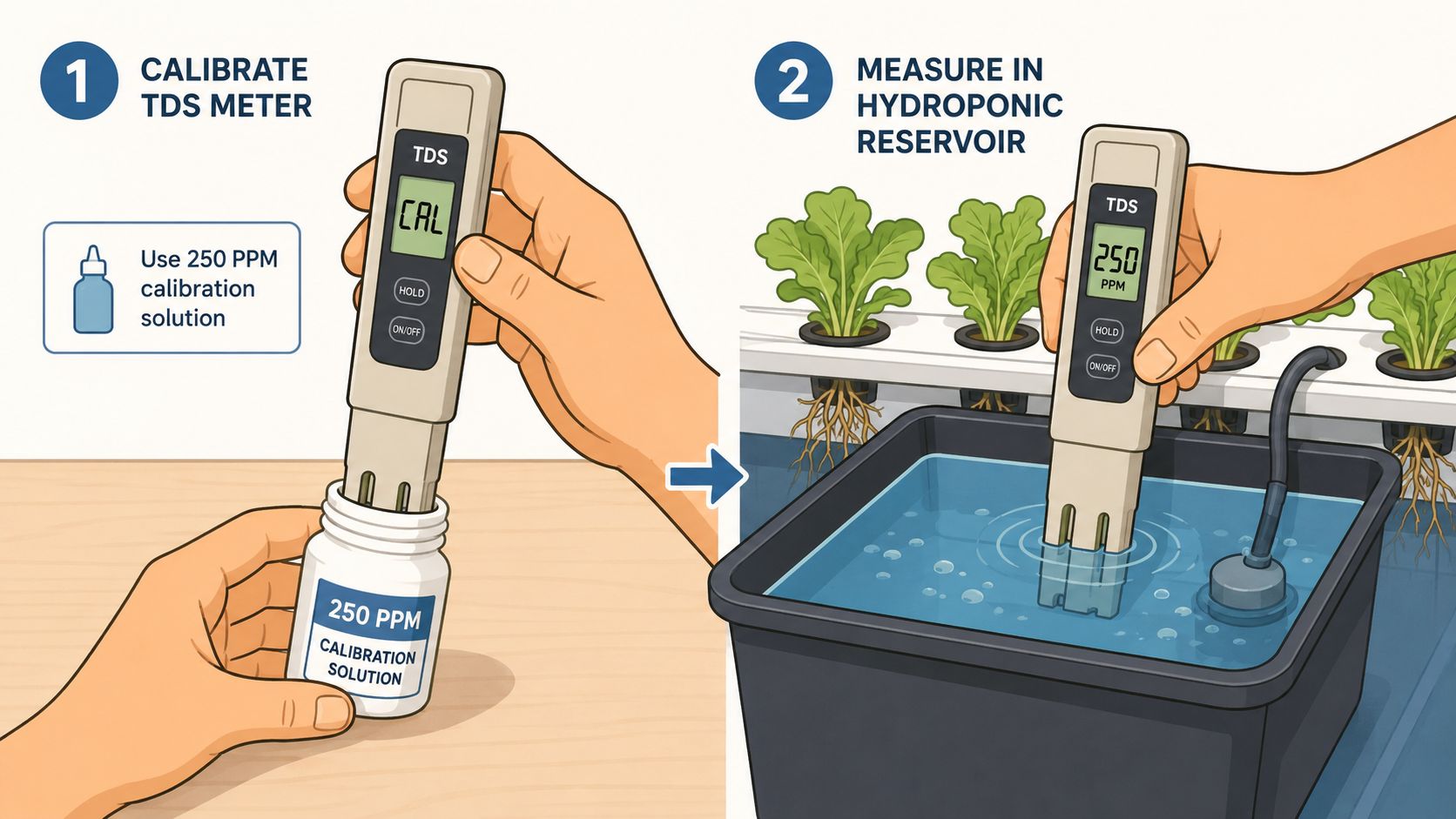
A simple calibration routine
Different brands vary a bit, but the basic process stays the same:
- Start with a clean probe: Rinse it with clean water before calibration. Old nutrient residue can throw off the reading.
- Use the proper calibration solution: Use the solution your meter expects, not whatever bottle happens to be on the shelf.
- Follow the meter prompts: Some meters calibrate automatically, others need a button press or manual adjustment.
- Wait for a stable value: Don't rush it. Let the reading settle before locking calibration in.
- Rinse again after calibration: That keeps calibration fluid out of your reservoir.
If your meter has replaceable caps or a storage recommendation, follow it. A neglected probe is one of the easiest ways to get sloppy data.
How to take a reservoir reading that actually means something
Once the meter is calibrated, the reading process should be boring. That's a good thing. You want the routine to be the same every time.
- Mix first, test second: Add nutrients, stir the reservoir thoroughly, then test.
- Let the water settle briefly: Swirling water and uneven mixing can skew what you see.
- Submerge the probe properly: Don't just touch the surface.
- Avoid touching the sides of the container: That can affect the reading on some setups.
- Read at a stable water temperature: Sudden temperature changes can make readings less useful.
Here's a visual walkthrough if you like seeing the process in action before doing it yourself.
The routine that works best
For most home growers, the easiest habit is to measure at the same points each time:
- Check starting water before adding nutrients
- Check again after mixing
- Log the result with the plant stage
- Watch how the reading changes between top-offs or reservoir changes
That log matters more than people think. A single reading is a snapshot. A pattern tells you whether the cultivar is eating hard, drinking hard, or getting pushed too far.
Quick check: If the meter reading jumps around every time you test the same reservoir, fix the process before changing the feed.
Ideal Nutrient Levels for Your Cultivars
Feed strength should change as the plant matures. Young plants need a lighter touch. Bigger plants in active growth can handle more. Flowering plants usually want a stronger mix than seedlings, but that doesn't mean every cultivar wants to be pushed to the limit.
Published hydro guidance from Foody Vertical Gardens lists 100 to 250 PPM for seedlings, 300 to 400 PPM for the first half of vegetative growth, 450 to 700 PPM for the second half of vegetative growth, 750 to 950 PPM for early flowering, and 1,000 to 1,600 PPM for late flowering, with flushing at harvest aiming for as close to 0 PPM as possible. The same guide notes that water below 200 PPM is considered clean drinking water, while above 400 PPM is not safe for human consumption, which shows how nutrient reservoirs often run far beyond normal drinking-water levels. You can review those stage ranges in Foody Vertical Gardens' guide to TDS meters.
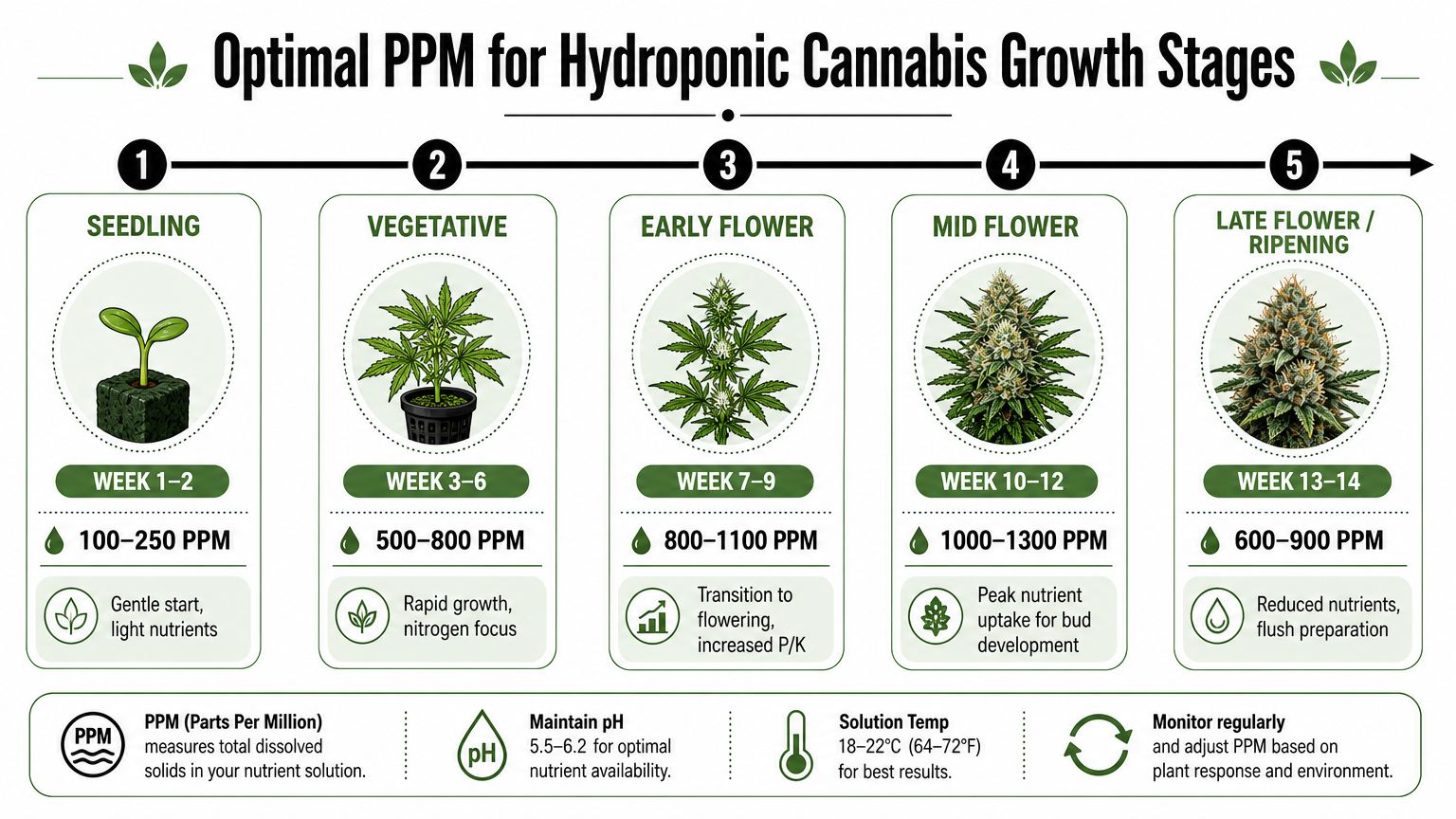
Use ranges, not rigid rules
Those numbers are a roadmap, not a dare.
A vigorous cultivar in a dialed-in hydro setup may handle the upper end of a range. Another one may show stress well before that. Autoflowers often appreciate a gentler hand, especially early on, while some larger feminized cultivars can ask for more as they settle into flower.
A practical way to use the ranges:
| Growth stage | General PPM range |
|---|---|
| Seedling | 100 to 250 PPM |
| Early vegetative growth | 300 to 400 PPM |
| Late vegetative growth | 450 to 700 PPM |
| Early flowering | 750 to 950 PPM |
| Late flowering | 1,000 to 1,600 PPM |
| Harvest flush | As close to 0 PPM as possible |
How to read the plant, not just the meter
The meter gives you a target. The plant gives you permission to stay there or back off.
Watch for the basics:
- Healthy response: Steady growth, good leaf posture, normal color for the cultivar
- Too light a feed: Pale growth, slower development, hungry-looking plant
- Too heavy a feed: Burnt tips, overly dark leaves, stalled growth, clawing in some cases
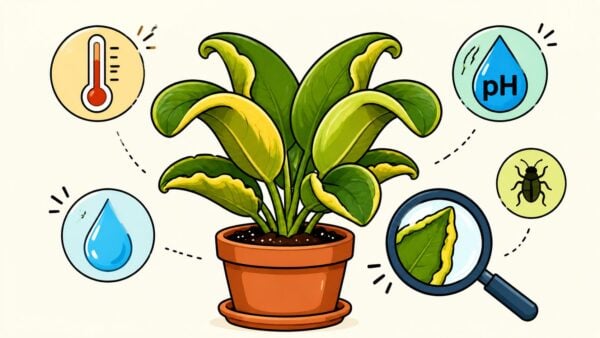
- Mixed signals: Often a sign to check water quality or pH before adding more nutrients
At this point, a lot of growers make their best progress. They stop chasing “maximum feeding” and start feeding for clean growth.
Match the feed to your setup
Hydro systems don't all behave the same. Reservoir size, top-off habits, cultivar vigor, and water source all change how fast the solution shifts. A small home system can swing much faster than a larger, more stable one.
If you want to tighten up the full feeding plan around these ranges, this guide on best nutrition for a cannabis plant helps connect the meter reading to what the plant needs at each stage.
Don't reward a hungry-looking plant by dumping nutrients in all at once. Move in small steps, then watch the next response.
Common Mistakes and How to Fix Them
Most TDS mistakes aren't about the meter failing. They come from trusting the number without asking what created it.
The biggest one is ignoring the water you started with. Existing hydro guidance points out that a grower can end up with an “acceptable” final PPM reading while starting from water that already contains substantial bicarbonates or other ions. Those dissolved solids can distort pH stability and reduce the room left for actual nutrients. That issue is discussed clearly in Growee's write-up on TDS meters and source water.
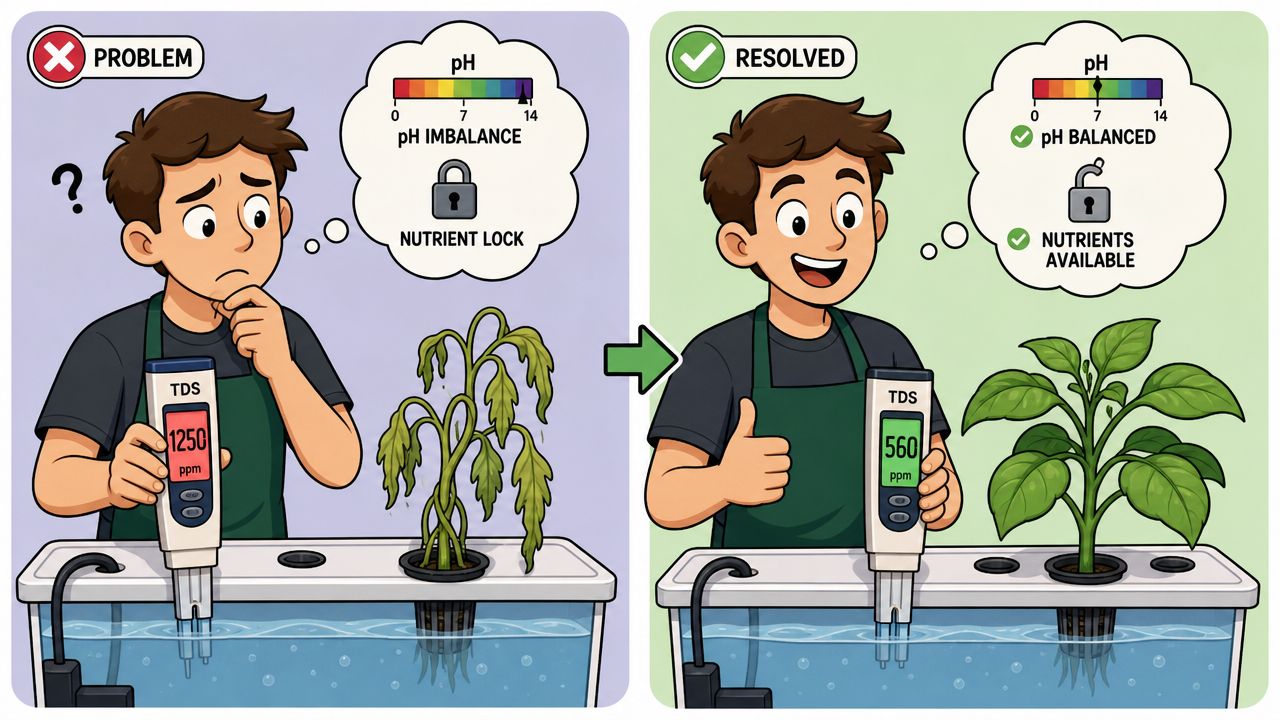
Mistake one, treating all PPM as equal
A final reading can look fine while the water underneath it is working against you. If your tap water is loaded with dissolved minerals, your meter sees that total, but it doesn't separate “helpful nutrient mix” from “stuff already in the water.”
That's why two growers can mix to the same final number and get different results.
Fix it: Test the starting water before adding nutrients. Log that baseline. If the source water is already carrying a lot of dissolved solids, leave more room for your nutrient program and keep a closer eye on pH behavior.
Mistake two, comparing numbers across mismatched meters
This one causes a lot of bad advice in grow chats. One person says they feed at a certain PPM. Another copies it. The meters don't use the same conversion scale, and now the second grower is unknowingly feeding a different strength.
Fix it: Standardize your own process. If you share readings with other growers, compare meter scales or use EC as the common reference. Consistency beats borrowed numbers.
Mistake three, chasing symptoms with more feed
Leaves don't always look rough because the plant wants more nutrients. If the starting water is already heavy, or the pH is drifting, adding more nutrient solution can stack problems instead of solving them.
A better troubleshooting flow looks like this:
- Check baseline water: Know what was in the reservoir before feeding.
- Verify pH: If pH is off, nutrient uptake can get weird fast. This guide on pH for cannabis is worth keeping handy.
- Review recent changes: New nutrient brand, stronger dose, hotter room, faster drinking rate.
- Then adjust feed strength: Small corrections beat dramatic ones.
A TDS meter tells you how much dissolved material is in the water. It does not tell you whether that material is balanced, useful, or causing drift somewhere else.
Mistake four, trusting one reading too much
A single reading is easy to overvalue. Reservoirs change as water evaporates, plants drink, and nutrients get used unevenly.
Fix it: Track patterns. If the reading rises while water level falls, the solution may be concentrating. If the reading drops quickly, the plants may be taking up nutrients fast. If the number stays in range but the plant still looks off, the problem may be your water source or pH, not the amount of feed.
Grow with Confidence and Control
Once you understand tds meter hydroponics, the whole process gets less mysterious. The meter stops being a random gadget and becomes what it should be: a simple decision tool. You mix, measure, observe, and adjust. That's it.
The useful part isn't chasing a perfect number. It's building a repeatable system. You know what your meter is measuring. You know how to calibrate it, how to take a clean reading, and how to judge whether that reading makes sense for the plant's stage. That's the difference between reacting emotionally to every leaf and running a grow with control.
There's also a practical payoff. You waste less nutrient solution, catch issues earlier, and stop overcorrecting every time a plant looks slightly different. Home growing gets a lot more enjoyable when your routine starts producing reliable results.
That confidence carries over into cultivar choice, too. Once your environment and feeding are more predictable, you can pick feminized or autoflower cultivars based on the kind of growth pattern, aroma, and overall vibe you want, instead of choosing around fear of making mistakes.
You don't need perfect gear or a commercial room. You need a clean routine and the discipline to trust it.
A strong harvest usually comes from a bunch of small, boring decisions done well. Calibrate the meter. Test the source water. Feed within a sensible range. Watch the plant. Adjust in small steps. That's how growers get better, and it's how hydro starts feeling a lot less like gambling.
If you're ready to pair better reservoir control with dependable genetics, browse Botanist Seeds to compare feminized and autoflower cultivars that fit your setup, your space, and the kind of home grow you want to run.