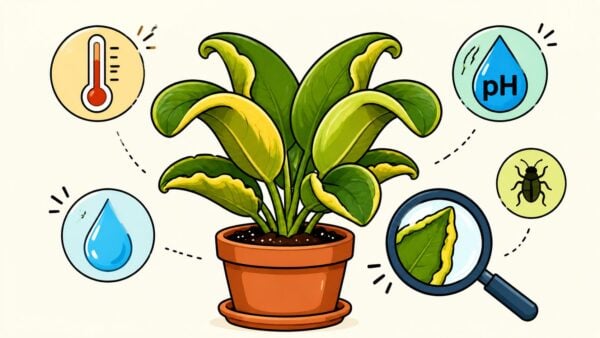
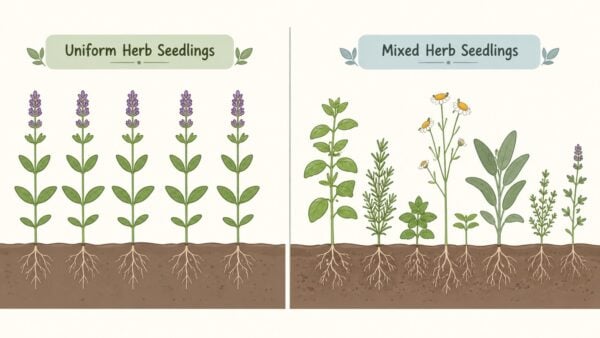
Best Spray for Powdery Mildew: 2026 Solutions

You check your plants, expecting a normal morning. Then you spot a pale white patch on a fan leaf, maybe two. At first it looks harmless, almost like dust, but deep down you already know that a random dusty leaf in a clean grow space usually isn't random.
Powdery mildew can wreck your momentum fast, especially when you're growing for your own stash and every healthy leaf matters. The good news is that this problem is manageable if you catch it early, choose the right spray for powdery mildew, and avoid the mistakes that burn plants worse than the fungus does.
That White Powder on Your Leaves Is Not a Good Thing
The first time most growers see powdery mildew, they hesitate. That hesitation is what gives it room to spread.
You notice a little white fuzz on a leaf edge. You rub it with your finger and some of it comes off. For a second, you hope it's leftover residue from a foliar feed, a dusty fan, or anything else. Then you check another leaf and find the same soft, flour-like coating starting to form in a second spot. That's usually the moment your stomach drops.

Powdery mildew is common enough that you shouldn't treat it like a personal failure. Crowded canopies, stale air, stressed plants, and a little bad luck can all line up at once. It shows up on nice-looking plants too, including vigorous cultivars that seemed perfectly happy the day before.
What matters in the first hour
When you find it, skip the panic move of spraying everything with whatever bottle is closest.
Do this instead:
- Isolate the problem mentally: Figure out whether you're seeing one small outbreak or signs across multiple plants.
- Inspect nearby leaves: Check upper surfaces first, then work inward through the canopy.
- Hold off on mixing products: A rushed sulfur spray followed by an oil spray later can create a second problem, leaf damage.
- Act the same day: Small outbreaks are easier to suppress than established ones.
Practical rule: A weak early response beats a late aggressive response.
The goal is control, not heroics
A lot of home growers look for one miracle spray. That's usually the wrong mindset. Powdery mildew control is about timing, coverage, and safe product choice. One treatment might slow it down, but a clean finish usually comes from a sequence of smart decisions.
That means identifying it correctly, choosing either a DIY spray or a commercial fungicide that fits your stage of growth, and applying it without stressing the plant more than necessary. If you're growing feminized or autoflower cultivars for personal supply, this is really about protecting weeks of work and keeping the whole run from sliding backward.
How to Spot Powdery Mildew Before It Takes Over
Early identification is half the battle. If you're unsure what you're looking at, it's still better to inspect closely now than wait until whole leaves look dusted with flour.
Powdery mildew usually starts subtly. A tiny white circular spot appears on a leaf surface, often flat at first, then more obvious as it spreads. It doesn't look sparkly like trichomes, and it doesn't behave like ordinary dust.
What it looks like in real life
Use this quick check:
- Look for irregular white patches: They often start as small spots, then widen into a thin powdery film.
- Rub gently with a fingertip: Early mildew may smear or wipe away. Trichomes won't.
- Check nearby leaves fast: If it appears on more than one leaf in the same zone, assume it is active.
- Look past the top leaves: Hidden interior foliage often provides a clearer picture.
Natural resin is part of the plant. It glitters, stays attached, and follows the plant's structure. Powdery mildew looks like it landed on top of the leaf.
If you're still comparing symptoms, this guide on white spots on weed leaves helps sort out mildew versus other common causes.
What growers confuse it with
A few things throw people off:
- Dust or foliar residue: Usually more random and less anchored to the leaf tissue.
- Trichomes on sugar leaves: These look crystalline, not chalky.
- Water spots or dried spray marks: These tend to have sharper edges or ring patterns.
If you think it might be powdery mildew, treat that as a useful warning, not an overreaction.
Why catching it early changes everything
A field study found that the UC Davis risk-index model achieved 89.82% prevention effectiveness, compared with 73.53% for a classical model and 55.05% for a DSS model, which supports the idea that early, risk-based timing matters more than fixed routine spraying (comparative powdery mildew spray study).
That lines up with what home growers see in practice. The plants that recover cleanly are usually the ones that got attention when the mildew was still a few spots, not a canopy-wide mess.
A simple threshold for action
If you can see white patches clearly without hunting for them, you're already late for a purely casual response. You don't need to wait for a lab test or a dramatic outbreak. Confirm as best you can, then move.
The mistake isn't treating a little too early. The mistake is staring at it for three days, hoping it disappears on its own.
Your Go-To DIY Powdery Mildew Sprays
DIY options make sense when the outbreak is light, you're in early growth, or you just want a low-cost first response. They aren't magic, and they aren't all equally reliable, but they can be useful if you mix them carefully and apply them with discipline.
Popular home recipes have become pretty standardized over time, including 1 tablespoon of baking soda per gallon of water and a 40% milk to 60% water mix, both of which remain common because they're cheap and easy to make (home remedy ratios for powdery mildew).
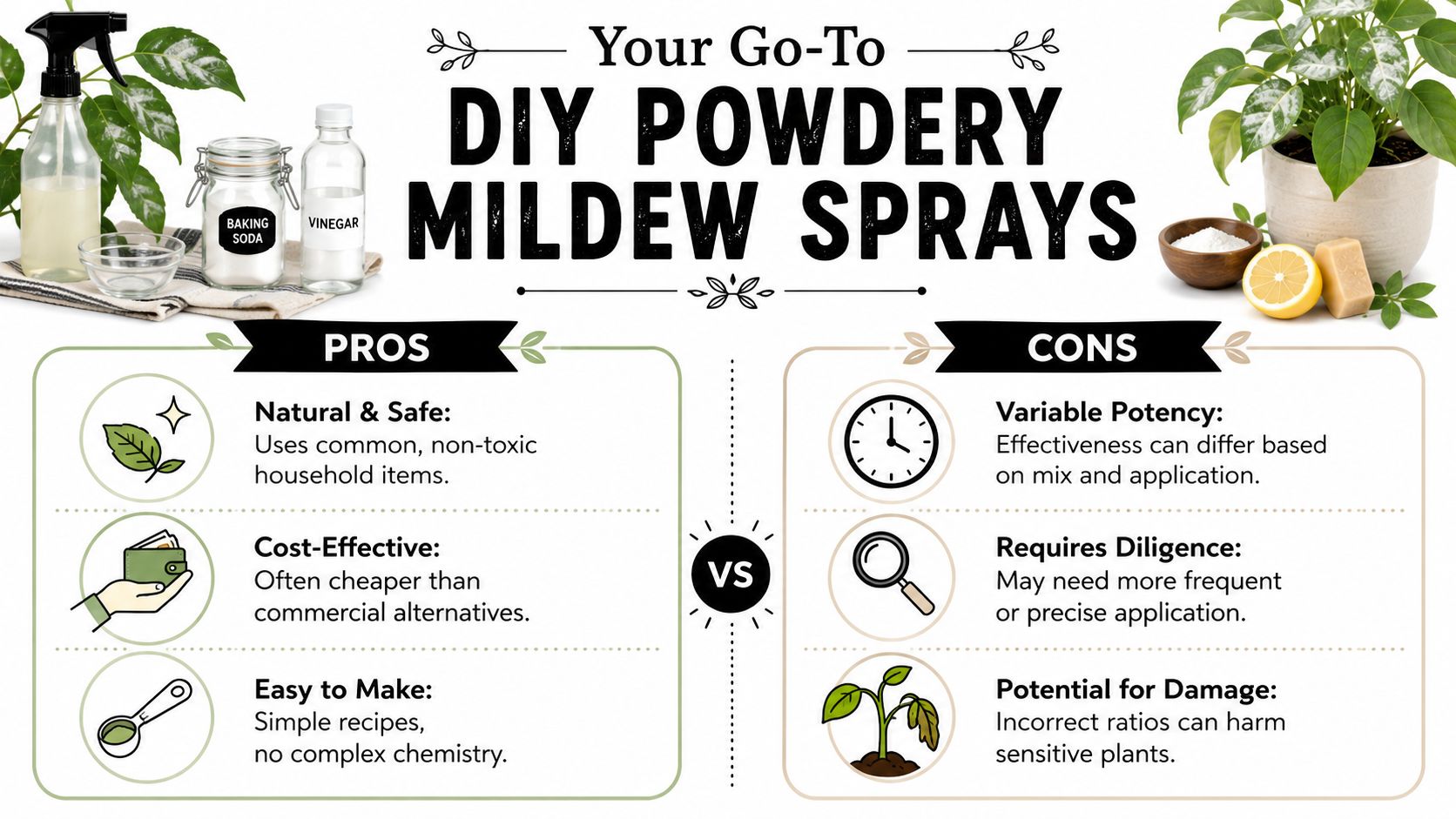
DIY powdery mildew spray recipes
| Spray Type | Mixing Ratio | Best For |
|---|---|---|
| Baking soda spray | 1 tablespoon per gallon of water | Mild early spotting |
| Milk spray | 40% milk, 60% water | Light to moderate visible mildew |
| Vinegar spray | 2 to 3 tablespoons per gallon, or 4 tablespoons per gallon depending on recipe | Small test applications on minor outbreaks |
| Neem oil spray | Follow product label | Mild to moderate suppression when using a horticultural oil product |
| Jojoba oil spray | Follow product label | Mild to moderate suppression on sensitive grows |
What each one does well
Baking soda is the classic cupboard fix. It's easy to make and easy to remember. I think of it as a reasonable first move for a tiny outbreak, especially when you need to respond immediately and don't have a store-bought product on hand.
Milk spray gets recommended so often because it's simple and accessible. For home growers with just a few plants, it's one of the least intimidating options to try.
Vinegar recipes show up everywhere, but they're the one I'd handle most carefully. The line between useful and harsh feels thinner there, especially on tender foliage.
Where DIY sprays fall short
DIY mixes can help, but they come with trade-offs:
- They demand consistency: One lazy application won't do much.
- Coverage matters a lot: Miss the undersides and interior leaves, and mildew keeps going.
- Sensitive plants can react badly: Even common household ingredients can stress leaves if mixed too strong or sprayed under rough conditions.
Home remedies are best for mild to moderate cases, not for pretending a heavy outbreak is under control.
How to use DIY sprays without making a mess
A practical routine looks like this:
- Mix fresh batches: Don't let homemade spray sit around forever.
- Test one leaf first: Wait and look for spotting or burn before broad spraying.
- Use a fine mister: You want even coverage, not runoff.
- Stop if damage appears: A harsh homemade mix can set you back fast.
If the mildew keeps returning after a couple of careful applications, that's usually your sign to move up to a commercial product with more predictable behavior.
Choosing a Safe Commercial Fungicide
DIY sprays are fine for light work. When you want more dependable control, commercial products are easier to repeat consistently and easier to rotate intelligently.
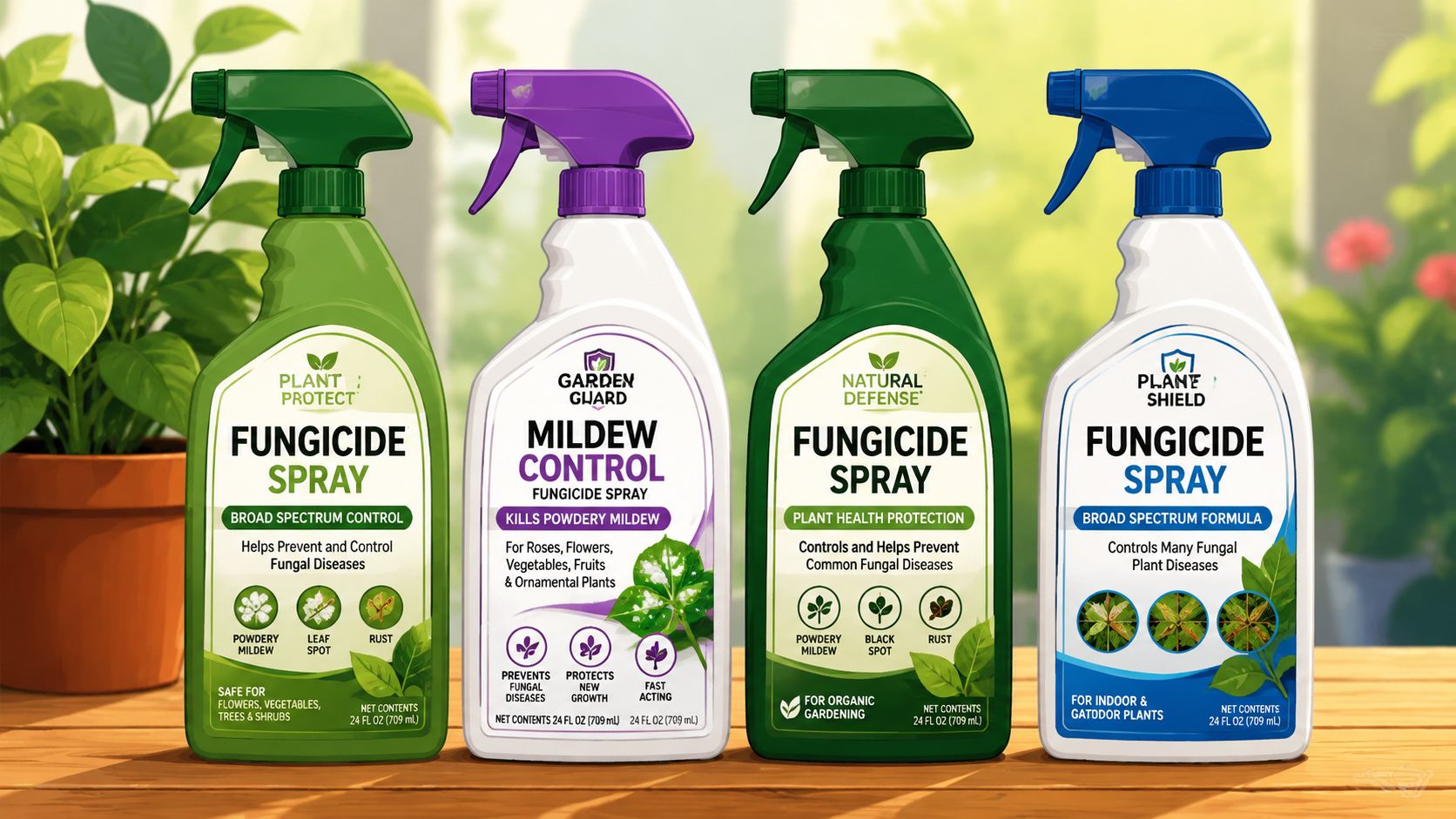
The most useful categories for a home grower are usually horticultural oils, carbonates, and wettable sulfur. Each can fit, but not in every situation.
Comparing the main options
Horticultural oils, including neem oil and jojoba oil, are often a good match for mild to moderate infections. They make sense when you've caught the problem early and want a product that can suppress existing mildew while also protecting against new spores.
Carbonates, such as potassium bicarbonate products, are appealing when you want a commercial option that isn't sulfur or oil. They fit nicely into rotation thinking because they give you another mode of action to work with.
Wettable sulfur is more of a prevention-minded tool. It has a long history in powdery mildew management, and it's often more useful when you're trying to stay ahead of a recurring problem than when you're looking for a dramatic rescue.
Rotation matters more than brand loyalty
Extension guidance recommends limiting resistance-prone fungicide classes to no more than 3 applications per growing season and rotating them with lower-resistance-risk options like sulfurs, carbonates, and oils. The same guidance points growers toward protective sprays at 7 to 10 day intervals as new tissue appears (Pacific Northwest powdery mildew management guidance).
That tells you something important. Repeating the same product because it worked once isn't always smart. The better move is to build a calm, boring rotation.
To put it in simple terms:
- Use oils when pressure is light and conditions allow safe use.
- Switch categories instead of hammering one product repeatedly.
- Use sulfur strategically when prevention is the main goal and timing is right.
A short visual walkthrough can help if you like seeing product handling in context:
What works versus what sounds good
What works is a product you can apply safely, thoroughly, and on schedule.
What doesn't work is buying three bottles, mixing whatever sounds strongest, and blasting the canopy in one session. Powdery mildew punishes impatience. So do commercial sprays when they're used carelessly.
If you're shopping, read the active ingredient first, not the front label. The front sells confidence. The active ingredient tells you how the product fits into your actual plan.
How to Apply Your Spray for Maximum Effect
Most failures aren't because the spray was worthless. They happen because the grower applied a decent product at the wrong time, in the wrong order, or with sloppy coverage.
If you're using any spray for powdery mildew, the application routine matters as much as the bottle.
The biggest mistake growers make
The most common expensive mistake is combining sulfur and oil too closely.
Plant health guidance is very clear that oil sprays should never be applied within 2 weeks of sulfur sprays, and oils also should not be used when temperatures are above 90°F or on drought-stressed plants (UC IPM guidance on powdery mildew and spray safety).
That rule catches a lot of home growers because both sulfur and oil products get described as gentle or natural. Natural does not mean compatible.
Safety check: If you used sulfur recently, keep oil off the plant until that full interval has passed.
A better application routine
Use a repeatable process every time:
- Inspect before spraying: Remove badly hit leaves if they are clearly gone and not worth saving.
- Spot test first: Spray one small area and wait to see how the plant reacts.
- Spray in gentle conditions: Avoid high heat, intense direct light, and thirsty plants.
- Cover both sides of the leaf: Contact products only help where they land.
- Let the plant dry with airflow: Don't leave a wet, stagnant canopy sitting after treatment.
If your plants are bushy, some light cleanup helps coverage. Good structure work matters, and careful pruning cannabis plants can make foliar treatments much more effective.
Timing mistakes that quietly ruin results
A few bad habits show up over and over:
- Spraying in hot conditions: Even a good product can stress foliage when the plant is already struggling.
- Spraying a drought-stressed plant: That's asking the leaf surface to absorb more stress.
- Missing inner canopy leaves: Powdery mildew loves protected pockets.
- Applying too much at once: Dripping leaves don't mean better coverage.
What good coverage actually looks like
You want a light, even coat across the affected surfaces. Not puddles, not runoff, not a rainstorm from the sprayer. A fine mist is usually better than a heavy blast.
Check your nozzle, slow down, and move the foliage with your free hand if you need to reach hidden surfaces. Home grows often fail on the boring details, not on the product choice itself.
Long-Term Prevention and Cultural Controls
If you keep getting powdery mildew, the spray isn't the whole problem. The room, the plant structure, and the grow routine are usually helping it along.
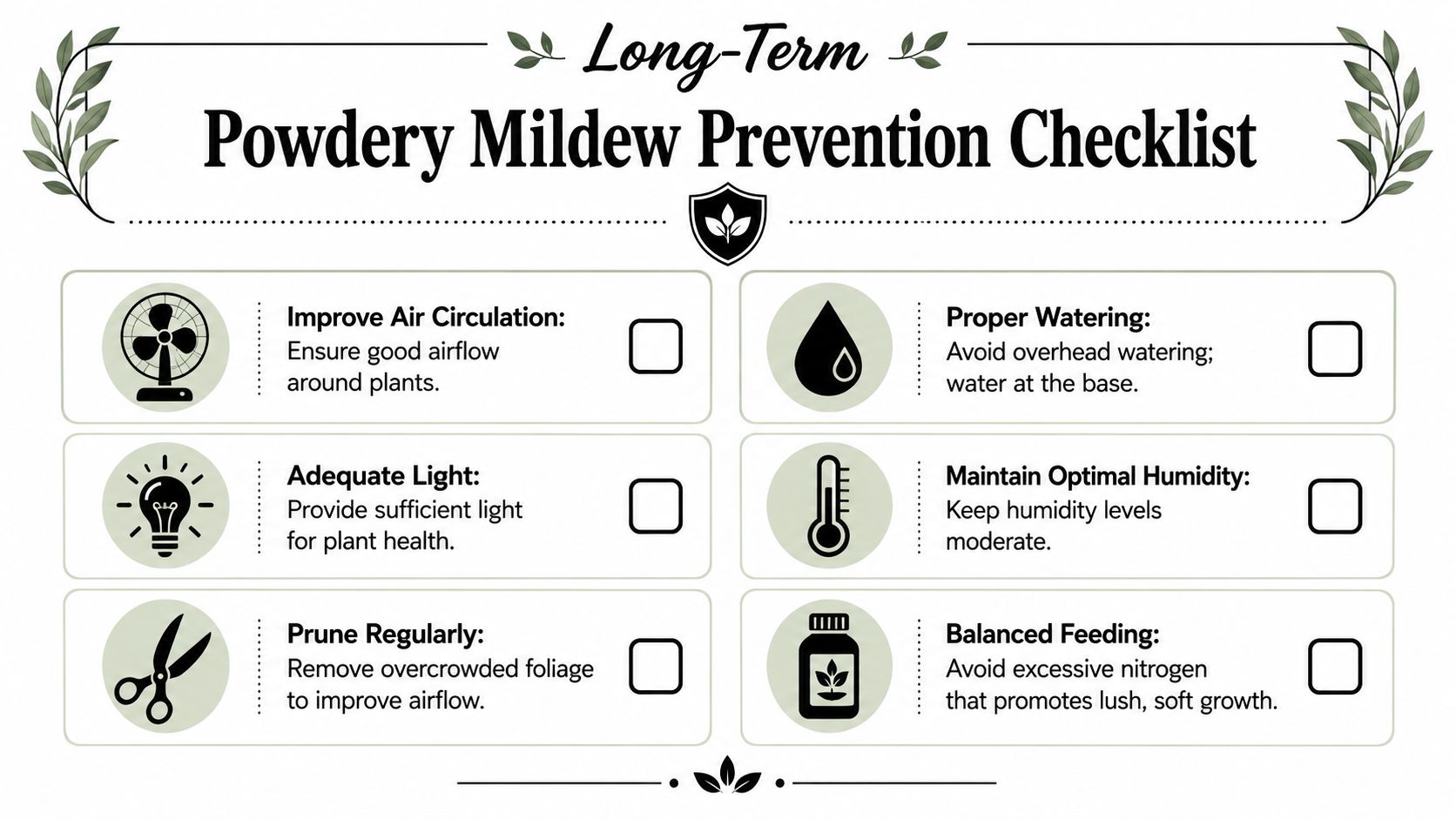
A healthy prevention plan is less dramatic than treatment, but it's what saves harvests. Good airflow, a manageable canopy, steady watering habits, and cleaner environmental control do more than any single foliar product.
The room has to help you
Powdery mildew loves crowded, stale spaces.
You can make life harder for it by cleaning up the environment:
- Create airflow: Keep air moving through and under the canopy.
- Prune congestion: Remove overcrowded foliage so leaves don't sit pressed together.
- Water with intention: Avoid routines that keep the canopy damp or the plant stressed.
- Watch humidity pressure: Tight environmental swings tend to show up later as disease pressure.
If you're dialing in the room, a solid weed VPD chart helps connect temperature, humidity, and plant comfort in a more useful way than guessing.
Prevention starts before symptoms
Outdoor and greenhouse growers have one extra preventive tool worth knowing about. Dormant-season lime-sulfur sprays are used before bud break to reduce overwintering mildew inoculum, and typical use rates are 4 to 10 gallons per acre in enough water for full coverage (dormant lime-sulfur timing and rate guidance).
For the home grower, the larger lesson matters even if you're not measuring acres. Prevention works best before lush new growth shows up, not after the fungus is already comfortable.
A clean season usually starts with habits that seem small at the time: spacing, pruning, sanitation, and not letting one suspicious leaf stay in the room all week.
Genetics still matter
Some cultivars handle stress and disease pressure better than others. That doesn't make any plant mildew-proof, but it can make your life easier.
When you're choosing feminized or autoflower cultivars for a home setup, think beyond aroma and yield. Growth pattern matters. Open structure, manageable vigor, and a plant that fits your space can reduce the constant fight against cramped foliage and poor airflow.
Long term, the best spray for powdery mildew is the one you rarely need because your room stays balanced and your plants aren't set up to struggle.
If you're planning your next run, Botanist Seeds makes it easier to compare feminized and autoflower cultivars that fit your space, your experience level, and the kind of harvest you want. A smart cultivar choice won't replace good grow habits, but it can make the whole process smoother, from canopy management to finishing with a cleaner, more reliable personal supply.