





Money Maker Strain: The Complete 2026 Grower’s Guide

You're probably looking at Money Maker for the same reason most home growers do. You want a cultivar that feels worth the time, power bill, tent space, and daily check-ins. Not just something with a cool name, but something with a long track record of producing a satisfying harvest when the run is managed well.
That's where Money Maker stands out. It has the old-school reputation people still talk about for a reason. It's one of those cultivars that keeps showing up in grow conversations because it combines compact structure, dense flowers, and a production-focused growth style that suits home setups surprisingly well. The big catch, and the part many strain writeups gloss over, is that heavy flowers can become a physical problem if you don't plan support early.
Why Everyone Is Talking About Money Maker
A lot of growers hit the same point after a few average runs. They stop chasing novelty and start looking for something proven. They want a cultivar that has already earned its place, one that's known for doing the main job well, filling the canopy with chunky flowers and making the whole cycle feel worthwhile.
Money Maker fits that search almost perfectly. It's not famous because it's trendy. It's famous because it built a reputation around output and consistency, then kept that reputation for decades.

A classic with real history
Money Maker is an Indica-dominant hybrid with a 70% Indica / 30% Sativa split, and it hit a major milestone when it won 1st place at the High Times Cannabis Cup in the hydroponic category in 1994, which helped establish it as an award-winning benchmark cultivar from the 1990s, as noted in this Money Maker strain review.
That kind of history matters. Plenty of cultivars get hyped for a season and vanish. Money Maker didn't. It stayed in circulation because growers kept finding it useful, especially people who care more about practical harvest results than chasing whatever's newest.
Why it still gets recommended
For a home grower, the appeal is easy to understand:
- It has pedigree: You're not gambling on an unknown cultivar with vague claims.
- It suits indoor spaces: Its structure tends to favor growers working in tents, closets, or compact rooms.
- It rewards planning: If you keep the canopy even and support the branches, it can be a very satisfying plant to bring to harvest.
Money Maker isn't the kind of cultivar that wins you over with mystery. It wins you over by acting like a dependable workhorse.
There's also a lifestyle angle that matters. Growing your own means skipping dispensary lines, keeping more control over what you consume, and feeling that little rush of pride when jars on the shelf came from your own setup. Money Maker speaks directly to that self-sufficient mindset. It has the reputation of a cultivar that wants to produce, and that's exactly what many home growers are after.
The Genetic Heritage of Money Maker
Money Maker makes more sense once you look at the family tree. The plant's growth style isn't random. It comes from a very specific mix of old-school building blocks that growers already know for sturdiness, density, and vigor.
The three-way cross
Money Maker carries a genetically locked 70% Indica / 30% Sativa ratio from a three-way cross of Original Master Kush, Hindu Kush, and Skunk #1, and that background directly shapes its compact, bushy morphology with tight internodal spacing that suits high-density Sea of Green canopy management, according to this Money Maker cultivar profile.
That tells you a lot before you even pop a seed. Tight spacing between nodes usually means a fuller plant with less wasted vertical stretch. In a home tent, that's a plus. You can keep the canopy controlled without feeling like the plant is fighting the room.
What the lineage suggests in practice
Original Master Kush and Hindu Kush point toward the side of Money Maker that most growers notice first. It tends to grow with a solid frame, broad influence from Kush structure, and a natural preference for staying lower and fuller rather than reaching hard for the ceiling.
Skunk #1 changes the picture. It adds some of the vigor that keeps the plant from feeling too stubborn or slow. It also helps explain why Money Maker developed a long-running reputation as a production cultivar, not just a pretty one.
How that translates in the grow space
When you grow a cultivar with this kind of background, you usually notice a few practical things:
- Canopy control is simpler: The plant's shape lends itself to even tops and efficient use of light.
- Dense flower sites come naturally: Tight internodes can stack buds closely, which is great for yield but demands attention to airflow.
- Training works best when it's light-handed: You're usually shaping and supporting, not trying to force a wild plant into submission.
Grow-room read: Money Maker tends to reward growers who keep the plant organized rather than overly manipulated.
Another useful point from its background is adaptability. Existing descriptions tie this cultivar to strong performance across different media and production styles, which lines up with how many home growers operate. Some people run soil in fabric pots. Others prefer coco, hydroponics, or a more hands-on feed schedule. Money Maker has the reputation of handling different systems without losing the compact, heavy-flowering identity that made it popular in the first place.
A mostly indica cultivar developed by Strain Hunters Seed Bank, with lineage from Original Master Kush, Hindu Kush, and Skunk #1, is also described as producing dense, resin-heavy flowers and a compact structure ideal for high-density canopies in this Money Maker guide from Joint Commerce.
Its Aroma Profile and Expected Vibe
Money Maker has the kind of aroma profile that feels familiar in a good way. If you like classic cannabis smells over candy-shop novelty, this cultivar usually lands in the right zone. It leans earthy first, then opens into spice, with a sweeter edge that keeps it from feeling flat or muddy.
What you'll likely notice in the jar
The Kush side usually shows up as that grounded, dense aroma people often describe as earthy, hashy, or peppery. The Skunk influence softens and rounds it out. Instead of reading like a one-note heavy indica, Money Maker often comes across as richer and more layered.
In practical terms, the aroma tends to feel like this:
- Earth and spice: The base note that gives it that classic old-school profile.
- A touch of sweetness: Not sugary, more like a softer finish behind the deeper notes.
- A slightly pungent edge: Enough presence to make trimming and curing feel rewarding.
If you like learning how aroma compounds shape the personality of a cultivar, this guide to cannabis terpenes is a useful place to sharpen your nose before harvest.
The vibe after the cure
Money Maker's overall vibe is usually best suited for slowing things down. It feels like an evening cultivar to a lot of people, the kind of jar you reach for when the day's work is over and you want something that matches a quieter pace.
That doesn't mean every plant will feel exactly the same. Small differences in phenotype, harvest timing, and cure can nudge the experience a bit. Still, the common thread is a heavier, more settled mood rather than something bright and racy.
A well-cured batch of Money Maker usually feels like the cannabis version of staying in on purpose.
Why that matters for home growers
There's a special kind of satisfaction in opening a jar and getting that deep, mature aroma from flower you grew yourself. It's part of why so many people stick with home cultivation. You avoid the errand, the wait, the markup, and the tax hit. Even better, you get to build a stash that matches your own taste instead of picking from whatever's left on a shelf.
Money Maker suits that mindset well. It offers a sensory payoff that feels classic, substantial, and home-grower friendly. It's not trying to be flashy. It's trying to be satisfying, and for a lot of growers, that's better.
Money Maker Lab Data Expectations
Lab numbers are where a lot of strain pages get messy. They either throw out figures with no context or treat one test result like it defines every plant forever. With Money Maker, it's smarter to treat lab data as a rough expectation, not a guarantee for every seed, every room, and every harvest.
Here's the clean version. This cultivar is generally discussed as a potent option with low CBD and a more traditional indica-leaning profile. The exact result in your jars will depend on genetics, environment, feed consistency, harvest timing, and cure quality.

Money Maker strain at a glance
| Attribute | Expected Value |
|---|---|
| THC Potency | High, often described in the 20 to 24 percent range |
| CBD Levels | Typically low, often described as under 1 percent |
| Other Cannabinoids | Minor, trace amounts |
| Overall impression | Potent, pronounced, indica-leaning experience |
If you want a clearer read on how dispensaries and labs frame potency beyond a single THC number, this breakdown of TAC vs THC helps put those labels in context.
How to use the numbers without overthinking them
The useful takeaway isn't the bragging-rights number. It's how the finished flower is likely to feel in real use. A cultivar with high THC and very low CBD usually reads as more direct and more forceful, especially if the flower is grown well and cured properly.
For home growers, that means two things:
- Respect harvest timing: Pulling too early can leave the effect feeling less complete.
- Respect the cure: A rushed dry and cure can flatten both the aroma and the overall experience.
What lab expectations can't tell you
A number won't tell you if the jar smells deep and loud. It won't tell you whether the flower burns clean, breaks up nicely, or gives you the exact vibe you ultimately want. That's where cultivation skill matters more than the label.
Lab data can guide expectations. It can't replace good growing.
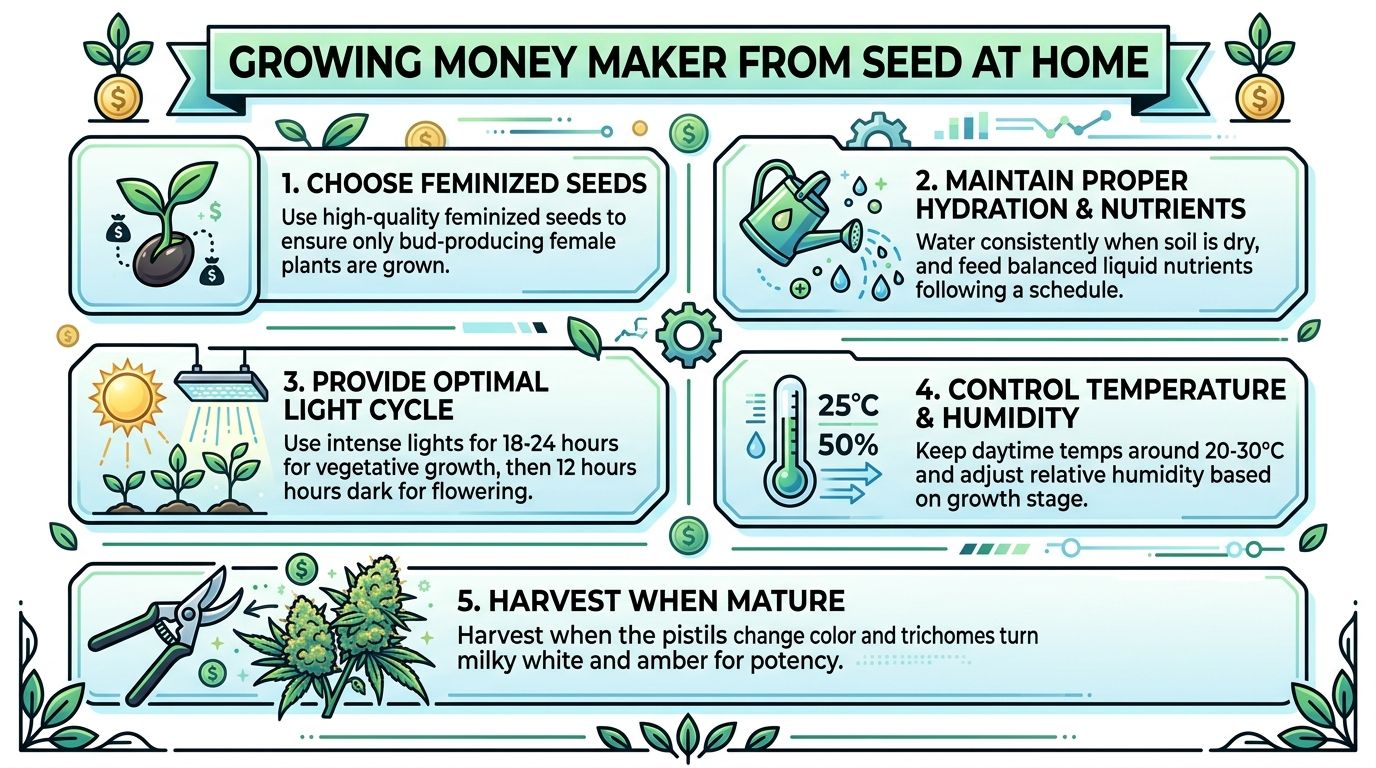
Growing Money Maker From Seed at Home
Money Maker is one of those cultivars that can make a home grower feel smart for choosing it, but only if the setup matches the plant. It has the kind of structure that works well indoors, and it's a strong candidate for people who want a productive run from feminized seeds without dealing with unnecessary complications. The key is understanding that high production creates its own problem. Big flower weight can turn into branch failure fast.
Start with structure in mind
Money Maker isn't a cultivar I'd classify as difficult, but I also wouldn't call it casual if you like to wing it. The plant's compact habit can make growers relax too much early on. They see a squat, tidy plant and assume support can wait until late flower. That's the mistake.
The flower set can get dense enough that branch support stops being optional. Existing coverage often highlights Money Maker's yield potential of up to 1,000 g/m², but it also underplays the structural risk of branch collapse under dense bud load, as noted in this Weedmaps Money Maker overview.
Practical rule: If a branch already looks overloaded in mid flower, it won't get stronger by itself later.
What works in a home setup
For most hobby growers, Money Maker does best when the whole run is built around control and support rather than aggressive experimentation.
Seedling to veg
A few basics matter more than anything fancy:
- Choose feminized seeds: You're using your plant count and canopy space for flower production, not guesswork.
- Keep the early environment stable: Money Maker usually responds better to consistency than constant adjustment.
- Train for openness: Light topping or low-stress training can help create a broad, manageable plant, but don't overdo it.
The goal in veg is simple. Build a plant with enough airflow through the center and enough branch spacing that later support is possible. If you let it become a crowded bush too early, flower management gets harder than it needs to be.
Flowering approach
Money Maker suits indoor growers because the compact frame is easier to manage under artificial light. A Sea of Green style can make sense for this cultivar because of the tight internodal spacing mentioned earlier, but even in a small hobby tent, the same principle applies. Keep tops even, keep the canopy accessible, and avoid a tangled mess.
What usually works best:
- Trellis netting early: Put the first layer in before the flowers get heavy.
- Soft plant ties for problem branches: Good for individual limbs that start leaning.
- Bamboo stakes or support rods: Simple, cheap, and useful when a few branches outpace the rest.
What usually doesn't work:
- Waiting until branches are already folding
- Trying to tape everything together at the end
- Packing too many plants into a tent without access to the back corners
The overlooked challenge, branch collapse
This is the part that deserves more attention. Money Maker's reputation as a production cultivar is earned, but at home, production only helps if the plant physically makes it to harvest intact.
Why branches fail
Branch collapse usually comes from a few overlapping issues:
- Dense top flowers pull outward and down as they swell.
- Weak support planning leaves lateral branches carrying more weight than they can hold.
- Poor canopy balance creates a few oversized tops instead of evenly distributed load.
- Late intervention forces the grower to prop up damage instead of preventing it.
A snapped branch late in flower is annoying. A partially split branch can also slow the plant down, complicate airflow, and make your trimming pile smaller than it should be.
Support is part of the grow plan with Money Maker, not an emergency fix.
Practical support options
Different growers prefer different methods, but these are the most reliable at home:
| Support method | Best use |
|---|---|
| Trellis net | Holding an even canopy and distributing weight across multiple tops |
| Bamboo stake | Reinforcing one heavy branch that's leaning or twisting |
| Soft tie | Securing branches gently without cutting into the stem |
| Plant yo-yo | Helping isolated colas that need vertical lift near the end |
Use the simplest option that solves the actual problem. Not every plant needs a full web of gear, but every productive Money Maker run needs a support plan before late flower.
Feeding, airflow, and harvest mindset
Money Maker's dense flower structure means airflow matters. Keep enough space around the plant that air can move through and around the canopy. If leaves are stacked too tightly and branches are crossing all over the place, thin the plant just enough to open it up. This isn't about stripping it bare. It's about preventing crowded flower zones.
A few habits help a lot:
- Water with consistency: Large swings between too dry and too wet can make the whole plant less predictable.
- Feed for steady flower development: Don't chase every tiny leaf signal with a dramatic nutrient change.
- Inspect support points often: Ties that were fine last week can bite into swelling stems later.
- Harvest by maturity, not impatience: Money Maker rewards growers who let the plant finish properly.
For home growers, that's the main takeaway. Money Maker can absolutely live up to the name, but only if you grow it like a heavy-yielding cultivar from day one. If you treat branch support as part of the system, not a last-minute rescue, you'll have a much better shot at a smooth, satisfying harvest.
Phenotypes and Buying Reliable Seeds
Two Money Maker plants can share the same name and still show you slightly different personalities. That's normal. A home grower who expects every seed to produce a carbon copy usually ends up confused by normal phenotype variation.
What phenotype variation looks like
With Money Maker, one plant may lean more toward the shorter, stockier Kush side. Another may show a little more stretch and openness from the Skunk influence. You might also notice small differences in how tightly the flowers stack or how the aroma expresses itself during late flower and cure.
That variation doesn't mean the genetics are bad. It means you're growing a real cultivar, not a photocopy.
If you want a straightforward explanation of what growers mean by phenotype, this guide on phenotype in cannabis clears it up well.
How to judge seed quality without guessing
A smart seed purchase starts with the seller's information quality. If the listing is vague, thin, or loaded with hype but light on practical growing details, that's a warning sign.
Look for seed sources that provide:
- Clear lineage information: You should know what's in the cultivar.
- Useful grow descriptions: Structure, vigor, and general behavior matter more than flashy promises.
- Consistency in presentation: Reliable sellers usually describe cultivars in a way that lines up with what growers experience.
Good seed shopping questions
Ask yourself a few simple things before you buy:
- Does the seller explain the cultivar beyond generic sales language?
- Is the plant described in practical grow terms, not just effect terms?
- Does the cultivar sound suited to your space, your training style, and your patience level?
Buying seeds gets easier when you stop shopping for hype and start shopping for fit.
Feminized and autoflower choices
For most home growers, feminized seeds make the most sense when you want to devote your setup to flower production with fewer variables. Autoflower options can also appeal if you want a quicker, more schedule-friendly run and you know how to manage a plant with a shorter window for recovery.
The important part is matching the seed type to your setup, not to someone else's favorite forum post. If your tent is short and your time is limited, your best choice may be different from a grower running a dedicated room with a longer timeline.
Reliable seeds don't guarantee a perfect harvest. They give you a fair starting point. That's what matters.
Is Money Maker Your Next Big Harvest
Money Maker makes the most sense for growers who like practical classics. If you want a cultivar with a long-standing reputation, compact growth habits, dense flowers, and a strong sense of payoff at harvest, it checks a lot of boxes. It especially suits people who value productive indoor runs and don't mind doing a bit of hands-on canopy management.
It's not the best fit for every grower. If you prefer airy, low-maintenance plants that don't need much support, Money Maker may feel a little demanding by late flower. The plant's biggest strength, its production mindset, is tied directly to its biggest risk. Heavy flowers need physical planning.
Who it fits best
Money Maker is a strong candidate if you:
- Grow in a tent or compact room: Its structure is generally easier to manage than a lankier cultivar.
- Like old-school profiles: The aroma and overall vibe lean classic, not novelty-driven.
- Don't mind support work: Trellis, stakes, and branch ties are part of the process.
Who may want something else
You may want to skip it if you:
- Rarely check plants during flower
- Dislike canopy work
- Want a cultivar that forgives weak support planning
For the right home grower, though, Money Maker still earns the attention it gets. It offers the kind of reward that keeps people growing at home in the first place. You save yourself the trip, avoid the line, keep control over your own supply, and get that satisfying moment when the jars on the shelf came from your own work.
The best way to choose from here is simple. Compare cultivars against your space, your habits, and how much daily involvement you want.
If you're narrowing down your next run, Botanist Seeds makes it easy to compare feminized and autoflower options, sort through dependable genetics, and find a cultivar that matches your setup instead of just sounding good on a strain page.