



Best Air Purifier for Cannabis: A Grower’s Guide to Odor Control
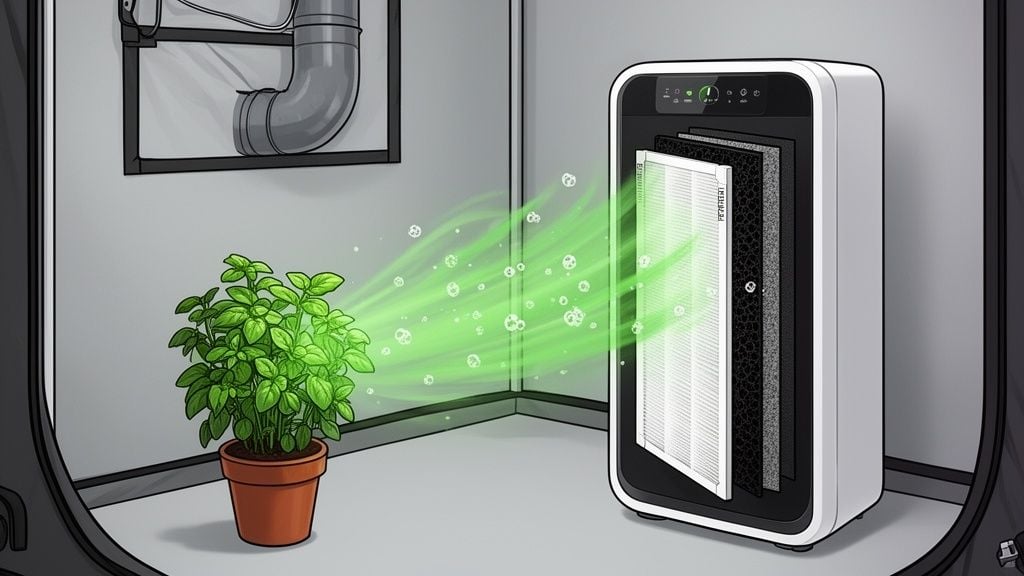
Growing your own cannabis is an incredible experience, but let's be honest: you probably don't want your entire home smelling like a dispensary. For total discretion and a healthier grow space, the best air purifier for cannabis will have a powerful combo: an activated carbon filter for odors and a HEPA filter for airborne particles.
Why Smart Growers Use Air Purifiers
We all know that growing top-shelf flower comes with a very distinct, powerful aroma, especially once your plants hit the flowering stage. While you might enjoy that smell, your neighbors, family, or landlord almost certainly won't. This is why a good air purifier isn't just a nice-to-have, it's a core piece of equipment for any serious home grower.
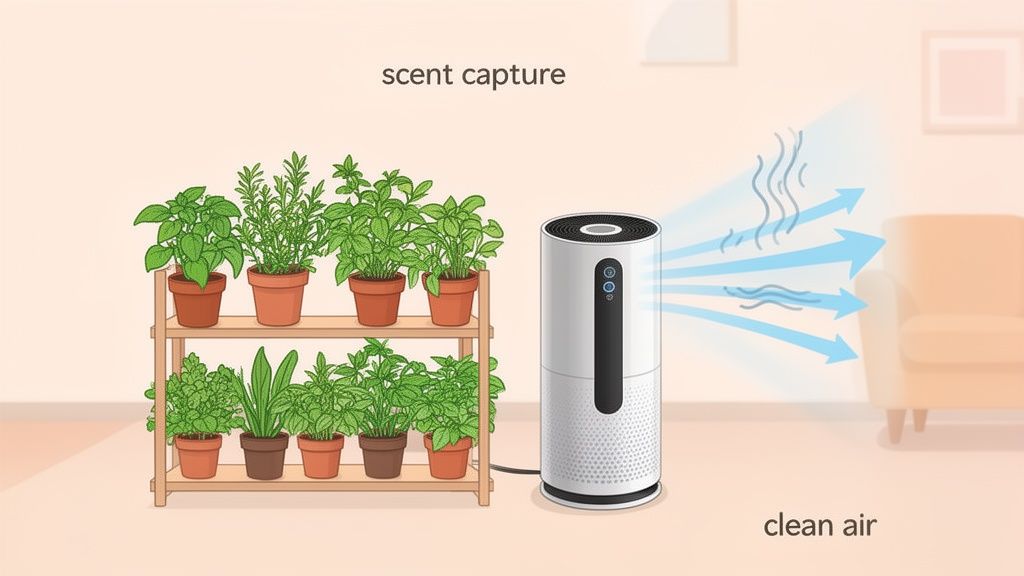
Think of it as cheap insurance for your privacy. Growing your own means skipping the high dispensary prices and long lines, but keeping a low profile is key for a stress-free operation. An air purifier is your first line of defense, neutralizing those telltale smells before they can escape the room.
More Than Just Odor Control
But a quality air purifier does more than just keep your hobby on the down-low. It actively cleans the air inside your grow space, which can quickly fill with dust and even pesky mold spores.
This dual-action cleaning provides two huge advantages for any home grower:
- Healthier Plants: By scrubbing contaminants from the air, you lower the risk of issues like powdery mildew and other airborne threats that can ruin a harvest. Clean air helps your plants breathe easy and focus their energy on producing fantastic buds.
- Cleaner Home: The purifier doesn't just clean the air for your plants; it cleans it for you and your family. It turns a potential source of strong odors into a non-issue, making your home a more pleasant place for everyone.
Adding an air purifier to your setup is a game-changer. Here’s a quick look at why it’s so important.
Key Benefits of Using an Air Purifier for Cannabis
| Benefit | Why It Matters for Home Growers |
|---|---|
| Odor Neutralization | Keeps your hobby private and prevents unwanted attention from neighbors or landlords. |
| Mold & Spore Removal | Reduces the risk of common fungal diseases like powdery mildew, protecting your harvest. |
| Dust Control | Creates a cleaner environment for your plants and reduces airborne particles in your home's air. |
| Improved Plant Health | Clean air allows for better gas exchange (CO2/oxygen), helping plants thrive. |
| Peace of Mind | Lets you focus on growing without worrying about smells or airborne contaminants. |
As you can see, an air purifier is a fundamental tool that protects both your plants and your privacy.
An air purifier isn't an afterthought, it's foundational. It works with your lights, fans, and nutrients to build the perfect environment for a successful and discreet home grow.
Ultimately, investing in an air purifier is a pro move that pays for itself in peace of mind and healthier plants. It’s just as crucial as your lighting rig or feeding schedule. To see how all these pieces fit together, check out our guide on lighting for growing cannabis indoors. A well-lit, clean, and properly ventilated space is the blueprint for an amazing harvest.
Understanding Air Purifier Filter Technologies
When you start shopping for an air purifier, especially for a cannabis grow, the marketing jargon can be overwhelming. It feels like every box is plastered with fancy-sounding tech. Let’s cut through the noise and talk about what actually works.
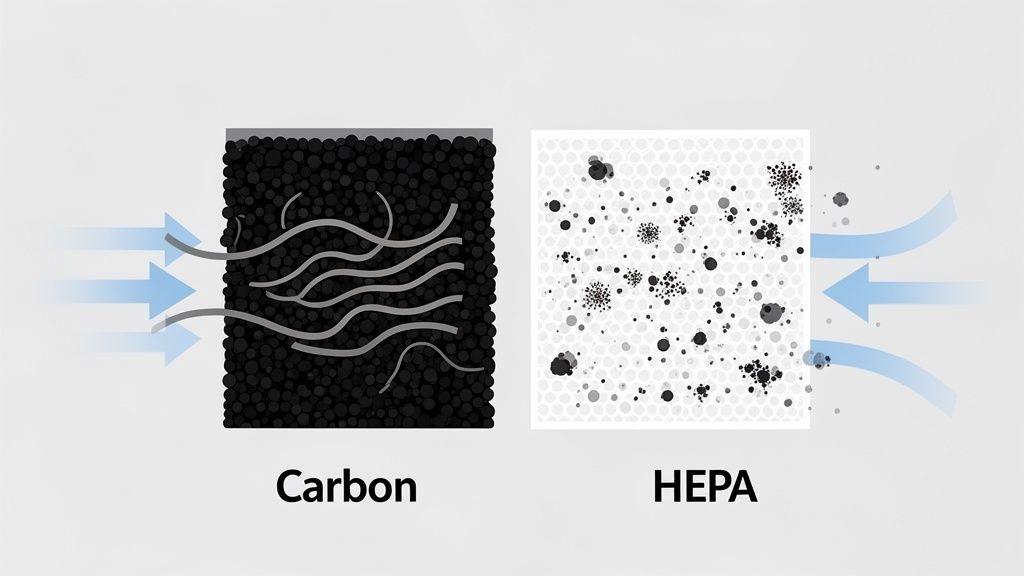
For a home grower, it really boils down to a two-part system: activated carbon and HEPA filters. Think of them as a tag team, with each one handling a very specific job. Getting a purifier with both is the secret to truly clean, odor-free air.
The Odor Killer: Activated Carbon Filters
This is your number one tool for managing the distinct, powerful aromas that come with flowering cannabis cultivars. An activated carbon filter is basically a high-tech sponge for smells. The carbon inside is "activated" by treating it with oxygen, which creates millions of microscopic pores all over its surface.
This process gives the carbon a massive internal surface area. As stinky air, filled with what are called Volatile Organic Compounds (VOCs), is pulled through the filter, the odor molecules get trapped in those pores. They physically stick to the carbon in a process called adsorption, and what comes out the other side is clean, neutral air.
For home growers, a thick, heavy carbon filter is non-negotiable. The more carbon a filter contains, the more odors it can adsorb and the longer it will last before needing a replacement.
You'll find these filters in grow tent exhaust systems, and for good reason. A standalone purifier with a beefy carbon filter acts as a fantastic second line of defense, scrubbing any smells that might escape when you open your tent for watering or training.
The Particle Catcher: HEPA Filters
While the carbon filter handles the smells, the HEPA filter is all about capturing the physical particles floating around. HEPA stands for High-Efficiency Particulate Air, and it's a serious standard. To be called a true HEPA filter, it has to trap at least 99.97% of airborne particles down to 0.3 microns in size.
To give you some scale, a single human hair is about 50-70 microns thick. A HEPA filter is snagging things out of the air that are completely invisible to the naked eye.
For a cannabis grower, this is incredibly useful for removing:
- Mold Spores: This is a huge one. It drastically reduces the risk of powdery mildew or other fungal outbreaks that can devastate a crop.
- Dust: It simply keeps your grow space cleaner and reduces airborne irritants for you and your plants.
By scrubbing these particulates from the air, you’re creating a much healthier environment for your plants. It reduces their stress and lets them put their energy where you want it: into vigorous, healthy growth. This carbon-and-HEPA combo is the undisputed gold standard.
Technologies to Be Cautious About
You'll almost certainly come across other technologies, like ionizers and ozone generators, that make big promises. While they might sound advanced, they come with some serious red flags for a home grow setup.
- Ionizers: These devices release charged ions into the air, which causes dust and other particles to cling to nearby surfaces like your walls or floor. They don't actually remove the particles from the room, and some models can produce small amounts of harmful ozone as a byproduct.
- Ozone Generators: These units intentionally produce ozone (O3), a highly reactive gas that does destroy odors. The problem? Ozone is a powerful lung irritant that is dangerous for people, pets, and even your plants at concentrated levels.
Frankly, the risks just aren't worth it. We strongly recommend avoiding ozone generators entirely and being very wary of ionizers. Stick to the proven, safe, and effective duo of activated carbon and HEPA filtration. That's all you need to handle the air quality challenges of a home grow without introducing any new hazards.
How to Choose the Right Size Purifier for Your Grow
Picking the right size air purifier might seem tricky, but it really comes down to one number: CADR. This stands for Clean Air Delivery Rate, and it's the single most important spec for matching a purifier to your grow space.
Think of it this way: your grow room is a swimming pool filled with dirty air. The CADR is like the size of the bucket you're using to empty it. A bigger bucket, a higher CADR, is going to clear out all that funky air a whole lot faster.
First, Find Your Room's Volume
Before you even start looking at CADR ratings, you need to know the volume of the space you're trying to clean. This is a simple calculation. Just grab a tape measure and get the length, width, and height of your grow tent or room in feet.
Once you have those three measurements, multiply them together. The result is your total volume in cubic feet.
The Formula: Length (ft) x Width (ft) x Height (ft) = Room Volume (cubic feet)
For a classic example, let's take a common 4×4 grow tent that’s 7 feet tall.
- Length = 4 feet
- Width = 4 feet
- Height = 7 feet
The math is straightforward: 4 x 4 x 7 = 112 cubic feet. That’s the total amount of air your purifier has to work with.
Matching CADR to Your Grow Space
Okay, you've got your room volume. Now you can find a purifier with enough muscle for the job. To really get a handle on the powerful smells of flowering cannabis, you need a purifier that can achieve at least 5 Air Changes per Hour (ACH). This just means it’s capable of completely filtering all the air in your room five times every hour.
To figure out the minimum CADR you need, we'll use a simple formula that connects your room volume and your target ACH.
Here’s the formula to calculate the CADR you should be looking for:
[Room Volume (cubic feet) x Air Changes per Hour (ACH)] / 60 = Minimum CADR
Let’s plug in the numbers from our 4×4 tent example, which has 112 cubic feet of volume. We’re aiming for 5 air changes per hour, so the calculation is:
- (112 cubic feet x 5 ACH) / 60 minutes = 9.3 CADR
This tells us you need a purifier with a CADR of at least 10 to properly manage the air in a 4×4 tent. Honestly, it’s always a smart move to buy a unit with a slightly higher CADR than the bare minimum. A more powerful purifier can run on a lower, quieter setting and still get the job done perfectly.
CADR Sizing Cheat Sheet for Common Grow Tents
To make things even simpler, here's a quick cheat sheet for some of the most common grow tent sizes. Just find your tent on this list to get a solid idea of the minimum CADR you’ll need.
This table gives you a great starting point for finding the right purifier.
| Grow Tent Size (feet) | Room Volume (cubic feet) | Recommended Minimum CADR |
|---|---|---|
| 2' x 2' x 5' | 20 cubic feet | ~2 CADR |
| 3' x 3' x 6' | 54 cubic feet | ~5 CADR |
| 4' x 4' x 7' | 112 cubic feet | ~10 CADR |
| 5' x 5' x 7' | 175 cubic feet | ~15 CADR |
| 4' x 8' x 7' | 224 cubic feet | ~19 CADR |
Remember, this CADR rating is for the standalone air purifier itself, which works with the carbon filter in your main exhaust system. Getting the right size air purifier for cannabis ensures it works efficiently, keeps your air clean, and helps you maintain a stealthy and successful grow.
Integrating a Purifier into Your Grow Room Setup
So, you’ve done the math and picked out an air purifier with enough muscle for your grow space. Now for the real question: where do you actually put the thing to make it work with your existing setup? Getting the placement right is critical. It’s the difference between a machine that silently eliminates every trace of odor and one that just hums in the corner, doing next to nothing.
First, a quick check to make sure you've got the sizing right before you plug anything in.
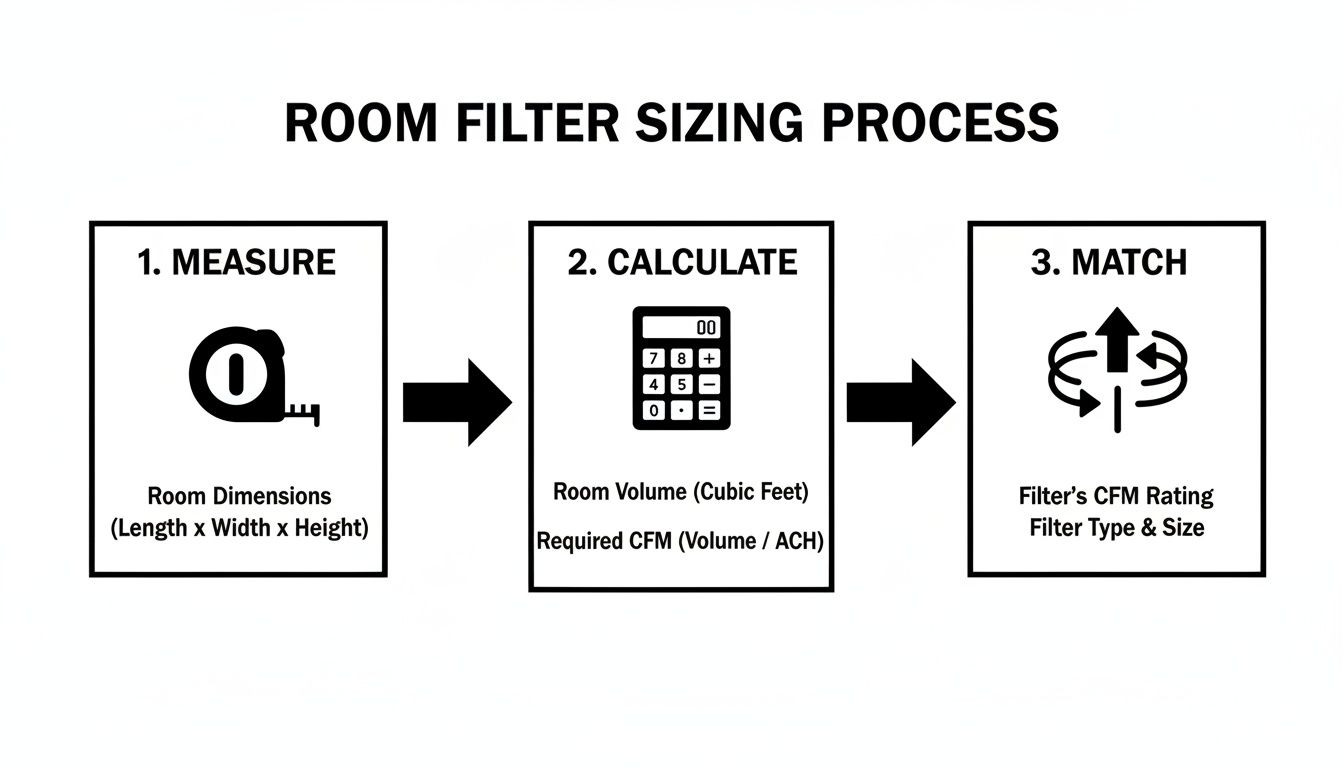
Following this process: measuring your room, calculating the volume, and matching it to the purifier's CADR: ensures your unit is powerful enough to handle the job from day one.
The first big decision is whether the purifier belongs inside or outside your grow tent. For nearly every home grower, the answer is outside the tent. Shoving a bulky appliance inside your grow tent just eats up precious real estate, gets in the way of your plants, and adds a little extra heat where you’re trying to get rid of it.
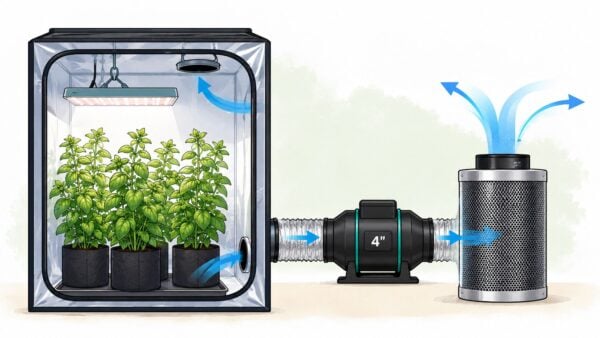
Think of it this way: your tent already has a carbon filter and exhaust fan doing the heavy lifting. The standalone purifier is there to act as a "room scrubber." Its job is to police the air in the room surrounding the tent, catching any smells that sneak out when you open the door. This gives you a two-stage defense system, which is the key to complete peace of mind.
Creating an Airflow Loop
To truly master odor control, you need to get all your ventilation gear working together. The goal is to create a seamless airflow loop that scrubs smelly air before it has a chance to escape. This whole system hinges on maintaining what's called negative pressure.
Negative pressure is just a technical way of saying your exhaust fan is pulling a little more air out of the tent than your intake is pushing in. This creates a slight vacuum, so air is constantly being sucked into the tent through any tiny gaps. It’s a simple but brilliant trick that guarantees no funky, unfiltered air can leak out around zippers or ports. Your air purifier then stands guard outside, ready to neutralize anything that escapes during maintenance.
Negative pressure is your secret weapon. You'll know you have it right when you can see the walls of your grow tent bowing inward just slightly. It's a visual confirmation that all air is being forced through your carbon filter, not finding other ways out.
Getting this airflow loop set up is pretty straightforward. Each piece of equipment has a specific job:
- Intake Fan: Pulls fresh, CO2-rich air into the bottom of the tent for your plants to breathe.
- Plants: Do their thing, photosynthesizing and releasing those fragrant terpenes that we're trying to control.
- Carbon Filter & Exhaust Fan: This duo pulls the warm, terpene-heavy air from the top of the tent, forces it through the carbon filter to scrub the odor, and then vents the clean air out.
- Air Purifier: Sits in the same room as the tent, constantly cleaning the ambient air and acting as your final line of defense.
Best Practices for Placement
Where you place the purifier makes a big difference. Don't just tuck it in a random corner and hope for the best. A little bit of strategy will dramatically boost its effectiveness.
Here are a few tips from the field for ideal placement:
- Give It Room to Breathe: Never shove the unit right up against a wall or behind furniture. Most purifiers need at least a foot of clear space on all sides to properly draw in and push out air.
- Target the Source: Keep the purifier in the same room as your grow tent. Ideally, position it somewhere between the tent door and the main door to the room. This way, it acts as a sentry, catching any odors that bolt when you open the tent.
- Mind the Airflow: Avoid placing your purifier directly in the path of your tent's intake vents. You want it scrubbing the room's air, not fighting with your tent’s dedicated ventilation system for the same air.
By integrating your air purifier for cannabis this way, you create a powerful, multi-layered system that keeps your grow completely discreet. If you want to get more insight on optimizing your tent's environment, our guide on choosing the perfect grow tent kit will help you get everything dialed in.
Upkeep, Noise, and Keeping Your Grow Low-Key
Think of your air purifier as a vital piece of gear, not just another appliance you can set and forget. To get the performance you paid for, you've got to give it a little attention. The good news is that the upkeep is simple, and a basic routine will keep your unit running smoothly, your air fresh, and your hobby private.
The single most important job is managing your filters. A clogged filter isn't just ineffective; it can actually cause problems. Once it's saturated with dust and particles, airflow gets choked off. This makes the fan motor work harder and dramatically reduces the purifier's ability to clean the air.
A Realistic Maintenance Schedule
Keeping your air purifier in prime condition doesn't take much time. It really just comes down to checking your filters every month or so and swapping them out when they're spent. Keep in mind that your HEPA and activated carbon filters will wear out at different rates.
- Pre-Filters: If your unit has a washable pre-filter, give it a good rinse every 30-60 days. This is your first line of defense, catching bigger stuff like pet hair and dust, which helps your main filters last much longer.
- HEPA Filters: These are the workhorses for particles, and they typically last between 6 to 12 months. The timeline really depends on your environment. Just pop it out and take a look: if it’s visibly gray and choked with dust, it’s time for a new one.
- Activated Carbon Filters: For neutralizing those potent cannabis aromas, you’ll likely need to replace these every 6 months. Their lifespan is all about how many odor molecules they’ve trapped. Once they’re full, they simply stop working.
A crucial tip: Don't wait until you can smell your plants to change the carbon filter. By the time the odor is noticeable, the filter has already been maxed out for a while. It's far better to be proactive and stick to a schedule.
How to Keep Things Quiet
A loud air purifier can draw just as much unwanted attention as the smell you're trying to eliminate. For any grower concerned with stealth, noise is a huge factor. When you're comparing models, pay close attention to the decibel (dB) rating.
Here’s what those numbers actually sound like in the real world:
- 20-30 dB: This is whisper-quiet, like the sound of rustling leaves. It's perfect for a bedroom or any space where you need silence.
- 40-50 dB: Think of the gentle hum from a modern refrigerator or the background noise in a quiet library. You can hear it if you listen for it, but it’s easy to tune out.
- 60+ dB: This is about the level of a normal conversation. At this volume, the purifier is a very distinct sound in the room and hard to ignore.
Here's the trick to minimizing noise: buy a purifier with a higher CADR than you technically need. This allows you to run it on a lower, quieter setting while still achieving the five air changes per hour your grow space requires. You'll only ever need to crank it to the highest setting for a quick scrub after you've had the tent open for trimming or watering.
By staying on top of filter changes and being smart about your setup, your air purifier for cannabis becomes a silent, reliable partner in your grow. It's also worth noting that a good purifier can help manage airborne particles that affect humidity. You can learn more about how to raise humidity in a grow tent in our article.
Finding the Right Purifier When No One's Marketing to You
Ever tried searching for an air purifier specifically for growing cannabis? It's a weirdly frustrating experience. You won't find a "Grower's Choice" sticker at your local hardware store, and mainstream brands seem to pretend we don't exist.
This silence from manufacturers can make finding solid, reliable info a real headache. There's plenty of market data out there, you can even read about the booming smart air purifier market on einpresswire.com, but none of it is segmented for our very specific needs.
What this means is you have to learn to read between the lines and look past the slick marketing. Instead of hoping to find a machine advertised for cultivation, you need to focus on the raw technology that actually neutralizes odors and scrubs the air clean.
What to Look for Instead of Hype
Forget the lifestyle photos and flashy buzzwords on the box. As a grower, your checklist is simple and non-negotiable. The only specs that matter are the ones that tackle the two dead giveaways of a grow: airborne particles and pungent smells.
To cut right through the noise, just zero in on these three things:
- The Filter Stack: This is non-negotiable. The purifier absolutely must have both a true HEPA filter for dust and mold spores, and a thick activated carbon filter to adsorb odors. This one-two punch is the only thing that works.
- CADR Rating: This number is your horsepower. It tells you exactly how much clean air the unit pumps out. As we've discussed, you have to match the CADR to your room's volume, especially to keep up with the powerful aroma of flowering cultivars.
- Noise Level (dB): If you're running a stealth grow, a loud purifier is a liability. A constant hum or whirring fan can be just as suspicious as the smell you’re trying to eliminate.
By focusing on these three technical specs, you can ignore all the sales fluff and make a decision based on pure performance. The market may not be designed for us, but the technology we need is out there if you know what you’re looking for.
Become Your Own Expert
The best way to approach this is to trust what you already know. You’re the expert on your own grow space. You know its size, you know how fragrant your chosen cultivars get, and you know exactly how important discretion is for your peace of mind.
Don't hold your breath waiting for a company to finally release the "perfect" cannabis air purifier. The secret is that they already have. You just have to use your knowledge to find a high-quality unit designed for removing airborne particles and VOCs (volatile organic compounds).
If a purifier has a great HEPA filter, a heavy carbon filter, and the right CADR for your room, it is a cannabis air purifier. You'll be making a smart purchase based on what works, not on who has the best sales pitch.
Clearing the Air: Your Top Questions Answered
Let's run through some of the most common questions we get from growers about dialing in their air purification. This is the stuff you need to know to keep your grow space clean, quiet, and discreet.
Can't I Just Use a Carbon Filter Instead of a Purifier?
Your carbon filter is non-negotiable, it's your first and best line of defense against odors escaping your exhaust. But a standalone air purifier in the same room? That's your secret weapon. It’s there to catch any smells that sneak out when you open the tent door for watering or maintenance.
Think of it this way: the carbon filter handles the air leaving the tent, while the air purifier constantly scrubs the air in the room around it. They work together.
The carbon filter cleans the air being exhausted from your tent. The air purifier cleans the air in the room itself. Using both creates a two-stage defense for total odor elimination.
How Long Do Carbon Filters Last for Cannabis Odor?
It really depends on the filter's quality, the size of your grow, and just how loud your cultivars get. For a typical small-scale setup, a good carbon filter should serve you well for about 6 to 12 months of continuous use.
You’ll know it’s time for a swap when you start catching those telltale whiffs of cannabis in the room. Pro tip: always have a fresh replacement filter on hand before you flip your plants to flower. That’s when the smell really cranks up, and you don’t want to be caught off guard.
Will a Purifier Affect My Grow Tent's Climate?
Nope, not in any meaningful way. An air purifier’s job is simply to pull air through its filters; it isn't designed to cool or heat it. While its fan does create a bit of air movement, the impact on your tent's internal temperature and humidity is practically zero.
This is especially true when you place the purifier in the room outside the tent, as we recommend. Your intake and exhaust fans are your primary climate controls. The purifier is just there to clean the air, not to change the weather in your grow.
With your air quality dialed in, you can focus on what really matters: cultivating amazing plants. At Botanist Seeds, we make it easy to find the perfect feminized or autoflower cultivars for your setup. Use our comparison tools to discover your next favorite strain and get growing with confidence.