


How Long Does Weed Last: Effects & Storage Guide
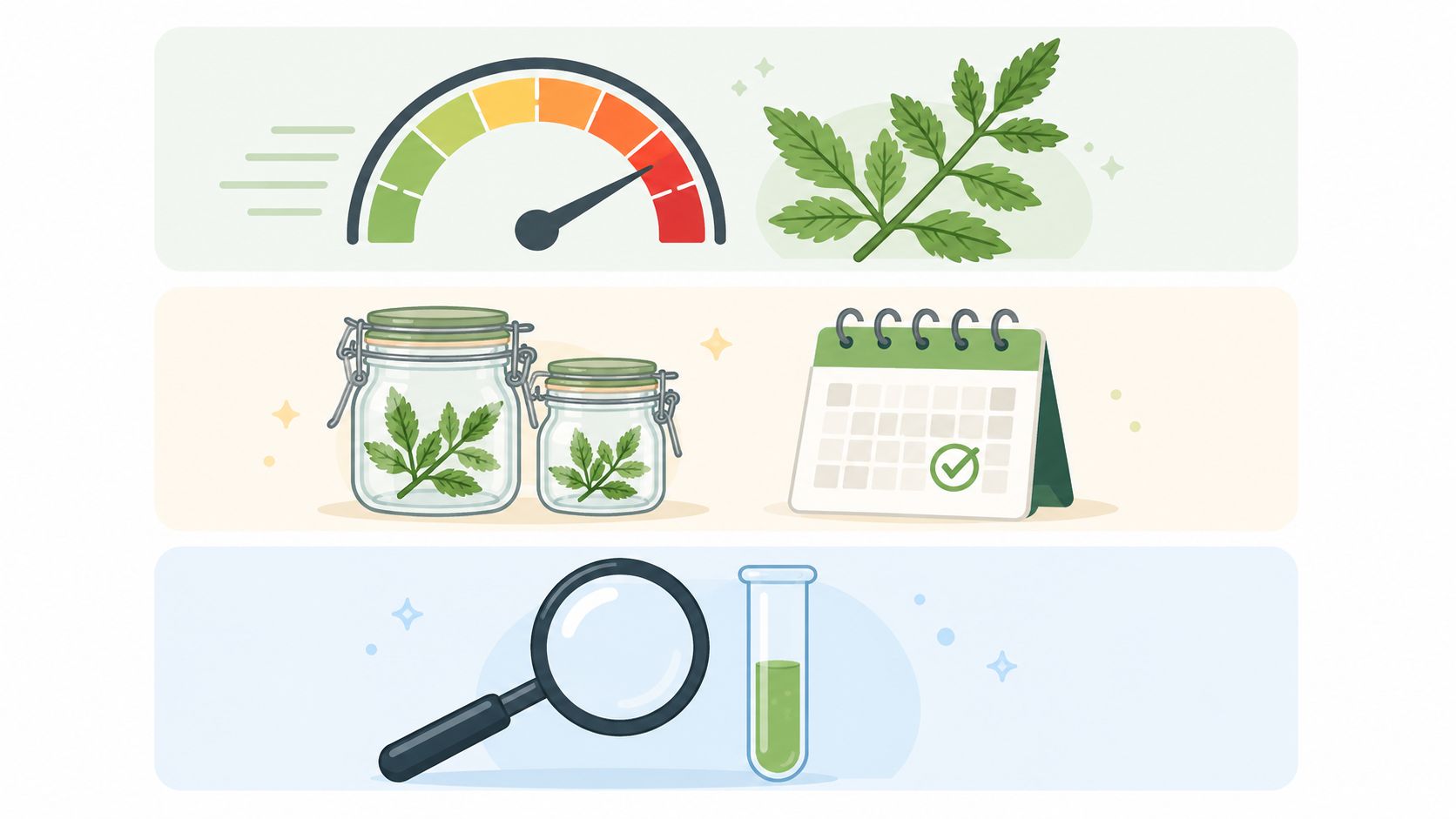
You've probably seen this happen. A jar from your last harvest is sitting in the cupboard, your friend asks how long weed lasts, and suddenly that simple question turns into three different conversations.
Are they asking how long the vibe lasts after using it? How long the flower stays fresh in the jar? Or how long it stays detectable in the body?
Those are not the same thing, and mixing them up is where most of the confusion starts. A home grower cares about all three for different reasons. You want your harvest to keep its aroma and character. You want to understand why one cultivar feels short and punchy while another hangs around much longer. And sometimes you just want straight answers about detection times without getting a lecture.
It Depends on What You Are Asking
When people type in how long does weed last, they're usually asking one of three things.
The first is about the experience. Someone smoked, vaped, used a tincture, or had an edible, and they want to know how long that session is likely to stick around. This is the version people ask when they're planning their evening, a concert, a movie, or just trying not to be caught off guard by a slower, heavier edible.
The second is about storage life. This is the home grower version. You put in the work, dried and cured your flower, and now you want to know how long that stash stays worth reaching for. Not “is it technically still there,” but “does it still smell right, taste good, and feel like the cultivar you grew.”
The third is about detection. That's not about the vibe at all. It's about how long cannabis can still show up depending on the kind of test and your use pattern.
Practical rule: If you don't separate these three questions, every answer sounds contradictory.
A quick example makes it easier. You might feel the effects of one session for part of a day, keep the flower in a jar for many months, and still have a very different detection window depending on the test. Same plant, three different timelines.
For growers, that distinction matters because it changes what action you take. If you want a smoother, more predictable session, you look at method and cultivar. If you want long-lasting freshness, you focus on storage. If you care about testing, you need to think in terms of detection windows, not how you felt.
That's the cleanest way to answer the question. Weed can last for hours, for months, and for much longer in testing contexts. It just depends on which “last” you mean.
How Long the Vibe Lasts After You Use It
The easiest way to think about this is like caffeine. Some methods hit fast and fade sooner. Others take their time and hang around longer.
Smoking or vaping is the espresso version. You notice it quickly, it tends to come on faster, and the session's direction becomes evident relatively early. Edibles are more like a slow-release drink. They don't always announce themselves right away, which is exactly why people sometimes underestimate them. Tinctures often land somewhere in the middle depending on how they're used and how your body handles them.
A simple way to compare methods
Here's a practical side-by-side view.
| Method | Onset Time | Peak Effects | Total Duration |
|---|---|---|---|
| Smoking or vaping | Usually felt quickly | Earlier in the session | Shorter, more front-loaded |
| Edibles | Slower to arrive | Later, often broader and heavier | Longer lasting |
| Tinctures | Often between inhaled and edible timing | Moderate peak | Moderate to longer duration |
That table stays general on purpose. Real-world timing varies a lot from person to person, and method alone never tells the whole story. Still, the pattern is reliable enough to help with planning.
Smoking and vaping feel more immediate
With inhaled cannabis, the feedback loop is short. You usually notice the aroma, flavor, and first wave of the vibe early, so it's easier to pace yourself. If you've grown a cultivar with a bright terpene profile and a sharp, upbeat feel, smoking or vaping tends to show you that character pretty clearly and pretty quickly.
That's one reason home growers often use inhaled methods to really learn a cultivar. You get a more immediate read on the flower you dried, cured, and stored.
Edibles are where timing throws people off
Edibles are different because they take the scenic route. You don't always get that instant “okay, I feel it” signal. That delay is where a lot of bad guesses happen. People assume nothing's happening, take more, then end up riding a much bigger wave than they wanted.
Edibles punish impatience more than almost any other method.
The vibe can also feel different. Many people describe it as fuller, heavier, or more drawn out compared with smoking or vaping. If your goal is a short, tidy session, edibles usually aren't the first choice.
Tinctures sit in the middle for many people
Tinctures can be more flexible. Some people use them for a measured, lower-drama session. The experience often feels less abrupt than smoking and less drawn out than edibles, though it still depends on product style and how you use it.
That middle-ground quality is why some growers like tinctures when they want more control without the long runway that edibles can bring.
The real takeaway
If someone asks how long weed lasts and means the vibe, the best answer is this:
- Smoking or vaping usually feels quicker and shorter
- Edibles usually arrive later and last longer
- Tinctures often fall somewhere between those two
That's the baseline. Your own results still depend on the details, which is where the next part matters.
Factors That Change Your Experience
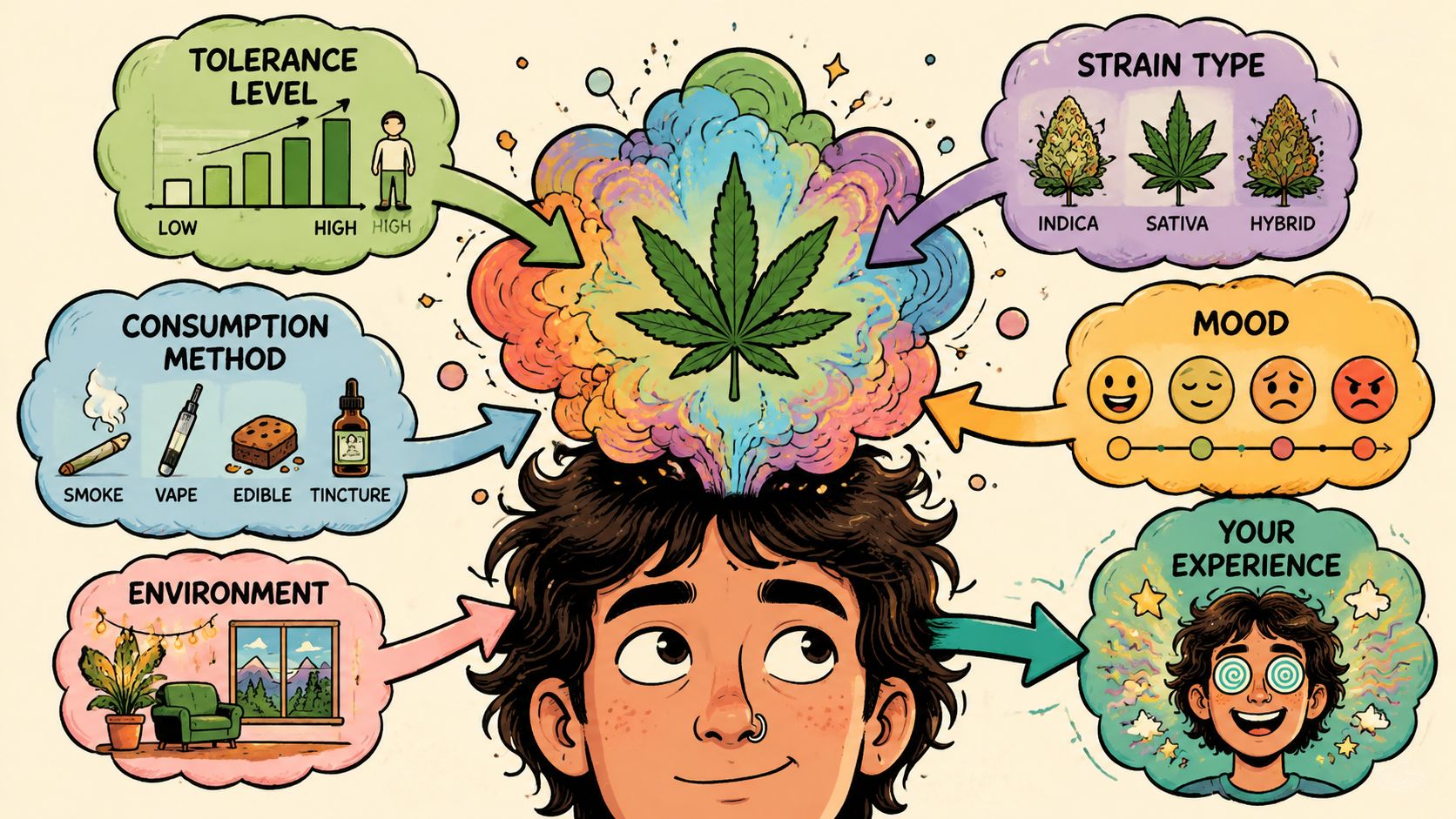
Two people can use the same flower and walk away with very different stories. That doesn't mean one of them is wrong. It means the experience depends on more than the product alone.
Amount changes the whole arc
This one seems obvious, but it gets ignored all the time. A light session and a heavy session don't just differ in intensity. They often differ in how long the whole ride feels stretched out.
Consider coffee. A few sips is one thing. A giant mug on an empty stomach is another. Cannabis works the same way in a practical sense. More product often means a stronger start, a broader peak, and a longer fade.
The cultivar profile matters
Not all cultivars land the same. Some feel crisp, bright, and short-lived. Others feel denser and more lingering. Aroma matters here too, because terpene expression often shapes how a cultivar feels in real life, not just how it smells when you crack the jar.
If you want a better handle on why one cultivar feels lively and another feels heavier, this guide to cannabis terpenes is worth reading.
Tolerance changes the readout
Tolerance works a lot like spicy food. If you rarely eat heat, a little feels like a lot. If you eat it all the time, your baseline shifts.
That doesn't mean higher tolerance makes someone immune. It means the same amount may feel shorter, softer, or less dramatic to one person than to another. For regular users, the early part of the session may feel less pronounced even when the flower is still doing what it does.
Your body and your setting both matter
Metabolism affects how quickly your body moves through the experience, especially with slower methods. So does whether you've eaten, how tired you are, and the general mood of the moment.
Then there's environment. The same cultivar can feel very different on a quiet evening at home than it does at a loud party or in a busy public place.
Worth remembering: The method starts the story, but your body, tolerance, and setting decide how it reads.
A useful habit for growers is keeping simple notes. Not a lab notebook. Just enough to remember which cultivars felt quick, which felt long, and what method gave you the clearest version of each one.
How Long Your Harvested Flower Stays Fresh
A common home-grower moment goes like this: you open a jar from last season, the buds still look decent, but the smell is quieter and the whole thing feels a little tired. That usually answers one version of “how long does weed last.” Your flower can stay usable for quite a while, yet lose the character that made it special in the first place.
Freshness works a lot like coffee beans or dried herbs. They do not spoil overnight, but they slowly give up aroma, flavor, and strength if they sit too long or sit badly. With harvested flower, the first signs are usually softer aroma, flatter taste, and a less vivid overall effect.
The shelf life most growers should plan around
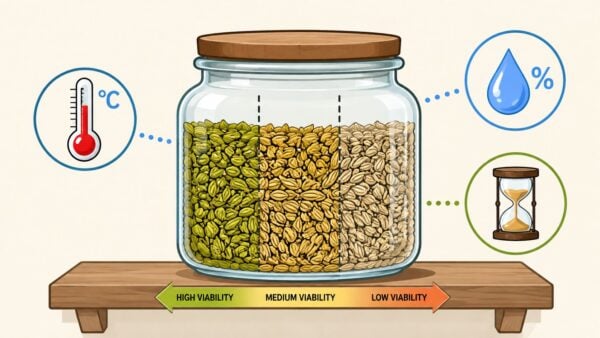
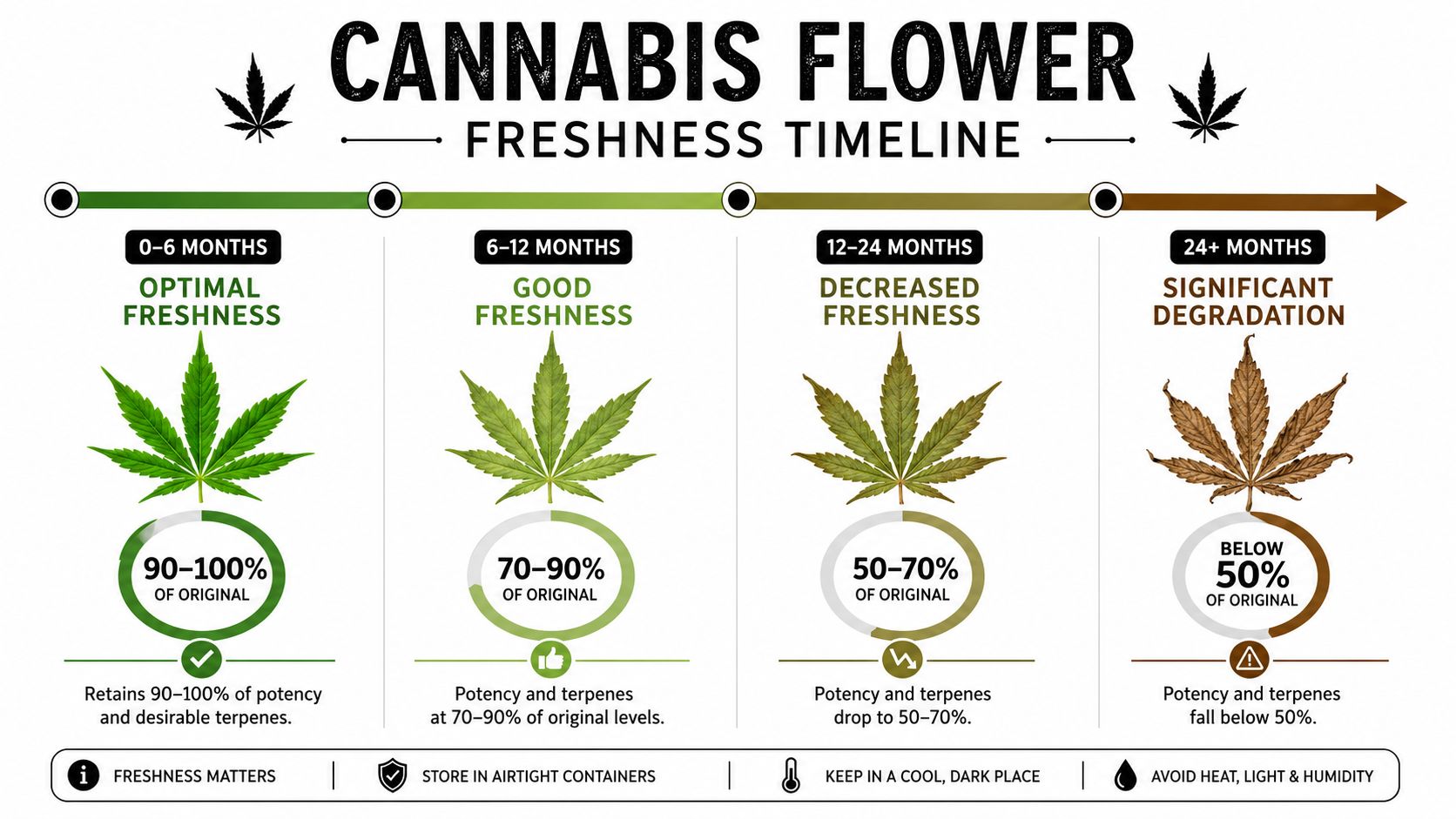
For practical stash planning, properly dried and stored flower is often still usable for about 6 to 12 months. With very good storage, some material can hold up for 1 to 2 years. A supported storage window for dry flower is 1 to 2 years when it is carefully prepared and kept in the dark at room temperature, according to this cannabis storage summary.
That said, “usable” and “fresh” are not the same thing. A jar can still smoke after a long stretch on the shelf and still be well past its best. Growers notice this fastest with flavorful, aromatic cultivars because the loss shows up in the nose and taste before the flower seems completely spent.
The four enemies in the jar
If cured flower is going to age well, four things need to stay under control. Each one chips away at quality in a different way.
- Light: Bright exposure speeds up degradation.
- Air: Oxygen slowly dulls aroma and freshness.
- Heat: Warm conditions push delicate compounds to break down faster.
- Bad humidity: Too much moisture invites mold risk. Too little leaves buds harsh, brittle, and crumbly.
Good storage starts before the jar. If the flower went in too wet or dried unevenly, you are already behind. If that part still feels fuzzy, this guide to using a dehumidifier when drying weed helps connect your drying room decisions to better shelf life later.
Potency loss is real
Storage affects more than smell and flavor. Potency changes over time too.
A separate controlled-storage study on cannabis trimmings found the steepest decline in potential THC happened early, with average total potential THC down 11.83% by day 30 and above 12.5% by day 60 across storage conditions, according to the PubMed study record.
Older flower can still be serviceable for rolling, infusing, or casual use. It just may not feel like the same harvest you were proud of when you first filled the jar.
For a home grower, that is the practical answer. Your stash may last a long time on paper, but peak freshness is a shorter window. If you want your harvest to keep its voice, storage habits matter almost as much as the grow itself.
A Grower's Guide to Smart Storage
You finish trimming, jar up a harvest you are proud of, and check it a month later. The buds still look decent, but the smell is flatter and the smoke is rougher than you remember. That letdown usually comes from storage, not the plant itself.
For a home grower, storage is the part that protects all the work that came before it. Drying and curing set the stage. Storage keeps the result steady. A good setup is less about gadgets and more about giving your flower a calm place to sit, like putting produce in the right drawer instead of leaving it on the counter.
What actually works
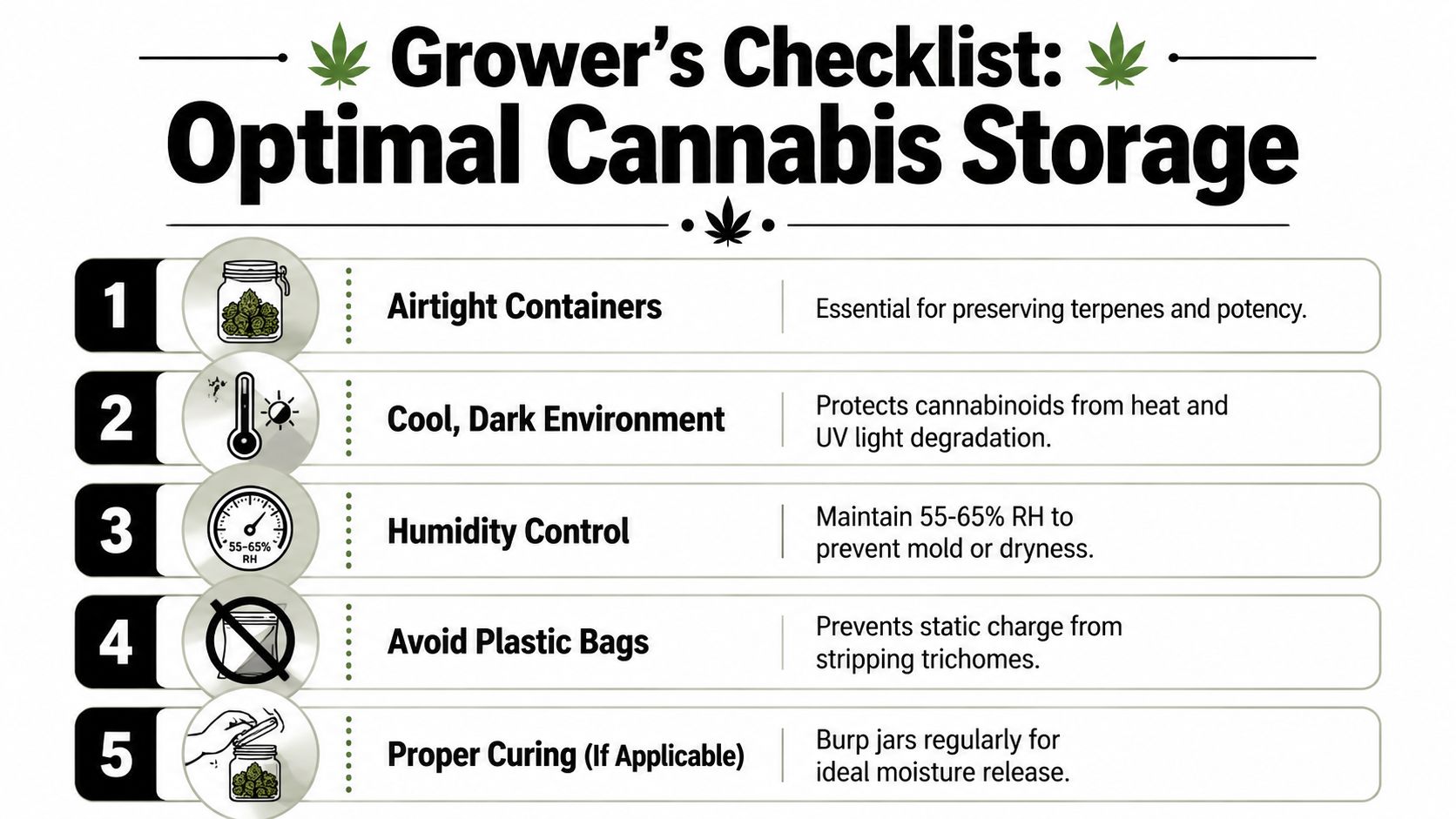
Start with a container that closes tightly and shields the flower from light. For many growers, a glass jar with a solid seal is the practical choice because it is easy to clean, easy to label, and easy to check without handling the buds too much.
The storage spot matters too. A closet shelf, drawer, or cabinet in a room with steady conditions works better than a windowsill, garage, or car. The goal is consistency. Flower keeps best when the environment stays boring.
Earlier guidance in this article covered the usual target range for cool storage and balanced humidity. The short version is simple. Keep jars cool, dark, sealed, and away from temperature swings. Plastic bags are fine for a quick handoff, but they are weak long-term homes for a stash.
A practical storage checklist
- Choose a jar that fits the amount: Too much empty space means more trapped air around the buds.
- Keep light off the flower: Use a dark cabinet or an opaque container.
- Avoid warm spots: Skip areas near appliances, heaters, and sunny windows.
- Watch moisture signs: If buds feel damp, smell off, or show suspicious spots, read this guide on how to identify mold on weed before you keep the jar closed.
- Open jars with a reason: Constant checking changes the environment inside.
Here's a helpful walkthrough before you seal up a long-term stash:
Common storage mistakes
The fridge gets recommended a lot, but a household refrigerator has frequent door openings and shifting moisture levels. That is a poor match for dried flower. A freezer can create a different problem. Trichomes become brittle, which makes buds easier to damage during normal handling.
Another mistake is storing everything in one large jar. If you dip into the same jar every day, the whole stash gets repeated exposure to air and changing humidity. Smaller jars work better for long holds because you only disturb what you plan to use.
Don't forget seed storage
Seeds need their own setup. If you are saving feminized or autoflower seeds for another run, keep them cool, dark, dry, and clearly labeled. The same principle applies here. Stable conditions protect quality better than fancy tricks.
Good storage supports the second meaning of "how long weed lasts." It helps your stash stay fresh longer, even though freshness is a different question from how long the vibe lasts or how long cannabis stays detectable.
What to Know About Detection Times
This is the third meaning behind how long does weed last, and it's the one that gets mixed up with the vibe most often. Detection time is not the same thing as how long you feel anything.
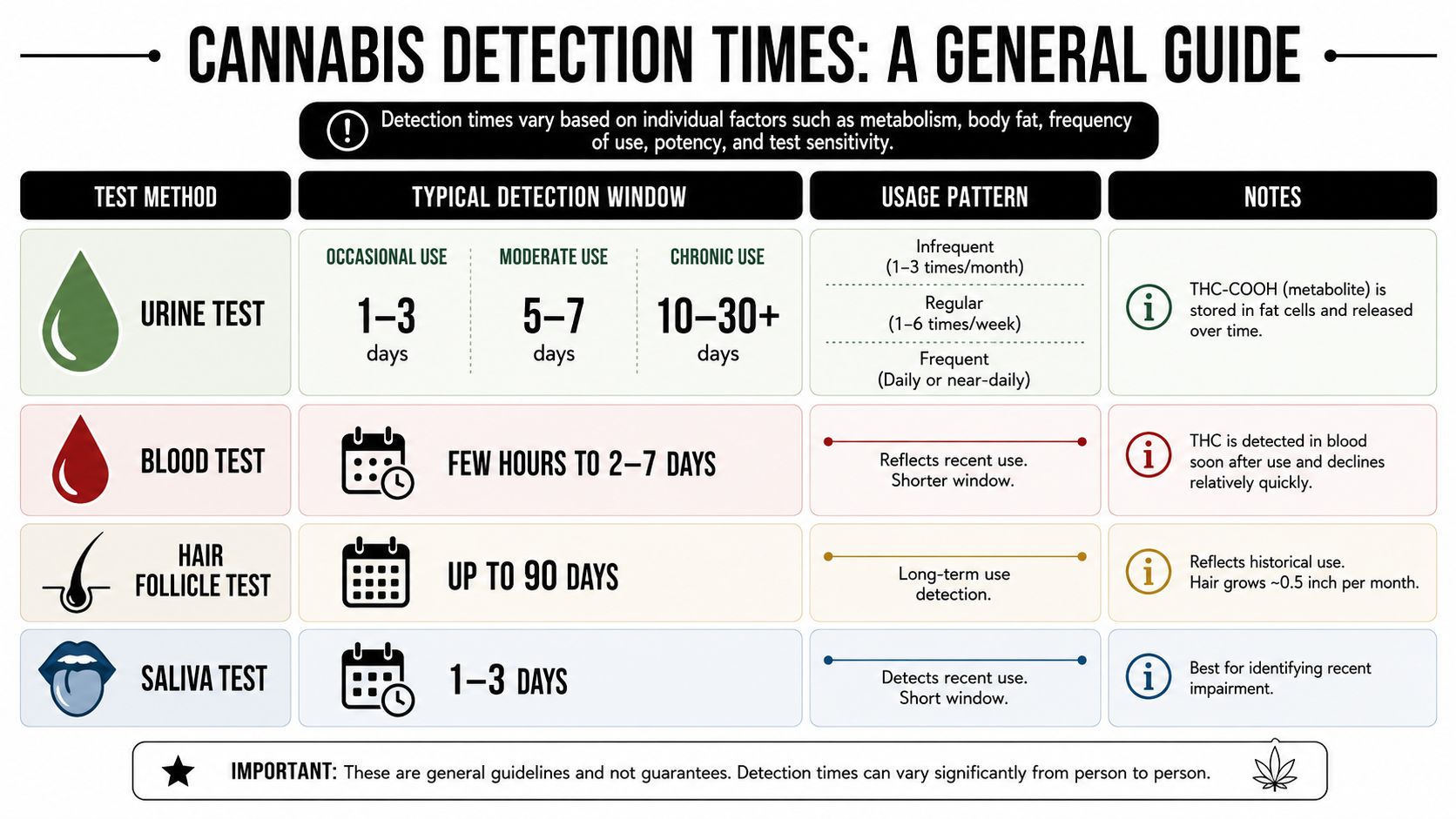
Different tests look for different signals, and the window changes a lot based on use pattern. Someone who uses occasionally and someone who uses often are not working with the same timeline.
The broad windows people should know
Independent health guidance reports cannabis can remain detectable for 24 to 72 hours in saliva, 3 to 30 days in urine, and up to 90 days in hair, with chronic users sometimes detectable much longer in blood, according to Priory's overview of cannabis detection times.
That's the headline, but the details matter.
- Saliva tests usually focus on a shorter recent-use window
- Urine tests can vary a lot, especially for regular users
- Hair tests reach much farther back
- Blood testing is more variable and often discussed in relation to recent use patterns
Why frequency matters so much
If there's one practical point to remember, it's this: frequency of use changes the answer more than people expect.
A one-off session doesn't create the same pattern as regular use. That's why copying someone else's timeline from a forum is a bad idea. Their method, frequency, and body may be nothing like yours.
Detection windows are ranges, not promises.
That's the safest way to think about them. Useful for education, not useful as a guarantee.
Keep the two questions separate
A lot of confusion disappears when you split this into two clean thoughts.
- How long did I feel it?
- How long could it still be detected?
Those answers can be very different. If you keep that distinction in mind, the whole topic gets a lot less messy.
Putting It All Together for Your Next Grow
The question how long does weed last really has three answers.
The vibe lasts on one timeline, and that depends a lot on method, amount, cultivar, and your own tolerance. Your stash freshness runs on a different timeline, and that comes down to storage. Then there's detection, which follows test type and use pattern rather than how the session felt.
For a home grower, the most useful part is control. You can choose cultivars that fit the kind of experience you like. You can dry and store your flower in a way that protects the aroma and character you worked hard to produce. And you can avoid a lot of confusion just by knowing which version of “last” you're asking about.
Growing your own supply gives you more than jars on a shelf. It gives you consistency, fewer compromises, and a much better shot at enjoying your flower while it still feels like the cultivar you intended to grow.
If you're picking genetics for your next run, Botanist Seeds makes it easier to compare cultivars by growth style, aroma profile, and setup fit, so you can choose something worth growing and worth storing well.