




Best Online Seed Bank: Your Guide to Confident Choices
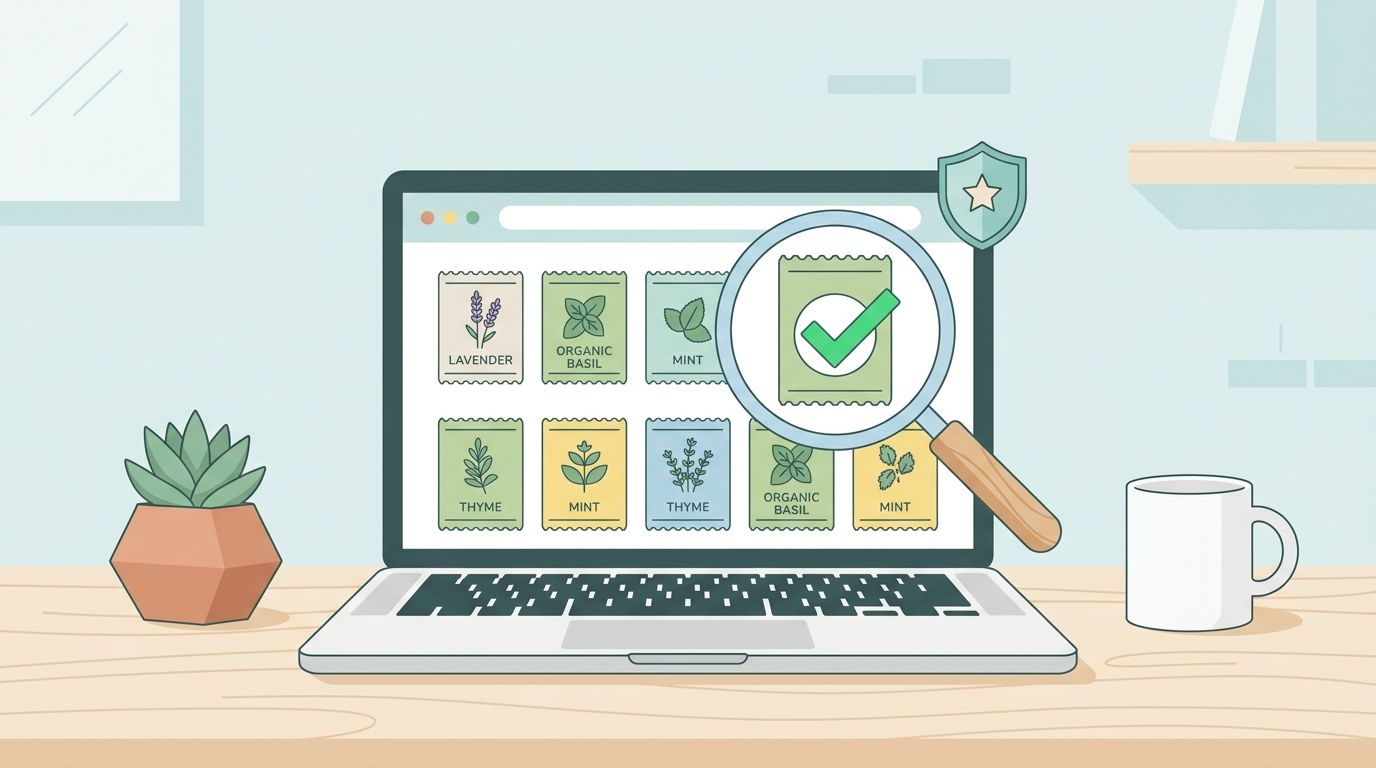
You're probably doing what most home growers do at the start. You open a few tabs, search for the best online seed bank, and within ten minutes everything starts to blur together. One site has flashy cultivar names. Another promises elite genetics. A third looks like it hasn't been updated in years but still has loyal fans in forum threads.
That's where people make the wrong call. They shop the way they'd shop for a hoodie or a grinder, when seeds are closer to the foundation of the whole grow. If the seed quality is shaky, the rest of your setup has to work harder just to stay on track.
A lot of guides just hand you a list of names. That can help, but it doesn't teach you how to judge a seed bank for your own setup, budget, and patience level. A small tent grower looking for a simple autoflower run doesn't need the same thing as someone planning a longer feminized photo grow with room to compare cultivars side by side.
The better move is to use a framework. Once you know what matters, genetics, stability, shipping, guarantees, support, and clarity, you can evaluate almost any seed bank without getting pulled in by hype. That's what separates a confident buy from an expensive lesson.
Why Choosing Your Seed Bank Matters
The easiest mistake to make is assuming all seed banks are basically selling the same thing. They're not. Two banks can list a cultivar with a similar name, but the grow experience can be very different depending on how the genetics were selected, stored, labeled, and supported.
That difference shows up later, not at checkout. It shows up when one plant grows exactly like the description and another turns into a weird outlier that eats time, space, and nutrients. For home growers, that matters a lot. Growers typically aren't running huge rooms where one disappointing plant gets lost in the mix. If you've got a small tent, every seed counts.
The market has grown fast, which gives growers more choice, but also more noise. The global cannabis seeds market is projected to reach $6.5 billion by 2031, growing at a CAGR of 18.4% from 2021 to 2031, according to Global Cannabis Times coverage of the cannabis seeds market forecast. More options sounds great until you realize it also means more copycat listings, more vague descriptions, and more stores competing for attention.
What this decision affects
A good seed bank choice usually shapes more than just the first week of your grow. It affects:
- Predictability: You want a cultivar that grows in a way that matches the listing.
- Time management: Good genetics save time you'd otherwise spend troubleshooting weird growth.
- Confidence: Clear policies and solid support make it easier to order without second guessing.
- Enjoyment: Home growing is more fun when the plants smell, stretch, and finish the way you expected.
Practical rule: Buy seeds the same way you buy lights or genetics gear, by performance and reliability, not by the loudest branding.
If you care about saving money on dispensary taxes, skipping the line, and growing something you enjoy from start to jar, the seed bank decision deserves real attention.
The Seven Pillars of a Great Seed Bank
The best online seed bank isn't always the one with the biggest banner or the longest menu. It's the one that gives you enough clear information to make a smart decision, then follows through after you order.
Here's the framework I'd use every time.
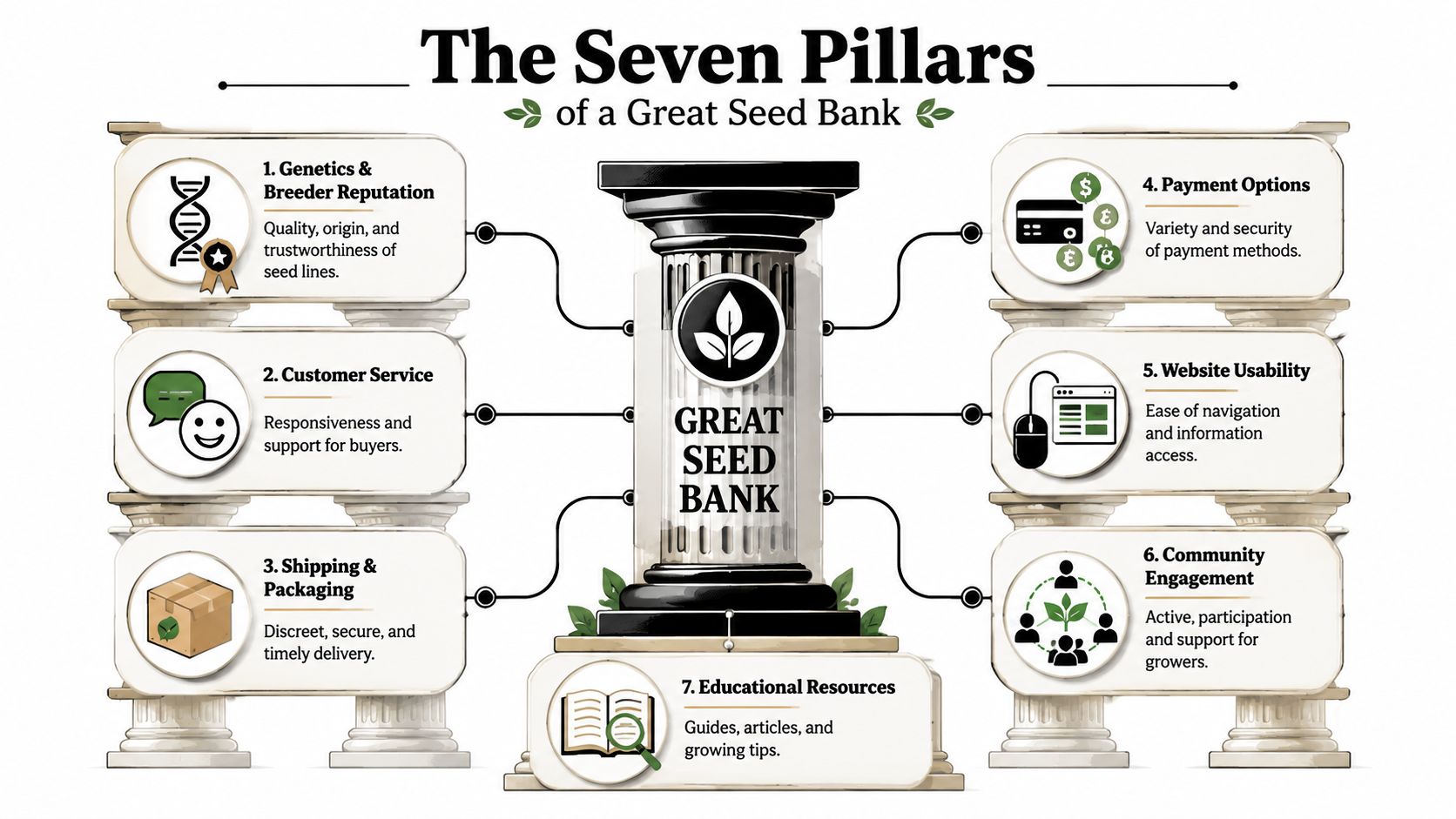
Genetics and breeder reputation
This is the core. If the genetics are weak, the rest doesn't matter much.
Look for seed banks that tell you where the cultivar comes from, how it tends to grow, what kind of structure to expect, and what sort of aroma profile it carries. Good listings don't hide behind vague terms like “top shelf” or “fire.” They give you enough detail to judge whether a cultivar fits your tent, your schedule, and your taste.
Germination guarantee
A real guarantee signals that the bank is willing to stand behind the seed quality it ships. That matters because verified germination rate is the highest impact technical spec when choosing an online cannabis seed bank, and it should exceed 90%, with reputable banks pairing that data with a germination guarantee, as noted by MG Magazine's guide to choosing cannabis seed banks.
If a site says nothing specific about germination, I treat that as missing information, not a small detail.
Legality and location
This one gets overlooked. Where the bank operates from affects shipping speed, reliability, and how much stress comes with the order. A domestic option is often easier for growers who want fewer moving parts and less waiting around.
Shipping and packaging
You want discreet packaging, clear tracking policies, and straightforward reship terms if something goes wrong. Fast shipping is nice, but clarity is better. A bank that explains its process usually handles problems better too.
A broader look at the premium seed market can help you spot which sellers are trying to build trust through transparency and which ones are mostly selling image.
Here's a quick visual breakdown before you compare sites in separate tabs.
Payment options, support, and proof
The last three pillars are less exciting, but they matter:
- Payment options: A solid bank offers secure, normal-feeling payment methods and explains them clearly.
- Customer service: Test responsiveness before buying if you want. Send a simple question and see how they reply.
- User reviews: Don't just count stars. Read for patterns. Are growers praising stable cultivars and smooth support, or just saying “arrived fast”?
A polished homepage means very little if the cultivar pages are thin, the policies are vague, and nobody answers questions.
Decoding Genetics and Seed Types
If you've ever grown two seeds sold under the same cultivar name and ended up with plants that looked like distant cousins, you already know why genetics deserve their own conversation. Catalog size gets attention, but genetic stability is what makes a home grow feel manageable.
That's why I'd rather buy from a bank with a tighter, better explained lineup than from one with a giant wall of names and not much else.
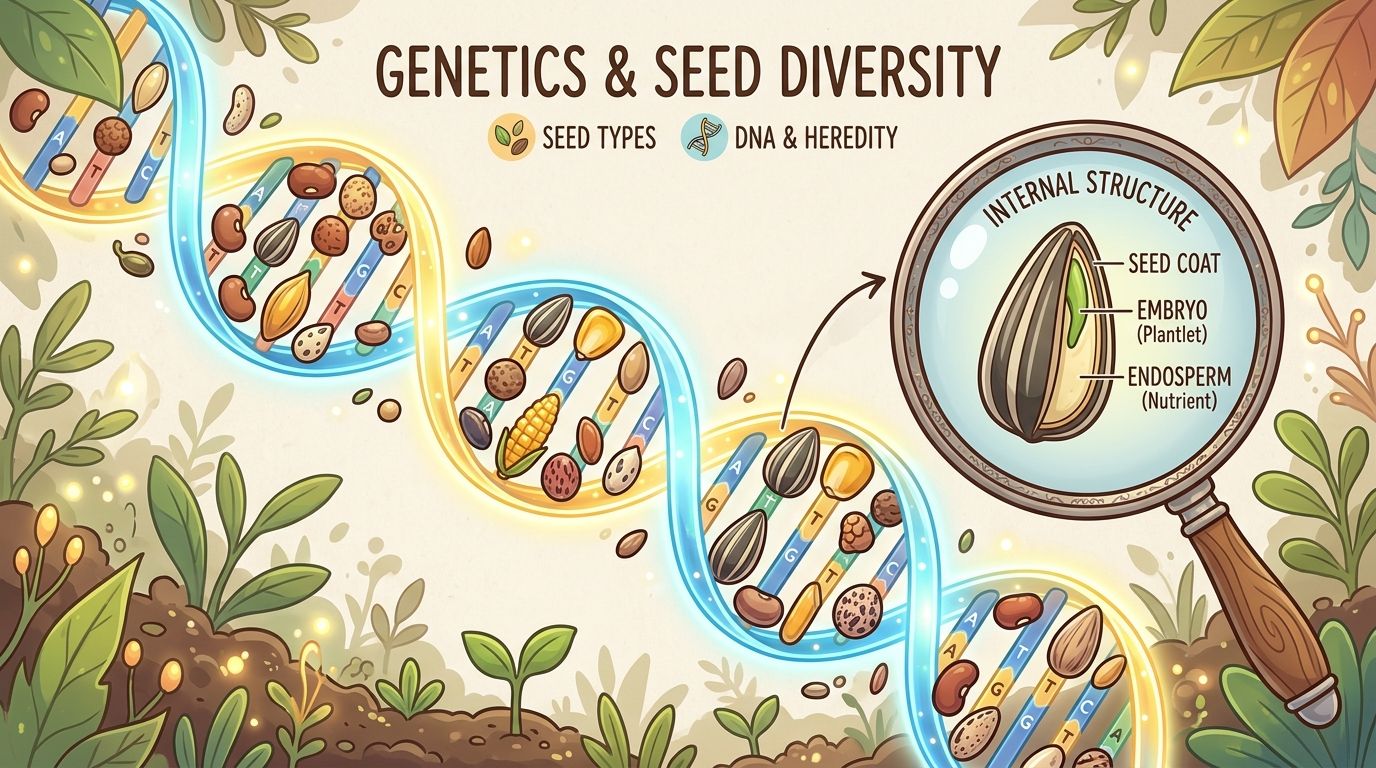
Why feminized seeds make life easier
For most hobby growers, feminized seeds are the practical choice. They simplify the run, reduce wasted space, and keep your attention on plant quality instead of avoidable complications. According to The Insight Partners cannabis seeds market report, the primary benefit of feminized seeds is that they eliminate the need to identify or remove pollinating male plants, saving weeks of effort and preventing up to 50% of crops from yielding nothing.
That's a big deal if you're growing in a closet, a corner tent, or any setup where every container matters.
Where autoflower cultivars fit
Autoflower cultivars are great for growers who value speed, simplicity, and a more forgiving schedule. They're a strong fit for people who want a straightforward cycle without managing light timing as closely as they would with photoperiod plants.
They also fit real life. If your routine is busy, or you want a compact run that doesn't drag on, autos can be a smart move. If you're weighing the tradeoffs between plant types, this guide on autoflowering vs photoperiod cultivation helps clarify which style makes more sense for your space.
Genetic stability matters more than menu size
This is the part most “best seed bank” lists skip. A bank can offer hundreds of cultivars, but if the lines aren't stable, that variety doesn't help much. It just gives you more ways to end up with surprises you didn't ask for.
Genetic stability means the plant you grow behaves close to the description you bought. The structure is in the expected range. The internode spacing makes sense. The aroma profile lands in the neighborhood described on the site. The finish window feels believable. For a home grower, that's the difference between a fun project and a frustrating one.
Good genetics don't guarantee a perfect run. They give you a fair shot at one.
What stable cultivars look like on the page
When I'm evaluating a listing, I'm looking for signs that the bank knows the cultivar beyond the name. That usually includes:
- Growth pattern details: Tall and stretchy, compact and bushy, or balanced.
- Aroma notes: Citrus, gas, fruit, earth, spice, or something similarly specific.
- Expected behavior: How the plant handles indoors, whether it stays manageable, whether it suits smaller spaces.
- Consistency across listings: The site doesn't describe every cultivar in the same copy-and-paste style.
If every page sounds interchangeable, I assume the bank is selling names first and genetics second.
The most useful seed banks don't just help you buy seeds. They help you predict the grow.
Your Seed Bank Buying Checklist
This is the tab-open checklist I'd use before placing any order. It's simple on purpose. You should be able to scan a seed bank in a few minutes and decide whether it deserves your money.
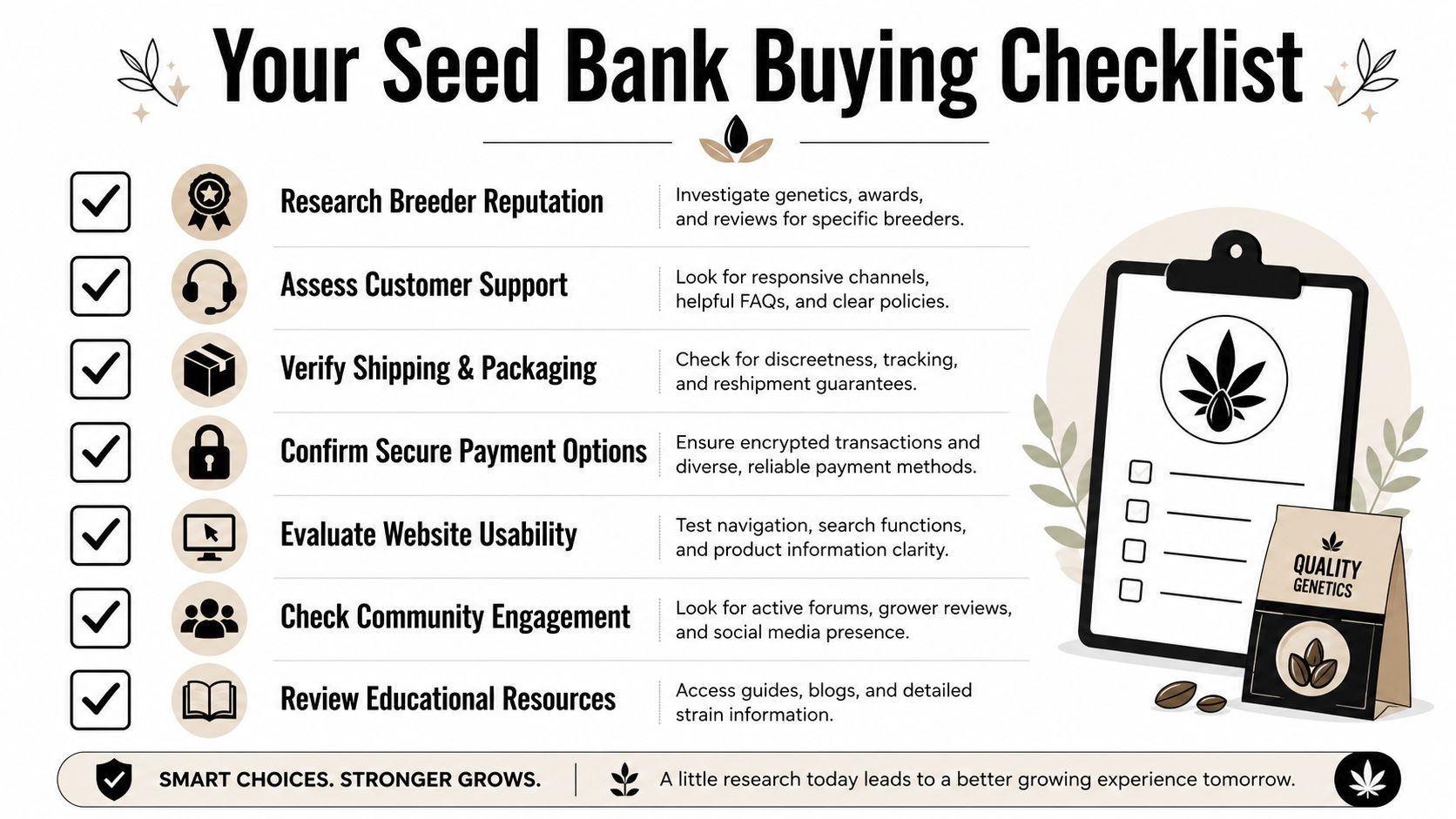
Run this check before you buy
- Read the cultivar pages closely: Don't stop at the name and pack size. Look for useful details about plant shape, aroma, flowering behavior, and what kind of setup it suits.
- Check the policy pages: If shipping, reship, or germination terms are hard to find, that's a bad sign.
- Look for breeder clarity: The bank should make it obvious who bred the seeds or how the line is sourced.
- Test support: Send a quick question if you're unsure. A clear answer tells you a lot.
- Scan reviews for specifics: Reviews that mention plant structure, consistency, and service are more useful than hype.
- Check storage and seed care info: Good banks usually educate buyers, not just sell to them.
- Compare location and delivery expectations: Especially if you want a smoother domestic order.
Here's a more structured version you can keep next to your browser.
| Criteria | What to Verify |
|---|---|
| Genetics | Clear cultivar descriptions, breeder info, realistic growth details |
| Germination policy | Easy-to-find guarantee terms and straightforward instructions |
| Shipping | Discreet packaging, tracking clarity, reship policy |
| Payment | Secure checkout, clearly explained methods |
| Reviews | Specific feedback about consistency, support, and delivery |
| Support | Contact method works, replies are helpful and direct |
| Education | Useful grow guides, storage tips, and cultivar information |
Pay attention to how the site feels
A reliable seed bank usually feels organized. Search works. Filters make sense. Product pages aren't thin. Policies aren't buried in tiny footer text. That doesn't guarantee quality by itself, but poor usability often travels with sloppy operations.
I also like to see practical growing content on site. A bank that teaches buyers how to handle seeds usually has a stronger long-term mindset. If you want a basic refresher after buying, this piece on how to preserve weed seeds covers the storage side well.
Quick check: If you can't tell what a cultivar is likely to smell like, how it tends to grow, or what happens if the order has an issue, keep browsing.
The checklist should make the choice smaller
The point isn't to find a “perfect” seed bank. It's to cut out weak options fast.
A lot of sites can pass one or two tests. Fewer can pass all of them. When a bank gives you strong genetics info, sensible policies, readable product pages, and responsive support, the decision gets much easier. You stop shopping by excitement and start shopping by fit.
That's usually when growers make better choices.
Seed Bank Comparison Matrix and Scoring Rubric
Cross-market comparison data shows that seed bank value usually sits inside a pretty practical range, with price-per-seed bands of roughly $2 to $12, germination policies that range from replacement to store credit, and shipping coverage that can run from domestic-only to worldwide with stealth options. That's why the cheapest pack isn't automatically the smartest buy. Very low prices without documentation are a warning sign, because they often travel with weak strain traceability or inconsistent breeder sourcing.
| Criteria | Excellent | Acceptable | Red Flag |
|---|---|---|---|
| Genetic documentation | Breeder listed, lineage shown, generation noted | Some breeder info, partial lineage details | Generic strain name only |
| Germination policy | Clear replacement or store credit terms | Policy exists but has limits | No clear guarantee language |
| Shipping | Tracking, discreet packing, clear reship policy | Standard shipping with basic tracking | Vague delivery terms |
| Price | Fair price with documented sourcing | Mid-range price, limited proof | Very low price, no provenance |
| Reputation | Strong third-party feedback and consistent reports | Mixed but mostly stable | Reputation built only on marketing |
How to use the matrix without overthinking it
Score a bank against what matters to you, not what looks flashy. A first-time grower may care most about shipping clarity and germination terms, while a collector may care more about lineage and batch documentation. Different goals deserve different weights.
The useful trick is to treat each category like a checkpoint. If a vendor fails on documentation but wins on price, that isn't a win, it's a trade-off you need to notice before ordering.
Why ratings cluster around clearer guarantees
In one multi-bank comparison, customer ratings clustered around 4+ stars for vendors with clearer guarantees, broader shipping reach, and stronger discount structures. That doesn't mean every 4-star bank is good, but it does show how service terms shape buyer satisfaction. When the support policy is clear, buyers tend to feel better about the whole process.
Red Flags to Watch Out For When Buying Seeds
Bad seed banks rarely announce themselves. They usually look decent at first glance, then fall apart when you look at the details. That's why skepticism helps.
A common mistake is assuming international always means better, or older means more trustworthy. Sometimes it does. Sometimes it just means slower shipping, less clarity, and harder problem solving if anything goes sideways.
Vague listings and empty promises
If a site sells cultivars with almost no usable detail, treat that as a warning. “Legendary,” “premium,” and “exclusive” are not descriptions. You need enough information to understand what you're buying.
These are the biggest red flags on product pages:
- Thin cultivar descriptions: No growth pattern, no aroma notes, no practical growing info.
- No clear guarantee: If the bank avoids specifics on nonviable seeds, you're taking all the risk.
- Overstuffed menus: Hundreds of flashy names, but every listing reads the same.
- No breeder transparency: You can't tell where the genetics come from or how they're handled.
Shipping trouble is still trouble
For U.S. growers, location matters more than some buyers want to admit. According to a discussion referenced by growers on the Microgrowery thread about reputable U.S. seed banks, ordering from a domestic seed bank usually means faster delivery and less exposure to the customs delays or seizures that can affect international seed orders.
That doesn't mean every international bank is bad. It means shipping risk is real, and a domestic source can remove a whole category of hassle.
If a seed bank makes ordering feel confusing before you've paid, support probably won't get better after you've paid.
Weird payment setups and weak support
I get cautious when a site gives very limited payment choices without explaining why, or when the checkout process feels stitched together from different systems. A trustworthy store doesn't need to feel shady.
Support matters too. If contact pages are bare, replies are slow, or answers read like canned text, that usually shows up elsewhere in the customer experience. Good seed banks know buyers have real questions about cultivars, timing, and order issues. They don't act annoyed by that.
Review patterns that don't pass the smell test
I'm not impressed by five-star walls with no detail. What I want to see is mixed but believable feedback, with real comments about delivery, seed quality, and how the plants behaved. If every review sounds generic, or all the negatives mention the same unresolved issue, pay attention.
The goal isn't to avoid every possible problem. It's to avoid the problems that were obvious before checkout.
How Botanist Seeds Meets the Standard
A good framework should work on any seed bank, including the one you're already considering. When you apply the same standards to Botanist Seeds, the fit is pretty clear.
Built around curated cultivars
Instead of trying to overwhelm buyers with endless noise, Botanist Seeds focuses on a curated catalog of feminized and autoflower cultivars. That matters because most home growers don't need maximum quantity. They need clear options that fit their space, schedule, and goals.
The product experience is designed around practical selection. That includes straightforward browsing, cultivar comparison, and descriptions that help growers think in real-world terms like plant behavior, aroma profile, and setup fit.
Stronger buying experience
The standards that matter most are the same ones growers use everywhere else:
- Clear information: Product pages aim to help buyers compare cultivars without guesswork.
- Modern shopping flow: The site is built to make selection simple instead of cluttered.
- Dependable genetics focus: The catalog emphasizes reliable seed choices over random filler.
- Useful tools: Comparison features help growers narrow choices based on their own priorities.
That last point matters. A lot of people searching for the best online seed bank aren't looking for the biggest seller. They're looking for a place that helps them choose well.
A seed bank earns trust when it makes the decision easier, not louder.
Aligned with how home growers actually shop
Botanist Seeds fits the standards that matter to hobby growers because it treats seed buying like a practical decision. You're not forced to decode vague marketing or sort through pages of clutter to find a cultivar that makes sense for a small tent, a quick auto run, or a more deliberate feminized grow.
That kind of clarity is what good seed banks get right.
Start Your Grow with Confidence
Finding the best online seed bank isn't really about crowning one winner for everyone. It's about knowing how to judge quality for yourself. Once you start looking at genetics, stability, guarantees, shipping, support, and site clarity, weak options become easier to spot.
That's a big shift for a home grower. You stop buying off hype and start buying for outcomes. Better fit, fewer headaches, and a much better shot at ending the run with jars you're proud of.
What's often overlooked is genetic stability. Big menus are fun to browse, but stable cultivars are what make the grow feel rewarding. If the plant acts close to how it was described, your planning gets easier. Your training choices make more sense. Your harvest feels less like a gamble.
Home growing already gives you plenty of wins. You can skip dispensary lines, avoid extra tax costs, and build your own stash around the aromas and vibes you enjoy. Buying from a seed bank that respects your time makes that whole process smoother.
Use the checklist, trust your eyes, and don't let flashy branding make the decision for you.
If you want a cleaner way to compare cultivars and shop with more confidence, take a look at Botanist Seeds. The catalog is built for growers who want dependable feminized and autoflower options, straightforward browsing, and a simpler path to finding the right cultivar for their setup.