Discover the Legendary Lambs Breath Strain: A 2026 Guide

A buddy once passed me a jar of Lamb's Breath and said, “This smells like an old record shop and a spice cabinet.” That stuck with me because it nails why this cultivar still gets chased today. It isn't just hype, it has personality.
An Introduction to a Legendary Cultivar
Lamb's Breath has one of those names that carries a full story before you even pop a seed. It's tied, at least by reputation, to Bob Marley, and that alone gives it a different weight than some trendy dessert cultivar with a flashy label and no roots. When growers talk about the Lamb's Breath strain, they're usually talking about more than flavor or potency. They're talking about Jamaican heritage, old-school sativa structure, and a bright, social vibe that still feels distinct.

What keeps this cultivar relevant is that it doesn't feel generic. It has that classic narrow-leaf, rangy energy people expect from older Caribbean lines. If you like cultivars that feel polished, uniform, and easy to predict, Lamb's Breath may not be your first pick. If you like plants with history and a little attitude, it makes a lot more sense.
Why growers still care about it
A lot of hobby growers want something that feels connected to cannabis culture before everything got heavily hybridized. Lamb's Breath checks that box. It's often described as energetic, uplifting, and creative, which is a big reason people keep looking for it instead of settling for whatever “sativa” happens to be nearest on a menu.
Lamb's Breath feels like a cultivar you grow because you want a classic in the stash jar, not just another fast turnover plant.
That matters at home. Growing your own isn't only about the end result. It's also about the satisfaction of pulling a recognizable, respected cultivar through a full cycle with your own setup, your own dry room, and your own cure.
What makes it worth the effort
This isn't the kind of plant people chase because it looks the prettiest in every room. They chase it because the overall package stands out.
- Cultural pull: The Bob Marley connection gives it a real place in cannabis lore.
- Old-school character: It carries the feel of a heritage Jamaican cultivar rather than a modern candy profile.
- Personal payoff: When you grow it well, you skip dispensary lines and end up with a stash that feels earned.
For the home hobbyist, that's a big part of the appeal. You're not just growing weed. You're growing a cultivar with a story, and that makes the work more fun.
The Jamaican Origin Story
Lamb's Breath makes the most sense when you see it as a landrace-leaning Jamaican cultivar instead of just another strain name floating around online. The old lore matters here because it explains why the plant tends to grow the way it does, and why growers still treat it with a bit more respect than a random commercial cross.
A commonly repeated version of the story says Lamb's Breath is believed to be a true Jamaican landrace that was introduced to the United States in the 1960s by Steve Lamb, a Florida-based smuggler. That same account also says he reportedly taught local growers how to separate plants to produce larger buds, according to this Lamb's Bread origin writeup. Whatever parts of the legend you accept as fact, the key point is clear. This cultivar's identity starts in Jamaica, not in a modern hype cycle.
What landrace means to a home grower
For a hobbyist, “landrace” isn't just a romantic label. It usually means the cultivar comes from older regional genetics shaped by a specific climate over time. In this case, warm, bright, tropical conditions helped define the plant's structure and behavior.
If you want a clean explainer on that broader category, it's worth reading about landrace cannabis genetics. It helps frame why some classic cultivars don't behave like compact, highly standardized modern hybrids.
Why the origin affects the grow
Jamaican roots show up in practical ways once the plant is in your room or garden:
- Structure: Expect a more open frame than squat indoor hybrids.
- Vigor: These plants often want space, airflow, and time to express themselves.
- Climate preference: Warm conditions suit them better than cool, damp corners.
That's where some growers get tripped up. They buy a heritage cultivar and then treat it like a tight, stacky tent plant bred for maximum convenience. That usually doesn't end well.
Practical rule: Don't fight a cultivar's background. Work with it. If a Jamaican line wants warmth, airflow, and headroom, give it those things early instead of trying to correct problems late.
The trade-off with older genetics
The upside is character. The downside is that character can come with more variation and more need for observation. That's not a flaw. It's just the nature of older, less homogenized stock.
A lot of growers prefer that. You get a plant that feels alive and distinct instead of one that behaves like every other catalog photo. If you enjoy the hands-on side of home growing, Lamb's Breath is the kind of cultivar that rewards attention.
Aroma Flavor and Overall Vibe
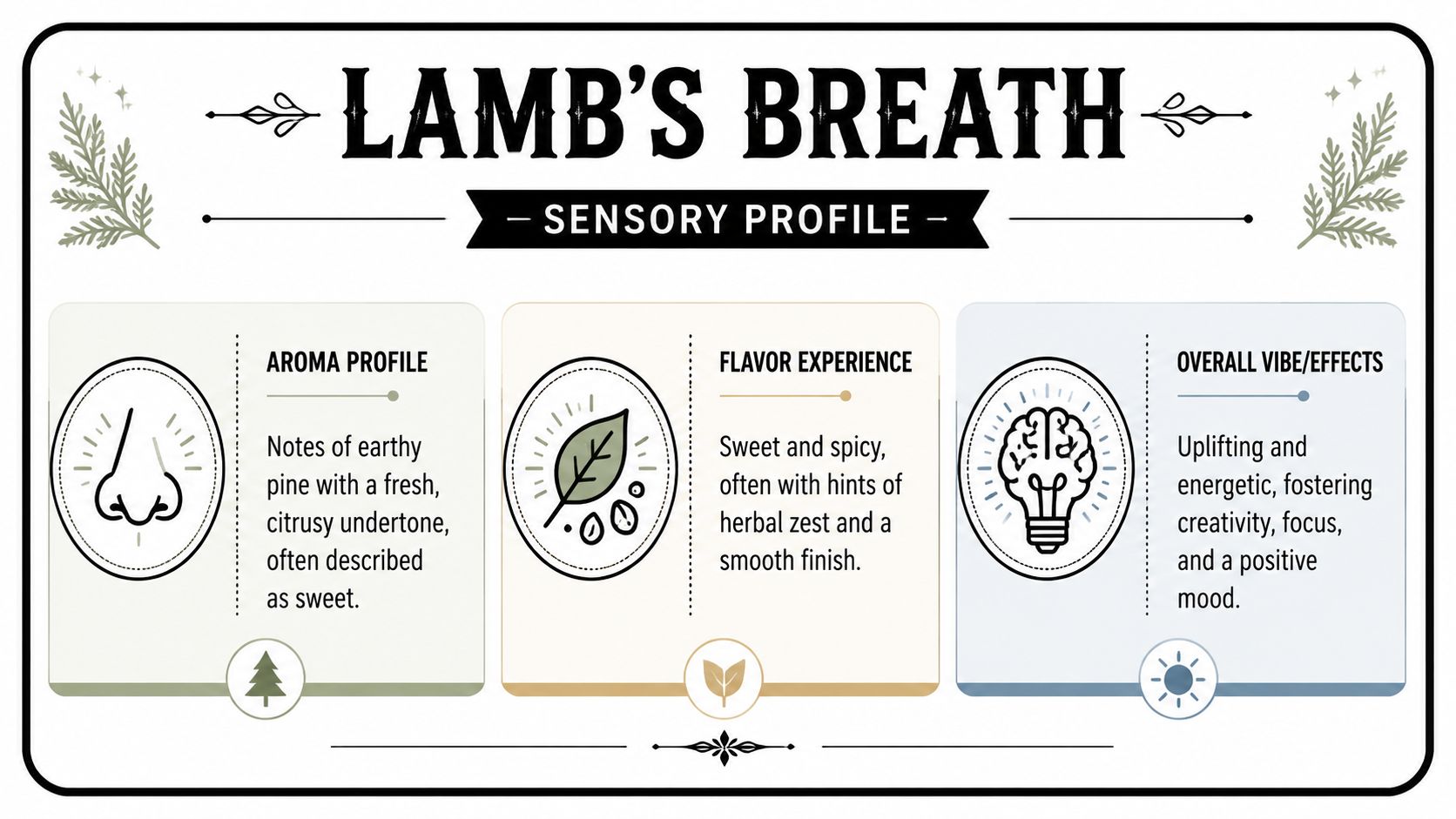
The smell is where Lamb's Breath usually wins people over, or warns them off. This isn't a soft fruit bowl cultivar. It has a funkier, older profile that leans savory, earthy, and spicy. Done right, it smells like something with actual history behind it.
The dominant terpene profile behind that signature is caryophyllene at 3.16 mg/g, limonene at 1.14 mg/g, and myrcene at 10.98 mg/g, which shape the cultivar's pungent, cheesy, and spicy-herbal aroma, as detailed in this Lamb's Breath terpene profile. If you want a better handle on why those compounds matter across cultivars, a quick read on cannabis terpenes helps connect the dots.
What the jar aroma is actually like
When you crack a well-cured jar, the first thing that usually hits is pungency. Then you start to pick up the layers.
- Cheesy funk: That savory sharpness gives it an unmistakably old-school edge.
- Woody depth: It doesn't smell candy-sweet or creamy. It has a dry, grounded backbone.
- Spicy-herbal lift: Pepper, green herbs, and a little brightness keep it from feeling flat.
Some people love that immediately. Others need a minute because they're expecting something sweeter. That's one of the honest trade-offs with Lamb's Breath. It has a profile for growers who appreciate classic funk more than modern confectionery.
Flavor on the inhale and exhale
The flavor tends to track closely with the aroma. You'll usually get earthy and herbal notes up front, followed by woody spice and a lingering savory finish. If the dry and cure were sloppy, that funky profile can get muddy fast. If the dry was patient and the cure was clean, the flavor lands with a lot more definition.
A rushed cure hurts this cultivar more than people expect. The rough edges become the whole story. A proper cure lets the spicy and woody parts come forward instead of leaving you with a blunt, grassy hit.
A cheesy cultivar needs a clean finish. If it tastes swampy instead of spicy, the problem is usually the post-harvest work, not the genetics.
The overall vibe
Lamb's Breath is usually sought out for an uplifting, energetic, and creative feel. It's the kind of stash people reach for when they want motion, conversation, music, or a project. It doesn't carry the heavy, settled feel many growers associate with more indica-leaning cultivars.
That said, this is still a cultivar that benefits from moderation, especially if you're testing a new cut or a new seed run. The vibe is often bright and clear, but a heavy hand can turn “focused” into “a little too loud” for some people.
A simple way to think about it:
| Trait | What to expect |
|---|---|
| Aroma | Pungent, cheesy, woody, spicy-herbal |
| Flavor | Earthy, herbal, peppery, savory |
| Mood | Bright, active, creative, social |
If your ideal homegrown stash leans classic, funky, and lively, the Lamb's Breath strain still earns its place.
Expected Lab Profile and Phenotypes
Lamb's Breath gets more interesting once you stop expecting total uniformity. This cultivar is known for variation, and for a home grower, that's not bad news. It just means you need to watch the plants instead of assuming every seedling will read from the same script.
One of the most useful identifiers is structural. This cultivar is known for four distinct phenotypes, with three expressing classic sativa traits and one showing more indica-like structure. It also has narrow leaves and long spacing between nodes, traits linked to its tropical origin, according to Leafly's Lamb's Bread profile.
What those phenotypes look like in a grow
The three more sativa-leaning phenotypes are usually the ones that stretch harder and show that classic narrow-leaf look. They tend to read as more open and vertical. The more indica-like expression usually looks a bit stockier, with a sturdier frame.
That doesn't mean one is “better” than the others. It means your training choices may need to shift.
- Tall, open expressions: Better suited to topping, tying down, and canopy control early.
- Stouter expression: Easier to manage in a smaller footprint, but still not something I'd treat like a dense bush cultivar.
- Across the board: Watch internodal spacing. It tells you a lot about how the plant wants to grow.
What the lab profile means in practical terms
Commercial batches of Lamb's Breath more commonly land in a THC range of 16% to 21%, with some modern phenotypes testing much higher, as noted earlier in the article. In practice, that puts it in a potency range that can satisfy experienced smokers without making the cultivar feel one-note or brute-force.
CBD is typically minimal, and minor cannabinoids can show up in smaller amounts. For the home grower, that matters less than the broader takeaway. This cultivar tends to express itself through clear personality, terpene character, and headspace, not just raw strength.
Don't judge Lamb's Breath by one photo or one plant. The real skill is spotting which phenotype you've got early enough to train and finish it well.
What to watch for in your own room
A quick visual checklist helps:
| Plant trait | What it usually suggests |
|---|---|
| Narrow leaves | Stronger classic sativa expression |
| Long node spacing | More stretch, more need for training |
| Sturdier frame | The more indica-like phenotype |
| Bright green buds with golden pistils | A classic look many growers associate with this cultivar |
That variation is exactly why stable sourcing matters so much. You're not just buying a name. You're buying the odds of getting the expression you want.
A Home Growers Guide to Lambs Breath
Lamb's Breath can reward a home grower nicely, but it doesn't like lazy environmental management. If your room swings all over the place, or your airflow is weak, this cultivar will show you the weak spots in your setup fast.
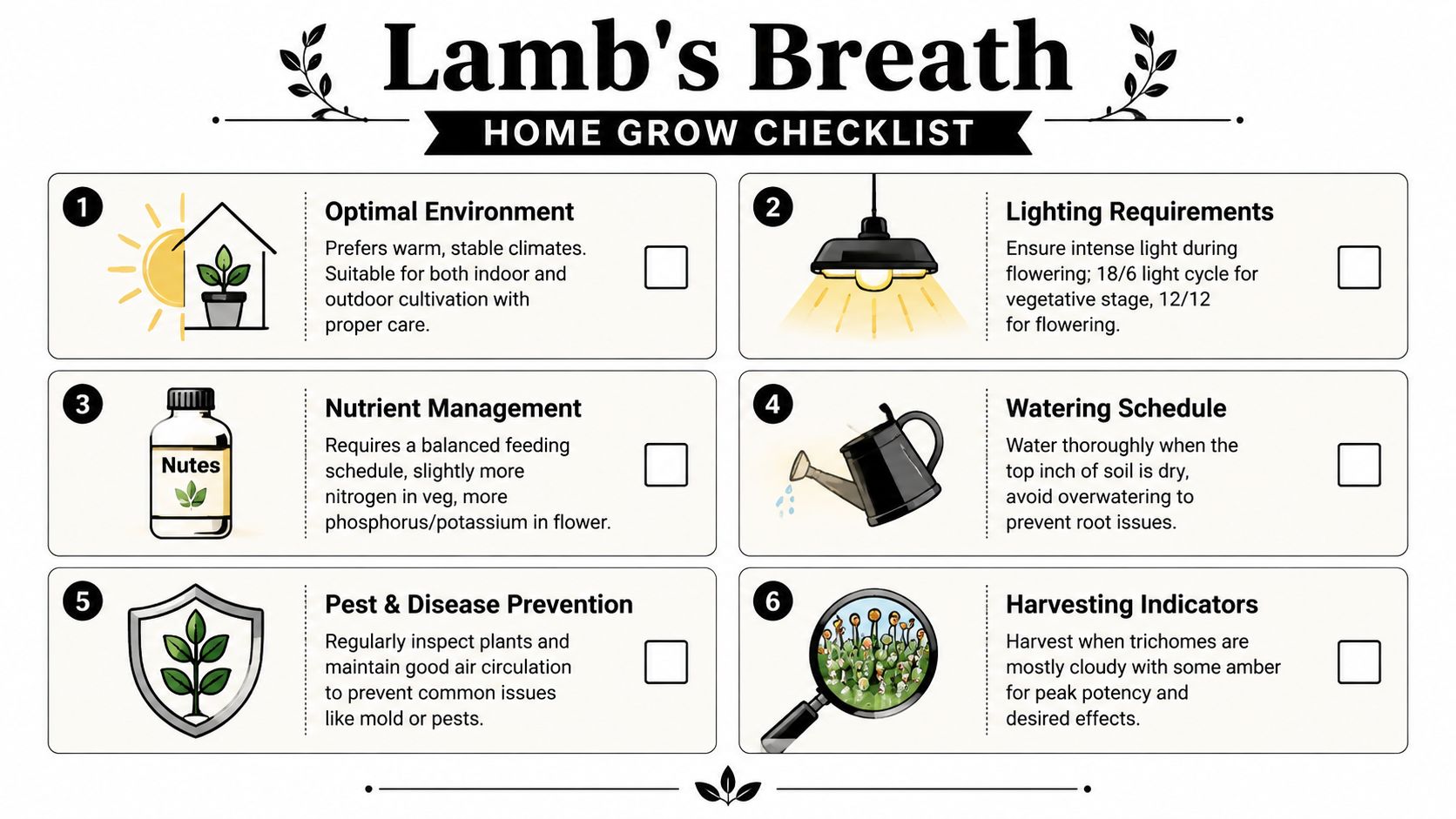
For cultivation, the key baseline is straightforward. Home growers should keep Lamb's Breath between 70–85°F (21–29°C) with relative humidity at 40–50% to better match its native climate and help avoid mold, as covered in the earlier origin source. Those numbers matter because this cultivar responds best when the room feels stable, warm, and well ventilated.
Indoor versus outdoor reality
This is one of those cultivars that often looks more natural outdoors in a warm climate. The structure makes sense there. Indoors, you can still do very well, but you need to manage height and airflow like you mean it.
If you're running a tent, don't wait for stretch to become a problem. Start shaping the plant while it's still manageable.
- Indoor growers: Use topping and low-stress training early to spread the canopy.
- Outdoor growers: Give it room and don't cram it between denser cultivars that block airflow.
- Small spaces: Consider whether your setup can handle a cultivar that wants vertical freedom.
Why feminized and autoflower options make sense
For a home hobbyist, feminized seeds cut out a lot of hassle and make the whole run more efficient. You're using your tent, light, nutrients, and time on productive plants from the start. That's just a smarter way to run a personal grow.
Autoflower versions, when available from a reliable breeder, can also be a solid fit for growers who want a simpler timeline and less dependence on strict light-cycle changes. The trade-off is control. A photoperiod feminized plant gives you more time to recover from mistakes and shape the structure.
What works and what doesn't
Here's the blunt version.
What usually works
- Warm, steady conditions: This cultivar dislikes erratic rooms.
- Good air movement: Its open structure helps, but stale air still creates problems.
- Early training: A little shaping early saves a lot of swearing later.
- Moderate feeding: Start measured, then respond to the plant.
What usually doesn't
- Crowded canopies: You lose airflow and invite trouble.
- Cold, damp rooms: That fights the plant's background.
- Late training panic: Bending a stretched plant after the fact is a pain.
- Overwatering: Especially in a cool room, that can slow everything down.
Flowering and finishing
This cultivar generally has a flowering time of 9 to 10 weeks. That's reasonable for a sativa-leaning plant, but it still asks for patience. Chopping too early usually costs you the character you grew it for.
The dry and cure matter just as much as the grow. If you preserve the terpene profile properly, Lamb's Breath keeps that funky, woody spice intact. If you rush it, the result can feel flat and rough.
A practical home routine looks like this:
- Train early so the canopy stays open.
- Hold the environment steady instead of chasing problems after they show up.
- Feed with restraint until the plant tells you it wants more.
- Harvest patiently and don't sabotage the finish with a rushed dry.
That's the difference between “I grew Lamb's Breath” and “I did this cultivar justice.”
Finding and Choosing Quality Seeds
A lot of growers blame themselves for disappointing runs when the actual problem started with shaky genetics. That's especially true with classic cultivars like Lamb's Breath, where name recognition can hide a lot of inconsistency.

If you're shopping this cultivar, don't stop at the label. Look for a seller with a reputation for stable, clearly presented genetics and a catalog that makes comparison easy. A curated marketplace like the premium seed market is useful because it lets you compare options instead of impulse-buying from a random listing.
What quality looks like
Good seed shopping is mostly about reducing surprises you didn't ask for.
- Clear cultivar information: You want a seller that explains what the genetics are supposed to express.
- A focus on feminized and autoflower options: That keeps the process simpler for home growers.
- Consistency in catalog quality: If everything looks vague, the genetics probably are too.
One practical check is simple. Ask yourself whether the listing helps you picture the plant in your space. If it doesn't tell you enough to make that call, keep looking.
A quick visual rundown can help sharpen your shopping instincts:
Why comparison beats guesswork
A random seed can still grow. That doesn't make it a smart buy. Home growing takes time, electricity, nutrients, and patience. Starting with better genetics gives you a much better shot at getting the growth pattern, aroma profile, and overall vibe you expected.
That's why comparison tools matter. If Lamb's Breath sounds right on paper but your tent is tiny and your patience is short, another cultivar may fit better. Smart growers don't just buy what sounds legendary. They buy what fits their setup.
Frequently Asked Questions
How do I control stretch in a small indoor tent
Start early. Lamb's Breath often shows a more open, sativa-style structure, so it pays to top and train before the plant decides the canopy shape for you. Low-stress training works well because it spreads the branches without stalling the plant too hard.
If your tent is short, don't veg longer than your space allows. A compact veg period plus steady training usually works better than letting the plant get ambitious and trying to fix it later.
If you think training can wait another week, it probably can't.
What should I do if the plant looks hungry mid-grow
Don't assume it needs a heavy feed right away. First check the obvious stuff: root-zone moisture, airflow, and whether your environment has drifted out of range. A plant in a poor environment can look underfed even when the nutrient bottle isn't the issue.
When you do feed, move in small steps. Lamb's Breath usually responds better to measured adjustments than dramatic swings.
How long should I cure Lamb's Breath to keep the aroma sharp
Be patient. A careful cure is what helps that woody, spicy, funky profile show itself properly. If you rush from dry to jar and call it done, the aroma can feel rough or unfinished.
The best practical approach is to cure until the smell becomes more defined and less green. That's not glamorous advice, but it's the truth.
Is this cultivar beginner-friendly
It can be, but only if the beginner is willing to observe the plant and keep the room stable. The grow itself isn't impossible. The challenge is that this cultivar doesn't always reward autopilot habits.
A first-timer with a clean setup, decent airflow, and a willingness to train can do well. A first-timer who wants a totally hands-off plant might be happier elsewhere.
Is Lamb's Breath always extremely strong
Not always. Commercial batches more commonly test between 16% and 21% THC, while some modern phenotypes have been documented as high as 31.33% THC, based on the lab range reported earlier. That's a wide spread, and it's one more reason to treat the cultivar name as a starting point instead of a guarantee.
In practical terms, start modestly with any new batch or phenotype. Lamb's Breath is often chosen for its lively, engaging vibe, and there's no benefit in overshooting that.
If you're comparing classic cultivars and want genetics that fit your space and goals, take a look at Botanist Seeds. Their catalog and comparison tools make it easier to sort through feminized and autoflower options without wasting a season on the wrong pick.