




Gummy Worms Strain: A Home Grower’s Cultivation Guide
You're probably in the same spot a lot of home growers hit after a couple of solid runs. The tent is working, your dry room routine is finally dialed in, and now you want a cultivar that feels a little more current than the old standbys. Not something fussy for the sake of being fussy, just a project that smells great, looks interesting, and makes the whole grow feel fun again.
That's where Gummy Worms lands for a lot of growers. It has that modern candy-shop appeal, but it's also the kind of plant that rewards attention without demanding a lab coat. If you like the idea of opening your tent and getting hit with sweet citrus and creamy dessert notes, this is the sort of cultivar that can make a normal grow cycle feel like a hobby again instead of a chore.
Growing your own also changes the math in a very practical way. You skip dispensary lines, avoid retail taxes, and get control over how the flower is dried, cured, and stored. Just as important, you get the satisfaction of looking at a jar on the shelf and knowing every step of that harvest came from your own setup.
Why the Gummy Worms Strain Is a Grower Favorite
A lot of growers find Gummy Worms the same way. You scroll through seed options, see another Kush, another Cake, another Cookies cross, and nothing really grabs you. Then a candy-named cultivar shows up, and this one sounds like it could be worth the space in the tent.
Gummy Worms works because it doesn't feel generic. The name tells you what kind of sensory lane it's in, and the plant usually backs that up with the kind of sweet, fruit-leaning profile that makes trimming less annoying and jar checks more enjoyable. It feels like a project with personality.
Why home growers keep coming back to candy cultivars
For a hobbyist, a favorite plant usually checks more than one box:
- It keeps the grow interesting: Some cultivars are fine on paper but boring in practice. Gummy Worms tends to hold attention because the aroma develops in a way that feels rewarding week by week.
- It gives you something distinct: If your stash already leans earthy, gassy, or heavy dessert, this one brings a brighter candy angle.
- It makes the harvest feel personal: Sweet-smelling cultivars often become the jars friends ask about first, and that's part of the fun.
Practical rule: Pick at least one cultivar each season because you're excited to grow it, not just because it's familiar.
The gummy worms strain also fits nicely into the self-sufficient home grower mindset. You're not just chasing a label from a menu. You're building your own version of the experience, from seedling structure to final cure. That matters more than people admit.
What doesn't work
Growers usually get disappointed with this cultivar for one of two reasons. First, they expect every plant sold under the Gummy Worms name to be identical. They won't be. Second, they treat it like a plain production run and ignore aroma preservation during dry and cure.
If you want the payoff this cultivar is known for, you can't rush the last stretch.
The Candy-Coated Genetics of Gummy Worms
Gummy Worms works best as a home-grow project when you treat it like a cultivar family, not a single locked-in plant. The candy theme is consistent across versions. Plant shape, vigor, finish time, and how the aroma settles in during flower can shift quite a bit depending on the breeder or cut.
That variation is part of the appeal.
The name grew out of the late-2010s West Coast wave of candy-forward hybrids that followed the success of lines like Zkittlez, Gelato, and Runtz. By the early 2020s, Gummy Worms had already spread across legal markets and started showing up in several breeder catalogs and retail menus. For a hobby grower, that means one thing above all: verify the genetics before you pop seeds, because the label alone does not tell the whole story.
Two notable versions growers should know
One recognized version comes from Lit Farms. Weedmaps lists that Gummy Worms as an indica-dominant hybrid, 60% indica and 40% sativa, bred from Apples N Bananas x Red Velvet Runtz, with an indoor flowering time of about 60 days, according to Weedmaps' Gummy Worms listing.
Another version tied to the same name comes from Compound Genetics. Weedmaps describes that cut as a balanced 50% indica and 50% sativa hybrid from White Runtz x Gummiez, and notes that it is known for testing above 26% THC.
For the home grower, those differences are practical, not academic. One expression may stack a little broader and finish with a denser, heavier look. Another may stay more balanced in structure and show a different pace in flower. Same project name. Different garden behavior.
Gummy Worms Cultivar at a Glance
| Characteristic | Expectation |
|---|---|
| Breeder variation | Multiple versions circulate under the Gummy Worms name |
| Lit Farms version | Indica-dominant hybrid, 60/40, from Apples N Bananas x Red Velvet Runtz |
| Lit Farms flowering time | About 60 days indoors |
| Compound Genetics version | Balanced hybrid, 50/50, from White Runtz x Gummiez |
| Compound cut potency note | Known for testing above 26% THC |
| Common theme | Candy-forward, fruit-heavy profile with creamy dessert backing |
What the lineage means in the grow room
If you have grown modern candy hybrids before, the parent lines here will look familiar. Apples N Bananas, Red Velvet Runtz, White Runtz, and Gummiez all suggest strong aroma potential, good bag appeal, and some real plant-to-plant variation. That last point matters most in a small home setup, where every square foot counts.
Uniformity is nice, but selection usually pays off more with a line like this. Keep notes on branching, internode spacing, stretch after the flip, and when the sweeter notes first show up. Growers who understand how cannabis phenotype selection works usually get more out of Gummy Worms because they know what to keep and what to pass on.
The best Gummy Worms run usually comes from the plant that actually delivers the candy profile you wanted, not the one with the flashiest seed description.
Aroma Flavor and General Vibe
A good Gummy Worms run announces itself before the jars are even full. Late in flower, the room usually picks up a bright candy scent with citrus on top and a softer cream note underneath. That mix is what keeps this cultivar interesting to grow. You are not chasing sweetness alone. You are chasing sweetness with some shape to it.
What it smells and tastes like in real life
The profile usually lands on sweet fruit first, then citrus zest, then a creamy finish that rounds it out. In a home grow, that matters. A loud candy nose can be fun for five minutes, but the plants worth keeping are the ones that still smell layered when you brush a stem, trim a branch, or crack a cured jar a few weeks later.
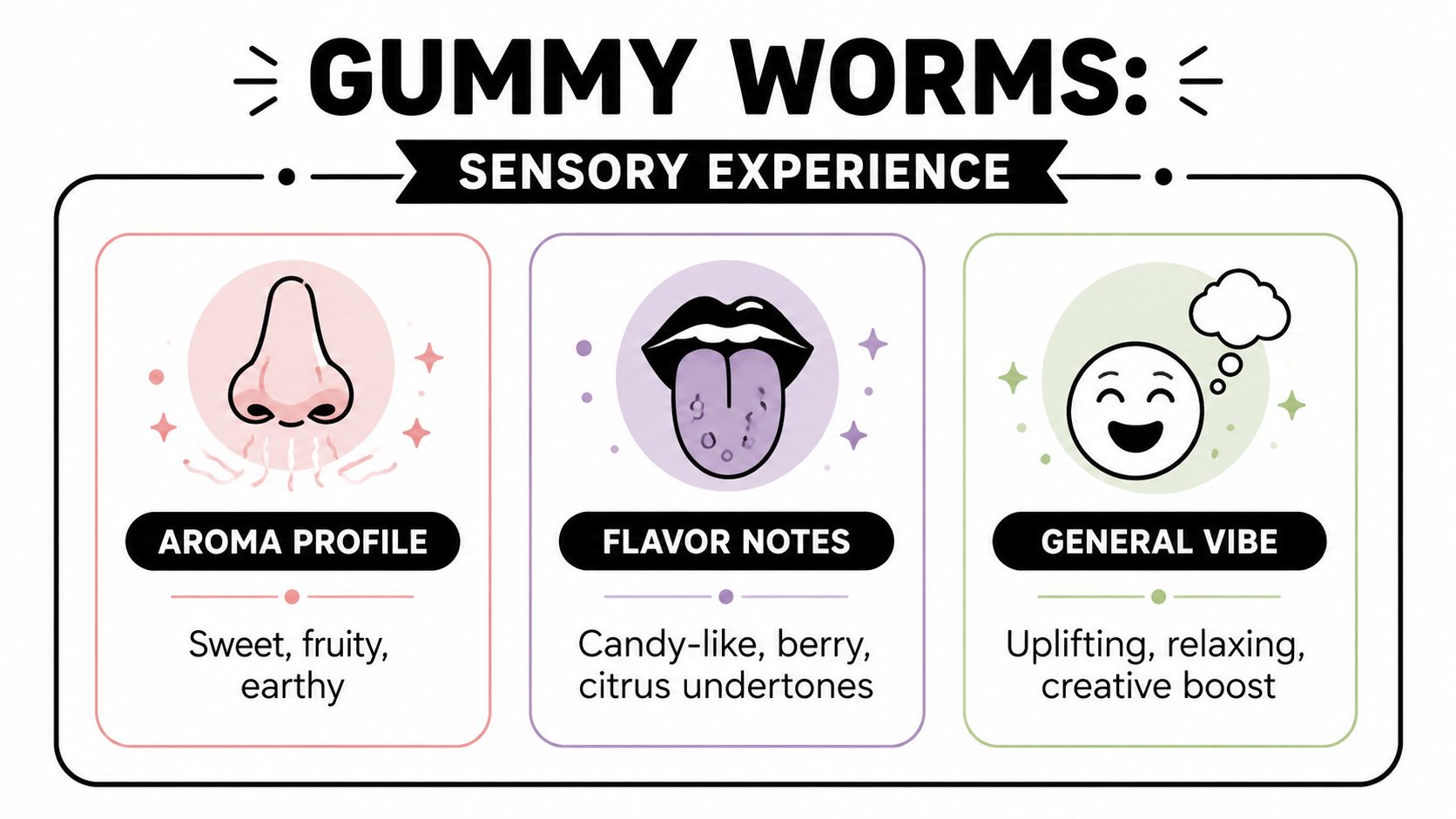
Expression can shift from plant to plant. Some phenos push the fruit harder. Others carry more of that creamy dessert background. For the hobby grower, that is part of the appeal. You get to notice which plant makes the tent smell like gummy candy with orange peel, and which one drifts closer to a smoother, creamier finish.
If you want to connect those smells to the compounds behind them, this guide to common cannabis terpenes is a useful reference.
The vibe people usually look for
The finished experience usually fits the balanced modern-hybrid category. Growers and smokers tend to like it for the same reason. It feels current, flavorful, and easy to come back to, without turning into a novelty jar that gets opened once and forgotten.
That balance also makes the project satisfying from start to finish. You get a tent that smells rewarding near harvest, flowers with strong bag appeal, and a cure that can hold onto those brighter candy notes if the dry goes well. Rush the finish, and the profile flattens out. Dry and cure it patiently, and Gummy Worms usually gives you the kind of jar you want to show a friend.
- Aroma in flower: Sweet fruit with a citrus lift and a creamy base
- Flavor expectation: Candy-forward, with more depth than a simple sugary note
- Jar appeal: Strongest when drying and curing preserve the brighter top-end aroma
- Overall feel: Balanced, upbeat, and relaxed
Judge this cultivar by the nose first. With Gummy Worms, the real reward is growing a plant that smells as good in late flower as it does after cure.
Your Indoor Gummy Worms Growing Blueprint
Indoor is where a lot of growers will get the cleanest expression from Gummy Worms. You control the environment, you keep the flowers out of rough weather, and you've got a much better shot at preserving the candy profile that makes this cultivar worth the effort.
The Lit Farms version is listed with an indoor flowering time of about 60 days in the earlier section, which gives hobbyists a useful benchmark for planning. Still, the smarter move is to watch the plant in front of you instead of worshipping the calendar.
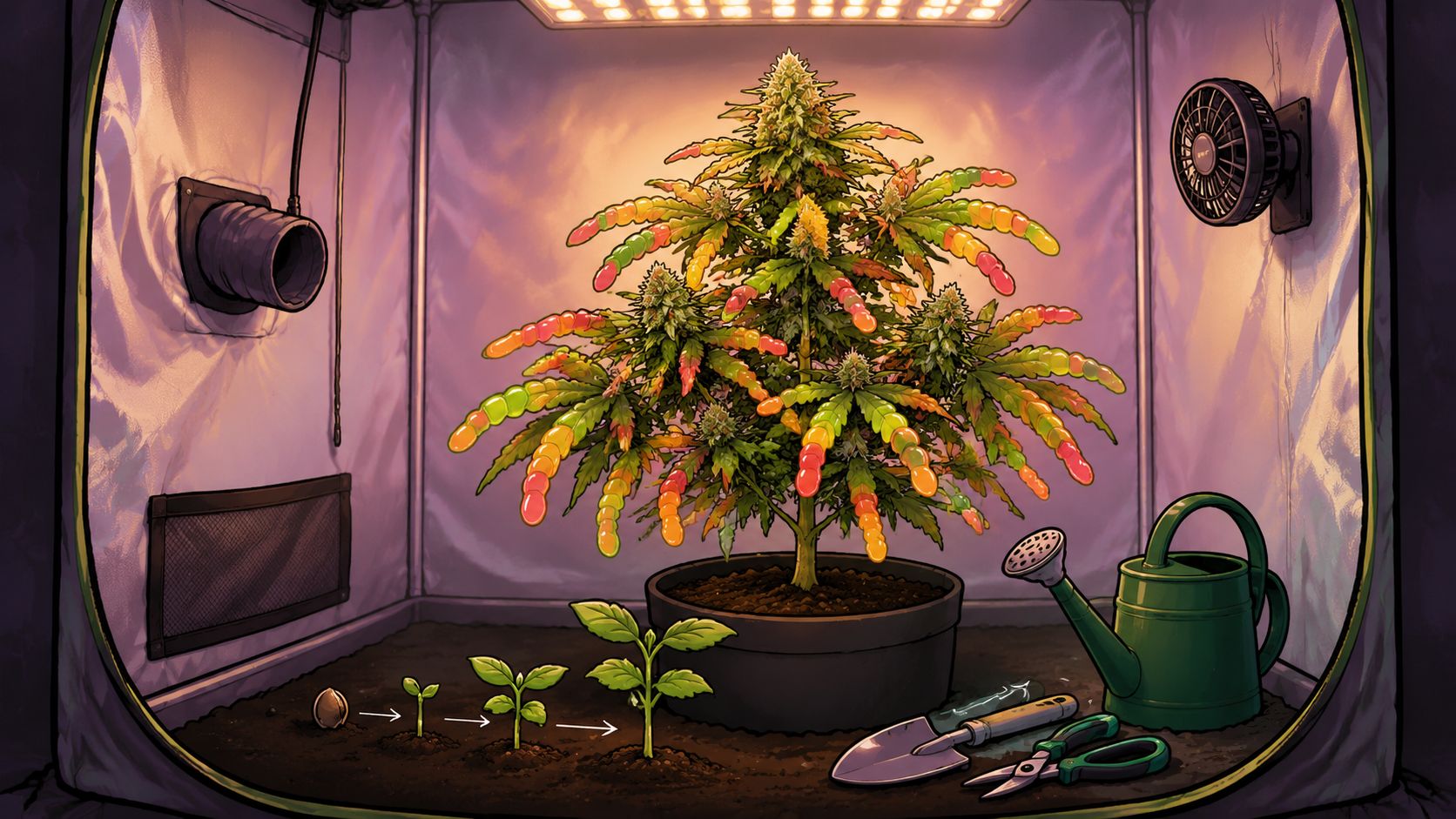
Start simple and keep the canopy even
This isn't the cultivar I'd use to test every training trick I saw online that week. Gummy Worms usually responds best when the grower keeps the structure manageable and focuses on an even canopy.
A straightforward indoor approach looks like this:
- Begin with a clean medium: Whether you run soil or coco, start with something you understand well. New cultivar, familiar root zone.
- Build a broad plant early: Topping or light low-stress training can help open the center and create more useful tops.
- Avoid overcrowding: Candy cultivars with dense flowers don't reward lazy airflow planning.
- Stay consistent in flower: Big swings in environment can flatten the quality you were hoping to preserve.
What usually works best
A lot of home growers overcomplicate the indoor run. The gummy worms strain does better when you nail the basics.
- Feminized seed planning: Feminized seeds keep the project focused on productive plants, which is exactly what most hobby growers want in a limited-space tent.
- Light management: Keep the canopy level so your top sites mature more evenly. A lopsided plant under a flat light pattern wastes good square footage.
- Defoliation with restraint: Remove what blocks airflow and useful light. Don't strip it bare and pretend stress is strategy.
- Odor prep: This cultivar can get loud. Have your carbon filter situation handled before mid flower, not after.
Grow room note: If a plant starts throwing the aroma you wanted, don't chase extra stress or extra inputs. Protect the expression you've already got.
Common mistakes that cost quality
The first mistake is pushing nitrogen too long into flower. That can leave the plant looking green and healthy while the final aroma comes out less defined than it should.
The second is poor spacing. Gummy-style cultivars often look best when they're dense, frosty, and neatly stacked. That same density can turn into a headache if leaves are jammed together and humidity lingers.
A few practical checkpoints help:
- Early flower: Watch the stretch and make canopy corrections before it turns into crowding.
- Mid flower: Sniff plants individually. This is often when the best expressions start separating themselves.
- Late flower: Focus on support, airflow, and patience.
- Harvest prep: Make space in the dry area before chop day so you're not improvising the most important part.
The indoor reward
Indoor Gummy Worms is satisfying because it gives visible feedback. If your environment is steady, the plant tends to tell you pretty clearly whether you're on the right track. The smell gets louder, the flowers tighten up, and the project starts to feel like one of those runs you'll remember.
That's a big reason growers get attached to this one.
Taking Your Gummy Worms Grow Outdoors
Outdoor growing changes the project completely. Indoors, you manage the room. Outside, you work with the season you've got. That can be a huge advantage if you've got a good spot, decent airflow, and enough privacy to let the plant finish without constant stress.
The gummy worms strain can be a really enjoyable outdoor cultivar for growers who like seeing a plant express itself with more room around it. The structure often feels less constrained, and the whole grow has a more relaxed rhythm than a tent run.

Pick the site before you pick the plan
A bad location wrecks more outdoor grows than bad genetics ever will. If the area stays damp, gets poor sun, or traps stale air, you're fighting uphill from day one.
A better outdoor setup usually includes:
- Direct sun: Give the plant the brightest part of the yard you can.
- Air movement: Natural breeze helps keep the canopy drier and healthier.
- Drainage: Roots hate sitting wet after every irrigation or rain.
- Easy access: If checking the plant feels annoying, you won't check it enough.
Build around your local conditions
Outdoors, the smart grower adjusts to the climate instead of pretending every cultivar should behave the same in every yard.
If your area runs humid late in the season, keep the plant opened up and avoid letting the center turn into a dense knot of leaf and branch. If your climate is hot and dry, focus more on root-zone stability and mulch so the plant isn't constantly cycling between thirsty and stressed.
Some practical outdoor habits matter more than fancy inputs:
- Use a roomy container or well-prepped bed: Roots need space and oxygen.
- Stake early if needed: Waiting until branches are heavy is how stems split.
- Inspect after weather changes: Rain, heat spikes, and wind all change what the plant needs.
- Keep feeding steady: Outdoors usually rewards consistency over aggression.
Outdoors, the best growers don't “set and forget.” They make small corrections all season long.
Pest pressure and flower protection
Outdoor growers need to be honest with themselves. If your garden already deals with chewing insects, powdery mildew, or late-season moisture, Gummy Worms won't magically ignore those problems because the aroma is nice.
That doesn't mean the cultivar is difficult. It means prevention beats reaction.
A practical outdoor routine includes:
- Checking undersides of leaves: Catch issues before they spread.
- Cleaning up lower growth: Less clutter usually means fewer hiding spots and better airflow.
- Avoiding constant wet foliage: Water the root zone, not the whole plant, when possible.
- Watching dense flower sites closely: Candy-forward cultivars still need structure management outdoors.
Why outdoor can still be worth it
Outdoor Gummy Worms has a different kind of appeal than the indoor version. Indoors feels polished. Outdoors feels alive. You get sunlight, seasonal expression, and often a bigger sense of connection to the whole process.
For hobby growers, that can be the best part. You step into the yard, check the flowers, rub a stem, and get that sweet citrus smell right on your hands. It's a slower, more hands-on relationship with the plant, and for some growers, that's exactly why they do this in the first place.
Choosing the Best Gummy Worms Seeds
Choosing Gummy Worms seeds comes down to one simple question. Do you want a novelty name, or do you want a home grow project that pays off in the room and in the jar?
This cultivar has a lot going for it. The candy-forward identity is easy to understand, the grow itself can be rewarding for a hobbyist, and the final harvest has the kind of personality that makes a run memorable. But none of that matters if the starting genetics are shaky.
Why feminized seeds make the project smoother
For the home grower, feminized seeds are the cleanest path. You're using your tent, your electricity, your time, and your drying space for plants you intend to finish. That predictability matters even more with a cultivar like Gummy Worms, where you're often chasing a specific candy-citrus expression.
According to the earlier Weedmaps reference, the Lit Farms version is available only as feminized seeds. That lines up nicely with how most hobby growers want to work anyway. Fewer complications, more focus on plant quality.
What to look for before you buy
Don't just buy based on the name. Look for the details that help you make a smart choice.
- Breeder clarity: You want to know whether you're looking at a Lit Farms style expression, a Compound-style expression, or another seed line entirely.
- Lineage transparency: Parentage gives you a better read on what may show up in aroma and plant structure.
- Flowering expectation: A realistic indoor timeline helps you plan your space and dry room.
- Cultivar fit: Be honest about whether your setup is better for compact indoor work or a larger outdoor project.
If you're comparing options, spend a few minutes using resources that explain seed-line differences and market positioning instead of relying on flashy product copy. A guide to the premium seed market can help you spot the difference between real value and hype.
Buy seeds the same way you choose grow equipment. Look for reliability first, then excitement.
The best reason to run Gummy Worms
This cultivar hits a sweet spot for hobbyists. It feels modern without feeling disposable. It gives you a sensory reward during the grow, not just after harvest. And if you do your part with canopy control, drying, and cure, it has a good shot at becoming one of those jars you reach for because you're proud of how it came out.
That's really the whole appeal. You're not just growing flower. You're building your own supply, on your own schedule, with a cultivar that makes the work feel worth it.
If you're ready to pick a Gummy Worms project that fits your setup, Botanist Seeds makes it easy to compare genetics, narrow down feminized options, and choose a cultivar that matches the way you grow.