




Khalifa Kush Strain: A Grower’s Guide
You’re probably in the same spot a lot of home growers hit after a few runs. You want something with a real reputation, not just a flashy name on a seed pack. You want a cultivar that feels worth the tent space, the electricity, and the patience.
Khalifa Kush seeds usually come up right there in that search. They’ve got the story, the recognition, and the kind of profile that makes growers pay attention. The tricky part is cutting through the hype and figuring out whether this cultivar fits your setup, your timeline, and the kind of harvest you want to enjoy at home.
That’s where a practical approach helps. If you keep things simple, pick the right seed type, and stay consistent through the grow, Khalifa Kush can be a very rewarding plant to run.
Your Guide to Growing an A-List Cultivar
A lot of growers shop for seeds in two modes. One is pure curiosity. The other is efficiency. You either want to try something iconic, or you want a cultivar that earns its keep in the tent. Khalifa Kush sits in the middle of those two.
It has the kind of reputation that makes collectors interested, but it also has documented production benchmarks that matter to actual growers. That’s useful, because a name alone doesn’t fill jars. You still need a cultivar that can flower in a reasonable window and respond well to a solid home setup.
What makes this cultivar worth your attention
Khalifa Kush is usually discussed as a premium Kush-line cultivar with a clear identity, not a random hybrid with vague branding. That matters when you’re choosing what to grow next. A well-defined profile gives you a better idea of the plant structure, aroma direction, and overall growing style you’re signing up for.
For hobby growers, that can mean a smoother decision process:
- You know the lane: This cultivar is widely described as an indica-dominant type with classic OG Kush influence.
- You know the appeal: People usually pick it for its loud profile, top-shelf image, and strong THC-forward reputation.
- You know the tradeoff: Premium cultivars still need attention. Good genetics help, but they won’t replace basic grow discipline.
Practical rule: Pick a cultivar for your space first, and for its reputation second.
Keep the goal simple
If your main goal is a clean, satisfying home grow, don’t overcomplicate it. Focus on four things:
- Choose the right seed type for your setup
- Start the seeds carefully
- Keep the environment steady
- Read the plant instead of chasing every online tip
That’s the difference between an enjoyable run and a frustrating one. Khalifa Kush seeds can absolutely fit a hobby grower’s routine, but they reward calm, steady growing more than constant tinkering.
What’s the Deal with Khalifa Kush
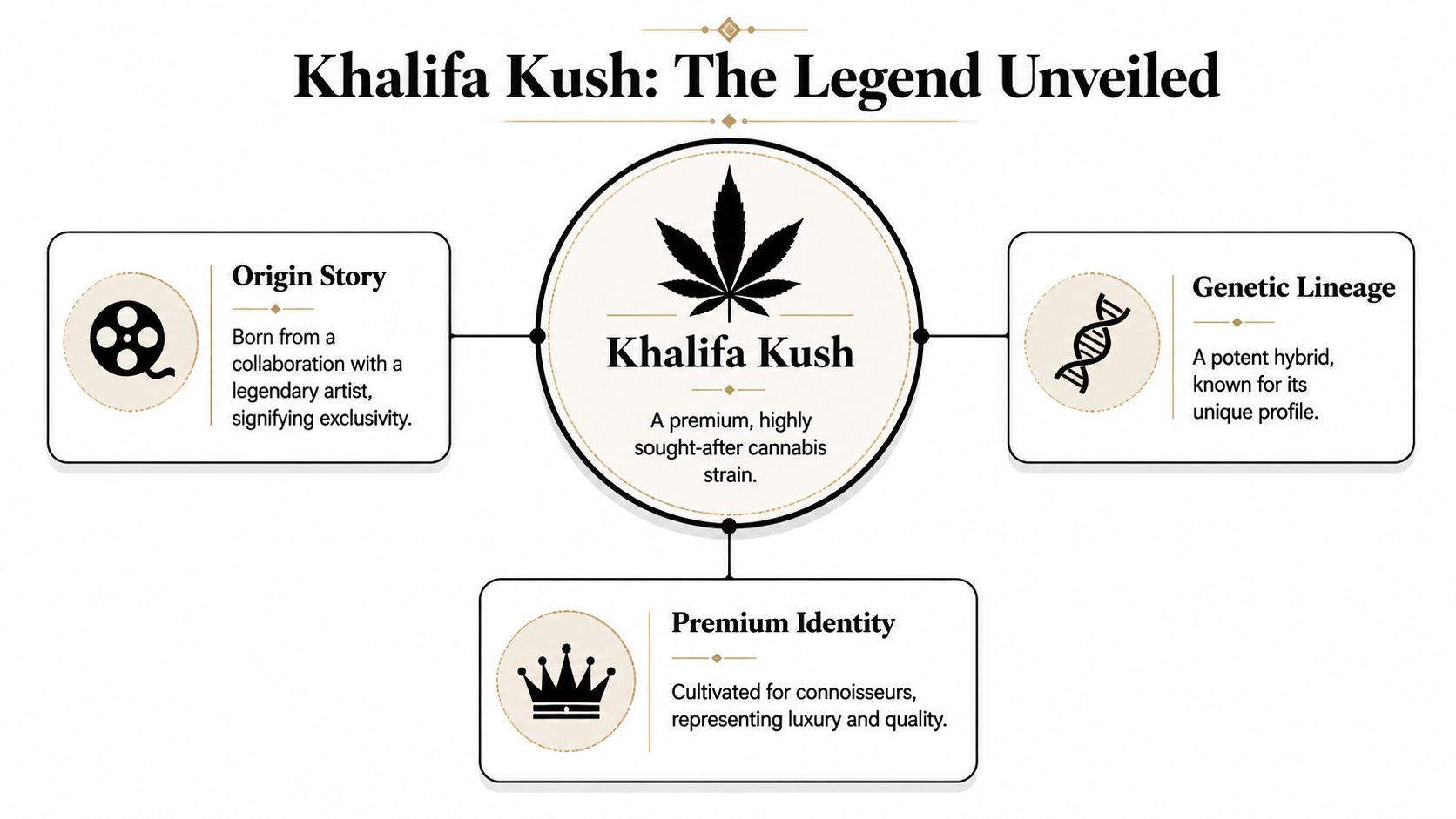
Khalifa Kush didn’t become well known by accident. Its identity has always been tied to exclusivity, OG Kush lineage, and a very public celebrity connection. That backstory helped shape the cultivar’s premium image from the start.
According to the Khalifa Kush brand story, the cultivar was developed specifically for Wiz Khalifa in the early 2010s and kept in his private stash before commercialization. That route from private cut to public release took roughly 3 to 4 years, depending on the source and market context. That timeline is part of why Khalifa Kush feels less like a trend and more like a branded legacy cultivar.
The core profile
Public strain references tend to line up on the basics. Khalifa Kush is commonly described as an indica-dominant hybrid, often listed around 80% indica and 20% sativa, and typically framed as an OG Kush descendant. That profile became part of its early market identity and helped separate it from more generic modern hybrids.
The potency side is also pretty consistent. Seed and strain listings place it firmly in the high-potency category, with THC commonly reported in the mid to high twenties. One technical listing notes 24 to 27 percent THC or up to 30 percent THC, while CBD is generally minimal to negligible in public descriptions, as noted by a seed bank in its Khalifa Kush seed profile.
What growers and smokers usually notice first
This isn’t a subtle cultivar. Khalifa Kush is usually associated with a bold Kush-style sensory profile. Most growers looking for it aren’t chasing mild flower. They want that unmistakable OG family character, usually described in the citrus, pine, gas, and earthy lane.
A big part of that comes from the terpene side. Public cultivation references describe the profile as limonene, caryophyllene, pinene, and myrcene forward, with total terpene content commonly cited around 1.5% to 3.5% dry weight, according to this Khalifa Kush strain guide from JointCommerce.
The easiest way to understand Khalifa Kush is this: it’s a cultivar people choose for identity as much as output.
Why it still matters
Some cultivars stay relevant because they produce huge yields. Others stay relevant because they offer a profile growers remember. Khalifa Kush belongs in that second group first, with solid practical value layered on top.
For a home grower, that’s a strong combo. You’re not just running a famous name. You’re running a cultivar with a documented backstory, a stable public identity, and a sensory profile that has stayed desirable for years.
Choosing Your Khalifa Kush Seeds Feminized vs Autoflower
This is the decision that shapes your whole grow. Not the nutrients. Not the training style. The seed type.
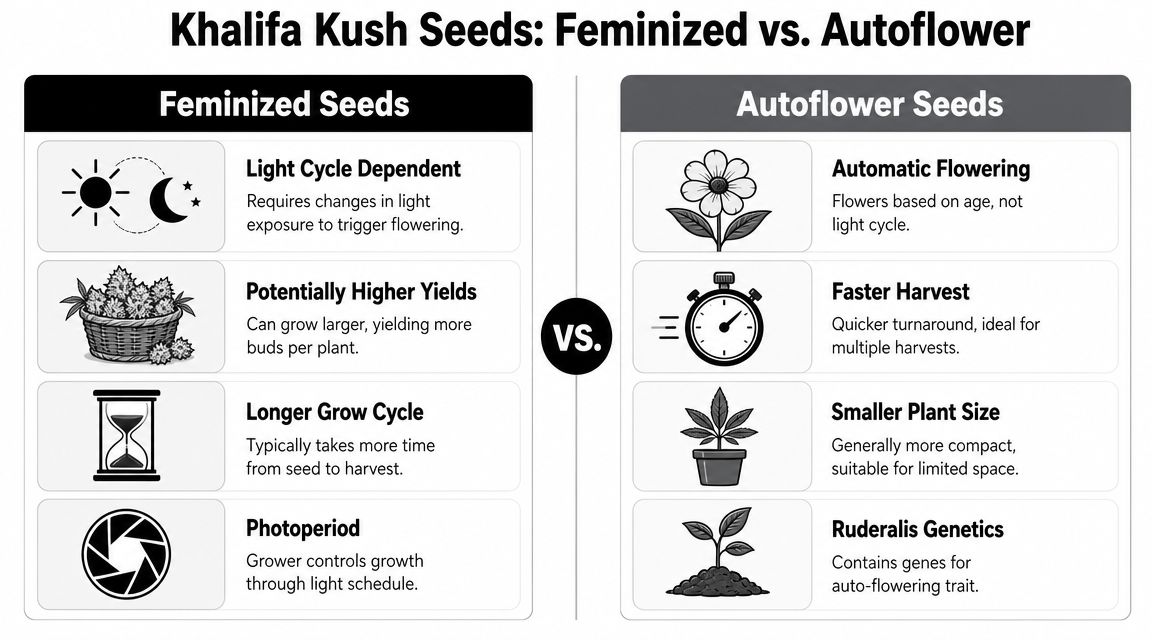
If you’re choosing between feminized and autoflower Khalifa Kush seeds, the right answer depends on how you grow at home. Some people want more control and don’t mind a longer run. Others want speed, simplicity, and a plant that fits a tighter space.
Feminized seeds
Feminized photoperiod seeds make sense for growers who want more control over plant size and timing. You control how long the plant stays in veg, which gives you room to shape the canopy, recover from small mistakes, and fill your space properly before flowering starts.
That usually makes feminized seeds a better fit if you have:
- A dedicated tent: More room to let the plant develop before flower
- Time to train: Topping, low-stress training, and canopy cleanup all fit better with photoperiod plants
- A quality light setup: Strong lighting helps you take advantage of the longer growth window
If you’re still sorting out the difference between the two seed styles, this guide on autoflower vs photoperiod seeds gives a clean side-by-side overview.
Autoflower seeds
Autoflower Khalifa Kush seeds are better for growers who want a faster, lower-maintenance run. They’re especially useful in small tents, closets, balconies, or any setup where keeping things compact matters.
Autoflowers are often the easier call when your priorities look like this:
| Grower priority | Better fit |
|---|---|
| Tight space | Autoflower |
| More schedule control | Feminized |
| Faster turnaround | Autoflower |
| Bigger plant shaping options | Feminized |
Autoflowers can be a strong choice if you want less fuss around light scheduling. They're also convenient for growers who want a simpler path from seed to harvest without managing a separate vegetative period.
Quick gut check: If you want control, choose feminized. If you want convenience, choose autoflower.
Which one fits your home grow
Pick feminized Khalifa Kush seeds if you enjoy the process and want to guide the plant more closely. Pick autoflower Khalifa Kush seeds if you want a cleaner, quicker run with fewer moving parts.
Neither option is automatically better. They just solve different problems. The best seed choice is the one that matches your space, your routine, and how hands-on you want to be once the plant gets moving.
Getting Your Khalifa Kush Seeds Started
Starting seeds feels more technical than it really is. Most problems happen because growers fuss with them too much. Keep it clean, gentle, and simple.
A basic paper towel method works well for hobby growers because it lets you check progress without guessing. You don't need special gear. You just need moisture, warmth, and patience.
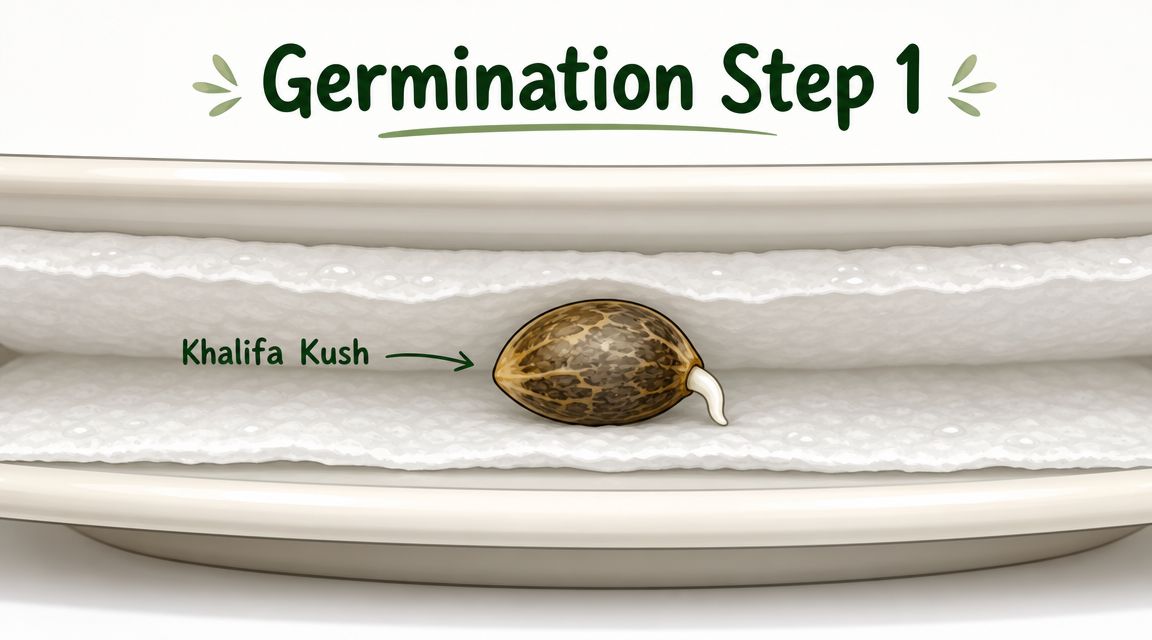
A simple germination method
- Moisten two paper towels: They should be damp, not dripping.
- Place the seed between them: Set the towels on a plate or inside a clean container.
- Keep the setup warm and dark: A cupboard or shelf works fine.
- Check once a day: You're waiting for the taproot to emerge.
- Move it gently into your medium: Once the taproot shows, place the seed root-down into lightly moistened soil or starter mix.
That's it. The biggest mistake is handling the sprout too much or leaving the towels soaked.
What to do after the taproot appears
Once the seed is in its first container, don't drown it. Seedlings need a light touch. Keep the medium slightly moist, give them gentle light, and avoid feeding too early.
A few easy rules help:
- Use a small starter pot: It's easier to control moisture.
- Don't bury it too deep: A shallow planting depth is enough.
- Go easy on watering: Wet soil slows roots down just as often as dry soil does.
- Keep the environment steady: Young seedlings like consistency more than intensity.
If you want a more detailed walkthrough for the first indoor setup, this guide on how to plant weed seeds indoors is a helpful companion.
Leave the seedling alone enough to grow. New growers often lose momentum by trying to “help” every few hours.
A Basic Grow Guide for Khalifa Kush
Khalifa Kush rewards a steady hand. You don't need a complicated feed chart or a room full of gadgets to grow it well. You need decent light, sensible watering, and enough patience to let the plant develop without forcing it.
For growers who like numbers, there are a few useful ones. Public strain listings commonly place Khalifa Kush in the 24% to 28% THC range, with a 55 to 65 day flowering time and indoor yields around 500 g/m², according to AllBud's Khalifa Kush strain listing. Treat those as reference points, not promises.
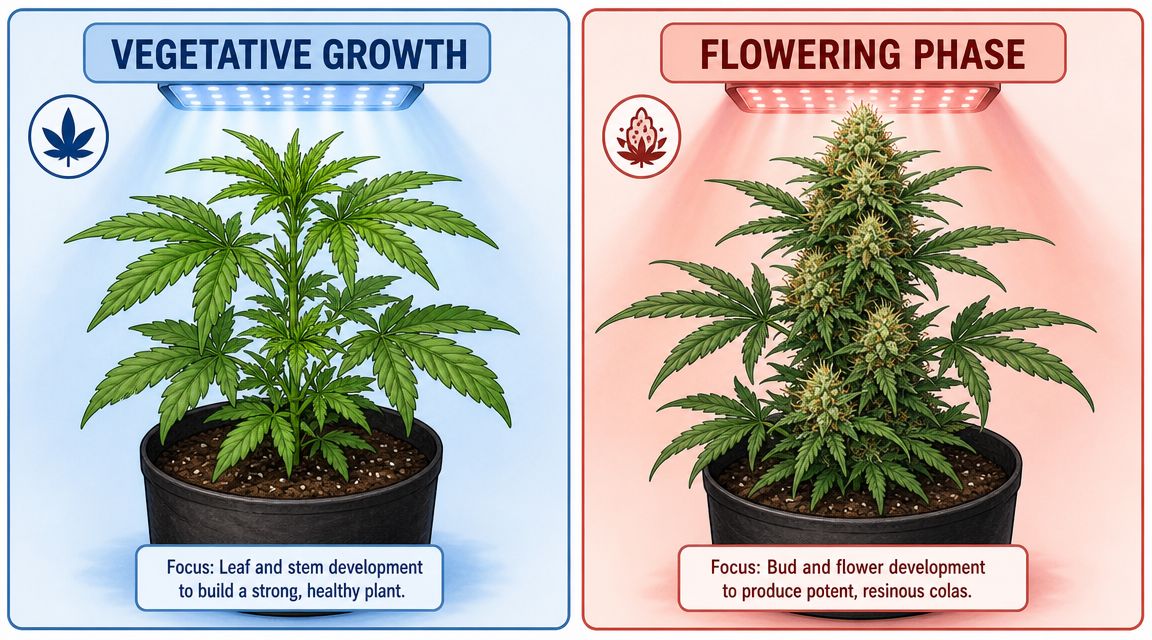
Vegetative growth
In veg, your main job is building a healthy frame. For feminized photoperiod plants, many home growers use an 18/6 light cycle because it gives the plant plenty of time to grow while still providing a dark period. The plant should look balanced, upright, and steadily expanding, not racing upward or drooping all day.
Pay attention to the basics:
- Light placement: Keep the plant close enough to get strong light without bleaching the top growth.
- Water rhythm: Let the medium dry back a bit before watering again.
- Airflow: A small fan helps the plant build stronger stems and keeps the space from getting stale.
- Training: Gentle low-stress training can help open the canopy and keep growth even.
If you're growing an autoflower version, the same basic principles still apply, but be more careful with stress. Autos usually respond best when you keep interruptions to a minimum.
Flowering habits
When a feminized plant is ready to flower, most growers switch to 12/12. That's when the plant starts shifting energy away from structure and into bud formation. During this stage, consistency matters more than experimentation.
Watch for a few things:
| Growth stage | What to focus on |
|---|---|
| Early flower | Stretch control, even canopy, stable watering |
| Mid flower | Clean environment, steady feeding, good airflow |
| Late flower | Aroma retention, humidity control, careful observation |
The terpene-heavy reputation of this cultivar makes late flower especially important. Dense, resin-rich buds can be rewarding, but they also demand a stable environment.
Keep it boring: Great flower usually comes from a grow that stayed consistent, not from one with constant adjustments.
Feeding and environment
Khalifa Kush generally does best when you avoid extremes. Overfeeding is a common self-inflicted problem. Start light, watch the leaf color and tip burn, and increase only when the plant shows it can handle more.
A few plain rules go a long way:
- Start nutrients gently: It's easier to add than to undo.
- Don't water on a fixed calendar: Water when the plant and medium need it.
- Protect late flower quality: Stable humidity and steady lighting help preserve aroma and finish.
- Harvest with patience: Rushing the last stretch usually costs more than it saves.
For a hobby grower, that's the whole roadmap. Healthy veg, clean flower, and restraint when you're tempted to overmanage the plant.
Common Issues and What to Do About Them
Most grow problems aren't disasters. They're signals. The plant is telling you something changed, and your job is to respond early instead of panicking late.
Khalifa Kush is the kind of cultivar where small environmental issues can show up clearly, especially if you're pushing for dense flowers and strong resin development. That's not a reason to avoid it. It just means sloppy habits tend to show faster.
A few common trouble spots
If your plant starts stretching hard in veg, your light is probably too weak or too far away. Fix the light intensity or distance before the structure gets awkward. Training can help, but light quality comes first.
If the leaf tips burn or the foliage gets too dark and glossy, back off the feed. A lot of growers confuse “premium cultivar” with “heavy feeder.” Those aren't the same thing.
If the plant looks droopy all the time, check your watering rhythm before blaming nutrients. Overwatering slows root activity and makes healthy plants look tired.
Efficiency matters in a home setup
There's another angle growers often skip. Crop efficiency matters, not just raw harvest weight. Public cultivation commentary around Khalifa Kush notes that growers increasingly think in terms of grams per kilowatt-hour, not only grams per square meter, and that light response and training suitability matter when trying to get more from a modern indoor grow, as discussed in this seed bank’s cultivation note.
That matters for a hobbyist too. If you're paying for power, you want a plant that uses your space and light well.
A smart home grower doesn't just ask, “How much did I harvest?” They ask, “Did this cultivar make sense for my tent, my light, and my time?”
The practical fix mindset
Use a basic troubleshooting approach:
- One change at a time: Don't change feed, light height, watering, and airflow all in one day.
- Watch new growth: Old damage won't heal, but healthy new leaves tell you the fix is working.
- Train with purpose: Open the canopy only if it improves light distribution or airflow.
- Stay calm: Most home-grow problems are manageable if you catch them early
That mindset saves more grows than any miracle product ever will.
Ordering Khalifa Kush Seeds with Confidence
Before ordering any cannabis seeds, check your local rules. Home cultivation laws vary a lot by location, and it's on you to know what's allowed where you live. That quick check is part of growing smart.
Once legality is sorted, the next question is quality. This matters more with Khalifa Kush than many first-time buyers expect. Seed-grown plants can vary, and that variation can be a real issue if you're hoping for a specific look, aroma, or overall vibe from the cultivar.
Why seed source matters
Public guidance on Khalifa Kush seed selection points to a real concern: seed-grown plants can show substantial phenotypic variation, so growers who want a more consistent outcome should choose seed stock from a source that prioritizes genetic stability, as noted by a seed bank’s Khalifa Kush page.
That doesn't mean seed-grown plants are a bad choice. It means you should buy with realistic expectations. A trusted source gives you a better shot at consistency. A random listing with thin product information usually doesn't.
What to look for before you order
Use a short checklist before buying Khalifa Kush seeds:
- Clear cultivar information: The listing should tell you what kind of plant you're buying, not just hype it up.
- Seed type that matches your setup: Feminized for control, autoflower for convenience.
- Real grow details: Flowering window, structure notes, and expected growing style should be easy to find.
- Modern shopping experience: Clean site navigation and straightforward support make the whole process less annoying.
If you want a broader look at how reliable seed sellers present genetics and shopping info, the premium seed market guide is worth a read.
Confidence comes from good decisions, not hype
A satisfying home grow starts before germination. It starts when you choose a cultivar that fits your space, then buy from a source that treats genetics seriously.
That's how you avoid wasting time on the wrong plant. It's also how you get more of the good stuff that makes home growing worth it in the first place: fewer dispensary runs, fewer retail markups, and the satisfaction of filling your own jars with flower you raised yourself.
If you're ready to compare Khalifa Kush Seeds with other top cultivars for your tent, timeline, and skill level, take a look at Botanist Seeds. The catalog is built to make seed selection simple, with clear information, dependable genetics, and a shopping experience that feels easy instead of overwhelming.