Dante’s Inferno Strain: Grow & Effects Guide 2026
You're probably here because Dante's Inferno keeps showing up in menus, seed chats, and grow forums, and the descriptions are all over the place. One grower says it's dense, frosty, and dessert-heavy. Another says their plant leaned louder, gassier, and a little less uniform than the photos. That mismatch is exactly why this cultivar is worth talking about like a grower, not like a menu writer.
Dante's Inferno has the kind of reputation that makes people want to pop a pack fast. It also has the kind of modern hybrid background that rewards patience, note-taking, and smart selection. If you're growing from seed, the true challenge isn't just getting to harvest. It's figuring out which expression is worth keeping.
Meet the Dante's Inferno Cultivar
If your goal is a modern home run cultivar with strong bag appeal, loud flavor, and a heavyweight evening vibe, Dante's Inferno belongs on the short list. It's generally described as an indica-dominant hybrid made from Oreoz × Devil Driver, and several listings place it around 70% indica / 30% sativa with THC commonly reported around 25% to 30% according to AllBud's Dante's Inferno listing.
That profile tells you a lot before you even germinate a seed. This cultivar is not typically chosen when seeking something light, casual, or forgiving on the consumption side. It's usually treated as a high-impact flower, the kind people save for later in the day when they are ready to settle in and enjoy it.
Why growers keep chasing it
A lot of new-school cultivars get attention because they photograph well. Dante's Inferno gets attention because growers and buyers both tend to care about the same things here:
- Potency matters: The reported THC range puts it firmly in the strong category.
- Flavor matters: It's often grouped with dessert-forward modern hybrids, which has obvious appeal for home growers who want flower that feels special.
- Bag appeal matters: Dense, resin-heavy flower tends to hold attention fast, both in jars and in trim bins.
Practical rule: If you want easy predictability above all else, this may not be your first pick from seed. If you enjoy hunting for standout expressions, it starts to make a lot more sense.
There's also a simple home-grow reason people keep circling back to it. Growing your own lets you skip dispensary lines, avoid retail markup and taxes, and build a stash that matches your taste instead of whatever happened to be in stock that week. A cultivar like Dante's Inferno makes that trade feel worthwhile because the upside can be excellent when the plant expresses well.
The Story Behind This Modern Hybrid
Dante's Inferno didn't come out of old-school heirloom stock. It's part of the newer breeder-driven wave where the target is obvious: loud terps, visual appeal, strong resin production, and enough uniqueness to stand out in a crowded field.
It's widely reported as an Oreoz × Devil Driver cross from Clearwater Genetics and Tiki Madman, and published listings don't fully agree on the exact split. Some present it as closer to balanced, while others lean it much more indica, which is noted in Vivosun's Dante's Inferno grow guide.
Why the parentage matters
When you're growing a cultivar from seed, the lineage gives you clues about what to watch for. With Dante's Inferno, the useful takeaway isn't some neat label. It's that this cross comes from modern parent stock known for bold expression.
That usually means a few practical things in the garden:
- Expect standout traits, not perfect uniformity: Modern hybrids can produce some excellent plants, but they don't always line up like clones.
- Watch structure early: Some seedlings stay compact and stack tightly. Others show a little more reach and need earlier shaping.
- Aroma shifts can be meaningful: If one plant is clearly sweeter or funkier than the others by early flower, pay attention. That often ends up mattering later.
What works with modern breeder cultivars
Growers get frustrated with this type of cultivar when they treat every seedling like it should finish the same. That's usually the wrong move.
A better approach is to treat the first run as a sorting round:
- Label every plant from day one.
- Take notes on vigor, branch spacing, and smell during stem rubs.
- Photograph each plant at the same points in veg and flower.
- Keep your environment steady so you're judging genetics, not stress responses.
Breeder-driven cultivars often reward selection more than brute-force feeding. The grower who observes well usually beats the grower who just pushes harder.
That's the story behind Dante's Inferno. It isn't just popular because of the name. It's popular because it fits what a lot of today's growers and smokers want from a modern cultivar, while still leaving enough variation to make a phenotype hunt interesting.
Aroma Flavor and Overall Vibe
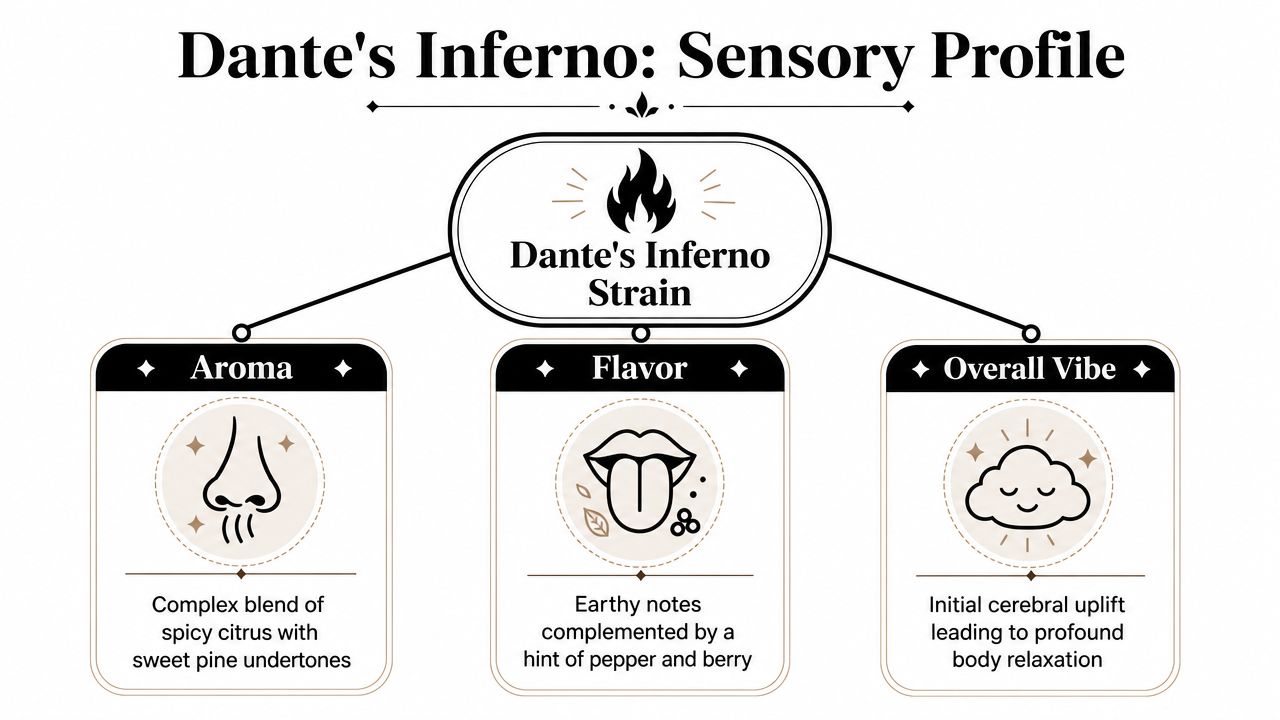
The appeal of the Dante's Inferno strain starts with the fact that it doesn't come across like plain generic flower. People usually gravitate to it because it lands in that dessert-forward lane, but not in a flat one-note way. There's usually some sweetness in the profile, then something darker, funkier, or spicier underneath that keeps it from feeling soft.
What the chemistry suggests
Independent strain reviews repeatedly describe Dante's Inferno as a high-THC cultivar, commonly testing around 25% to 30% THC with low CBD, which is why it's usually framed as better suited to experienced consumers in Try Cannavine's strain profile.
That matters because high-THC flower with low CBD doesn't have much built-in softening. In plain terms, the vibe tends to feel more direct and more forceful. If you like flower that announces itself quickly, that's part of the draw. If you prefer something gentler and more forgiving, this one can feel like a lot.
How that translates in real use
Most growers and buyers who chase this cultivar are looking for some version of the following:
- A sweet front end: Often the first thing people notice.
- A richer finish: Earth, spice, gas, or a darker dessert note can show up behind the sweetness.
- A heavier session: More unwind than social spark for many people.
That last point is important. The label alone doesn't tell you exactly how a given plant will hit, especially from seed, but the broad pattern is pretty clear. Dante's Inferno is usually discussed as a strong cultivar with a more evening-friendly feel than an all-day smoke.
Why terpene handling matters
A lot of growers blame genetics when the flower smells flat. Sometimes it really is the cut. Other times the problem is dry room handling, rough trimming, or curing too fast.
If you want the aromatic side of this cultivar to show up properly, focus on protecting resin and slowing the finish enough to preserve the details. If you want a better handle on how compounds shape aroma and flavor, Botanist Seeds has a useful primer on cannabis terpenes.
The flower that smells loud on the plant but dull in the jar usually wasn't ruined in genetics. It was usually rushed after chop.
Growing Dante's Inferno at Home
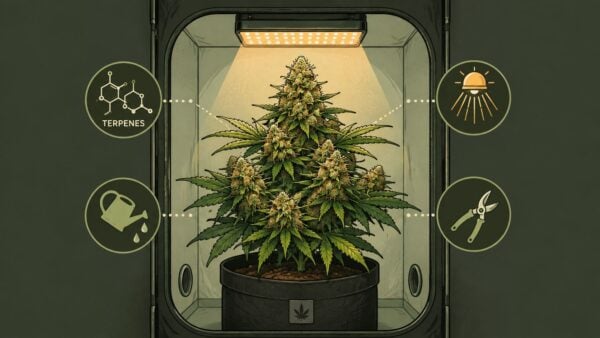
Dante's Inferno isn't the cultivar I'd hand to someone who wants a zero-thought grow. It's manageable, but it rewards attention. If you're willing to stay on top of canopy shape, airflow, and dry-back timing, it can be a very satisfying plant to run at home.
What to expect in the tent
This cultivar is best approached like a resin-first modern hybrid. That means you don't grow it just to fill space. You grow it to produce flower with strong finish quality.
A few habits help right away:
- Keep the canopy even: Uneven tops make it harder to judge each plant fairly and harder to manage light intensity.
- Prioritize airflow: Dense modern flower can hold moisture where you don't want it.
- Feed with restraint: Overfeeding often makes these plants look glossy and busy, but not necessarily better.
In soil, many hobby growers like the buffering and forgiveness, especially if they're sorting multiple expressions from seed. In hydro, the growth can move faster, but mistakes also show up faster. Neither route is automatically better. The better choice is the one you can run consistently.
Training that usually helps
Dante's Inferno tends to benefit from basic structure work instead of aggressive punishment. You want a plant that opens up and exposes sites, not one that spends a week recovering because you got heavy-handed.
Good options include:
- Topping once the plant is established: Helps create more usable tops.
- Low stress training: Opens the center and improves light distribution.
- Light defoliation: Useful when large fans block key sites or airflow stalls.
What usually doesn't help is stacking too many interventions at once. If you top, strip, bend, and transplant in a tight window, you learn less about the cultivar and more about how much stress it can absorb.
Keep the environment boring
That sounds less exciting than talking nutrients, but it's the truth. Modern hybrids with good resin potential often show their best side when the room stays stable and unremarkable.
Watch for:
| Focus area | What you want |
|---|---|
| Canopy spacing | Enough room for light and airflow to reach interior sites |
| Irrigation rhythm | Consistent wet to dry cycles, not constant saturation |
| Late flower handling | Cleaner air movement and less leaf crowding |
| Drying approach | Slow enough to preserve aroma instead of blowing it off |
A visual walkthrough can help if you like seeing setup choices in context.
The payoff with this cultivar usually comes from stacking small correct decisions. Nothing fancy. Keep the plant healthy, shape it early, don't overfeed it, and protect the finish.
Your Harvest Timeline and Key Milestones
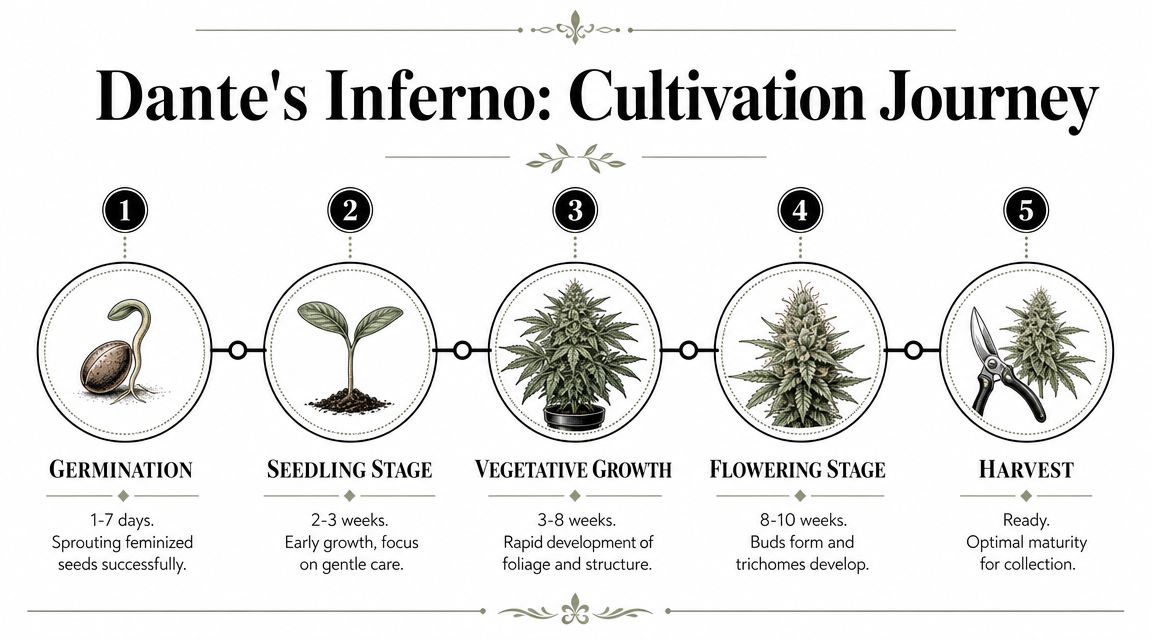
The calendar matters less than plant signals, but a rough timeline still helps you stay organized. With Dante's Inferno, the bigger point isn't racing to harvest. It's timing the finish so the resin, aroma, and overall character are worth the wait.
Early stages matter more than people think
A strong start solves a lot of later problems. Germinate your feminized seeds in a method you can control well, then avoid the common mistake of doing too much once they crack. Seedlings don't need intensity. They need steadiness.
During early growth, keep an eye on:
- Posture: Upright, relaxed growth beats forced speed.
- Leaf response: Healthy leaves tell you the root zone is behaving.
- Uniformity: Even at this stage, one plant may already show more vigor.
When you move into veg, use that period to build the shape you want. A plant that enters flower with good branch spacing is easier to light, easier to inspect, and easier to compare against the rest of the run.
Flowering is where selection begins
By the time buds start setting, your notebook should already be doing some work. This is when differences between plants become worth tracking closely.
One commercial profile reports measurable terpene data of β-caryophyllene at 4.21 mg, β-myrcene at 2.06 mg, and limonene at 1.80 mg, noted in Glacier Cannabis' Dante's Inferno profile. For a grower, that matters less as bragging rights and more as a reminder that this cultivar has a terpene-forward reputation, so your flowering and curing choices directly affect what makes it special.
Harvest note: Don't judge readiness by swollen buds alone. Resin maturity tells the truth more reliably than flower size.
A practical flower checklist looks like this:
- Mid flower: Check structure, stacking, and whether each plant is staying clean through the center.
- Late flower: Smell each plant separately, not the room as a whole.
- Final window: Inspect resin heads closely and compare that with the aroma and overall fade.
If you want a refresher on what resin maturity looks like, this guide to trichomes on weed is worth bookmarking.
Dry and cure decide the final grade
A lot of growers do a solid flower run and then lose quality after chop. Dante's Inferno is not the cultivar to rush through that stage. If the goal is loud jars and preserved character, the final handling has to stay clean and patient.
Use a simple post-harvest mindset:
- Trim gently: Resin loss is real.
- Dry evenly: Fast drying usually costs you depth.
- Cure with attention: Open, check, and adjust instead of sealing and hoping.
Here, the flower either becomes memorable or just looks good in photos.
Understanding Phenotypes and Selecting a Keeper
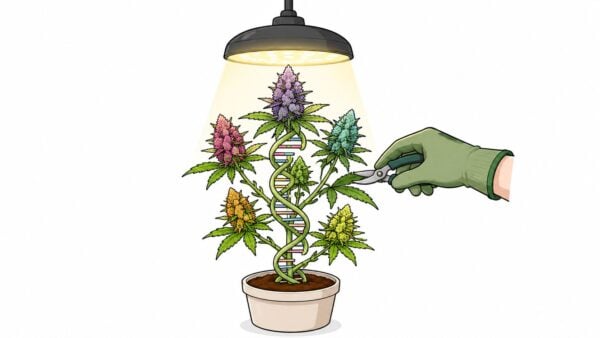
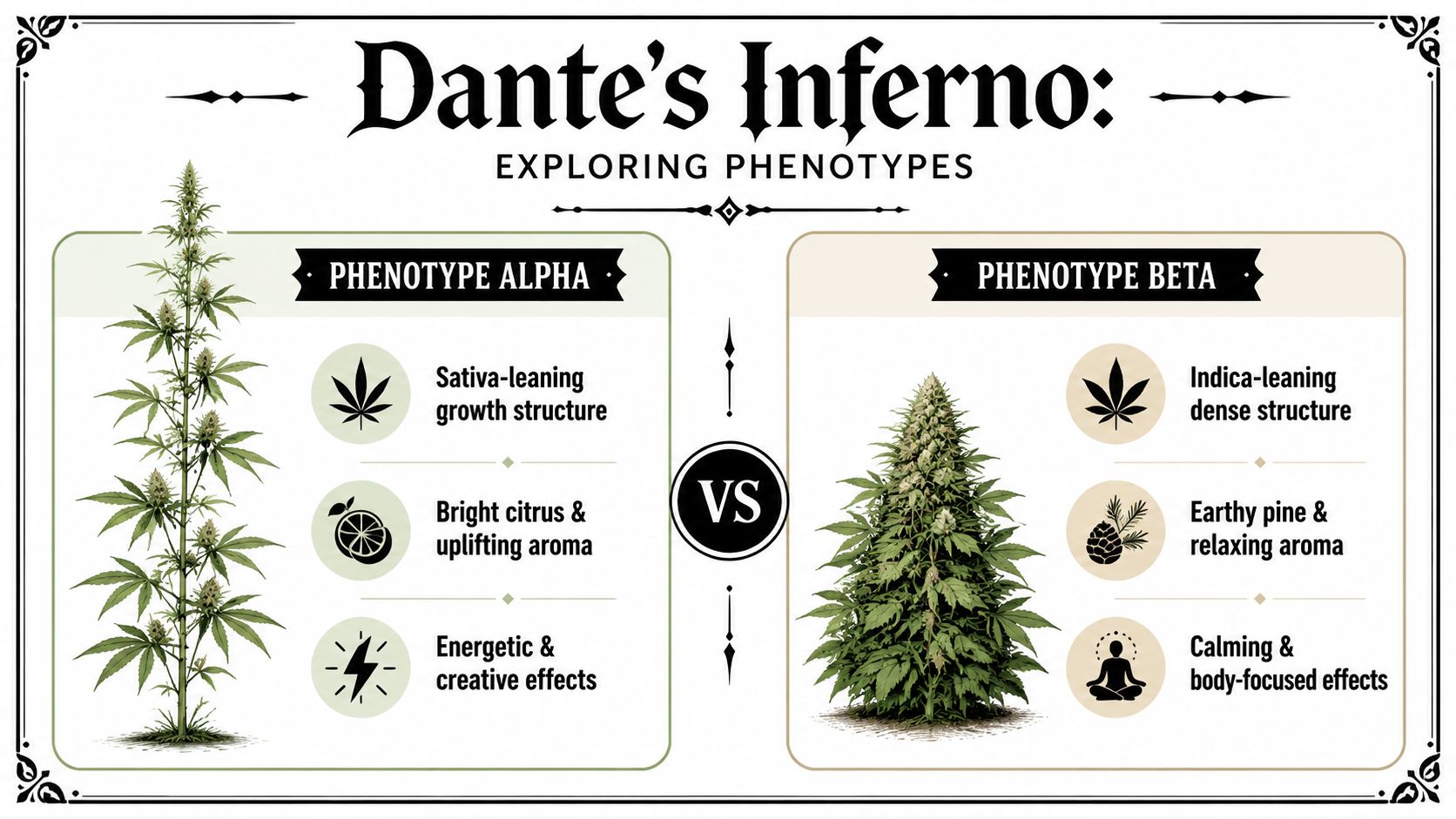
This is the part most strain pages skip, and it's the part home growers usually care about most. If you grow Dante's Inferno from seed, you shouldn't expect every plant to mirror the same promo shot. The name might be the same. The expression often won't be.
An independent listing raises a real question about whether Dante's Inferno is a stable seed line or more of a limited drop with strong clone-only selection pressure, and it notes that the original seed stock sold out while only clones remained available in one listing, as seen on SeedFinder's Clearwater Genetics entry. That's useful context because it suggests some of the hype may be tied to standout cuts, not perfectly standardized seed packs.
What variation usually looks like
In a seed run, variation tends to show up in a few places first:
| Trait | What to watch for |
|---|---|
| Structure | Compact and stacky vs slightly taller and looser |
| Aroma | Sweeter dessert side vs darker funk or gas |
| Resin behavior | Early frost vs late heavy coating |
| Finish pace | Plants that look done together may not actually mature together |
That's normal. It doesn't mean the pack is bad. It means you're dealing with a modern hybrid where selection matters.
How to pick a keeper without fooling yourself
The easiest mistake is picking the frostiest plant too early. Resin matters, but it isn't the whole scorecard. A real keeper should check multiple boxes.
Look for a plant that gives you most of this list:
- Strong structure: Branches hold themselves well and the canopy is easy to manage.
- Consistent vigor: The plant moves with purpose without acting wild or fragile.
- Aroma you want again: Not just loud, but desirable.
- Resin with substance: Good coverage plus good finish quality.
- A harvest window that fits your room: Some excellent plants are inconvenient.
A keeper isn't just the prettiest plant in one run. It's the one you'd be happy to grow again because it earns its space.
If you're new to the idea, this breakdown of a cannabis phenotype is a good companion read.
The simplest selection system
Keep it boring and objective:
- Tag every plant clearly.
- Take stem rub notes in veg.
- Photograph each plant weekly in flower.
- Jar and evaluate separately after cure.
- Choose after the smoke, not before.
That last point saves a lot of regret. Plenty of plants win the beauty contest and lose in the jar.
Finding the Right Seeds for Your Garden
If Dante's Inferno sounds like your kind of cultivar, buy with the right mindset. Don't shop for it like a mass-market uniform line. Shop for it like a modern hybrid that may reward a little selection work.
What to prioritize when buying
Start with feminized seeds if your goal is a cleaner path to harvest. That keeps your space focused on productive plants and makes a home run simpler to manage, especially if your tent or room is small.
Then pay attention to the source:
- Breeder transparency: Clear lineage matters.
- Seed seller reputation: Good handling and accurate listings matter more than hype copy.
- Your own setup: If you don't have room to compare plants, buy accordingly and keep expectations realistic.
For growers who like comparing options side by side, Botanist Seeds offers a comparison-focused shopping experience that can help narrow down cultivars based on your setup and priorities.
The big appeal here is easy to understand. Dante's Inferno has the modern traits people want, strong flavor potential, serious resin appeal, and enough variation to make a seed run interesting. The trade-off is that you may need to sort through a few expressions before you find the one that makes you want to keep cuts and run it again.
That's not a flaw. For a lot of home growers, that's the fun part.
If you want to compare genetics more carefully before you buy, Botanist Seeds makes that process easier with a catalog built around clearer strain selection. It's a practical place to sort cultivars by fit, narrow your options, and choose seeds that make sense for your space, your experience level, and the kind of harvest you want.