



Legalization of Cannabis News: 2026 Home Grower Guide
If you feel like you need a law degree just to keep up with cannabis news, you’re not alone. The legal landscape is shifting so quickly that it can be tough to track. But here's the good news: the overall trend is clear, and it’s overwhelmingly positive for anyone who wants to legally grow their own cannabis from seed.
The 2026 Cannabis Legalization Map
Trying to get a clear picture of U.S. cannabis laws can make your head spin. What’s legal in one state might be a felony just a few miles away. But for home growers, this patchwork of regulations is creating incredible new opportunities as more states come online.
This isn’t some niche topic anymore. The conversation around legalization has hit the mainstream, and the momentum is undeniable. What felt like a risky, complicated idea just a decade ago is now a simple reality for millions of Americans who want the freedom to grow a few plants for themselves.
Adult-Use vs. Medical-Only States
The most critical distinction you need to understand is the difference between "adult-use" and "medical-only" states. Think of it like this: adult-use is like walking into a brewery and buying a six-pack, while medical-only is like needing a specific registration to access cannabis.
- Adult-Use States: In these states, any adult (usually 21+) can buy and have cannabis, similar to how alcohol is regulated. This is where you’ll most often find the green light for home cultivation.
- Medical-Only States: Here, you must be a registered patient. Home growing rules can be all over the map: some states permit it for patients, but many don't.
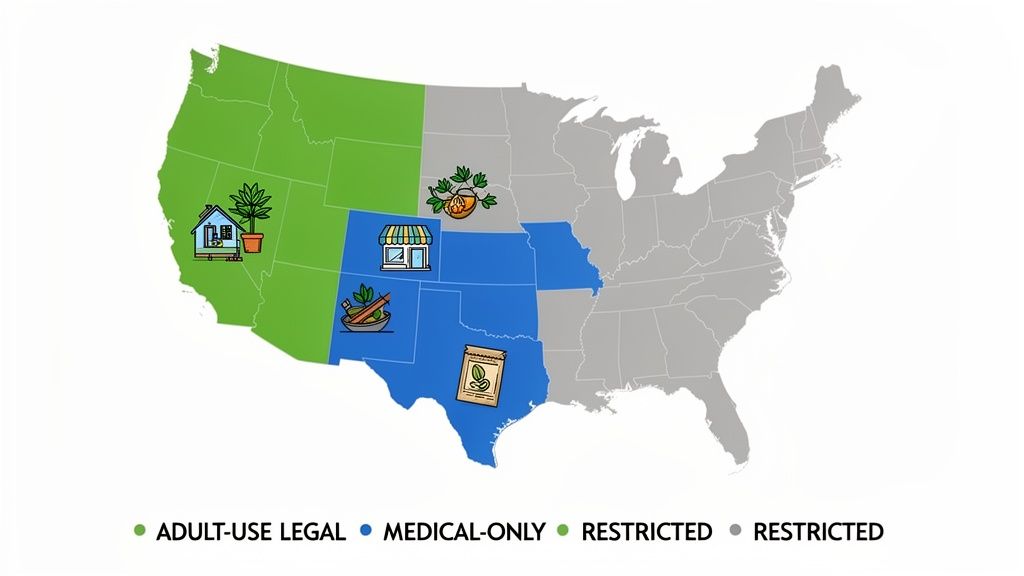
This infographic breaks down the current situation, showing where states stand on medical and recreational cultivation.
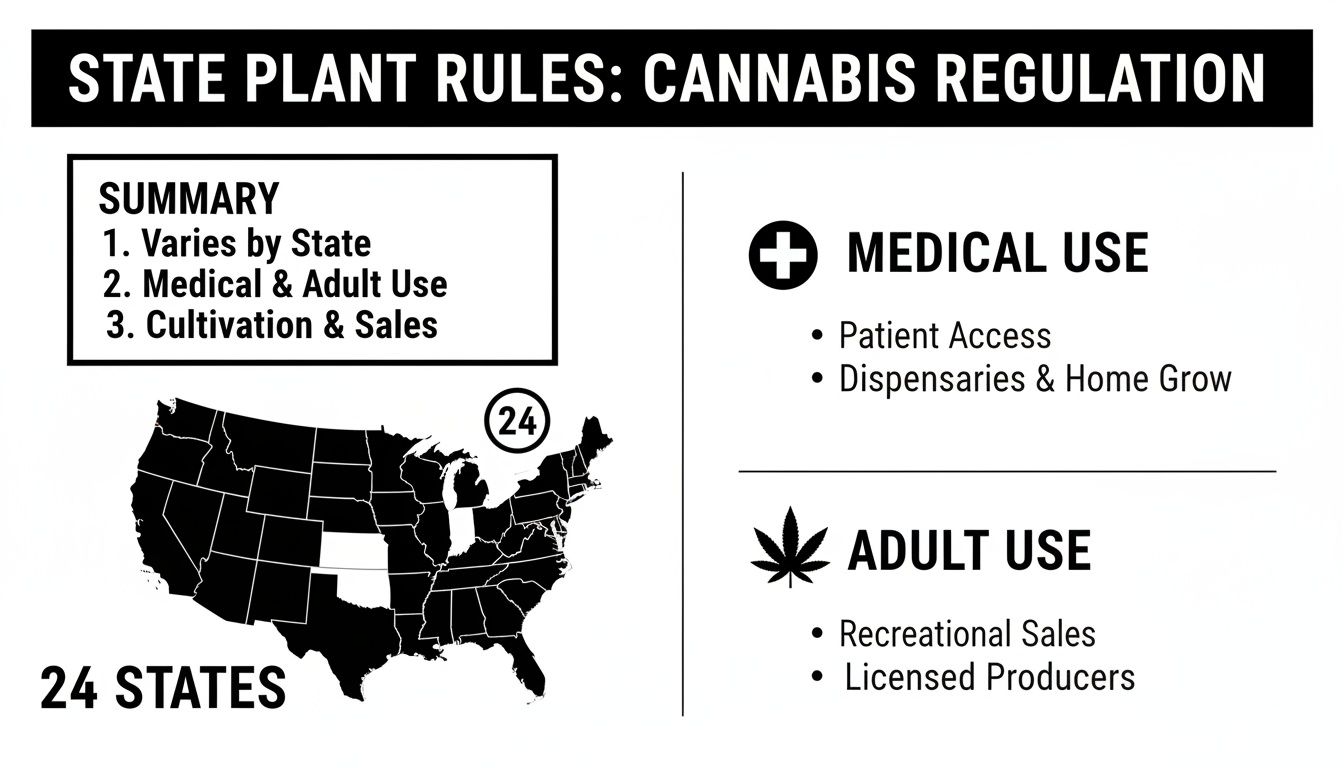
As you can see, the move toward full adult-use legalization is sweeping the nation. This is creating a country where your ability to grow is defined entirely by your zip code.
To make this easier to understand, here's a quick breakdown of what these different legal statuses mean in practice.
U.S. Cannabis Legalization Status 2026 Snapshot
| Legal Status | What It Means For You | Home Grow Generally Allowed? | Online Seed Purchasing |
|---|---|---|---|
| Fully Legal (Adult-Use) | Adults 21+ can purchase and possess cannabis from licensed dispensaries. | Yes, with plant count limits. | Legal and straightforward. |
| Medical-Only | Only registered patients can access cannabis. | Sometimes, but often restricted to patients. | Varies by state. Check your state's rules before ordering. |
| Decriminalized Only | No jail time for small amounts, but it's still illegal. Fines are common. | No. | Risky, as cultivation remains illegal. |
| Fully Illegal | Possession and cultivation can lead to serious criminal charges. | No. | Highly risky. |
This table is just a snapshot, of course. The key is to always check the specific laws in your state, as the rules can change fast.
This article is general information, not legal advice. Laws change often, so confirm the current rules with your state or a licensed attorney before buying seeds or growing.
The National Trend Toward Legal Growing
The domino effect of legalization isn't just a feeling; it's backed by hard numbers. As of early 2026, 24 states and Washington D.C. have fully legalized cannabis for adults. The impact has been huge, creating thousands of jobs and diverting money away from illegal markets.
A perfect real-world example is Colorado. As the first state to open adult-use dispensaries, its market has since created tens of thousands of jobs and gutted illegal drug trafficking. Federal seizures at U.S. ports of entry plummeted from 2.4 million pounds in 2013 to just over 154,000 pounds in 2022.
This nationwide shift is fantastic news for hobby growers. It means less legal ambiguity and better access to world-class genetics. You can follow the latest developments and how they affect growers in our ongoing legalization of cannabis news coverage.
Ultimately, as more states legalize, buying feminized and autoflower seeds online becomes safer and more reliable. This growing acceptance empowers you to skip the dispensary lines and taxes, taking full control of your supply from seed to harvest. It’s all about the pride and satisfaction of cultivating your own premium flower.
How Legal Home Growing Became Possible
The fact that you can now casually browse for feminized seeds online is the result of a decades-long story. It’s a complete reversal from a time when cannabis was public enemy number one. To really appreciate today’s freedom to grow, it helps to look back at the key moments that paved the way.
It all began with a compassionate idea. In the 1990s, states like California took a pioneering step by creating the first medical cannabis programs. This was the first real crack in the armor of prohibition, proving that a regulated system could work without society falling apart.
These early medical laws opened up a national conversation that had been suppressed for years. People started seeing the plant differently, and the debate began shifting from "if" we should legalize to "how" we could do it responsibly. This slow, steady change in public perception was setting the stage for something much bigger.
The First Dominoes of Adult-Use Legalization
The real game-changer came in 2012 when Colorado and Washington made history. By becoming the first states to legalize cannabis for adult use, they launched a bold experiment that the entire world watched closely.
Their success proved that a taxed and regulated market wasn't just a hypothetical idea: it was a practical reality. All of a sudden, buying cannabis from a licensed shop was real, creating a blueprint that other states were eager to follow. This kicked off the "green wave" we're still seeing in legalization news today, as each new state adds pressure on the holdouts.
The economic ripple effect has been nothing short of staggering. Legalization unleashed one of the fastest-growing markets in modern history. To put it in perspective, the entire legal industry was valued at roughly $4 billion back in 2016. By 2022, that figure had skyrocketed to $30 billion. You can dig into the numbers behind this incredible boom with these drug abuse statistics.
This explosion in growth wasn't just about dispensaries selling flower. It carved out a legitimate space for the entire ecosystem, including the seed market. That's why you can now find a dizzying array of specific cultivars from trusted breeders online, something that would have been unthinkable just a decade ago.
Public Opinion Reaches a Tipping Point
As more states came online, the old stigmas surrounding cannabis began to crumble. The sky didn't fall. Instead, people saw that regulation worked, and public support for legalization shot to an all-time high, with a solid majority of Americans now favoring it.
This groundswell of public approval is the real engine driving the changes we see in cannabis news. It pushes politicians to act, encourages more states to reform their laws, and finally normalizes the simple act of growing a few plants at home. It’s created a powerful cycle:
- More Legal States: This expands the number of safe, regulated markets.
- Greater Public Acceptance: Normalization reduces fear and invites more people to see the benefits.
- Better Access for Growers: Higher demand fuels a thriving market for top-tier feminized and autoflower seeds.
This massive social shift is ultimately why a hobbyist can now confidently and legally cultivate their own supply. It’s about taking back control, saving money, and experiencing the satisfaction that comes from growing your own. The road from prohibition to personal freedom was a long one, but it has finally put the power back where it belongs: in your hands.
Navigating Your Local Home Grow Rules
So, your state finally legalized. The headlines have faded, the celebrations are over, and now you’re left with one exciting thought: "I can finally grow my own." But what does that actually mean for you, right now, in your own home?
Getting your first grow started is a lot less intimidating than it seems. Most states have a similar framework for home cultivation, but the devil is always in the details. Think of it this way: the state sets the main rules of the game, but your specific city or county can add its own house rules.
This is the single most important piece of advice you'll get: always check your local city and county ordinances. It’s not uncommon for a town to have stricter rules than the state: maybe a lower plant count or specific requirements for indoor-only growing. A quick search on your city's or county's official website is all it takes to find the answers you need.
The Big Three of Home Grow Compliance
When you boil it all down, nearly every set of regulations focuses on three core areas. Get these right, and you'll be well on your way to a legal, stress-free grow.
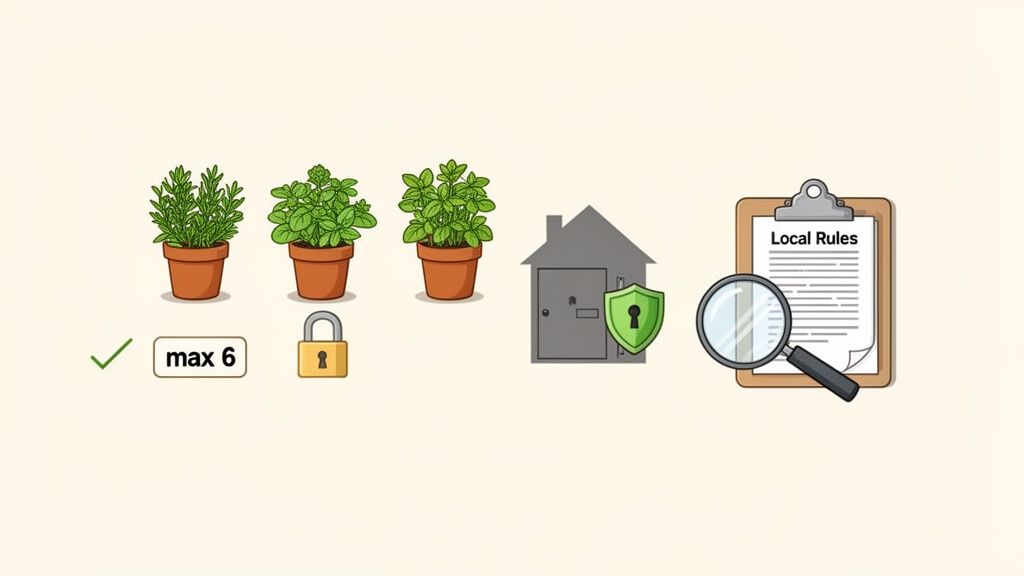
Plant Count: This is the headline number everyone looks for. States limit how many plants you can grow at once, typically on a per-person and per-household basis. For instance, a state might allow six plants per adult, but cap the entire home at 12 plants, regardless of how many adults live there.
Possession Limits: Just because you can grow it doesn't mean you can stockpile a dragon's hoard. The law distinguishes between what you can carry in public and what you can keep at home. The at-home limit is almost always much higher, recognizing that a single successful harvest can easily yield several ounces of dried flower.
Discretion and Security: This is just good common sense wrapped in legal language. Most adult-use states require plants to be grown in a secure area that isn't visible to the public, so check your state's exact wording. That means no front-porch grows or gardens in an unfenced yard where neighbors or kids can see them. A locked room, a grow tent in the garage, or a screened-in greenhouse are all perfect solutions.
These rules aren’t there to trip you up. They’re designed to ensure everyone can enjoy their new freedom responsibly and without bothering anyone else, which is exactly what most hobbyists want anyway.
Common Questions About Local Rules
As you start sketching out your grow space, a few questions inevitably pop up. Let's get them out of the way.
Can my landlord stop me from growing?
In most cases, yes. Even in a fully legal state, a landlord has the right to add a "no-grow" clause to a lease, just like they can prohibit pets or smoking. Always, always read your lease agreement carefully before you pop a single seed.
Do I have to worry about the smell?
You do. While many of us love the rich aroma of a flowering plant, your neighbors might not. If the smell is strong enough to be considered a "public nuisance," it can lead to official complaints. A high-quality carbon filter for your exhaust fan isn't just a good idea: it's an essential piece of equipment for being a good, discreet neighbor.
The spirit behind all these local rules is simple: be responsible and be private. If you stay within your plant limits, keep your garden out of sight, and manage the aroma, you’re playing by the book. It’s all about enjoying your hobby without creating a headache for anyone else.
Ultimately, following these guidelines is a tiny price to pay for the incredible reward of growing your own supply. For more on how buying seeds fits into the legal picture, you can read our guide on how Botanist Seeds operates legally. A little homework now will let you set up a home grow that is compliant, secure, and deeply satisfying.
Why Growing Your Own Is The Smart Move
Sure, having dispensaries on every corner is a huge step forward. But let's be honest: it also came with a few things no one loves, like the long lines, the sometimes-overwhelming product displays, and of course, the taxes. For any serious enthusiast, the real game-changer is taking matters into your own hands and growing at home.
This isn't just about sidestepping dispensary prices, even though the savings are a massive plus. It's about the satisfaction you get from mastering a skill. There’s a certain pride that comes from taking a tiny feminized seed, nurturing it, and guiding it all the way to a beautiful harvest. You stop being just a customer and become a true cultivator.
Total Control Over Your Supply
When you grab something off a dispensary shelf, you're placing your trust in their methods. But when you grow your own, you are the method. From day one, you decide exactly what goes into your plants: the soil, the nutrients, even the water.
That kind of control is something retail simply can't match. It gives you absolute transparency and the confidence that your final harvest is precisely what you intended it to be. If you're someone who really cares about quality and knows what you like, there's no better way to guarantee it.
Home cultivation puts you in the driver's seat. You’re no longer limited by a dispensary’s inventory or a budtender’s suggestions. Instead, you get to explore a whole world of cultivars to find the specific aromatic profiles and vibes that are perfect for you.
This freedom lets you fine-tune your harvest to your exact preferences. The whole experience shifts from a simple transaction to a personal and deeply rewarding journey. You become the expert on what works for you.
The Practical Perks of a Home Grow
Beyond the personal pride and control, growing your own brings some serious, real-world advantages that make it an easy choice for any hobbyist. These benefits go way beyond just keeping your jars full.
Here's a quick rundown of the benefits you'll notice almost immediately:
Significant Cost Savings: The financial win is impossible to ignore. State and local taxes can easily tack on 20-30% or more to your dispensary bill. When you grow, your only real expenses are the initial setup and a few cents per day for water and power. The long-term savings are huge.
Unmatched Convenience: Forget about rushing to the dispensary before closing or standing in a long line on a Saturday. Your personal supply is just a few steps away, ready whenever you are. For anyone with a packed schedule, this is a total game-changer.
Superior Quality Control: You know every single thing that went into your flower because you're the one who put it there. No mystery pesticides, no questionable growing mediums. Just clean, top-shelf flower that you grew with care from a premium feminized seed.
Wider Genetic Selection: Dispensary buyers tend to stock what’s popular and sells fast, which can limit your choices. The world of seeds, however, is a treasure trove of incredible and unique genetics. Growing your own opens the door to a far more interesting and diverse range of cultivars.
Think of it as the difference between buying pre-made coffee and grinding your own beans fresh every morning. One is convenient, but the other delivers superior quality, customization, and a much richer experience. As the legalization of cannabis news continues to cover expanding home grow rights, more people are discovering just how rewarding this hobby is. It's the perfect project for anyone who values their time, their wallet, and the pride of creating something incredible with their own two hands.
Understanding State Versus Federal Cannabis Laws
Navigating the world of cannabis legalization can feel like you're trying to follow two different roadmaps at once. It's the single biggest point of confusion for growers today. On one hand, your state gives you the green light. On the other, federal law still treats cannabis as a serious controlled substance. How do you make sense of that?
The bottom line is this: as a home grower, your state's rules are your rules. You must always operate within your state's legal framework. Following those local and state-level guidelines is what keeps you protected and compliant.
This federal-state friction is the reason for some of the strange quirks you see in the industry. It’s why banks, which are federally regulated, often refuse to work with cannabis businesses. It’s also why you can't mail cannabis or drive it across state lines, not even between two states where it's completely legal.
The Federal View: The Controlled Substances Act
So, where does the federal government's position come from? It all traces back to the Controlled Substances Act (CSA). This decades-old law puts cannabis in the most restrictive category possible: Schedule I. This classification means that, in the federal government's eyes, cannabis has "no currently accepted medical use" and a high potential for abuse.
Even though dozens of states have built their own legal cannabis systems, that federal law has never changed. The states have essentially carved out their own exceptions, creating a bubble of legality within their borders.
For the everyday person growing a few plants, that federal status can sound pretty scary. But in practice, the federal government has bigger fish to fry. Their enforcement priorities have consistently focused on large-scale, illicit trafficking operations, not the hobbyist who’s carefully following their state's home grow laws.
The goal here isn't to scare you; it's to make you a smarter, more confident grower. When you understand this legal gray area, you know exactly where the lines are drawn, allowing you to grow amazing cannabis while staying safely within the rules.
How Are Seeds Legal, Then?
This brings up the obvious question: if the plant is federally illegal, how can you order seeds online and have them shipped to your door? The answer lies in a piece of legislation that changed everything: the 2018 Farm Bill.
This landmark federal law officially legalized hemp. The key part of its definition is that hemp is any part of the cannabis plant that contains less than 0.3% Delta-9 THC by dry weight.
Because cannabis seeds themselves contain almost no THC, they neatly fit into this "hemp" category. This is the legal loophole that allows seed banks to operate. Seeds are typically sold as "souvenir" or "adult novelty" items, which are legally considered hemp products and can be shipped across the country.
- Seeds vs. Plants: The law makes a clear distinction between a dormant seed and a living, flowering plant.
- Intent Matters: The moment you germinate a seed with the plan to grow a plant that will go over the 0.3% THC limit, it becomes subject to your state's cannabis laws, not federal hemp law.
- Stay Local: Once your seeds sprout, they are fully governed by your specific state and local cultivation rules.
This crucial distinction is what underpins the entire home-growing movement. It gives you the freedom to legally purchase incredible genetics and then cultivate them under the protection of your state's home grow program. It’s a bit of a legal two-step, but it’s a dance that works.
Choosing Your Perfect Legal Cultivar
Alright, you've waded through the legal fine print. Now for the fun part: picking your plants. This is where the abstract world of cannabis laws meets the reality of your first home grow. It's time to stop thinking about regulations and start thinking about which cultivar will thrive in your space and suit your personal taste.
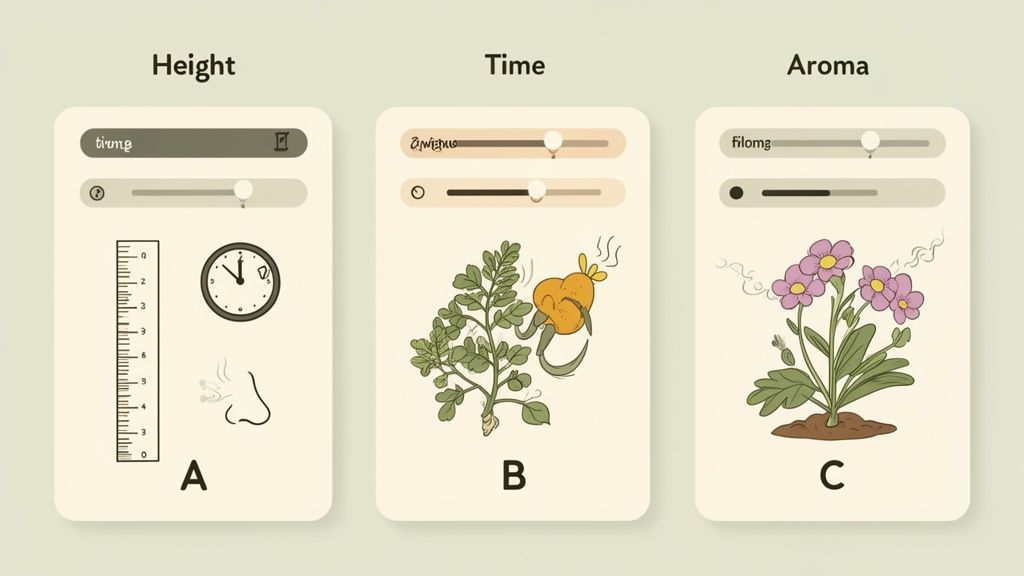
We want to make this as straightforward as possible. Our comparison tool is designed to act like an experienced friend, helping you match your specific setup with the perfect feminized or autoflower seeds. You can filter by the practical details that actually make a difference for a home grower.
Matching Cultivars to Your Grow Space
No two cultivars are exactly alike, and your available space is probably the biggest factor dictating your choice. A stealthy grow tucked away in a closet has completely different requirements than a bigger operation in a garage or basement. A little forethought here pays off big time.
For instance, if you're working with a low ceiling, filtering for cultivars with a shorter, more compact growth pattern is a must. This simple step keeps your plants from stretching too close to the grow lights and makes managing a tight space so much easier.
On the other hand, maybe your priority is a quick turnaround. In that case, you can zero in on attributes like flowering time. Some autoflowering cultivars can race from seed to harvest in as little as eight weeks. That's a massive win if you're looking for multiple harvest cycles per year. The goal is to find a plant that fits your timeline and space, not the other way around.
The real beauty of legal home growing is the freedom to choose. You can select a cultivar for its quick harvest time, its compact size for a stealthy setup, or its unique aromatic profile: all things you can’t control when buying from a dispensary.
Finding the Right Vibe and Aroma
Once you've got the practicalities squared away, you can get into the sensory experience. Every cultivar offers a unique character, from the way it smells in late flower to the kind of feeling it inspires. Our catalog helps you compare these qualities so you can find exactly what you're after.
Here are a few things to think about:
- Aromatic Profile: Are you a fan of bright citrus and fruit scents, or do you lean more toward deep, earthy pine notes? Comparing descriptions will help you find a profile you'll actually enjoy smelling for weeks.
- General Vibe: We skip the jargon and focus on the overall experience. Whether you’re looking for something that feels uplifting and creative or a cultivar that’s more mellow and relaxing, you can find options to match.
By sticking to feminized and autoflower seeds, we've removed the biggest potential headache for new growers. Up to 99.9% of feminized seeds develop into productive, flower-bearing plants, so male plants are rarely a concern. You can learn more about the different types of weed and what makes each special in our detailed guide. It’s all about giving you the confidence to turn legal knowledge into a successful first harvest.
Your Home Grow Questions, Answered
As more states open the door to home cultivation, a lot of the same questions pop up. It’s completely understandable: the rules can feel murky. Let's clear the air and tackle the most common concerns head-on, so you can start your first grow with confidence.
Think of this as a quick chat with a buddy who's already navigated these waters. The legal landscape does shift, but once you grasp a few core principles, you'll be able to handle almost any situation that comes your way.
Can I Get in Trouble for Ordering Seeds?
This is the big one, and the answer is simpler than you might think. Thanks to a key provision in the 2018 Farm Bill, cannabis seeds themselves are not illegal at the federal level. As long as they contain less than 0.3% Delta-9 THC, which virtually all seeds do, they are legally considered hemp products.
This is why you see them sold openly online, often as "adult novelty souvenirs." It allows for legal shipping across state lines. Now, the moment you decide to germinate that seed, you've crossed a new legal threshold. Your actions then fall under your specific state and local cultivation laws.
Remember: The law sees a clear difference between a dormant seed and a growing plant. Buying seeds is one step; growing them is another, and it’s regulated by your state’s specific home cultivation program.
How Many Plants Am I Allowed to Grow?
You won't find a single, nationwide number for this. Plant count limits are set at the state level, though a common starting point you’ll see is around six plants per person, often with a cap of 12 plants per household.
It's absolutely essential to check your local city and county ordinances, too. Sometimes they have stricter rules than the state. The best move is to do a quick search on your local government's website for the most accurate and up-to-date information. Don't just rely on what you've heard.
Can My Landlord Prohibit Me from Growing?
In almost all cases, yes. Even if you live in a state where recreational growing is completely legal, your landlord still has the right to prohibit it in their property. It works just like a no-pets or no-smoking clause in a lease agreement.
Before you even think about popping a seed, make sure you do this:
- Read Your Lease: This is your contract. If it forbids cultivation, violating it can lead to serious consequences, including eviction.
- Property Rights: At the end of the day, it's their property. A landlord's right to set rules for their building usually overrides your right to grow.
- Don't Assume: Never take for granted that a legal state means you have a green light to grow in a rental. Always check the paperwork first.
Ultimately, a successful and stress-free home grow comes down to being informed and responsible. By understanding these key rules, you can enjoy all the rewards of growing your own supply with total peace of mind.
Ready to find the perfect cultivar for your legal home grow? Botanist Seeds makes it easy with our simple comparison tool and a curated catalog of premium feminized and autoflower seeds. Explore your options today.